

Prompt Details
Model
Chat - (gpt-5.5)
Token size
448
Example input
[ROLE]: First-time engineering manager leading a backend platform team
[COMPANY_CONTEXT]: A Series B B2B SaaS company, about 200 employees, scaling its product
[TEAM]: Seven backend engineers of mixed seniority, previously without a dedicated manager
[MANDATE]: Improve delivery predictability and reduce production incidents
[CHALLENGES]: Low trust after a prior reorg and a large backlog of tech debt
Example output
Backend platform team — Series B SaaS, first-time engineering manager
PART 1 - FIRST PRINCIPLES
- Earn trust before changing anything, because this team lost confidence in the last reorg.
- Make delivery and incidents visible with simple metrics before judging the work.
- Pay down tech debt through steady scheduled effort rather than a disruptive freeze.
PART 2 - DAYS 1 TO 30: LISTEN AND LEARN
Goals: build trust, understand the system, and baseline delivery and incidents.
People to meet:
- Each of the seven engineers, one on one: ask what slows them down, what breaks most, and what they would fix first.
- Your manager: ask what delivery predictability means to them and how it is measured.
- Product partner: ask about roadmap pressure and the biggest recent misses.
- On-call lead: ask which incidents repeat and why.
Systems and metrics to understand: deployment frequency, lead time, change failure rate, mean time to recovery, incident count by cause, and the current sprint process.
Two early low-risk wins: publish a simple weekly delivery and incident dashboard, and fix one recurring noisy alert that wakes people at night.
PART 3 - DAYS 31 TO 60: CONTRIBUTE AND ALIGN
Goals: stabilize delivery and start reducing incidents.
Processes to assess or improve: sprint planning, estimation, code review turnaround, on-call rotation, and the postmortem habit.
Align the team to the mandate by setting two shared targets: a predictable sprint commitment and a measurable drop in priority incidents.
First changes to pilot: a lightweight definition of done, a blameless postmortem template, and a standing 20 percent allocation for tech debt.
PART 4 - DAYS 61 TO 90: LEAD AND DELIVER
Goals: show measurable progress and set the next two quarters.
Measurable outcomes: reduce priority incidents by a clear percentage versus the day-1 baseline and hit sprint commitments two sprints in a row.
Set the roadmap by ranking tech debt items against incident and delivery impact and agreeing the top three with product.
Handle the known challenges: rebuild trust by shipping the wins you promised, and tackle tech debt visibly so the team sees progress.
PART 5 - STAKEHOLDER MAP
Stakeholder | What they care about | How to engage them
Leadership | Predictable delivery and fewer incidents | Monthly metrics review with trend lines
Product partner | Roadmap progress and fewer surprises | Weekly priorities sync
The team | Trust, workload, and growth | Weekly one on ones and clear decisions
On-call and SRE | Stable systems and quiet nights | Shared incident reviews and alert cleanup
PART 6 - 30-60-90 SCORECARD
Milestone | Target date | Measure of success
Delivery and incident dashboard live | Day 20 | Dashboard shared and reviewed weekly
Noisy alert fixed | Day 25 | Off-hours pages reduced
Postmortem habit in place | Day 45 | Every priority incident gets a blameless postmortem
Tech debt allocation running | Day 50 | 20 percent of capacity tracked to debt
Priority incidents down | Day 85 | Clear percentage drop versus day-1 baseline
Sprint commitments met | Day 90 | Two consecutive sprints hit commitment
PART 7 - RISKS AND FIRST-WEEK CHECKLIST
Risks to avoid:
- Reorganizing or changing process in week one and deepening distrust.
- Declaring a tech debt freeze that stalls the roadmap.
- Judging engineers before understanding the system and its history.
First-week checklist:
1. Schedule one on ones with all seven engineers.
2. Ask leadership how delivery predictability is measured.
3. Read the last 90 days of incidents and postmortems.
4. Map the services the team owns and their dependencies.
5. Join the on-call channel and observe a rotation.
6. Identify one noisy alert to fix.
7. Send the team a short note on your first 30-day approach.


 Instant access
 Commercial use
 Money‑back
By purchasing this prompt, you agree to our terms of service
GPT-5.5


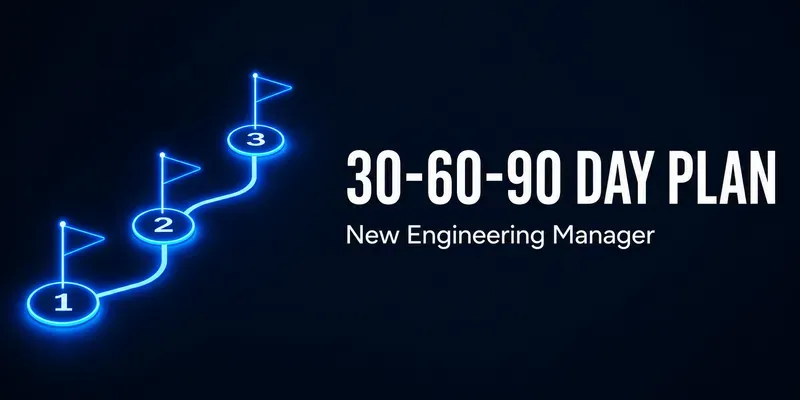
Step into a new engineering manager role with a plan instead of guesswork. Give the prompt the role, company context, team, mandate, and known challenges. It returns a full 30-60-90 day onboarding plan: guiding principles, a listen-and-learn phase, a contribute-and-align phase, a lead-and-deliver phase, a stakeholder map, a 30-60-90 scorecard with measurable milestones, and the top risks plus a first-week checklist. For new and newly promoted engineering managers.
...more
Added 14 hours ago
