

Prompt Details
Model
(claude-5-sonnet)
Token size
4,093
Example input
[agent domain]: AI customer-support ticket triage that classifies incoming requests and routes them to automated resolution or human specialists.
[state variables]: Rolling 100-ticket classification accuracy, agent override rate, unresolved-ticket rate, average resolution time.
[adaptation triggers]: Detect shift when agent override rate exceeds 18% over 50 consecutive tickets or classification accuracy falls below the approved operating threshold.
Example output
# 1. State Representation
**Rule:**
The system tracks four state variables with independent update mechanisms:
- **Rolling 100-ticket classification accuracy**: recomputed as a sliding window — each new ticket resolution (once ground truth is known, e.g., via override or confirmed resolution) pushes out the oldest of the 100 and recalculates accuracy = correct classifications / 100.
- **Agent override rate**: windowed over the most recent 50 consecutive tickets (per the adaptation trigger's own window) — recalculated as overrides / 50 each time a new ticket completes.
- **Unresolved-ticket rate**: incremented/decremented continuously as tickets enter "unresolved" or exit that state; not explicitly windowed by the input, so its window is a local gap (see below).
- **Average resolution time**: not given a window or decay method by the input — also a local gap.
**Worked Example:**
At ticket #4,512: classification accuracy over the last 100 tickets = 91/100 = 91%. Override rate over the last 50 tickets = 8/50 = 16%. These are illustrative readings only, not validation evidence.
**Failure Case:**
If ground truth for a classification (e.g., whether the routing was actually correct) arrives late — such as when a human specialist's disposition lags the ticket's initial routing by hours — the rolling accuracy window can be updated with stale or out-of-order labels, producing an accuracy figure that reflects a different set of tickets than the 100 most recently *routed*. This makes the state representation internally inconsistent between "tickets routed" and "tickets scored."
- **Rule Status:** OWNER-DECISION *(the unresolved-ticket rate window and average-resolution-time aggregation method are not supplied; update mechanics for two of four state variables are unresolved. Classification accuracy and override rate windows ARE supplied and RESOLVED.)*
- **Assumption-Dependent:** YES *(propagates from the two unresolved windows)*
- **Validation Status:** NOT-VALIDATABLE-FROM-INPUT — no data on whether this representation has been tested against real ticket streams or late-label conditions
- **Failure Severity:** DEGRADED *(stale-label misalignment corrupts a metric but doesn't itself trigger unsafe autonomous action — that depends on Phase 2)*
- **Arming Status:** BLOCKED *(two of four state variables lack a resolved update mechanism)*
---
# 2. Distribution Shift Detection
**Rule:**
Detection fires when EITHER:
- Agent override rate > 18% over 50 consecutive tickets, OR
- Classification accuracy falls below "the approved operating threshold"
The override-rate condition is fully specified: metric (override rate), window (50 consecutive tickets), threshold (18%) are all supplied.
The accuracy condition names a measurable quantity (rolling 100-ticket accuracy) but the firing boundary — "the approved operating threshold" — is a reference to a value that is never given a number.
`Rule Status: OWNER-DECISION` for the accuracy leg of this detector. The override-rate leg is RESOLVED.
**Worked Example:**
Override-rate leg: override rate reads 19% over tickets #6,201–#6,250 → condition crosses supplied threshold → detection fires.
Accuracy leg (symbolic only): if rolling accuracy = X% and approved operating threshold = T (unsupplied), detection fires when X < T. No numeric T can be substituted without inventing it.
**Failure Case:**
False negative: if override rate oscillates at 17.9%–18.1% around the boundary across successive 50-ticket windows, the detector can flicker in and out of firing without any real underlying shift, since a single ticket's outcome can cross a hard 18% line. This is a reproducible boundary-sensitivity failure of a hard threshold with no hysteresis specified.
- **Rule Status:** OWNER-DECISION *(override-rate leg RESOLVED; accuracy leg's threshold is OWNER-DECISION — the composite Rule inherits the weaker status)*
- **Assumption-Dependent:** YES *(the accuracy leg cannot be evaluated without an assumed threshold value)*
- **Validation Status:** UNVALIDATED *(the 18% figure is concrete/testable but no evidence is supplied that it was calibrated against real override behavior; the accuracy leg is NOT-VALIDATABLE-FROM-INPUT until the threshold exists)*
- **Failure Severity:** AUTONOMY-BLOCKING *(boundary flicker on the override-rate leg could cause oscillating shift detection, which downstream could drive unstable switching if not damped in Phase 4)*
- **Arming Status:** BLOCKED *(missing approved operating threshold; unresolved AUTONOMY-BLOCKING failure)*
---
# 3. Multi-Source Reconciliation
**Rule:**
The domain description does not name concrete data sources feeding the triage classifier (e.g., no mention of "ticket-metadata service," "classifier v2 vs. v3," "CRM system vs. support-desk system," or any named upstream systems with stated authority). The input gives state variables and triggers but not the sources whose outputs would need reconciling.
Per the governing instruction, generic Source A / Source B placeholders are not permitted, and if the domain is too vague to identify meaningful sources, this phase must halt.
`PHASE HALT`
**What is missing:** Named data sources or subsystems (e.g., which system produces the classification, which produces the override signal, whether there are multiple classifier versions or ticket-metadata feeds that could disagree) relevant to this triage pipeline.
**Why the Rule cannot be constructed:** Without at least one concrete, domain-specific source identified, there is nothing to reconcile — inventing "the classifier" vs. "the override log" as competing authorities would be fabricating sources not established by the input.
**What would unblock it:** A description of the actual upstream systems or signal producers in this triage pipeline — for example, whether ticket categorization comes from a single model, an ensemble, or is cross-checked against a separate rules engine, and which of those carries decision authority when they disagree.
*(Phase 4 does not structurally depend on Phase 3's output in this case, since the switch/rollback mechanism described in Phase 4 concerns policy versions, not source reconciliation — so Phase 4 can proceed.)*
---
# 4. Policy Switch with Rollback
**Switch Trigger:**
Detection result from Phase 2 (override rate > 18%/50 tickets, OR accuracy < approved operating threshold). Note: this trigger is only fully evaluable once Phase 2's OWNER-DECISION (the threshold) is resolved; the override-rate leg alone can fire it today.
**Switch Action:**
The domain and inputs do not specify what the adaptive system is authorized to change upon detection — e.g., whether it should switch classifier model versions, change the routing decision rule, adjust confidence thresholds for auto-resolution vs. escalation, or something else. No adaptive mechanism is named in {adaptation triggers} or {state variables}.
`Rule Status: OWNER-DECISION` — the switch action itself is unresolved; inventing "switch to a fallback classifier" would be granting control authority the input never established.
**Rollback Rule:**
Not supplied: post-switch monitoring signal, evaluation window, rollback boundary, and rollback action are all absent.
`Rule Status: OWNER-DECISION`
**Worked Example:**
DETECTION (override rate crosses 18% over 50 tickets, per Phase 2) → SWITCH (unresolved — target policy/action not specified) → OBSERVATION (unresolved — no monitored signal or window specified) → ROLLBACK/RETAIN (unresolved — no boundary or action specified).
Only the detection leg can be traced concretely; everything downstream is symbolic pending owner input.
**Failure Case:**
If a switch were triggered but no rollback boundary or window exists, the system has no defined mechanism to detect that the switched policy is itself performing worse — this is a reproducible "unsafe persistence" scenario: the system could remain on a degraded policy indefinitely because no evaluation window or reversion condition was ever defined to catch it.
- **Rule Status:** OWNER-DECISION *(switch action, rollback signal, window, boundary, and action are all unresolved; inherits OWNER-DECISION from Phase 2's accuracy threshold as well)*
- **Assumption-Dependent:** YES *(inherits YES from Phase 2)*
- **Validation Status:** NOT-VALIDATABLE-FROM-INPUT *(no rollback mechanism exists yet to validate)*
- **Failure Severity:** AUTONOMY-BLOCKING *(unbounded persistence on a degraded policy with no rollback path is a canonical unattended-operation hazard)*
- **Arming Status:** BLOCKED
---
## DEPLOYMENT READINESS
**Verdict:** INCOMPLETE
**Control Summary:**
- RESOLVED Rules: 1 partial (override-rate detection leg only)
- OWNER-DECISION Rules: 4 (unresolved-ticket-rate/resolution-time update mechanics; accuracy operating threshold; switch action; rollback signal/window/boundary/action)
- PROPOSED-STRUCTURAL Rules: 0
- ASSUMPTION-DEPENDENT: YES: Phases 2, 3 (halted), 4
- Validation status across all four Rules: none VALIDATED; 1 UNVALIDATED (override-rate threshold), 1 NOT-VALIDATABLE-FROM-INPUT (Phase 1), 1 mixed UNVALIDATED/NOT-VALIDATABLE (Phase 2 accuracy leg), 1 NOT-VALIDATABLE-FROM-INPUT (Phase 4)
- PHASE HALTs: 1 (Phase 3 — no concrete sources identified in the domain description)
- AUTONOMY-BLOCKING Failure Cases: Phase 2 (boundary flicker on hard threshold), Phase 4 (unbounded persistence with no rollback path)
- Arming Status by phase: Phase 1 — BLOCKED; Phase 2 — BLOCKED; Phase 3 — HALTED (not evaluable); Phase 4 — BLOCKED
**Blocking Conditions:**
- Approved operating threshold for classification accuracy not supplied
- Update mechanics for unresolved-ticket rate and average resolution time not supplied
- No named data sources/subsystems for Phase 3 reconciliation
- Switch action (what the system is authorized to change) not supplied
- Rollback signal, evaluation window, rollback boundary, and rollback action not supplied
- No hysteresis/dwell-time specified for the override-rate boundary, creating a reproducible flicker risk
**Evidence Needed Next:**
The single highest-leverage owner decision is the **approved operating threshold** for classification accuracy — it unblocks the second leg of Phase 2 detection and, transitively, sharpens what Phase 4's switch trigger actually is. Concurrently, naming at least one concrete upstream source/subsystem would unblock Phase 3, and specifying the switch action would let Phase 4 move from purely symbolic to partially resolved.

$29.99-25%
$22.49
SPECIAL PROMOTION — Offer ends 12 October

 Instant access
 Commercial use
 Money‑back
By purchasing this prompt, you agree to our terms of service
2
Favorites
53
Views
CLAUDE-5-SONNET


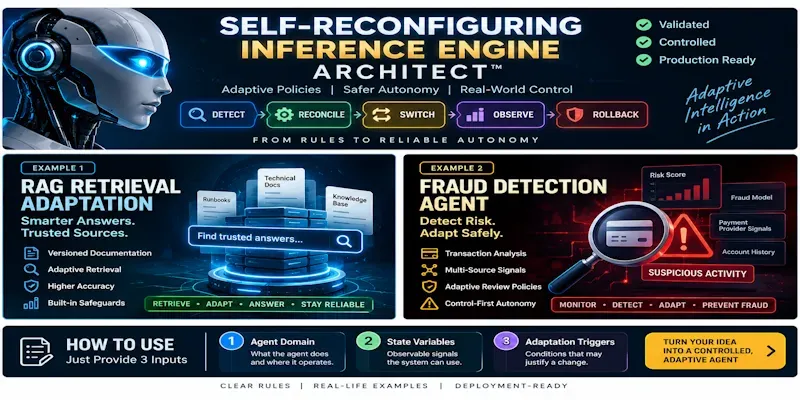
This prompt builds a four-phase adaptive control specification covering state representation, distribution-shift detection, multi-source reconciliation, and policy switching with rollback
...more
Added 3 weeks ago
