

Prompt Details
Model
(claude-5-sonnet)
Token size
2,171
Example input
[PROCESS_SOURCE_PACK]: Mode: CAPTURE only — I just want to document what actually happens today, not redesign it yet. Policy doc "Expense Approval Policy v2," section 3: "Any expense report under $500 requires approval from the employee's direct manager. Once approved, it is submitted to payroll for reimbursement within 5 business days." Interview with the payroll lead: "Managers usually approve within a day or two, but sometimes an expense sits for weeks if the manager is traveling. There's no backup approver defined anywhere that I know of."
[AUTHORITY_AND_CONSTRAINTS]: Authority: direct managers only, per the policy document. No delegation process is documented. Currency: USD. No monetary limits beyond the $500 threshold already stated.
[ACTION_EXAMPLES]: One example: expense report ER-4471, submitted by employee E-9002, amount $340, category "travel," submitted 2026-09-01. No approval recorded yet as of the data pull date.
Example output
SCOPE, MODE AND SOURCE REGISTER
Mode: CAPTURE only, per explicit instruction — no DESIGN section will
be produced this run.
S01 — Expense Approval Policy v2, section 3. DOCUMENTED RULE.
S02 — Payroll lead interview. REPORTED PRACTICE (explicitly self-flagged
by the interviewee as inconsistent — "sometimes sits for weeks").
S03 — ER-4471 action example. RECORDED EVENT (submission only; no
decision recorded).
Authority limits: single-approver model (direct manager), no documented
delegation or backup path — this absence is preserved as UNKNOWN, not
filled in.
No inaccessible material — all three inputs were fully readable.
CURRENT STATE
AS01 — Expense submitted by employee, routed to direct manager.
Source: S01. DOCUMENTED RULE.
AS02 — Manager approves or does not respond.
Source: S01 (approval requirement) + S02 (reported delay pattern).
Transition AS01→AS02 is DOCUMENTED RULE; the delay/no-backup behavior
observed at AS02 is REPORTED PRACTICE, not itself a documented rule —
kept distinct per the source register above.
AS03 — Approved report submitted to payroll, reimbursed within 5
business days. Source: S01. DOCUMENTED RULE.
UNKNOWN BRANCH: what happens when a manager is unavailable for an
extended period (the reported multi-week delay) is not covered by any
supplied policy. This is the single largest gap in the current-state
map — flagged, not resolved by inventing a backup-approver assumption.
GAP AND DECISION REGISTER
G01 — Affected step: AS02. Evidence: S02 (reported practice describing
weeks-long delays). Practical effect: reports can stall indefinitely
with no defined escalation, delegation, or timeout. Owner decision
needed: should a backup-approver or timeout-escalation rule be defined,
and if so, at what threshold?
G02 — Affected step: AS01→AS02. Evidence: S01 states only "direct
manager" as approver with no alternate named anywhere. Practical
effect: if a manager role is vacant or the manager leaves the company,
there is no documented rule for who approves in their place. Owner
decision needed: does an org-chart escalation (skip-level manager)
apply by default, or does this require explicit new policy?
PROPOSED STATE
Not produced — CAPTURE-only mode was explicitly requested. If DESIGN
mode is added in a future run, G01 and G02 above are the natural
starting points.
ACTION-REVIEW PACKET — ER-4471
Request/version: ER-4471, no version increments recorded (single
submission, no resubmission).
Payload: employee E-9002, amount $340, category "travel," submitted
2026-09-01.
Diff from previous version: N/A — first and only submission.
Affected scope: reimbursement of $340 to employee E-9002 via payroll.
Evidence and policy clause: S01 section 3 (amount is under the $500
threshold, so single manager approval applies — no finance-level
review required per the supplied policy).
Eligibility and required reviews: one approval, from E-9002's direct
manager. Independence: not explicitly addressed in S01 (no stated rule
that the approver cannot also be the requester, though a "direct
manager" framing implies this is structurally unlikely here) — noted
as an assumption resting on organizational structure, not an explicit
policy statement.
Expiry/conditions: no expiry rule is documented anywhere in S01 for
expense approvals (contrast: the built-in refund-workflow demonstration
elsewhere in this tool has an explicit 30-minute expiry — this policy
has no equivalent, and that absence is stated, not assumed away).
Consequences: approve → routes to payroll per AS03; reject → outcome
not specified in supplied policy (does the employee get notified? can
they resubmit?) — UNKNOWN, flagged.
Recovery facts and unknowns: current approval status as of data pull:
no decision recorded. Days elapsed since submission: not calculable
without today's date, which was not supplied — this tool does not
invent a current date to assess how "stale" this request is.
Unresolved blockers: none block packet readiness itself (all
decision-critical facts for evaluating THIS request are present); the
G01/G02 gaps are systemic, not blockers to reviewing ER-4471 on its own
merits.
Packet readiness: READY FOR AUTHORISED REVIEW.
QUALITY GATE
Q1 PASS — all current-state claims trace to S01 or S02 with correct
evidence typing.
Q2 PASS — DOCUMENTED RULE, REPORTED PRACTICE, and the explicit absence
of a DESIGN section stay cleanly separated.
Q3 PASS — no invented delegation or backup-approver authority; the gap
is named, not filled.
Q4 PASS — the single lifecycle transition sequence (submit→approve→
reimburse) is fully covered; the "manager unavailable" branch is
correctly marked UNKNOWN rather than silently assumed.
Q5 PASS — ER-4471's packet has every decision-critical fact present
(amount, threshold comparison, approver identity) available.
Q6 PASS — one current-state flow, one action example, two gaps —
all accounted for; no walkthrough contradicts the tables above.
OVERALL: REVIEWABLE WORKFLOW DRAFT WITH OPEN GAPS
(G01/G02 remain open by design — CAPTURE mode does not resolve gaps,
only surfaces them for a future DESIGN pass.)
TOP QUESTIONS (max 4)
1. Should a backup-approver or timeout-escalation rule be added for
when a manager is unavailable for an extended period?
2. Is there an implicit skip-level-manager fallback when a manager role
is vacant, or does this need new explicit policy?
3. What happens on rejection — is the employee notified, and can they
resubmit the same report or must they submit a new one?
4. Is manager/requester independence formally required, or only true
in practice because of how the org chart happens to be structured?

$19.99-25%
$14.99
SPECIAL PROMOTION — Offer ends 12 October


Get this prompt + 9 more with SelectFrom $14/mo · Cancel anytimeFrom $14/mo · Cancel anytime
View Select
 Instant access
 Commercial use
 Money‑back
By purchasing this prompt, you agree to our terms of service
5.0
1 review
1
Favorites
80
Views
CLAUDE-5-SONNET


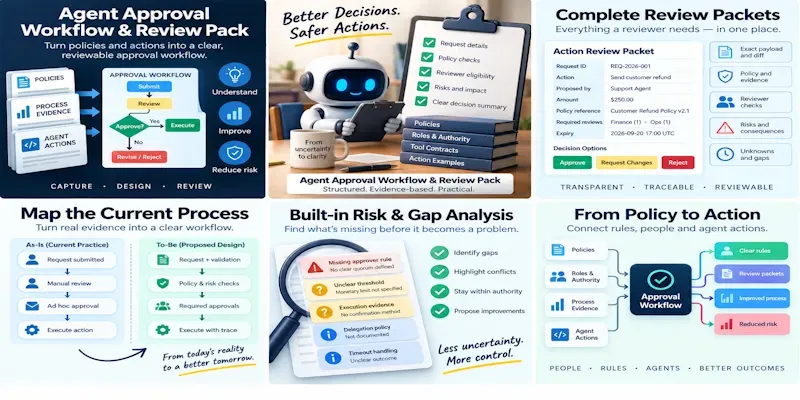
Use when an agent or automation needs human review but its approval rules, revision handling or review requests are unclear. Get a current-state map and a separately labelled proposal, plus action packets that show exactly what a reviewer is being asked to allow.
...more
Added 3 weeks ago

- Reviews for this prompt (1)