

Prompt Details
Model
(claude-5-sonnet)
Token size
3,857
Example input
[AGENT_OPPORTUNITY]: We identified an opportunity for a customer-support escalation agent. It should watch unresolved support tickets, gather relevant ticket history and product documentation, identify when engineering involvement is likely needed, prepare an evidence-backed escalation brief, route it to the appropriate engineering team, and track whether the escalation receives a response. It should not autonomously promise refunds, change customer accounts, or make production changes.
[CONTEXT_CONSTRAINTS_AND_PATTERN_REFERENCES]: The company uses Zendesk, Slack, Jira, and an internal knowledge base. Ticket state may change over several days, so the agent needs durable task state. Engineering routing depends on product area. Human approval should be required before high-impact customer commitments. Reliability is more important than maximum autonomy. Consider supervisor/worker, tool-use, human-approval, durable-state, reflection, and event-driven patterns where justified.
Example output
# 1. AGENT OPPORTUNITY RECONSTRUCTION
| Element | Content | Confidence |
|---|---|---|
| **PRIMARY USER** | Support agents/leads (recipients of escalation quality) and engineering on-call/teams (recipients of the brief) | HIGHLY LIKELY |
| **PROBLEM** | Unresolved tickets that actually need engineering aren't consistently identified, evidenced, or routed to the right team | CONFIRMED |
| **TRIGGER** | A ticket remains unresolved and/or is updated in Zendesk | HIGHLY LIKELY (exact threshold/timing rule not given — UNKNOWN) |
| **DESIRED OUTCOME** | Correctly routed, evidence-backed escalation brief delivered to the right engineering team, with tracked follow-up | CONFIRMED |
| **INPUTS** | Zendesk ticket + history, internal KB articles, (implicitly) product-area taxonomy | CONFIRMED / PLAUSIBLE for taxonomy detail |
| **OBSERVABLE STATE** | Ticket status/age, prior escalation status, Jira issue status, Slack thread status | HIGHLY LIKELY |
| **DECISIONS** | (a) Escalate or not, (b) which engineering team/product area, (c) what evidence is relevant, (d) whether a customer commitment requires human approval | CONFIRMED |
| **ACTIONS** | Gather evidence, draft brief, create/route Jira issue, post to Slack, monitor for response, remind/escalate on silence | CONFIRMED |
| **TOOLS/SYSTEMS** | Zendesk, Slack, Jira, internal KB | CONFIRMED (availability of API scopes — UNKNOWN) |
| **HUMAN PARTICIPANTS** | Support agent (ticket owner), an approver for consequential customer commitments, engineering team as recipient | HIGHLY LIKELY |
| **TIME HORIZON** | Multi-day, since "ticket state may change over several days" | CONFIRMED |
| **COMPLETION CONDITION** | Escalation acknowledged/resolved by engineering, or ticket resolved without needing escalation | HIGHLY LIKELY |
| **HIGH-IMPACT ACTIONS** | Refunds, account changes, production changes — explicitly excluded from autonomy | CONFIRMED |
| **UNKNOWNS** | Escalation threshold rules, product-area→team mapping logic, ticket volume/concurrency, API scopes/rate limits, SLA for engineering response, whether a human must approve *every* escalation or only customer-facing commitments | UNKNOWN |
**Classification:** This is an **AGENTIC WORKFLOW**, not a full autonomous multi-agent system, a copilot, or a single model call. It requires multi-step tool use, judgment (is this really an engineering issue? which team?), and state that persists across days — that rules out a single model call or pure copilot. But the control flow is largely a bounded sequence per ticket (observe → decide → act → track), which does **not** require open-ended multi-agent autonomy. Where deterministic logic can do the job (e.g., checking whether a Jira issue already exists for a ticket), it should — not every step needs an LLM call.
---
# 2. WORKFLOW & CONTROL-FLOW MAP
```
TRIGGER (Zendesk ticket created/updated, unresolved beyond threshold — CONFIRMED trigger source, UNKNOWN threshold)
→ OBSERVE (fetch ticket + full history from Zendesk; retrieve related KB articles; check for existing Jira escalation)
→ INTERPRET (does this look like an engineering issue vs. a support-resolvable one? what product area?)
→ DECIDE (escalate / hold / resolve-with-KB; select target team)
→ ACT
- draft evidence-backed brief
- [HUMAN GATE if brief contains a customer commitment]
- create/route Jira issue
- post Slack notification to engineering channel
→ VERIFY (Jira issue exists, Slack post delivered, no duplicate escalation)
→ CONTINUE (durable state: wait for engineering response, days-long)
→ COMPLETE / ESCALATE (engineering responds → close loop; no response by SLA → remind or escalate to human)
```
- **SEQUENTIAL:** evidence-gather → decide → draft → route (each depends on the previous)
- **PARALLEL:** ticket-history fetch and KB retrieval can run concurrently — PLAUSIBLE optimization, not required for correctness
- **LONG-RUNNING:** post-escalation tracking (days) — CONFIRMED requirement
- **RECURRING:** polling/checking for stale unresolved tickets and stale escalations — HIGHLY LIKELY needed even if primary trigger is event-based, since Zendesk webhooks can be missed
- **EXCEPTION PATHS:** ambiguous product area → human routing decision; insufficient evidence → hold and request more info; likely-duplicate escalation → suppress
- **HUMAN GATES:** required before any customer-facing commitment (CONFIRMED). Whether routine engineering routing itself needs approval is UNKNOWN — treated below as autonomous-with-notification, since routing to engineering is reversible and low-impact, unlike promising a refund.
- **EXTERNAL WAIT STATES:** waiting on engineering response in Jira/Slack — CONFIRMED, drives the durable-state requirement
- **RETRY POINTS:** any Zendesk/Slack/Jira API call
- **COMPLETION STATES:** resolved-without-escalation, escalated-and-resolved, escalated-and-abandoned (SLA breach → human escalation)
No agent-style reasoning loop is needed for the mechanical parts of this flow (posting to Slack, creating a Jira issue, checking status) — those are deterministic tool calls. The LLM's job is narrower: judging escalation-worthiness, selecting the team, and writing the brief.
---
# 3. ARCHITECTURAL FORCES
| Force | Evidence | Architectural Consequence | Confidence |
|---|---|---|---|
| **State duration** | "Ticket state may change over several days" | Requires durable, externally persisted state per ticket, not in-memory/session state | CONFIRMED |
| **Tool complexity** | 4 systems (Zendesk, Slack, Jira, KB), each with read and/or write ops | Needs a tool gateway layer with per-tool error handling, not raw ad hoc calls | HIGHLY LIKELY |
| **Decision complexity** | "Identify when engineering involvement is likely needed" + team routing by product area | Nontrivial judgment step — justifies an LLM-based classifier/decision step, not a static rule table alone | HIGHLY LIKELY |
| **Action consequence** | Explicit exclusion of refunds/account/production changes; approval required for "high-impact customer commitments" | Two-tier autonomy: routine internal actions (Jira/Slack) can be autonomous; customer-facing commitments require a human gate | CONFIRMED |
| **Traceability** | "Reliability is more important than maximum autonomy," evidence-backed brief required | Every escalation must carry an audit trail (what evidence, why this team, who approved what) | CONFIRMED |
| **Event frequency** | Ticket monitoring over an unspecified but presumably ongoing volume | Needs event-driven triggering, not a single-run script | HIGHLY LIKELY |
| **Reliability requirements** | "Reliability and traceability matter more than maximum autonomy" (explicit) | Favors deterministic control flow with LLM used at specific judgment points, bounded retries, explicit failure states — not open-ended autonomous looping | CONFIRMED |
| **Need for specialization** | Single coherent responsibility chain (evidence → decision → brief → routing → tracking) | Does not clearly require multiple specialized agents; a single tool-using worker with clear phases is sufficient — MULTI-AGENT SPECIALIZATION IS NOT STRONGLY SUPPORTED | PLAUSIBLE (weighs against supervisor/worker) |
| **Parallelism** | No evidence of need for concurrent independent workstreams within one ticket | Low — parallelism only helps at the retrieval sub-step, not architecturally significant | PLAUSIBLE |
| **Human oversight** | Explicit approval requirement for consequential actions | Human-approval gate is a hard requirement, not optional | CONFIRMED |
| **Recovery requirements** | Multi-day external wait states, tool calls to 3rd-party systems | Needs explicit retry/recovery for tool failures and for "engineering never responded" | HIGHLY LIKELY |
| **Latency sensitivity** | Not stated | UNKNOWN — likely low sensitivity given multi-day horizon, but not confirmed |
---
# 4. MINIMUM REQUIRED ARCHITECTURE
| Capability | Needed? | Justification |
|---|---|---|
| Single agent (tool-use worker) | **YES** | Core per-ticket judgment + drafting + tool orchestration |
| Router | **YES (lightweight)** | Product-area → engineering team mapping; can be rule-based augmented by LLM classification for ambiguous cases — does not require a full "supervisor" architecture |
| Planner | NO | Workflow is a fixed sequence (observe→decide→act→track), not open-ended multi-step planning |
| Supervisor + specialized workers | **NO (rejected — see Stage 7)** | No confirmed need for multiple concurrent specialized agents; a single worker with distinct phases covers the requirement |
| Evaluator / verification step | **CONDITIONAL** | A lightweight "evidence-grounding check" before sending the brief reduces hallucination risk and supports the traceability requirement — justified, but should be a bounded check, not an open reflection loop |
| Retrieval | **YES** | KB + ticket history lookup is core to "evidence-backed" |
| Tool gateway | **YES** | Zendesk/Slack/Jira integration surface |
| Durable state | **YES** | Explicit multi-day requirement |
| Event triggers | **YES** | Ticket monitoring is inherently event-driven, with a recurring poll as a backstop |
| Human approval gate | **YES** | Explicit requirement for consequential customer commitments |
| Memory (long-term, cross-ticket) | **NOT CONFIRMED** | No evidence of a need for learning across tickets; only per-ticket durable state is required |
**Conclusion:** The minimum architecture is a **single event-driven, tool-using agent operating over durable per-ticket state**, with a lightweight routing/classification step, a bounded evidence-verification check, and a human-approval gate for consequential actions. A full supervisor/multi-worker architecture is not currently justified.
---
# 5. PATTERN CANDIDATE MATRIX
| Pattern | Family | Source |
|---|---|---|
| Event-driven orchestration | Control | Derived + user-referenced |
| Sequential workflow / state machine | Control | Derived |
| Tool-use agent | Tools | User-referenced |
| Tool gateway | Tools | Derived |
| Retrieval-augmented context | Knowledge | Derived |
| Working-state store (durable state) | Knowledge | User-referenced |
| Human approval gate | Human control | User-referenced |
| Verification / lightweight reflection (pre-send evidence check) | Reasoning | Derived (weak form of user-referenced "reflection") |
| Supervisor–worker | Multi-agent | User-referenced |
| Idempotent execution / duplicate-escalation suppression | Reliability | Derived |
| Retry with bounds | Reliability | Derived |
| Dead-letter / unresolved-task handling (SLA breach → human) | Reliability | Derived |
---
# 6. PATTERN FIT / REJECTION ANALYSIS
**Tool-use agent**
- Problem solved: performing reads/writes across Zendesk, Jira, Slack, KB from LLM judgment
- Requirement mapped: TOOLS/SYSTEMS, ACTIONS
- Evidence: CONFIRMED (four named systems, explicit actions)
- Benefit: single coherent execution surface
- New complexity: tool-call error handling
- Failure mode introduced: tool misuse / wrong-parameter calls
- Preconditions: API access confirmed for all four systems (currently UNKNOWN)
- **FIT: STRONG**
**Durable-state store**
- Problem solved: tracking escalation status across days, surviving process restarts
- Requirement mapped: TIME HORIZON
- Evidence: CONFIRMED ("ticket state may change over several days")
- Benefit: reliable multi-day tracking, recoverability
- New complexity: state schema design, staleness handling
- Failure mode introduced: stale/inconsistent state if not synced with Zendesk/Jira truth
- Preconditions: a persistence layer (DB or workflow-engine state) is available — PLAUSIBLE, not confirmed
- **FIT: STRONG**
**Event-driven orchestration**
- Problem solved: initiating work when tickets change state, without constant polling
- Requirement mapped: TRIGGER
- Evidence: HIGHLY LIKELY (ticket monitoring implies events), but exact trigger mechanism UNKNOWN
- Benefit: efficient, timely response
- New complexity: webhook reliability, missed-event handling
- Failure mode introduced: missed triggers → escalations silently not created
- Preconditions: Zendesk supports webhooks/triggers — PLAUSIBLE, not confirmed
- **FIT: STRONG, with a recurring-poll backstop (CONDITIONAL) to cover missed events**
**Human approval gate**
- Problem solved: preventing autonomous consequential customer commitments
- Requirement mapped: explicit constraint (no autonomous refunds/account/production changes)
- Evidence: CONFIRMED
- Benefit: matches stated reliability-over-autonomy priority
- New complexity: approval routing, timeout handling if approver doesn't respond
- Failure mode introduced: approval bottleneck if approver is unavailable
- Preconditions: an identified approver/role — UNKNOWN
- **FIT: STRONG**
**Lightweight verification/evidence check ("reflection")**
- Problem solved: reduces risk of an ungrounded or wrong-team escalation reaching engineering
- Requirement mapped: "evidence-backed," reliability priority
- Evidence: PLAUSIBLE (not explicitly requested, but strongly implied by "evidence-backed" and "reliability matters more than autonomy")
- Benefit: catches unsupported claims before they leave the system
- New complexity: one extra bounded LLM pass
- Failure mode introduced: none significant if bounded (single pass, not a loop)
- Preconditions: none beyond the drafting step existing
- **FIT: CONDITIONAL — include as a single bounded check, not open-ended reflection**
**Supervisor–worker (multi-agent)**
- Problem solved: coordinating multiple specialized agents working concurrently
- Requirement mapped: none directly — the workflow is a single coherent chain per ticket, not multiple parallel specialized responsibilities
- Evidence: user-referenced as a pattern to *consider*, but no workflow evidence of concurrent specialization needs
- Benefit: would allow, e.g., a dedicated "evidence agent" and "routing agent" — but nothing in the requirements needs them to run independently or concurrently
- New complexity: inter-agent handoff protocol, coordination overhead, more failure surface, harder traceability (works against the stated reliability priority)
- Failure mode introduced: supervisor bottleneck, duplicated/contradictory state between workers
- Preconditions: a genuine need for parallel specialized judgment — not established
- **FIT: WEAK — see Stage 7 for full rejection rationale**
**Router (product-area → team mapping)**
- Problem solved: "engineering routing depends on product area"
- Requirement mapped: CONFIRMED
- Evidence: CONFIRMED
- Benefit: correct team receives the brief
- New complexity: maintaining a mapping table; ambiguous cases need fallback
- Failure mode introduced: misrouted escalation
- Preconditions: a product-area taxonomy and team mapping exist — PLAUSIBLE, not confirmed
- **FIT: STRONG, as a lightweight classification/lookup step — not as a full architectural "router pattern" requiring separate infrastructure**
**Idempotent execution / duplicate suppression**
- Problem solved: avoiding duplicate Jira issues/Slack posts if the same ticket triggers multiple times
- Requirement mapped: derived from durable state + event-driven trigger combination
- Evidence: PLAUSIBLE (a natural consequence of the architecture, not explicitly stated)
- Benefit: prevents noisy, duplicate escalations that would undermine trust in the system
- New complexity: dedupe key design (ticket ID ↔ Jira issue ID)
- Failure mode introduced: none if implemented correctly
- Preconditions: durable state exists (already required)
- **FIT: STRONG**
---
# 7. OVERENGINEERING & ANTI-PATTERN CHECK
- **Unnecessary multi-agent design:** The workflow is a single coherent per-ticket chain (evidence → decision → brief → route → track). There is no confirmed need for concurrent, independently-reasoning specialized agents. A supervisor–worker architecture would add coordination overhead, a new failure surface (inter-agent handoff), and would work against the explicit priority of "reliability and traceability... over maximum autonomy." **Rejected.**
- **Unnecessary planning loop:** No evidence of open-ended multi-step planning; the sequence is fixed per ticket. A planner would add complexity without benefit. **Rejected.**
- **Unbounded reflection:** A single evidence-grounding check before sending the brief is justified; an iterative critique loop is not supported by evidence and risks unbounded latency/cost. **Rejected in unbounded form; accepted as one bounded pass.**
- **Excessive memory:** No evidence of a need for cross-ticket long-term memory (e.g., learning patterns over time). Only per-ticket durable state is justified. **Rejected for now — flagged as a possible future addition, not built.**
- **Agent-to-agent chat without functional need:** Since no multi-agent architecture is adopted, this doesn't arise. **N/A.**
- **Duplicate responsibilities:** Avoided by keeping evidence-gathering, decision, drafting, and routing as sequential steps of one worker rather than splitting them into overlapping agents.
- **Too many model calls:** The design uses distinct, purposeful LLM calls (classify/decide, draft, verify) rather than looping — bounded and traceable.
- **Autonomy without value:** Routine internal actions (creating a Jira issue, posting to Slack) are autonomous because they're reversible and low-impact; nothing autonomous is added beyond what's needed to hit the stated outcome.
- **Central supervisor bottleneck / hidden single point of failure:** Avoided by not introducing a supervisor process at all; the durable-state store (not a supervisor agent) is the single source of truth, and it's a data store, not a reasoning bottleneck.
---
# 8. SELECTED PATTERN STACK
1. **Event-driven trigger** (Zendesk webhook, with recurring-poll backstop)
2. **Tool-use agent** (single worker, phased: gather → decide/route → draft → verify → act → track)
3. **Retrieval-augmented context** (ticket history + KB)
4. **Lightweight router/classifier** (product area → engineering team)
5. **Durable-state store** (per-ticket escalation record)
6. **Bounded verification pass** (evidence-grounding check before send)
7. **Human approval gate** (only for customer-facing commitments)
8. **Idempotent execution / duplicate suppression**
9. **Retry-with-bounds + dead-letter handling** (for tool failures and SLA-breach escalations)
---
# 9. COMPOSED AGENT ARCHITECTURE
**Event trigger**
- Role: initiates a per-ticket run
- Upstream: Zendesk webhook / recurring poll job
- Downstream: Context Builder
- State read: last-processed state (to avoid reprocessing)
- State written: run-started marker
- Tools used: Zendesk (read)
- Failure handling: missed webhook covered by periodic poll; poll failure retried with backoff
- Human interaction: none
**Context Builder (retrieval)**
- Role: assembles ticket, ticket history, and relevant KB articles
- Upstream: Event trigger
- Downstream: Decision/Router step
- State read: ticket ID, existing escalation record (dedupe check)
- State written: assembled context snapshot (working context, not persistent)
- Tools used: Zendesk (read), internal KB (read)
- Failure handling: partial context (e.g., KB unavailable) → proceed with reduced confidence flag, do not block
- Human interaction: none
**Decision/Router**
- Role: judges escalation-worthiness; if escalating, selects product area/team
- Upstream: Context Builder
- Downstream: Brief Drafter, or terminates (no escalation needed)
- State read: assembled context
- State written: decision + rationale (audit trail)
- Tools used: none directly (LLM reasoning over assembled context)
- Failure handling: ambiguous product area → flag for human routing rather than guess
- Human interaction: none unless ambiguous
**Brief Drafter**
- Role: writes the evidence-backed escalation brief
- Upstream: Decision/Router
- Downstream: Verification step
- State read: context + decision
- State written: draft brief
- Tools used: none directly
- Failure handling: missing evidence for a claim → omit claim rather than fabricate
- Human interaction: none
**Verification (bounded)**
- Role: checks the brief's claims are grounded in retrieved evidence; flags anything unsupported
- Upstream: Brief Drafter
- Downstream: Human Gate (if customer commitment present) or Action step
- State read: draft brief + source context
- State written: verification result
- Tools used: none directly
- Failure handling: fails verification → returns to Brief Drafter once (bounded retry), then escalates to human if still failing
- Human interaction: none unless it fails twice
**Human Approval Gate**
- Role: reviews only when the brief contains a customer-facing commitment
- Upstream: Verification
- Downstream: Action step
- State read: draft brief
- State written: approval decision + approver identity (audit)
- Tools used: Slack (notify approver)
- Failure handling: no response within SLA → reminder, then escalate to a backup approver/manager
- Human interaction: **primary human gate**
**Action (Router execution)**
- Role: creates/updates Jira issue, posts Slack notification
- Upstream: Human Gate (if triggered) or Verification directly
- Downstream: Result Verification
- State read: decision, brief, approval record
- State written: Jira issue ID, Slack message ID (linked to ticket record — dedupe key)
- Tools used: Jira (write), Slack (write)
- Failure handling: bounded retry (e.g., 3 attempts with backoff); on persistent failure, mark record as "action failed" and notify a human
- Human interaction: notification only
**Result Verification**
- Role: confirms Jira issue and Slack post exist as expected
- Upstream: Action
- Downstream: State Update
- State read: tool call results
- State written: confirmed-delivered flag
- Tools used: Jira (read), Slack (read)
- Failure handling: mismatch → retry action once, then flag for human
- Human interaction: none unless flagged
**State Update / Tracker (durable)**
- Role: maintains the escalation record over its multi-day life
- Upstream: all prior steps
- Downstream: recurring "check status" trigger
- State read/written: full escalation record (status, timestamps, links)
- Tools used: Jira (read, on each check), Zendesk (write, to reflect status back to the ticket)
- Failure handling: SLA breach with no engineering response → reminder, then human escalation
- Human interaction: only on SLA breach
---
# 10. STATE / MEMORY / CONTEXT MODEL
| State type | What is stored | Why | Lifetime | Readers | Writers | Stale-state risk | Privacy/access |
|---|---|---|---|---|---|---|---|
| **Execution state** | Current step in the per-ticket workflow (observed/decided/drafted/verified/approved/actioned) | Enables resume after failure/restart | Until ticket escalation resolved | Orchestrator | Orchestrator | Low if updated transactionally with each step | Internal only |
| **Working context** | Assembled ticket + history + KB snippets for one run | Feeds decision/drafting steps | Single run (not persisted beyond it) | Decision, Drafter, Verification steps | Context Builder | N/A (ephemeral) | Internal only |
| **Retrieved knowledge** | KB article excerpts relevant to the ticket | Grounding for the brief | Single run | Drafter, Verification | Context Builder | Risk of outdated KB content — mitigate by citing article + last-updated date in the brief | Internal only |
| **Persistent (durable) escalation record** | Ticket ID, decision + rationale, brief, Jira issue ID, Slack message ID, approval record, status timeline | Multi-day tracking, dedupe, audit | From escalation creation until closed + defined retention window | Tracker, Action, Result Verification, humans reviewing history | Orchestrator | Risk of drifting out of sync with actual Zendesk/Jira state — mitigate with periodic reconciliation reads | Internal, support/engineering-visible |
| **Audit history** | Every decision, evidence used, approvals, tool actions taken, timestamps | Traceability requirement (explicit priority) | Long-term (retention policy — UNKNOWN, likely governed by company data policy) | Support leads, compliance if applicable | Orchestrator (append-only) | Low — append-only by design | Should follow existing customer-data handling policy — UNKNOWN specifics |
**No long-term cross-ticket memory** (e.g., "agent learns escalation patterns over time") is included — not supported by current evidence, and would add complexity and privacy surface without a confirmed requirement.
---
# 11. TOOL & INTEGRATION ARCHITECTURE
| Tool | Purpose | R/W | Input | Expected output | Failure | Retry | Idempotency need | Approval requirement | Post-action verification | Availability |
|---|---|---|---|---|---|---|---|---|---|---|
| **Zendesk** | Read ticket + history; write status/notes back | Read + Write | Ticket ID | Ticket object, conversation history | API error, rate limit | Bounded (3x, backoff) | Not critical for reads; writes should be idempotent (avoid duplicate notes) | No | Confirm note/status persisted | CONFIRMED available, exact API scope UNKNOWN |
| **Internal KB** | Retrieve relevant documentation | Read | Query/keywords from ticket | Article excerpts | Search failure/no results | Bounded | N/A | No | N/A | CONFIRMED available, retrieval mechanism (search API vs. index) UNKNOWN |
| **Jira** | Create/route escalation issue; check status | Read + Write | Product-area/team, brief content | Issue ID, issue status | API error, permission error, wrong project | Bounded | **Critical** — must not create duplicate issues for the same ticket | No (routine), unless issue content includes a customer commitment | Confirm issue created in correct project with correct fields | CONFIRMED available, project/team mapping UNKNOWN |
| **Slack** | Notify engineering team; notify approver | Write | Channel/user, message content | Message ID | API error, wrong channel | Bounded | Should avoid duplicate posts | No (routine notification); yes if message contains a commitment | Confirm message delivered | CONFIRMED available |
No tool availability, API scope, or rate limit is assumed beyond what's stated — all marked per the table above.
---
# 12. AUTONOMY & HUMAN-GATE MATRIX
| Action | Classification | Autonomous? | Approval required? | Evidence required? | Escalation condition |
|---|---|---|---|---|---|
| Read ticket/history/KB | Read-only | Yes | No | N/A | N/A |
| Decide to escalate / select team | Low-impact (internal) | Yes | No | Yes — must cite evidence for the decision | Ambiguous product area → human routing |
| Draft escalation brief | Low-impact (internal, not yet sent) | Yes | No | Yes — every claim grounded | Verification failure twice → human review |
| Create/route Jira issue (no customer commitment) | Reversible | Yes | No | Yes | Tool failure after retries → human notified |
| Post Slack notification to engineering | Reversible | Yes | No | Yes | Delivery failure after retries → human notified |
| Brief containing a customer-facing commitment (e.g., "we will refund," "we will expedite a fix by X") | **Consequential** | **No** | **Yes — required per explicit constraint** | Yes | No approver response within SLA → backup approver |
| Refund / account changes | Irreversible / human-only | **No** | **Yes, and outside this agent's scope entirely** | N/A | Always routed to a human process, not this agent |
| Production changes | Irreversible / human-only | **No** | **Yes, and outside this agent's scope entirely** | N/A | Always routed to a human process, not this agent |
Autonomy is scoped strictly to internal, reversible actions (creating tickets, notifying teams, tracking). Anything touching customer commitments or the excluded categories (refunds, accounts, production) is a hard human gate or entirely out of scope, matching the explicit constraint.
---
# 13. FAILURE & RECOVERY ARCHITECTURE
| Failure | Detection | Containment | Retry | Recovery | Escalation | User-visible state |
|---|---|---|---|---|---|---|
| **Tool failure (Zendesk/Jira/Slack API error)** | Non-2xx response / timeout | Halt that step only | Bounded (e.g., 3x, exponential backoff) | Resume from last successful state | After max retries → notify human, mark record "action failed" | "Escalation pending — action failed, needs review" |
| **Missing/incomplete context (KB unavailable)** | Retrieval returns empty/error | Proceed with reduced-confidence flag rather than blocking entirely | One retry | Continue with available context, note gap in audit trail | If decision confidence too low → flag for human | "Escalation drafted with limited evidence" |
| **Stale state** | Reconciliation read finds mismatch (e.g., ticket already resolved elsewhere) | Halt further action | N/A | Re-sync state from source of truth (Zendesk/Jira) | If unresolvable automatically → human review | "State conflict detected" |
| **Bad/irrelevant retrieval** | Verification step flags unsupported claims | Draft not sent | One re-draft attempt | Re-run Drafter with feedback from Verification | Fails twice → human review | "Brief needs review — evidence insufficient" |
| **Unsupported/ambiguous decision (product area unclear)** | Classifier confidence below threshold | Do not auto-route | N/A | N/A | Immediate → human routing decision | "Needs manual routing" |
| **Duplicate action (double escalation for same ticket)** | Dedupe key check against durable state before acting | Prevented before it happens | N/A | N/A | If detected after the fact → merge/close duplicate, notify human | "Duplicate escalation prevented/merged" |
| **Routing failure (wrong team)** | Engineering marks issue as wrong team (Jira field/comment), or no response + manual flag | Re-route | N/A | Update routing record, notify correct team | If pattern recurs → flag mapping table for human review (not auto-corrected) | "Re-routed to correct team" |
| **Human non-response (approval or SLA)** | Timer against SLA | N/A | One reminder | N/A | Escalate to backup approver/manager after SLA breach | "Awaiting approval — reminder sent" / "Escalated for non-response" |
| **Partial completion (e.g., Jira created but Slack post failed)** | Result Verification step | Record marked partially complete | Retry the failed sub-action only | Complete the missing sub-action | After max retries → human notified with exact gap | "Partially completed — Slack notification pending" |
| **External system failure (Jira/Slack/Zendesk outage)** | Repeated failures across many tickets, not just one | Circuit-breaker: pause new actions against that system | Backoff with longer intervals | Resume when system healthy | If prolonged → notify human ops | "System outage — escalations queued" |
**No infinite autonomous retry** is used anywhere; every retry path is bounded and terminates in either success or a human-visible state.
---
# 14. ARCHITECTURE DECISION RECORD
| Decision | Driving force | Selected mechanism | Alternative | Why selected | Trade-off | Revisit trigger |
|---|---|---|---|---|---|---|
| Single tool-using agent vs. supervisor/multi-worker | No confirmed need for concurrent specialization; reliability > autonomy priority | Single phased worker | Supervisor–worker multi-agent | Simpler, more traceable, fewer failure surfaces | Less parallelism if volume grows very high | If ticket volume or the need for genuinely independent concurrent judgment (e.g., separate teams needing separate simultaneous negotiation) emerges |
| Durable state store vs. in-memory/session state | Multi-day time horizon (confirmed) | Persistent per-ticket record | In-memory workflow | Required for correctness given the stated time horizon | Added storage/reconciliation complexity | N/A — this is fixed by the stated requirement |
| Bounded verification pass vs. no check / vs. open reflection loop | "Evidence-backed" + reliability priority, but not open-ended | One-pass grounding check with one re-draft retry | No check (risk of hallucinated evidence) / iterative reflection loop (risk of unbounded cost/latency) | Balances reliability against overengineering | Adds one LLM call per escalation | If false-positive/negative rate on verification proves too high or low in practice — UNKNOWN until tested |
| Human gate scoped to customer commitments only, not all escalations | Explicit constraint only names refunds/account/production changes as excluded; routine engineering routing not stated as needing approval | Narrow human gate | Approve every escalation | Matches "reliability over maximum autonomy" without introducing an approval bottleneck for low-risk actions | Risk: if stakeholders actually want *all* escalations approved, this under-gates | **Must be confirmed with stakeholders before build — currently an assumption, not evidence** |
| Router as lightweight classification/lookup, not a standalone architectural component | "Routing depends on product area" — a mapping problem, not evidence of complex multi-step routing logic | Rule table + LLM fallback for ambiguous cases | Full dedicated routing agent/service | Matches the scale of the actual problem | If the mapping is very complex (e.g., many overlapping product areas), may need to grow into its own component | If product-area taxonomy proves large/ambiguous in practice |
---
# 15. IMPLEMENTATION BLUEPRINT
| Unit ID | Component | Responsibility | Dependencies | Input/Output | State | Tools | Failure handling | Human gate | Definition of done |
|---|---|---|---|---|---|---|---|---|---|
| U1 | Durable state schema | Define the escalation record structure | None | — / schema | Persistent record | None | N/A | No | Schema supports all fields in Stage 10 |
| U2 | Zendesk trigger integration | Detect new/updated unresolved tickets | U1 | Zendesk event → ticket ID | Run-started marker | Zendesk (read) | Missed events covered by poll (U3) | No | Reliably fires on ticket create/update in test env |
| U3 | Recurring poll backstop | Catch missed events, catch SLA breaches | U1 | Scan of open records | Reconciliation | Zendesk, Jira (read) | Bounded retries | No | Detects a deliberately-missed test event |
| U4 | Context Builder | Assemble ticket history + KB | U2 | Ticket ID → context bundle | Working context | Zendesk, KB (read) | Degrade gracefully on partial data | No | Produces complete bundle for a known test ticket |
| U5 | Decision/Router step | Escalate? which team? | U4 | Context → decision + rationale | Execution + audit state | None (LLM reasoning) | Low-confidence → human flag | No (unless ambiguous) | Correctly classifies a labeled test set of tickets |
| U6 | Brief Drafter | Write evidence-backed brief | U5 | Decision + context → draft | Execution state | None | Missing evidence → omit claim | No | Draft cites only retrieved evidence |
| U7 | Verification step | Ground-check the brief | U6 | Draft + context → pass/fail + notes | Execution state | None | One re-draft retry, then human | No (unless fails twice) | Catches deliberately-inserted unsupported claim in test |
| U8 | Human Approval Gate | Approve customer-commitment briefs | U7 | Draft → approve/reject | Approval record | Slack (notify) | SLA reminder → backup approver | **Yes** | Approval flow completes end-to-end in test |
| U9 | Action executor | Create Jira issue, post Slack | U7/U8 | Approved brief → issue ID, message ID | Persistent record update | Jira, Slack (write) | Bounded retry, dead-letter on persistent failure | No | Issue and message verifiably created |
| U10 | Result Verification | Confirm actions landed | U9 | Tool results → confirmed flag | Persistent record | Jira, Slack (read) | Retry once, then human flag | No | Detects a deliberately-failed action in test |
| U11 | Tracker / follow-up | Monitor for engineering response over days | U10 | Ongoing | Persistent record | Jira, Zendesk (read/write) | SLA breach → reminder → human escalation | On SLA breach | Correctly flags a simulated non-response after SLA |
**Sequencing / highest-risk-first:** Build and test **U5 (Decision/Router)** and **U7 (Verification)** first — these carry the actual judgment risk (wrong escalation calls, ungrounded briefs). The tool-plumbing units (U2, U9, U10) are comparatively low-risk engineering work. Prove the judgment quality before investing in the full durable-state and tracking infrastructure.
---
# 16. EVALUATION PLAN
| Test | Behavior under test | Pass condition | Fail condition | What failure would change |
|---|---|---|---|---|
| **Task success** | End-to-end: unresolved ticket → correctly escalated or correctly left unescalated | Matches a human-labeled ground-truth set on escalate/no-escalate decision | Wrong decision on labeled cases | Revisit decision-step prompting/threshold; possibly add more context signals |
| **Routing quality** | Product area → correct engineering team | Matches labeled team assignment | Misrouted brief | Revisit routing table completeness; may need dedicated routing logic |
| **Tool selection** | Correct tool called for each phase (e.g., doesn't call Jira write during read-only context step) | No out-of-scope tool calls in trace | Any unauthorized tool call | Tighten tool-access scoping per step |
| **Tool execution** | Jira issue / Slack message created with correct fields | Fields match expected schema | Missing/incorrect fields | Fix tool-call construction |
| **Evidence grounding** | Every claim in the brief traceable to retrieved evidence | Verification step catches all deliberately-inserted unsupported claims in a red-team test set | Any unsupported claim passes through | Strengthen verification step or its grounding source list |
| **State continuity** | Durable state correctly resumes after a simulated process restart mid-workflow | Workflow resumes at the correct step, no lost or duplicated work | Lost state or duplicated action after restart | Fix state persistence/checkpointing |
| **Duplicate-action prevention** | Same ticket triggering twice doesn't create two Jira issues | Only one issue created | Duplicate issue created | Fix dedupe-key logic |
| **Human escalation** | Approval gate fires only when a customer commitment is present; SLA breach triggers reminder then human escalation | Gate fires correctly on labeled test cases; SLA logic fires exactly at threshold | Gate skipped when it should fire, or fires when it shouldn't; SLA timing wrong | Revisit commitment-detection logic or SLA timer |
| **Recovery** | Tool failure triggers bounded retry then human-visible failure state, never silent loss | Failure surfaces correctly after max retries | Silent failure or infinite retry | Fix retry bounds/dead-letter handling |
| **End-to-end completion** | Full lifecycle from trigger to resolved/closed state | Record reaches a terminal state correctly in simulated full-run test | Record stuck in an undefined state | Audit state machine transitions for gaps |
No benchmark numbers are asserted — these are the tests to run; none have been executed.
---
# 17. AGENT PATTERN ARCHITECTURE PACK
## ARCHITECTURE IN ONE VIEW
```
Zendesk event (+ poll backstop)
↓
Context Builder (Zendesk history + KB retrieval)
↓
Decision/Router (escalate? which team?) ──ambiguous──> Human routing
↓
Brief Drafter (evidence-backed)
↓
Verification (bounded grounding check) ──fails 2x──> Human review
↓
[Human Approval Gate] ← only if brief contains a customer commitment
↓
Action executor (Jira issue + Slack notify)
↓
Result Verification
↓
Durable State Update
↓
Tracker (days-long wait) ──SLA breach──> Reminder → Human escalation
↓
COMPLETE (resolved) or loop back on new ticket activity
```
## PRIMARY PATTERN
Event-driven, tool-using single agent operating over durable per-ticket state.
## SUPPORTING PATTERNS
Retrieval-augmented context, lightweight routing/classification, bounded verification pass, human approval gate, idempotent execution, bounded retry with dead-letter/SLA escalation.
## WHY THIS ARCHITECTURE FITS
Maps directly to confirmed forces: multi-day state (durable store), four-system tool use (tool gateway), product-area routing (lightweight router), explicit exclusion of autonomous high-impact actions (human gate), and the explicit priority of reliability/traceability over maximum autonomy (bounded steps, audit trail, no open-ended loops).
## REJECTED COMPLEXITY
- **Supervisor–worker multi-agent architecture** — no evidence of a need for concurrent, independently-reasoning specialists; would add coordination risk without a corresponding benefit.
- **Open-ended reflection/planning loops** — replaced with one bounded verification pass.
- **Long-term cross-ticket memory** — not supported by current evidence; only per-ticket durable state is built.
## CONTROL LOOP
```
TRIGGER (unresolved ticket) → OBSERVE (context) → DECIDE (escalate/route) → ACT (brief, gate, Jira, Slack) → VERIFY (grounding, delivery) → COMPLETE / CONTINUE (track) / ESCALATE (SLA breach, ambiguity, repeated failure)
```
## STATE MODEL
Persist: per-ticket escalation record (decision, rationale, brief, Jira/Slack IDs, approval record, status timeline, audit trail).
Do not persist: raw working context per run, long-term cross-ticket memory.
## TOOL MODEL
Zendesk (read/write), Jira (read/write, dedupe-protected), Slack (write, notification), internal KB (read). No write access beyond these; no refund/account/production system access at all.
## AUTONOMY BOUNDARY
The agent may autonomously read from all four systems, decide escalation-worthiness, draft briefs, create Jira issues, and post Slack notifications — provided the brief contains no customer-facing commitment.
## HUMAN GATES
Any brief containing a customer-facing commitment; ambiguous product-area routing; verification failing twice; SLA breach with no engineering response. Refunds, account changes, and production changes are entirely outside this agent's action space, not merely gated.
## FIRST FAILURE TO DESIGN FOR
**Ungrounded/hallucinated evidence in the escalation brief** — this is the failure most likely to erode trust with engineering teams and directly contradicts the "evidence-backed" requirement; the bounded verification step exists specifically to catch this.
## FIRST COMPONENT TO PROTOTYPE
**Decision/Router + Verification steps** — these carry the actual judgment risk. Prove escalation-decision accuracy and evidence-grounding quality against a labeled ticket set before building the full tool-integration and tracking scaffolding.
## FIRST EVALUATION
**Evidence-grounding test** (red-team set with deliberately unsupported claims) — this has the highest information value, since a failure here undermines the entire "evidence-backed" premise of the system regardless of how well the plumbing works.
## DO NOT BUILD YET
Cross-ticket long-term memory/pattern learning; any component touching refunds, account changes, or production systems; a full supervisor/multi-agent expansion — none are supported by current evidence.
## REVISIT WHEN
- Stakeholders confirm whether *all* escalations require human approval, or only customer-commitment ones (currently an assumption).
- Ticket volume or the need for genuinely concurrent, independent specialist judgment emerges (would revisit supervisor/worker rejection).
- The product-area taxonomy proves too complex for a lookup table (would revisit router design).
- API access/scopes for Zendesk, Jira, or Slack are confirmed or found insufficient.
## STATUS
**READY WITH OPEN DECISIONS** — the architecture is coherent and bounded, but two material unknowns should be resolved before full build: (1) exact API access/scopes for the four systems, and (2) whether human approval should be scoped to customer commitments only or to every escalation.
---
Want this saved as a reference document (e.g., a Word or Markdown file) for your team?

 Instant access
 Commercial use
 Money‑back
By purchasing this prompt, you agree to our terms of service
3
Favorites
42
Views
CLAUDE-5-SONNET


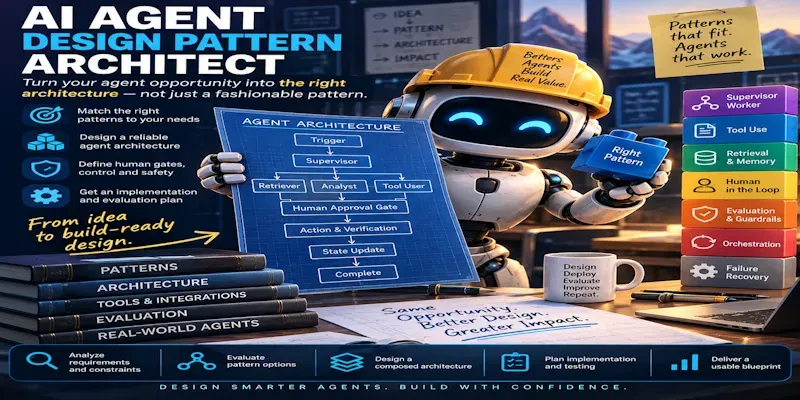
Turn a validated AI-agent opportunity into a defensible architecture pattern and build-ready design. This prompt reconstructs the opportunity, analyzes context, autonomy, state, tools, coordination, and failure requirements, compares suitable agent patterns, rejects unnecessary complexity, and produces a complete Agent Pattern Architecture Pack with control flow, human gates, recovery logic, implementation sequence, and evaluation tests.
...more
Added 10 hours ago
