

Prompt Details
Model
(claude-5-sonnet)
Token size
1,266
Example input
[ARGUMENT]: "Our company should replace all customer support agents with AI because our chatbot resolved 82% of tickets during a two-week pilot. Since the pilot was successful, full automation will reduce costs, improve customer satisfaction, and eliminate hiring challenges."
[STANDARD]: Executive review. Very strict logical analysis.
[FOCUS]: Evidence quality, causal reasoning, and unsupported conclusions.
Example output
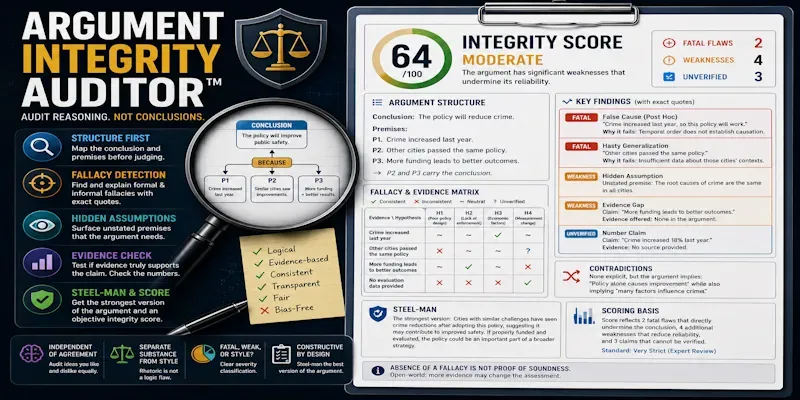
# ARGUMENT INTEGRITY AUDITOR™ v1.1 — OUTPUT
╔═══════════════════════════════════════════════╗
║ INTEGRITY SCORE: 18/100 · Conclusion outruns its evidence by a wide margin ║
║ Fatal: 3 Weaknesses: 4 Unverified: 3 ║
╚═══════════════════════════════════════════════╝
### ARGUMENT STRUCTURE
**Conclusion:** All customer support agents should be replaced with AI (full automation).
**Premises offered:**
- P1: The chatbot resolved 82% of tickets during a two-week pilot.
- P2 (implicit): 82% resolution = "the pilot was successful."
- P3 (asserted, not argued): Full automation will reduce costs.
- P4 (asserted, not argued): Full automation will improve customer satisfaction.
- P5 (asserted, not argued): Full automation will eliminate hiring challenges.
**Which premises actually carry the conclusion:** Only P1 is evidence-backed. P2 is a labeling move, not a finding. P3–P5 are not derived from P1 at all — they're appended claims riding on P1's coattails. Structurally, the argument has one data point supporting a claim about *partial* pilot performance, and three unsupported predictions about a *totally different* scope (full replacement) bolted on.
### FINDINGS
▸ **{FATAL} Fallacy: Non sequitur** — conf H
"Since the pilot was successful, full automation will reduce costs, improve customer satisfaction, and eliminate hiring challenges."
Why it fails: None of these three outcomes follow from "82% of tickets were resolved in two weeks." Resolution rate is not cost data, not satisfaction data, and not a hiring-pipeline analysis. The argument presents three separate empirical claims as if the pilot statistic proved them; it proved none of them.
▸ **{FATAL} Fallacy: Hasty generalization (unrepresentative sample)** — conf H
"our chatbot resolved 82% of tickets during a two-week pilot"
Why it fails: A two-week window and an unspecified ticket mix cannot support a conclusion about *permanent, full-scale* replacement of *all* agents. Pilots typically route simpler tickets to the automated channel; nothing in the text says this pilot handled the full complexity distribution of real support volume, or that performance would hold at scale or over time (e.g., seasonal spikes, novel issue types, edge cases).
▸ **{FATAL} Fallacy: False dichotomy** — conf M
"replace all customer support agents with AI"
Why it fails: The argument frames the choice as full automation vs. implied status quo, skipping the obvious middle ground (hybrid tiering, partial automation of the 82%-solvable tickets, phased rollout) that the pilot's own data would most directly support.
▸ **{WEAKNESS} Hidden assumption:**
Unstated premise the argument needs: The 18% of unresolved tickets are low-cost, low-frequency, or otherwise inconsequential to strip out of the "success" framing. If those are the highest-complexity or highest-value tickets, "82% resolved" could mean the chatbot handled the easy majority while leaving the hard, expensive cases — which is the opposite of a case for *full* automation.
▸ **{WEAKNESS} Hidden assumption:**
Unstated premise the argument needs: Customer satisfaction during the pilot (or in general) tracks resolution rate, and doesn't depend on interaction quality, escalation friction, or customers' preference for human contact. Resolution ≠ satisfaction; a ticket can be "resolved" and still generate a frustrated customer.
▸ **{WEAKNESS} Claim vs evidence:**
Claim: "full automation will reduce costs" | Evidence offered: none | Gap: no cost baseline (human agent cost per ticket), no automation cost (build, licensing, maintenance, escalation staffing for the 18%), no comparison. Number check: not applicable — no numbers were actually offered for this claim, only for the resolution rate.
▸ **{WEAKNESS} Claim vs evidence:**
Claim: "eliminate hiring challenges" | Evidence offered: none | Gap: this is a workforce/labor-market claim entirely disconnected from a ticket-resolution statistic. Even full automation of front-line support could create *new* hiring challenges (AI ops, escalation specialists, prompt/model maintenance).
▸ **{UNVERIFIED}** "82% of tickets" — the figure itself is internally consistent and not contradicted elsewhere in the text, so it is not flagged as false. But it is unverified in context: no ticket-volume baseline, no definition of "resolved" (fully closed vs. no further contact within X days vs. self-reported), and no comparison to the human-agent resolution rate it's implicitly being measured against.
▸ **{UNVERIFIED}** "improve customer satisfaction" — no CSAT, NPS, or comparable metric is cited from the pilot itself, despite this being an easy thing to have measured concurrently with resolution rate.
▸ **{UNVERIFIED}** "reduce costs" — no cost figures at all; flagged rather than rejected because it's plausible in principle, just entirely unsupported by anything in {ARGUMENT}.
*(No style-only findings — the language is plain and non-rhetorical; the problems here are entirely structural/evidentiary.)*
### CONTRADICTIONS
None found at the sentence level. The deeper tension is structural rather than a stated contradiction: the argument's own scope (a two-week pilot measuring one metric) is quietly swapped for a much larger scope (permanent, full-scale replacement across three different outcome dimensions) without acknowledgment. This isn't a logical contradiction so much as a scope-inflation move — flagged above as non sequitur and hasty generalization rather than double-counted here.
### STEEL-MAN
The strongest honest version of this argument would be: *"Our two-week pilot showed the chatbot autonomously resolved 82% of [ticket category X], suggesting AI can handle a defined subset of routine support volume without degrading [measured satisfaction metric]. We recommend expanding automation to that subset, with human agents retained for the remaining 18% and for categories not yet piloted, while we collect cost and satisfaction data at larger scale before considering further automation."*
To actually establish anything close to the original conclusion, it would need: (1) a resolution-rate comparison against human agents on the same ticket mix, (2) a satisfaction metric measured during the pilot, (3) an actual cost model comparing automation TCO to current staffing costs, (4) data on ticket complexity distribution to confirm the 82% isn't just "the easy tickets," and (5) a pilot duration long enough to rule out novelty effects or short-term anomalies.
### SCORING BASIS
Under an "executive review, very strict" standard, three fatal flaws (non sequitur, hasty generalization, false dichotomy) each independently sever the link between evidence and conclusion — a strict standard treats any one of these as sufficient to reject the recommendation as stated, and three compounds that. The score of 18 reflects that the *underlying data point* (82% resolution) is plausible and not itself contradicted, which keeps this off the floor — but the conclusion drawn from it is almost entirely unsupported. Absence of a fallacy in the "contradictions" section is not proof the argument is otherwise sound (open-world) — the fatal flaws found in the findings section are sufficient on their own to warrant rejection at this standard.

 Instant access
 Commercial use
 Money‑back
By purchasing this prompt, you agree to our terms of service
5.0
1 review
2
Favorites
43
Views
CLAUDE-5-SONNET


It does not care whether it agrees with the conclusion. A well-argued case for
a position it dislikes scores high; a sloppy case for a position it likes scores
low. The audit is about the reasoning, not the verdict.
- Fallacy detection with the offending quote and why it fails
- Hidden-assumption surfacing — the load-bearing claims left unsaid
- Claim ↔ evidence pressure-test, including quick sanity math on quoted numbers
- Contradiction finder across the whole argument
- Ends with the stronges
...more
Added over 1 month ago

- Reviews for this prompt (1)