

Prompt Details
Model
(claude-5-sonnet)
Token size
3,505
Example input
[RFP_TEXT]: Highland Regional Health Authority - Tender HRH/2026/22 / Clinical Waste Collection and Disposal / Eligibility: Bidders shall hold a current Environment Agency waste carrier licence (Upper Tier) and demonstrate a minimum annual turnover of GBP 2 million in each of the last three financial years. / Bidders shall hold ISO 14001 certification. / Bidders shall provide evidence of at least two comparable NHS or public healthcare contracts completed within the last five years. / A performance bond of 10 per cent of annual contract value is required at contract award. / The contract is for an initial four years with an estimated annual value of GBP 1.4 million. / The incumbent supplier has held this contract since 2015. / Evaluation: quality 60 per cent, price 40 per cent. / Tender return: 12:00 on 18 December 2026.
[FIRM_CAPABILITY]: Environment Agency waste carrier licence Upper Tier - held, current, expires 2028; turnover GBP 2.6m, GBP 2.4m, GBP 1.8m across the last three financial years; ISO 14001 - not held, application not started; healthcare contracts - one private hospital group contract completed 2024, no NHS contracts; performance bond - no existing bonding facility, bank indicated 6-8 weeks to arrange; 22 staff.
[COMPETITIVE_CONTEXT]: Incumbent held since 2015, no known service failures publicly reported; two other regional competitors known to hold ISO 14001 and existing NHS contracts; no prior relationship with this buyer.
[BID_COST]: Estimated 18 person-days internal plus GBP 4,000 external bid writing support; ISO 14001 certification cost estimated GBP 9,000 and 4-6 months lead time.
Example output
**1. VERDICT**
NO-GO. Three mandatory gates are blocked by things that cannot be
created before a deadline — a closed financial year, a four-to-six month
certification, and contract history that doesn't exist — and together
they show the firm has not yet competed in the NHS market at all.
**2. HARD GATE TABLE**
G1 — "Bidders shall hold a current Environment Agency waste carrier
licence (Upper Tier)" — PASS — capability confirms Upper Tier licence
held, current, expires 2028.
G2 — "demonstrate a minimum annual turnover of GBP 2 million in each of
the last three financial years" — FAIL-BLOCKED — capability shows GBP
2.6m, GBP 2.4m, GBP 1.8m; the third year falls below the threshold and a
closed financial year cannot be changed.
G3 — "Bidders shall hold ISO 14001 certification." — FAIL-BLOCKED —
capability confirms not held, application not started, 4-6 month lead
time stated in BID_COST against a deadline roughly three months out.
G4 — "provide evidence of at least two comparable NHS or public
healthcare contracts completed within the last five years" —
FAIL-BLOCKED — capability shows one private hospital group contract and
no NHS contracts.
G5 — "A performance bond of 10 per cent of annual contract value is
required at contract award." — FAIL-CLOSEABLE — no existing facility,
bank indicated 6-8 weeks, and the requirement bites at award rather
than at tender return.
**3. GATE INTERACTION**
(a) Failure pattern — market position, not paperwork. G3 and G4 are not
two missing documents; ISO 14001 and NHS contract history are what a
firm accumulates by operating in the public healthcare waste market.
The firm holds the operating licence (G1) but none of the market-entry
credentials. A competitor failing only G5 would be one facility short of
bidding. This firm is outside the market it is bidding into, which is a
different decision with a different remedy.
(b) Dead closures — G5 is a dead closure for this tender. Arranging a
bonding facility takes 6-8 weeks and costs real money, and it buys
nothing here because G2, G3, and G4 each independently make the bid
ineligible. Any spend on bonding should be justified as general business
capability, never as a cost of this tender.
(c) Compounding gates — G3 and G4 together. Individually, a firm might
lack ISO 14001 while holding NHS contracts, or hold the certification
while waiting on its first NHS award. Missing both, alongside
COMPETITIVE_CONTEXT confirming two regional competitors hold both, means
the firm is not currently a credible entrant in this sector rather than
narrowly short on two items. G2 reinforces this: the sub-GBP 2m year
suggests the firm is also below the scale the buyer is procuring at.
(d) Load-bearing gate — none. No single resolution changes the outcome:
resolving any one of G2, G3, or G4 still leaves two blockers. This is
the signature of a structural NO-GO rather than a marginal one, and it
is why the decision is not close.
**4. COMPETITIVE READ**
Incumbent strength — HIGH. {EVI}[CONF] RFP_TEXT states the incumbent has
held the contract since 2015; COMPETITIVE_CONTEXT reports no publicly
known service failures. An eleven-year incumbency with no visible failure
is the hardest position in public tendering to displace.
Evaluation bias — favours demonstrable track record. {EVI}[UNCONF] the
60/40 quality/price split, read with the two-contract healthcare
experience requirement, weights the award toward existing comparable
delivery history rather than price disruption.
Specification signals — moderate narrowing, not incumbent-specific.
{EVI}[UNCONF] the combination of Upper Tier licence, ISO 14001, GBP 2m
turnover, and two NHS contracts describes a narrow supplier profile, but
COMPETITIVE_CONTEXT confirms at least two regional competitors already
meet it, so the specification is not written around one supplier.
Agreement with the gate table — the two readings agree, and that
agreement is itself the finding. The specification is not unfairly
narrow, and the firm still fails it. That rules out the most common
counter-argument in a NO-GO discussion — that the tender was rigged —
and leaves the gap as a genuine capability difference.
**5. CLOSURE COST AND CARRY-FORWARD**
G2 — (a) Requires a completed financial year above GBP 2m. Controlled by
elapsed time, not by the firm. Cannot close before the deadline;
confirmed blocker. (b) Carry-forward: automatic if trading continues at
GBP 2.4m+ levels. No action needed beyond another trading year, and it
resolves itself for any tender after the next year-end.
G3 — (a) Requires ISO 14001: GBP 9,000, 4-6 months, timeline controlled
by the certification body. Confirmed blocker. (b) Carry-forward: the
highest-value investment available here. ISO 14001 is a standing
prerequisite across public sector environmental and waste tendering, so
it qualifies the firm for a class of tenders rather than one, and it resolves one of
the three blockers permanently. If any spend is approved off the back of
this audit, this is it.
G4 — (a) Requires two completed NHS or public healthcare contracts.
Cannot be manufactured within any timeline; confirmed blocker. (b)
Carry-forward: high value but slow — it requires winning smaller public
healthcare work first, which is itself easier once G3 is held. The
sequence matters: G3 is a prerequisite for building G4, so they are not
independent investments.
G5 — (a) Requires a bonding facility: 6-8 weeks, bank-controlled, needed
at award. Dead closure for this tender per section 3(b). (b)
Carry-forward: moderate and general — a standing bonding facility is
useful across public tendering, but it is not what excludes the firm
here and should not be prioritised over G3.
**6. BID COST vs VALUE**
Moot, not marginal. With three confirmed blocked gates, win probability
is zero rather than low, so the usual proportionality reasoning does not
apply — 18 person-days plus GBP 4,000 against GBP 1.4m annual value
would be comfortably rational if the bid were eligible, and that ratio
is irrelevant here. Presenting it as a close call would misrepresent the
decision. The GBP 9,000 ISO 14001 figure is the only number in BID_COST
worth carrying forward, and it belongs in a capability budget rather
than a bid budget.
**7. THE NO-GO CASE**
The verdict is NO-GO, so this states what would have to change, ordered
by carry-forward value from section 5(b):
First, ISO 14001 — GBP 9,000 and 4-6 months, qualifies the firm for public sector
environmental tendering broadly, and is a prerequisite for building the
NHS track record G4 requires. Second, public healthcare contract
history — begins with smaller public healthcare awards, which become
winnable once ISO 14001 is held; realistically a two-to-three year
build. Third, turnover — resolves itself with another trading year above
GBP 2m, no action required. Fourth, a standing bonding facility — useful
generally, lowest priority.
The practical read: this contract is not winnable in this cycle, and the
real decision is whether to fund ISO 14001 now so the firm is eligible
for the successor tender and the smaller public healthcare work in
between. Declining this tender costs nothing. Declining the
certification costs the next four years of this market.
**8. NOT CHECKED**
Whether the GBP 2m turnover requirement permits group or parent-company
figures — RFP_TEXT does not state.
Whether "comparable" healthcare contracts might include the private
hospital group contract held — RFP_TEXT specifies NHS or public
healthcare without defining comparability.
Full tender documentation beyond the eligibility and evaluation extracts
supplied.
Whether the incumbent is re-bidding — not stated in COMPETITIVE_CONTEXT.
Any framework or lot structure that might allow partial bidding — not
supplied.
Whether ISO 14001 certification bodies offer any expedited route — the
4-6 month figure in BID_COST is not attributed to a specific body.
**Assumptions:** the three financial years stated in FIRM_CAPABILITY are
the three most recent completed years; the tender return date is firm
with no extension announced.

 Instant access
 Commercial use
 Money‑back
By purchasing this prompt, you agree to our terms of service
1
Favorites
12
Views
CLAUDE-5-SONNET


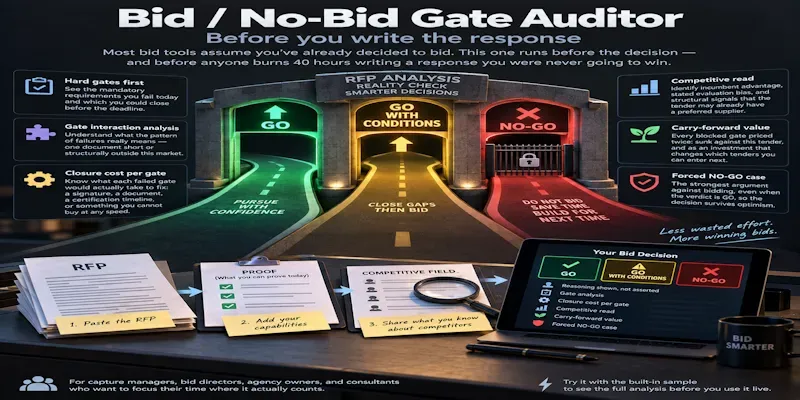
Paste the RFP, what your firm can prove today, and what you know about
the competitive field. You get a GO / NO-GO / GO-WITH-CONDITIONS verdict
with the reasoning shown, not asserted.
...more
Added 4 days ago
