

Prompt Details
Model
Chat - (gpt-5.6)
Token size
3,163
Example input
[analysis subject]: Customer churn increased after we introduced a new self-service onboarding flow. The team believes removing human onboarding caused the increase, but we currently have no controlled comparison proving causation.
[depth target]: Maximum
[domain context]: B2B SaaS product with sales-assisted acquisition and a recently redesigned onboarding journey.
[output purpose]: Determine what likely explains the churn increase and what we should test before redesigning onboarding again.
Example output
# CASCADE ANALYSIS REPORT
**Subject:** Customer churn increased after introduction of a new self-service onboarding flow
**Depth:** Maximum
**Domain:** B2B SaaS with sales-assisted acquisition and redesigned onboarding
**Purpose:** Determine likely explanations for the churn increase and what should be tested before another onboarding redesign
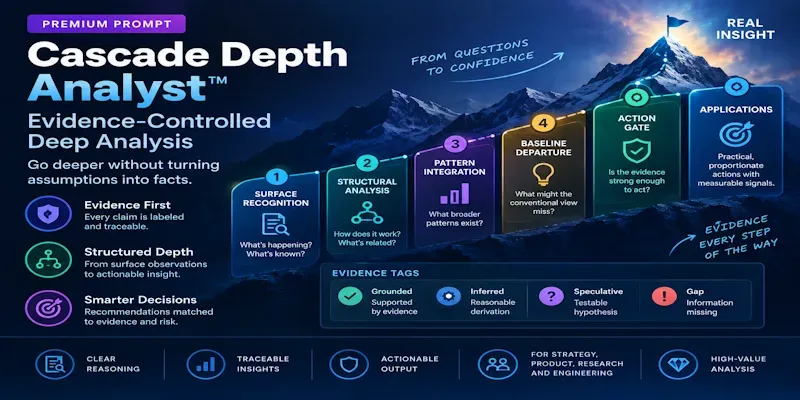
The analysis below follows the supplied CASCADE methodology: causal interpretations are not upgraded merely because the team believes them, and speculative explanations can justify evidence collection or bounded tests—not a major redesign.
──────────────────────────────────────────
## LAYER 1 — Surface Recognition
**L1-F1 — {Grounded}** Customer churn increased after the introduction of the new self-service onboarding flow.
**L1-F2 — {Grounded}** The onboarding journey changed from involving human onboarding to a self-service model.
**L1-F3 — {Grounded}** Acquisition remains sales-assisted, meaning the customer journey now contains human assistance during acquisition followed by a more self-directed onboarding experience.
**L1-F4 — {Inferred}** The timing creates a credible association between the onboarding change and churn increase, because the observed increase followed the intervention.
**L1-F5 — {Gap}** No controlled comparison establishes whether customers exposed to self-service onboarding churn more frequently than comparable customers receiving human onboarding.
**L1-F6 — {Gap}** No cohort-level churn data, activation metrics, time-to-value data, onboarding completion data, customer-segment breakdowns, acquisition-channel changes, product changes, pricing changes, or churn-reason evidence have been supplied.
**L1-F7 — {Gap}** The timing of churn relative to onboarding is unknown. The supplied information does not establish whether customers disengage during onboarding, shortly after activation, or substantially later.
**Baseline view — {Speculative}:** The team's current explanation is:
> Removing human onboarding → weaker onboarding experience → higher churn.
This is a plausible causal hypothesis, but chronology alone does not establish the mechanism. The supplied methodology explicitly prohibits converting chronology or user-stated causation into a grounded causal mechanism.
---
## LAYER 2 — Structural Analysis
### L2-F1 — Exposure-effect mechanism
**Source: L1-F1 + L1-F2 + L1-F5 — {Speculative}**
If removing human onboarding materially reduced customers' ability to configure, understand, or adopt the product, exposure to the self-service flow could reduce successful onboarding and subsequently increase churn.
The causal chain would be:
**SELF-SERVICE EXPOSURE → poorer onboarding outcome → poorer activation/adoption → higher churn**
But none of the intermediate links is currently observed.
---
### L2-F2 — Assistance-removal mechanism
**Source: L1-F2 + L1-F3 — {Speculative}**
Human onboarding may previously have performed functions that the redesigned journey does not replicate: clarification, configuration assistance, expectation correction, troubleshooting, or escalation.
If one or more of those functions affected retention, removing the person rather than merely changing the interface could matter.
This produces a more precise hypothesis than "self-service is bad":
**loss of a specific human function → unresolved onboarding friction → downstream churn.**
Which human function, if any, matters remains unknown.
---
### L2-F3 — Journey-transition mismatch
**Source: L1-F2 + L1-F3 — {Inferred}**
The customer journey now crosses a structural boundary:
**sales-assisted acquisition → self-service onboarding.**
That creates a potential dependency between what sales establishes before purchase and what the customer must independently accomplish afterward.
Therefore, onboarding performance cannot safely be analyzed purely as an isolated UI/UX problem.
---
### L2-F4 — Composition/confounding mechanism
**Source: L1-F1 + L1-F5 + L1-F6 — {Speculative}**
The post-launch customer population may differ from the pre-launch population.
Possible confounders include changes in:
**customer segment → company size → use case → sales channel → contract type → product mix → acquisition quality.**
If customer composition changed around the same time as onboarding, aggregate churn could rise even if the onboarding redesign had little causal effect.
The missing comparison data is not evidence that this happened.
---
### L2-F5 — Concurrent-change mechanism
**Source: L1-F1 + L1-F6 — {Speculative}**
Another product or commercial change could have occurred during the same period.
Examples requiring investigation rather than assumption include pricing, product reliability, feature changes, acquisition practices, or customer mix.
Thus the observed pattern currently supports:
**onboarding change + churn change**
but not uniquely:
**onboarding change → churn change.**
---
### L2-F6 — Aggregate-metric masking
**Source: L1-F1 + L1-F6 + L1-F7 — {Inferred}**
Aggregate churn alone cannot identify the mechanism because it collapses multiple stages and populations into one outcome.
A useful causal decomposition requires at minimum:
**Exposure → onboarding behavior → activation/adoption → retention**
with cohort and segment comparisons.
Without that decomposition, several mechanisms can generate the same top-line churn movement.
---
### L2-F7 — Redesign-identification problem
**Source: L1-F5 + L2-F1 + L2-F2 + L2-F4 + L2-F5 — {Speculative}**
Immediately redesigning onboarding would introduce another intervention before the first intervention's causal effect has been isolated.
That could make subsequent attribution harder:
**old onboarding → self-service onboarding → redesigned self-service**
while the underlying mechanism remains unidentified.
---
## LAYER 3 — Pattern Integration
### L3-F1 — The current problem is causal identification, not yet onboarding design
**Sources: L2-F1 + L2-F4 + L2-F5 + L2-F6 — {Speculative}**
Multiple structurally different explanations currently fit the same observation:
**A. Human assistance mattered.**
**B. The new flow itself introduced friction.**
**C. Different customers entered after launch.**
**D. Another contemporaneous change affected churn.**
**E. Several mechanisms interacted.**
These explanations imply different interventions.
Therefore the decision problem should first be framed as:
**Which causal pathway changed?**
rather than:
**How should we redesign onboarding?**
---
### L3-F2 — "Human vs self-service" is probably too coarse a treatment definition
**Sources: L2-F1 + L2-F2 + L2-F3 — {Speculative}**
The binary comparison bundles multiple mechanisms together.
Human onboarding may simultaneously provide education, configuration, accountability, expectation alignment, troubleshooting, and escalation.
Consequently, even evidence that human-assisted customers retain better would not automatically prove that full human onboarding should be restored.
The actionable causal unit could instead be one missing function.
---
### L3-F3 — The diagnostic unit should be the customer journey, not merely the onboarding interface
**Sources: L2-F3 + L2-F6 — {Inferred}**
Because acquisition remains sales-assisted while onboarding became self-service, retention may depend on continuity between stages.
The more informative analytical chain is:
**Sales promise/context
↓
Customer expectation
↓
Self-service onboarding requirements
↓
Activation
↓
Early product usage
↓
Retention**
A break anywhere in that chain could surface later as "onboarding churn."
---
### L3-F4 — Churn is a lagging diagnostic signal
**Sources: L2-F1 + L2-F6 — {Inferred}**
If onboarding affects churn through activation or adoption, churn occurs downstream of the mechanism.
Therefore, churn alone is relatively poor for locating the failure.
Earlier behavioral signals—such as progression, activation, time-to-value, support escalation, or abandonment—would provide stronger mechanism discrimination if those data exist.
---
## LAYER 4 — Departure from Baseline
### Baseline claim
**{Speculative}** Removing human onboarding caused churn to increase.
### What the baseline explains adequately
**{Speculative}** It provides one coherent mechanism consistent with the chronology: removal of useful human assistance could damage onboarding outcomes and subsequently retention.
**Evidence lineage:** L2-F1 → L2-F2.
### What it oversimplifies
**{Speculative}** It treats "human onboarding" as one treatment even though human assistance may contain several distinct retention-relevant functions.
**Evidence lineage:** L2-F2 → L3-F2.
### What it misses
**{Inferred}** It does not account for the structural handoff between sales-assisted acquisition and self-service onboarding.
**Evidence lineage:** L2-F3 → L3-F3.
**{Speculative}** It does not eliminate cohort composition or concurrent changes as alternative explanations.
**Evidence lineage:** L2-F4 + L2-F5 → L3-F1.
**{Inferred}** It relies heavily on the final churn outcome without identifying where earlier in the customer journey performance changed.
**Evidence lineage:** L2-F6 → L3-F4.
### What it potentially gets wrong
**{Speculative}** The intervention worth restoring may not be "human onboarding."
If causality exists, the actual missing treatment could be narrower—for example a particular clarification, configuration, escalation, or expectation-alignment function previously delivered by humans.
Therefore:
**Self-service vs human is currently the observed product change. It is not yet the identified causal mechanism.**
──────────────────────────────────────────
# ACTION GATE
**Candidates evaluated:** 5
**PASS:** 4
**EXCLUDED:** 1
The methodology requires high-impact commitments to have stronger evidence than bounded reversible experiments; speculative findings may support evidence gathering or appropriately bounded tests.
**PASS — Cohort reconstruction:** obtains evidence needed to discriminate onboarding effects from confounding.
**PASS — Funnel localization:** bounded diagnostic analysis identifying where customer behavior changed.
**PASS — Controlled assistance test:** directly tests whether human assistance affects intermediate outcomes without committing to restoring the previous operating model.
**PASS — Function-level intervention test:** tests the mechanism more precisely than "human versus self-service."
**EXCLUDED BY ACTION GATE — Full onboarding redesign:** Current evidence does not identify which mechanism caused the churn increase; another material redesign would be disproportionate to the evidence.
---
# APPLICATIONS
### 1. Reconstruct the pre/post onboarding cohorts
**Source finding:** L3-F1 — competing causal explanations remain viable **{Speculative}**
**Action:** Build comparable cohorts from before and after the onboarding launch and examine churn alongside customer characteristics and onboarding exposure.
**First step:** This week, create a customer-level dataset containing onboarding version/exposure, signup date, relevant customer segment variables, acquisition/sales attributes available in the system, activation events, and churn outcome.
**30-day signal:** Whether the churn difference persists after comparing materially comparable cohorts and whether it concentrates in identifiable segments.
**Action profile:** BOUNDED TEST
**Gate result:** PASS — directly addresses the primary causal-identification gap without committing to another product redesign.
---
### 2. Locate the earliest measurable divergence
**Source finding:** L3-F4 — churn is downstream of the likely mechanism **{Inferred}**
**Action:** Compare pre/post cohorts across the onboarding-to-retention sequence rather than beginning with churn.
**First step:** Reconstruct:
**onboarding start → critical steps → onboarding completion → activation → early usage → retention/churn**
and identify the earliest stage where comparable cohorts diverge.
**30-day signal:** Identification of a reproducible behavioral divergence preceding churn—or evidence that no meaningful onboarding-stage divergence is detectable.
**Action profile:** BOUNDED TEST
**Gate result:** PASS — measurable, reversible, and capable of distinguishing onboarding failure from later-stage retention problems.
---
### 3. Run a controlled human-assistance experiment
**Source finding:** L2-F1 — removal of assistance could mediate churn through poorer onboarding outcomes **{Speculative}**
**Action:** For eligible new customers, compare the existing self-service journey against the same journey plus a defined human-assistance treatment.
Do not simultaneously redesign the interface.
**First step:** Define exactly what the assistance treatment contains and predefine the intermediate outcomes to observe.
**30-day signal:** Differences in onboarding progression, activation, early usage, support needs, or another already-valid observable retention precursor.
**Action profile:** BOUNDED TEST
**Gate result:** PASS — directly tests the team's causal hypothesis while limiting cost and reversibility risk.
---
### 4. Decompose human onboarding into functions
**Source finding:** L3-F2 — "human versus self-service" bundles potentially distinct mechanisms **{Speculative}**
**Action:** Examine the previous human onboarding process and identify the concrete functions that disappeared. Test promising functions individually or in small combinations rather than automatically restoring the entire service.
**First step:** Review historical onboarding scripts, call notes, support escalations, implementation checklists, and staff interviews to construct a function inventory.
Example analytical categories—not assumed facts—include:
**education | configuration | expectation alignment | troubleshooting | accountability | escalation**
**30-day signal:** Evidence identifying which missing functions correlate with or experimentally improve early onboarding/activation behavior.
**Action profile:** BOUNDED TEST
**Gate result:** PASS — converts an underspecified causal theory into testable mechanisms without requiring wholesale restoration of human onboarding.
---
## Excluded by Action Gate
**EXCLUDED BY ACTION GATE — Redesign the self-service onboarding flow now — causal mechanism remains unresolved and the proposed intervention has greater cost and attribution risk than the available evidence supports.**
──────────────────────────────────────────
# EVIDENCE SUMMARY
**{Grounded}: 3**
**{Inferred}: 7**
**{Speculative}: 14**
**{Gap}: 4**
**Layer Halts:** None.
**Highest-confidence conclusion — {Inferred}:** The available evidence establishes a temporal association between the onboarding change and increased churn, but the current aggregate outcome is insufficient to identify the causal mechanism.
**Most consequential uncertainty — {Gap}:** We do not know whether comparable customers exposed to the new onboarding flow churn more frequently because of that exposure, nor where in the onboarding → activation → retention pathway the divergence begins.
**Evidence that would most improve the analysis:** A customer-level pre/post dataset connecting **onboarding exposure + customer/cohort characteristics + sales/acquisition context + onboarding behavior + activation/early usage + churn**, followed by a controlled comparison of self-service against a precisely defined assistance treatment.
### Decision implication
**Do not redesign onboarding again yet.** The strongest next move is **causal localization before solution design**: reconstruct cohorts → locate the earliest divergence → test human assistance → isolate which assistance function matters.
If the controlled assistance treatment improves early outcomes, the next question becomes **what function humans supplied**—not automatically whether human onboarding should return.

$19.99-25%
$14.99
SPECIAL PROMOTION — Offer ends 12 October

 Instant access
 Commercial use
 Money‑back
By purchasing this prompt, you agree to our terms of service
5.0
1 review
2
Favorites
67
Views
GPT-5.6


Turn complex subjects into progressively deeper analysis without letting weak evidence become confident conclusions.
Cascade Depth Analyst moves from surface observations to structural mechanisms, integrated patterns, and baseline-challenging insights while tracking evidence strength across every layer. A final Action Gate converts only sufficiently supported findings into proportionate, measurable actions.
Evidence → Structure → Patterns → Challenge → Action Gate
...more
Added 3 weeks ago

- Reviews for this prompt (1)