

Prompt Details
Model
(claude-5-sonnet)
Token size
3,315
Example input
[CHANGE_DESCRIPTION]: A pharmaceutical manufacturing company is replacing manual batch-release checklists with an AI-assisted digital quality-control workflow that automatically flags anomalies before final approval.
[RESISTANCE_EVIDENCE]: During the pilot, a senior quality engineer said: “The system flags unusual values, but it does not show which validation rule produced the warning. If I approve or reject a batch, I need an auditable reason tied to the specific control requirement.” Another engineer reported that two pilot alerts were generated from incomplete sensor uploads and said the team needs to understand how missing readings are handled before relying on the workflow. A production manager described the engineers as “very resistant to automation” and suggested more training sessions.
Example output
CHANGE: Replacing manual batch-release checklists with an AI-assisted digital quality-control workflow (pharmaceutical manufacturing)
RESISTANCE INSTANCE 1
Who: Senior quality engineer
Concern (evidence status): DOCUMENTED — states the system flags anomalies without showing which validation rule triggered the warning, and that approval/rejection decisions require an auditable reason tied to a specific control requirement
Source Classification: GENUINE RISK SIGNAL
Rationale: This is a specific, concrete, falsifiable claim about a workability gap in the change itself — not vague unease. Batch-release decisions in pharma manufacturing are subject to regulatory audit requirements (e.g., GMP traceability); a system that flags anomalies without linking them to the specific control requirement violated is a real operational/compliance gap, not a proxy for something else. The concern names exactly what's missing and why it matters functionally.
Mixed-Signal Check: NONE APPLICABLE — the concern is stated in risk language and the underlying content matches (specific, falsifiable, traceable to a workflow design gap, not to status or autonomy)
Mapped Response: Investigate the specific claim before responding. Verify whether the workflow can be modified to surface the triggering validation rule per flag. Do not proceed with full rollout on batch-release decisions until this traceability gap is either resolved in the design or shown not to exist.
RESISTANCE INSTANCE 2
Who: Pilot engineer (second, distinct from Instance 1)
Concern (evidence status): DOCUMENTED — reports two pilot alerts were generated from incomplete sensor uploads, and states the team needs to understand how missing readings are handled before relying on the workflow
Source Classification: INFORMATION GAP
Rationale: The concern is phrased around needing to understand a specific mechanism (missing-reading handling) rather than asserting the mechanism is broken. This reads as a gap in documented behavior, not a claim that the behavior is wrong — though it borders Genuine Risk Signal, since the trigger event (bad alerts from incomplete data) is itself evidence of a possible real defect. Classifying as Information Gap here rests on the concern being framed as "we need to understand how X is handled" rather than "X is handled incorrectly."
Mixed-Signal Check: Surface-Language Misdirection considered and rejected — there's no indication this is secretly about control or status; it's a direct procedural question. Flagging as CONTESTED is worth naming: the two false alerts are themselves a data point that could support Genuine Risk Signal if missing-reading handling turns out to be inadequate rather than merely undocumented.
Mapped Response: Close the specific gap: document and communicate exactly how the workflow handles incomplete sensor uploads (e.g., does it flag for manual review, suppress the alert, or apply a default). If investigation reveals the handling itself is inadequate rather than just unexplained, this instance should be reclassified to Genuine Risk Signal and treated accordingly — flag this contingency explicitly rather than closing the loop with documentation alone.
RESISTANCE INSTANCE 3 (third-party report — not independently classified)
Who: Production manager, describing the engineers as a group
Status: Not a first-person resistance instance. This is person C reporting a characterization of persons A and B's resistance ("very resistant to automation") rather than stating their own concern. Per protocol, this is not manufactured into a fourth classification — it is context suggesting a Behavioral-Inference-style framing was applied by the manager, but both underlying engineers already have direct, specific, documented statements in Instances 1 and 2 that contradict the "resistant to automation" framing (their concerns are precise and procedural, not general aversion).
Note: The manager's suggestion of "more training sessions" is a proposed Information Gap-style response applied to what are actually, on the evidence, a Genuine Risk Signal and a probable Information Gap/possible Genuine Risk Signal. Applying training as a blanket response risks exactly the misdiagnosis-escalation pattern this tool exists to prevent: neither engineer's stated concern would be resolved by more training — Instance 1 needs a design change (traceability), Instance 2 needs documentation of an existing mechanism.
STABILITY CHECK (Phase 5)
Result: STABLE. Reclassifying in reverse order (Instance 2 then Instance 1) produces the same source classifications — Information Gap and Genuine Risk Signal respectively — with no drift under either ordering.
ADVERSARIAL REVIEW (Phase 7)
Defect found and corrected: Initial read risked treating Instance 2 as a clean Information Gap without flagging the CONTESTED angle. Corrected by explicitly noting the two false alerts as evidence that could shift the classification to Genuine Risk Signal pending investigation, rather than assuming documentation alone resolves it. Also explicitly rejected the temptation to fold the production manager's "resistant to automation" framing into either engineer's classification — seniority/emotional-intensity of a third party's characterization is not evidence of source, per Phase 8 refusals.
EVIDENCE GAPS
- Instance 2: whether incomplete-sensor-upload handling is merely undocumented (Information Gap) or actually inadequate (Genuine Risk Signal) — resolved by testing/reviewing the workflow's actual behavior on incomplete data, not by asking the engineer more questions.
- No instance currently supports Loss-of-Control Fear or Competing Legitimate Priority — if these exist, they haven't surfaced in the evidence supplied; the production manager's generalized "resistant to automation" comment is not itself evidence of either, per Phase 8.
METHOD NOTE
Classifications are provisional decision aids based on available evidence, not psychological diagnoses of any individual. This tool identifies the most evidence-supported driver of resistance to guide a proportionate response — it does not replace direct conversation with the person raising the concern, and a classification should be treated as a hypothesis to test, not a verdict on someone's motives.
VERDICT: CONDITIONAL — Instance 2's classification (Information Gap vs. Genuine Risk Signal) depends on evidence not yet available: how the workflow actually handles incomplete sensor data. Instance 1 is classified with confidence. No response should be finalized for Instance 2 that assumes documentation alone resolves it.

$29.99-25%
$22.49
SPECIAL PROMOTION — Offer ends 12 October

 Instant access
 Commercial use
 Money‑back
By purchasing this prompt, you agree to our terms of service
5.0
1 review
2
Favorites
32
Views
CLAUDE-5-SONNET


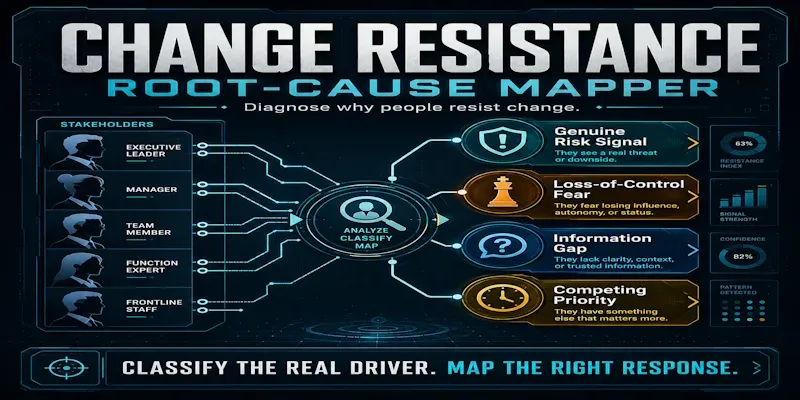
This tool classifies each instance of resistance into one of four structurally different sources: a genuine risk signal worth investigating before proceeding, a loss-of-control fear that needs a specific answer about authority and autonomy, an information gap that needs one particular fact closed, or a competing legitimate priority that needs sequencing, not persuading. Getting the source wrong doesn't just fail to help — treating a real risk warning as "resistance to change" discards a working
...more
Added over 1 month ago

- Reviews for this prompt (1)