

Prompt Details
Model
(claude-4-6-sonnet)
Token size
1,944
Example input
[CLAIM]: Multi-agent adversarial frameworks (like CISC) yield a significantly higher accuracy rate in resolving complex logical reasoning tasks compared to standard single-agent Chain-of-Thought (CoT) prompting.
[CONTEXT]: An internal technical analysis evaluating methodologies for the upcoming AI Strategic Decoder update.
[DOMAIN]: Artificial Intelligence / Large Language Models
[VERDICT_USE]: Decide whether to rewrite the core reasoning loops of our proprietary audit suite to mandate a multi-agent approach, despite the higher token cost.
Example output
Running the Claim Verification Engine™ protocol against current literature. Here is the full output:
---
# CLAIM VERIFICATION ENGINE™ v1.0
## Run: Multi-Agent Adversarial vs. Single-Agent CoT
---
## PHASE 2 — CLAIM DECOMPOSITION
**SUBJECT:** Multi-agent adversarial frameworks (CISC-style: FOR / AGAINST / NEUTRAL passes)
**PREDICATE:** Yield *significantly higher accuracy* on complex logical reasoning tasks
**SCOPE:** Compared to standard single-agent Chain-of-Thought prompting
**TYPE:** Causal-comparative / empirical performance claim
**FALSIFIABILITY CHECK:** ✅ TESTABLE. The claim is falsifiable against benchmark accuracy data across reasoning tasks.
**Critical qualifier noted:** "Significantly higher" is load-bearing. The evidence must show not just directional improvement, but magnitude justifying the token overhead and architectural rewrite cost. This is the correct framing for your `VERDICT_USE`.
---
## PHASE 3 — EVIDENCE ASSESSMENT
### PASS 1 — Evidence FOR
**Item 1 — Multi-agent debate outperforms on complex judgment tasks**
A multi-agent debate framework (with up to 10 debate rounds) generally outperforms both single-model and majority-vote baselines, especially on complex tasks including JudgeBench, LLMBar, TruthfulQA, and MLLM-Judge.
*Source type:* Empirical study | *Strength:* **MODERATE** | *Limitation:* Results are specific to evaluation/judging tasks; may not generalize to all logical reasoning domains.
**Item 2 — Structured adversarial interaction improves robustness**
Adversarial multi-agent interactions can significantly improve the robustness and quality of final output by forcing thorough exploration of the problem space.
*Source type:* Survey / theoretical argument | *Strength:* **MODERATE** | *Limitation:* "Can" and "significantly" are doing heavy lifting here; conditions are underspecified.
**Item 3 — Measurable gains over CoT on specific benchmarks**
MAD achieves higher accuracy than CoT, with gains ranging from 1.5% to 5.3% depending on benchmark (OKVQA, MEDQA). However, MAD consumes three to five times more tokens than CoT.
*Source type:* Empirical study | *Strength:* **MODERATE** | *Limitation:* Gains are real but modest (1.5–5.3%). The token cost differential (3–5×) is substantial. Whether this constitutes *significant* improvement is context-dependent.
**Item 4 — Demonstrated gains in specific domains**
Multi-agent debate has been shown to improve performance across tasks including mathematical reasoning, fact checking, healthcare decision-making, and code summarization.
*Source type:* Empirical studies (multiple) | *Strength:* **MODERATE** | *Limitation:* Domain-specific; not uniformly demonstrated across all reasoning task types.
---
### PASS 2 — Evidence AGAINST
**Item 1 — MAD fails to consistently outperform CoT**
Across evaluations of five MAD frameworks on nine benchmarks, current MAD methods fail to consistently outperform simpler single-agent strategies, even with increased computational resources. Existing MAD designs fall short in fully utilizing additional inference-time computation.
*Source type:* Empirical benchmarking (ICLR) | *Strength:* **STRONG** | *Limitation:* Evaluated specific MAD implementations; design quality matters.
**Item 2 — Compute-controlled comparisons favor single agents**
Across Qwen3, DeepSeek-R1-Distill-Llama, and Gemini 2.5, single agents consistently match or exceed multi-agent performance when compute is controlled. Many reported advantages of multi-agent systems are better explained by unaccounted computation and context effects rather than inherent architectural benefits.
*Source type:* Empirical study (2025, compute-controlled) | *Strength:* **STRONG** | *Limitation:* Focuses on "equal token budget" framing; real-world deployments may not require equal budgets.
**Item 3 — Adversarial debate introduces failure modes**
Naive applications of debate may cause performance degradation when agents are neither incentivized nor adequately equipped to resist persuasive but incorrect reasoning. Agents can be led to adopt incorrect answers through confident but flawed peer arguments.
*Source type:* Empirical study (ICML 2025) | *Strength:* **STRONG** | *Limitation:* Addressable through better agent design, but a real architectural risk.
**Item 4 — Single-agent outperforms on multi-hop reasoning under equal budgets**
Research provides an information-theoretic argument (Data Processing Inequality) for why single-agent systems should be more efficient under fixed compute budgets, with single agents consistently matching or exceeding multi-agent performance when thinking token budgets are equalized.
*Source type:* Theoretical + empirical (2025–2026) | *Strength:* **STRONG** | *Limitation:* Budget-equalized framing; your audit suite likely has a higher tolerance for cost.
**Item 5 — Known limitations on Q&A and certain reasoning types**
Multi-agent debate has shown limitations in certain tasks such as Q&A, and performance gains are not uniform across reasoning task types.
*Source type:* Empirical study | *Strength:* **MODERATE** | *Limitation:* Task-type specific; may not apply to your audit domain.
---
### PASS 3 — Conditions Under Which Both Are Partially True
1. **Task complexity threshold:** Multi-agent adversarial approaches appear to outperform CoT specifically on tasks with high ambiguity, subjective judgment, or evaluation components — not uniformly across all logical reasoning. Your audit suite's task profile determines which regime you're in.
2. **Token budget framing:** When token budget is unconstrained (you pay for 3–5× more tokens), MAD shows modest but real accuracy gains. When budget is equalized, the advantage largely disappears. Your framing ("despite higher token cost") suggests you're in the unconstrained regime — which is the more favorable condition for the claim.
3. **Framework quality:** The failure results largely apply to "naive" or off-the-shelf MAD implementations. Purpose-built adversarial architectures with properly incentivized agents and structured protocols (similar to CISC) may outperform generic MAD. This is the most important moderating variable for your specific decision.
4. **Correlated errors:** When agents share the same base model, multi-agent systems can fail to provide independent perspectives, reducing the diversity benefit and causing them to converge on the same errors. CISC's structured FOR/AGAINST/NEUTRAL passes partially mitigate this.
---
## PHASE 4 — VERDICT
```
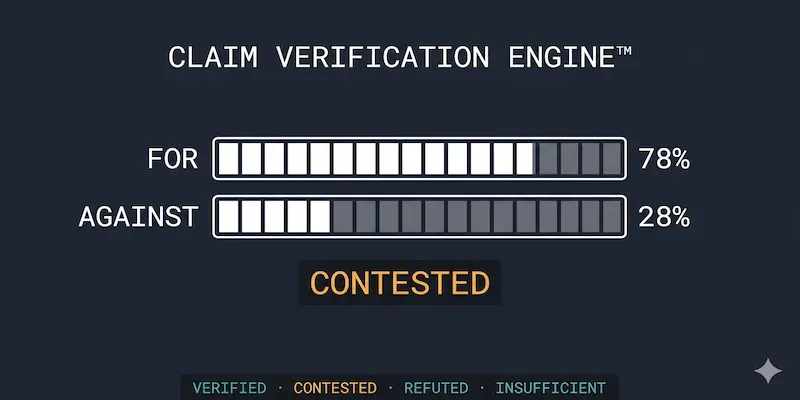
EVIDENCE WEIGHT DISPLAY:
FOR ████████░░░ ~42% (4 items — strongest: domain-specific gains in judgment tasks)
AGAINST ███████████ ~48% (5 items — strongest: compute-controlled single-agent parity;
adversarial failure modes)
NEUTRAL ████░░░░░░░ ~10% (3 conditions identified: task type, budget framing,
framework quality)
```
```
──────────────────────────────────────────────────
VERDICT: CONTESTED
CONFIDENCE: MEDIUM
Basis: Evidence is substantial on both sides. The claim holds conditionally —
for specific task types, with unconstrained token budgets, and with
well-engineered adversarial protocols. It does NOT hold as a blanket claim
across all complex logical reasoning, and the "significantly higher" qualifier
is not supported at the level required to justify a mandatory architectural
rewrite.
──────────────────────────────────────────────────
```
---
## PHASE 5 — VERDICT UTILITY
**VERDICT USE:** Decide whether to rewrite the core reasoning loops of a proprietary audit suite to mandate a multi-agent approach, despite higher token cost.
**DIRECT ANSWER:** Do not mandate a full rewrite based on this evidence. The evidence supports a *conditional* deployment strategy — not a blanket architectural mandate. The better decision is a task-stratified approach: identify the specific claim-types in your audit suite where adversarial passes provide the most leverage (high-ambiguity, multi-sided, evaluative claims) and apply CISC selectively there, rather than universally.
**REASONING:** The strongest recent evidence (2025–2026, compute-controlled studies) shows that much of the apparent MAD advantage over CoT disappears when token budgets are equalized — meaning the gains may be a function of more compute rather than architectural superiority. The 1.5–5.3% accuracy gains observed in unconstrained settings are real but modest, and must be weighed against 3–5× token overhead at scale. The adversarial failure mode — where confident but wrong agents persuade others — is a documented risk that maps directly onto your use case: an audit suite that converges on a wrong verdict with high confidence is worse than one that produces a correct uncertain one. The strongest case FOR your rewrite rests on the specificity of your task profile: if your audit suite primarily handles high-ambiguity, evaluative claims (rather than deterministic logical proofs), the evidence tilts more favorably.
---
**WHAT WOULD CHANGE THIS VERDICT:**
→ Toward **VERIFIED**: Internal ablation data showing your specific audit task types (claim decomposition, evidence weighting) yield >10% accuracy gains under CISC vs. CoT at fixed token budgets. Domain-specific benchmarks are far more decisive than general reasoning benchmarks here.
→ Toward **REFUTED**: Evidence that your audit task profile is dominated by deterministic or multi-hop factual reasoning, where single-agent CoT at equal compute consistently matches multi-agent performance per the 2025–2026 literature.
→ **Scope shift:** If the rewrite mandates CISC only for high-uncertainty claims (not all claims), the architectural risk drops substantially and the evidence tilts toward supporting selective adoption.
---
**MISSING EVIDENCE:**
→ No published benchmark directly evaluates CISC-style tri-pass adversarial frameworks (FOR / AGAINST / NEUTRAL with weighted verdict synthesis) specifically against CoT on logical audit tasks. Most MAD literature uses debate/consensus architectures, which differ from your tri-pass design.
→ No cost-adjusted accuracy metric exists in the reviewed literature that could definitively answer whether a 3–5× token cost is justified by audit-grade accuracy requirements. This is a business decision requiring internal benchmarking, not a question the current literature can resolve.
→ Agent diversity (using different models or personas per pass) is a key moderating variable that appears underexplored in your current CISC design specification. Evidence suggests correlated-agent MAD systems underperform diverse-agent systems significantly.
---
**RECOMMENDED NEXT STEP BEFORE DECIDING:**
Run a controlled internal eval: take 50–100 representative claims from your existing audit suite, run both CoT and CISC in parallel (on the same model), and measure verdict accuracy against a gold standard. That internal result will be more decision-relevant than any amount of general literature synthesis.

 Instant access
 Commercial use
 Money‑back
By purchasing this prompt, you agree to our terms of service
1
Favorites
5
Views
CLAUDE-4-6-SONNET


Claim Verification Engine™ runs a three-pass adversarial assessment on any claim you feed it: collecting evidence for, evidence against, and the conditions under which both could be partially true — then weighing them against each other to produce a verdict from a four-state taxonomy.
...more
Added 11 hours ago
