

Prompt Details
Model
(claude-5-sonnet)
Token size
1,670
Example input
[PLATFORM_CONTEXT]: microSaaS — Laravel 10 + Vue 3 + MySQL + Redis. 500 users. Founder (sole developer) left. No handover. Codebase: 25K LOC. No tests. No CI/CD.
[CODEBASE_SNAPSHOT]: Laravel: app/Models/ (8 models), app/Http/Controllers/ (18 controllers), app/Services/ (6 service classes), app/Jobs/ (4 queue jobs), routes/ (web.php, api.php). Vue 3: resources/js/ (12 page components, 25 reusable components, Pinia stores). Key: custom subscription billing (not using Laravel Cashier), manual invoice generation, complex role/permission system (Spatie Permission), scheduled jobs for reports, Redis for caching + queues. Deployment: manual via Forge. Secrets: hardcoded in config files (Stripe keys, mail password). Database: 30 tables, 3 custom migrations that modify core Laravel tables.
[ENGINEER_PROFILE]: Full-stack developer, 4 years Laravel, 3 years Vue, knows the stack well but never took over a production app alone. Needs to stabilize and then add features.
[ONBOARDING_GOALS]: Week 1: Secure the application (secrets, access, backup), understand data model. Week 2: Set up CI/CD, write first tests for critical paths. Week 3: Add "export to Excel" feature for reports.
Example output
# Codebase Onboarding Path: Laravel/Vue microSaaS Takeover
## 1. CODEBASE ASSESSMENT
- **Platform:** microSaaS — Laravel 10 + Vue 3 + MySQL + Redis, 500 users, 25K LOC
- **Complexity:** High (custom billing logic + custom permission system + zero tests = high hidden-risk surface despite modest LOC)
- **Documentation State:** None (sole founder-developer, no handover)
- **Biggest Risk:** Hardcoded secrets (Stripe keys, mail password) sitting in config files in what may be a version-controlled repo — this is a live security/compliance exposure, not just a code-quality issue. Second risk: custom subscription billing means Stripe webhook handling and invoice state logic exist only in this developer's head, encoded in code with no tests to reveal edge cases.
- **Safety Priority:** Rotate and remove hardcoded secrets, verify backup integrity, and lock down access (Forge, database, Stripe dashboard, admin accounts) before anyone touches business logic.
## 2. ONBOARDING PATH
Since the engineer is senior (4 yrs Laravel, 3 yrs Vue), the timeline is compressed but **security and data-model fundamentals are not skipped** — they're inherited-codebase non-negotiables.
### Week 1: Foundation & Security Lockdown
**Day 1 — Access Audit & Secrets**
- Setup: Get Forge access, database credentials, Stripe dashboard access, mail provider access, domain/DNS access. Confirm who else (if anyone) has admin access to any of these.
- Files to read: `config/services.php`, `.env.example` (or `.env` if committed — flag immediately if so), `config/database.php`
- Concept: Where secrets currently live vs. where they should live (`.env`, not tracked in git)
- Hands-on: Move every hardcoded key (Stripe, mail) out of config files into `.env`, rotate the Stripe keys in the Stripe dashboard (old ones may be exposed in git history even after removal), rotate the mail password. Confirm `.env` is in `.gitignore`.
- Milestone: "By end of Day 1, no live secret exists in a committed file, and all previously-exposed keys have been rotated."
**Day 2 — Backup Verification & Deployment Reality Check**
- Setup: Locate and test-restore the most recent database backup to a local/staging environment. Confirm backup frequency and retention.
- Files to read: Forge deployment script (or `deploy.sh` if present), any `.forge` config
- Concept: What "manual deploy via Forge" actually means step-by-step — is it git push + manual button click? Are there manual steps (migrations, cache clear) a person must remember?
- Hands-on: Do a full deploy to staging (or a cloned production instance) manually, documenting every step as you go — this becomes your first README.
- Milestone: "You've restored a backup successfully and can deploy the app end-to-end without the previous developer."
**Day 3 — Data Model Deep Dive**
- Files to read: `app/Models/` (all 8, skim), the 3 custom migrations that modify core Laravel tables (read these carefully), `database/schema` dump or run `php artisan schema:dump` if not present
- Concept: Why 3 migrations touch core Laravel tables — this is almost always either auth extension or permission-system wiring (Spatie). Understand exactly what was changed and why before you migrate anything else.
- Hands-on: Generate an ER diagram (manually or via a tool like `laravel-erd`) of all 30 tables. Annotate which tables are "core Laravel," which are Spatie Permission, and which are custom billing.
- Milestone: "You can draw the subscription → invoice → user relationship from memory."
**Day 4 — Custom Billing Logic (highest-risk business logic)**
- Files to read: `app/Services/` — specifically whichever service class(es) handle billing/invoicing (identify by name, likely something like `BillingService.php` or `InvoiceService.php`)
- Concept: Since this isn't Laravel Cashier, there's no framework safety net — trace the full lifecycle: subscription created → recurring charge → invoice generated → failure handling. Ask: what happens on a failed payment? Is there retry logic? Dunning?
- Hands-on: Trace one full billing cycle in code, from the Stripe webhook endpoint (check `routes/api.php` for the webhook route) through to invoice record creation. Write down every assumption the code makes about Stripe's behavior.
- Milestone: "You can explain what happens, step by step, when a customer's card is declined."
**Day 5 — Permissions & Roles**
- Files to read: Spatie Permission config, seeder or migration that defines roles, one controller that uses permission middleware/gates
- Concept: What roles exist, what they can do, and whether the custom migrations from Day 3 altered Spatie's default behavior
- Hands-on: Map every role to what it can access. Test logging in as each role type in staging.
- Milestone: "By end of Week 1, you can independently secure, deploy, back up, and explain billing + permissions for this app — without the founder."
### Week 2: CI/CD & First Tests
**Day 6-7 — CI/CD Pipeline Setup**
- Set up GitHub Actions (or your CI tool of choice) for: lint → test → deploy-on-merge-to-main. Start simple; Forge deploy can stay manual initially or be triggered via webhook.
- Hands-on: First green CI run on a trivial PR.
- Milestone: "A pull request now runs automated checks before merge."
**Day 8-9 — First Tests on Critical Paths**
- Priority order for test coverage: (1) billing/invoice generation logic, (2) permission/role access checks, (3) the 4 queue jobs (especially the report jobs, since scheduled job failures are silent by default).
- Hands-on: Write feature tests for the Stripe webhook handler and one permission gate. This is the highest-leverage testing you can do given zero existing coverage.
- Milestone: "The riskiest untested code path (billing) now has at least basic regression coverage."
**Day 10 — Review & Stabilization Check-in**
- Self-review: has anything broken in staging? Any surprises from testing that reveal bugs in the inherited billing logic?
- Milestone: "You feel confident this app won't silently break from a change you make."
### Week 3: First Feature — Export to Excel
**Day 11-12 — Design & Data Access**
- Files to read: the controller for whichever report(s) need exporting, relevant Eloquent model/query
- Hands-on: Add `maatwebsite/excel` (Laravel Excel) package, scaffold an Export class for the target report.
- Milestone: "Export class generates a correct .xlsx for a single report type in local dev."
**Day 13-14 — Ship It**
- Hands-on: Add the frontend trigger (Vue component/button), wire to a new export route, test via CI, deploy through the now-functioning pipeline.
- Milestone: "First feature shipped through your own CI/CD pipeline, with a test covering the export endpoint."
## 3. CONCEPT MASTERY CHECKLIST
| # | Concept | Verification Method | Priority |
|---|---------|---------------------|----------|
| 1 | Secrets management (.env vs config) | No secrets remain in committed files; keys rotated | Must |
| 2 | Custom billing lifecycle | Can verbally trace subscription→charge→invoice→failure | Must |
| 3 | Core-table migrations impact | Can explain what each of the 3 migrations changed | Must |
| 4 | Spatie role/permission mapping | Can list every role and its access scope | Must |
| 5 | Backup/restore process | Has successfully restored a backup | Must |
| 6 | Deployment process (Forge) | Has deployed independently without prior notes | Must |
| 7 | Redis usage split (cache vs queue) | Can identify which keys/queues serve which purpose | Should |
| 8 | Scheduled report jobs | Knows schedule, can manually trigger and verify output | Should |
| 9 | CI/CD pipeline | Pipeline runs green on a real PR | Should |
| 10 | Frontend state (Pinia) architecture | Can trace one store's data flow to a component | Nice |
## 4. CRITICAL FILE MAP
| Category | File Path | Why It Matters | When to Read |
|----------|-----------|-----------------|---------------|
| Secrets | `config/services.php` | Currently holds hardcoded keys | Day 1 |
| Env | `.env` / `.env.example` | Where secrets should live | Day 1 |
| Deployment | Forge deploy script | Only record of the deploy process | Day 2 |
| Migrations | The 3 core-table migrations | Non-standard Laravel behavior lives here | Day 3 |
| Data Model | `app/Models/*.php` (8 files) | Full domain model | Day 3 |
| Billing | `app/Services/BillingService.php` (or equivalent) | Custom, untested, highest financial risk | Day 4 |
| Billing | Stripe webhook route in `routes/api.php` | Entry point for all payment events | Day 4 |
| Permissions | Spatie seeder/config | Defines the entire access model | Day 5 |
| Jobs | `app/Jobs/*.php` (4 files) | Scheduled/queued logic, silent-failure risk | Day 5 |
| Frontend entry | `resources/js/app.js` (or main entry) | Vue app bootstrap, Pinia store registration | Week 2 |
| Reports | Controller behind target export report | Target for Week 3 feature | Day 11 |
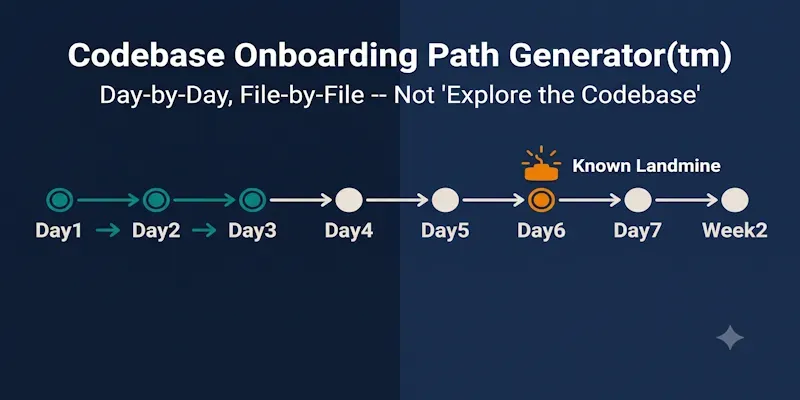
## 5. KNOWN LANDMINES
| Landmine | Location | Why It's Dangerous | How to Navigate |
|----------|----------|---------------------|-------------------|
| Hardcoded secrets | `config/services.php` and possibly `.env` in git history | Live credentials exposed to anyone with repo access, including in git log even after removal | Rotate keys immediately, purge from git history if repo is ever made public/shared |
| Custom billing (no Cashier) | `app/Services/` billing class | No framework safety net; edge cases (failed payments, proration, cancellation) are hand-rolled and untested | Trace every code path before modifying; write tests before touching |
| Core-table migrations | 3 custom migrations | Could conflict with future Laravel upgrades or Spatie package updates if they altered expected schema | Document exactly what changed; treat any framework/package upgrade as high-risk until reviewed |
| No tests, no CI | Entire codebase | Any change could silently break billing or permissions with no automated signal | Prioritize test coverage on billing/permissions before adding new features |
| Manual Forge deploy | Deployment process | Undocumented manual steps could be forgotten, causing partial/broken deploys | Document every step Day 2; automate what you can in Week 2 |
| Scheduled report jobs | `app/Jobs/` | Failures in scheduled jobs are often silent unless explicitly logged/alerted | Add failure logging/alerting as part of Week 2 stabilization |
## 6. MENTOR CHECKPOINTS
Since the founder is gone, there's no internal mentor — these become **self-checkpoints** or, ideally, points to loop in a trusted senior engineer/consultant for a second pair of eyes:
| Day | Checkpoint | What to Review |
|-----|-----------|-----------------|
| 1 | Secrets rotated | Confirm no keys remain exposed anywhere, including git history |
| 3 | Data model + migrations understood | Can you explain the 3 core-table changes to someone else? |
| 5 | Billing logic traced | Walk an outside reviewer through the billing lifecycle — fresh eyes often catch what you've normalized |
| 10 | CI/CD + first tests | Confirm pipeline actually blocks bad merges, not just runs |
| 14 | First feature shipped | Full review of the export feature before wider rollout |
---
A note on sequencing: given the hardcoded secrets, I'd treat Day 1 as non-negotiable even if it feels like it's cutting into "real" onboarding time — an exposed Stripe key on a live 500-user billing system is the kind of risk that outranks everything else on this list.

 Instant access
 Commercial use
 Money‑back
By purchasing this prompt, you agree to our terms of service
2
Favorites
32
Views
CLAUDE-5-SONNET


Personalized Learning Path for Navigating Unfamiliar Codebases
| **Model** | Built and tested for Claude (Opus/Sonnet/fable). On GPT-4o/Gemini, add "Do not omit a required output section even if input is sparse — state 'insufficient data' explicitly instead" as a reinforcement line — Claude follows this constraint more reliably by default. |
| **Cognitive Theory** | F21 (Mental Model) + F23 (Cognitive Load) |
...more
Added over 1 month ago
