

Prompt Details
Model
(claude-5-sonnet)
Token size
5,717
Example input
[CV_TEXT]: Priya Desai Senior Business Analyst Regional Transport Authority | 2020–Present - Led requirements discovery for a passenger-information and ticketing transformation programme. - Facilitated workshops with operations, finance, customer service, cybersecurity, and external suppliers. - Produced business requirements, functional specifications, process maps, user stories, acceptance criteria, and traceability matrices. - Managed requirement changes through formal impact assessment and approval. - Modelled current-state and future-state processes using BPMN. - Supported product owners with backlog refinement and prioritization. - Coordinated user-acceptance testing across six operational teams. - Investigated recurring service failures and identified process and system-control gaps. - Presented options, dependencies, and risks to programme boards and non-technical stakeholders. - Mentored three junior analysts. Previous experience: Business Analyst, Kestrel Insurance Group | 2016–2020 - Supported policy-administration and claims-system improvements. - Gathered requirements in a regulated insurance environment. - Produced data mappings and supported migration validation. Certifications: BCS Business Analysis Practice ITIL Foundation
[JOB_DESCRIPTION]: Lead Business Analyst — Digital Transformation Essential: - Extensive business-analysis experience in complex transformation programmes. - Strong stakeholder facilitation and workshop leadership. - Experience producing business and functional requirements. - Experience with process modelling. - Strong requirements traceability and change-control capability. - Ability to work with technical and non-technical stakeholders. - Experience supporting testing and operational implementation. - Experience mentoring or leading other analysts. Desirable: - BABOK certification or applied BABOK experience. - Public-sector experience. - Agile product-delivery experience. - Data-migration experience. - Familiarity with Azure DevOps Boards.
[SCREENING_PRIORITIES]: Stakeholder facilitation, requirements traceability, structured analysis, and operational implementation matter most. Treat BABOK as desirable rather than mandatory. Do not over-credit generic business-analysis work as formal BABOK application unless the CV provides distinctive evidence.
[PRIOR_GRAPH_JSON]: Leave blank.
Example output
# Section 0 — Screening Verdict
```
FIT SIGNAL: STRONG EVIDENCE
COVERAGE: 10 of 13 job description requirements EVIDENCED · 1 INFERRED · 2 UNKNOWN
DECISION INPUT: All eight essential requirements are directly evidenced with strong, specific quotes;
the open questions sit entirely in the desirable tier — whether "BCS Business Analysis
Practice" constitutes applied BABOK experience, and what tooling she used for the
traceability and backlog work the CV describes but never names.
```
FIT SIGNAL describes the strength of the documentary evidence, not a prediction about job performance.
---
# Section 1 — Requirement Coverage Map
| # | Requirement (as written in JD) | Class | Grade | Confidence | CV anchor |
|---|---|---|---|---|---|
| R1 | Extensive business-analysis experience in complex transformation programmes | — | EVIDENCED | HIGH | "Led requirements discovery for a passenger-information and ticketing transformation programme"; continuous BA-track roles 2016–present |
| R2 | Strong stakeholder facilitation and workshop leadership | C1 | EVIDENCED | HIGH | "Facilitated workshops with operations, finance, customer service, cybersecurity, and external suppliers" |
| R3 | Experience producing business and functional requirements | C2 | EVIDENCED | HIGH | "Produced business requirements, functional specifications, process maps, user stories, acceptance criteria, and traceability matrices" |
| R4 | Experience with process modelling | C2 | EVIDENCED | HIGH | "Modelled current-state and future-state processes using BPMN" |
| R5 | Strong requirements traceability and change-control capability | C2 | EVIDENCED | HIGH | "Managed requirement changes through formal impact assessment and approval" + "traceability matrices" |
| R6 | Ability to work with technical and non-technical stakeholders | C1 | EVIDENCED | HIGH | "Presented options, dependencies, and risks to programme boards and non-technical stakeholders"; workshops included cybersecurity (technical) alongside finance/customer service (non-technical) |
| R7 | Experience supporting testing and operational implementation | C1 | EVIDENCED | MEDIUM | "Coordinated user-acceptance testing across six operational teams" — testing support is direct; "operational implementation" specifically (go-live, handover) is not separately described |
| R8 | Experience mentoring or leading other analysts | C1 | EVIDENCED | HIGH | "Mentored three junior analysts" |
| R11 | Agile product-delivery experience (desirable) | C3 | EVIDENCED | MEDIUM | "Supported product owners with backlog refinement and prioritization" — distinctly Agile vocabulary, though scope is "supported," not owned |
| R12 | Data-migration experience (desirable) | C2 | EVIDENCED | HIGH | "Produced data mappings and supported migration validation" |
| R10 | Public-sector experience (desirable) | C5 | INFERRED | MEDIUM | Anchor: "Regional Transport Authority." Step: regional transport authorities are, in most jurisdictions, public-sector or quasi-public bodies; the CV never states "public sector" directly. |
| R9 | BABOK certification or applied BABOK experience (desirable) | C8 | UNKNOWN | — | CV names "BCS Business Analysis Practice," a different professional body's framework, not BABOK. No BABOK-distinctive terminology (knowledge areas, elicitation-technique naming, etc.) appears — only generic BA deliverables that the screening priorities explicitly flag not to over-credit. |
| R13 | Familiarity with Azure DevOps Boards (desirable) | C4 | UNKNOWN | — | No tool of any kind is named anywhere in the CV |
The job description does split essential from desirable, which this table respects.
---
# Section 2 — Competency Graph by Class
```
C1 — SOCIAL Grade mix: 4 EVIDENCED · 0 INFERRED · 0 UNKNOWN
EVIDENCED
· Multi-functional workshop facilitation (HIGH) — "Facilitated workshops with operations, finance,
customer service, cybersecurity, and external suppliers"
· Board-level, non-technical stakeholder communication (HIGH) — "Presented options, dependencies, and
risks to programme boards and non-technical stakeholders"
· Mentoring (HIGH) — "Mentored three junior analysts"
· UAT coordination across operational teams (MEDIUM) — "Coordinated user-acceptance testing across
six operational teams"
```
```
C2 — TECHNICAL Grade mix: 4 EVIDENCED · 0 INFERRED · 0 UNKNOWN
EVIDENCED
· Requirements & specification authorship (HIGH) — "Produced business requirements, functional
specifications, process maps, user stories, acceptance criteria, and traceability matrices"
· BPMN process modelling (HIGH) — "Modelled current-state and future-state processes using BPMN"
· Formal change control (MEDIUM) — "Managed requirement changes through formal impact assessment
and approval"
· Data mapping / migration validation (MEDIUM) — "Produced data mappings and supported migration
validation" (Kestrel Insurance Group)
```
```
C3 — ANALYTICAL Grade mix: 2 EVIDENCED · 0 INFERRED · 0 UNKNOWN
EVIDENCED
· Root-cause / control-gap investigation (HIGH) — "Investigated recurring service failures and
identified process and system-control gaps"
· Backlog prioritization support (MEDIUM) — "Supported product owners with backlog refinement and
prioritization"
```
```
C4 — PLATFORM PROFICIENCY Grade mix: 0 EVIDENCED · 0 INFERRED · 2 UNKNOWN
UNKNOWN
· Azure DevOps Boards — JD requirement R13, no CV signal
· Any named requirements/traceability/BPMN tooling (e.g. Jira, Confluence, Enterprise Architect,
Visio) — the CV describes the *activities* of traceability and process modelling in detail but
never names the tool used to do them
```
```
C5 — DOMAIN KNOWLEDGE Grade mix: 2 EVIDENCED · 1 INFERRED · 0 UNKNOWN
EVIDENCED
· Public transport sector (HIGH) — role and programme scope at "Regional Transport Authority"
· Regulated insurance sector (HIGH) — "Gathered requirements in a regulated insurance environment"
INFERRED
· Public-sector experience (MEDIUM)
Anchor: "Regional Transport Authority"
Step: regional transport authorities are typically public-sector or quasi-public bodies in most
jurisdictions; the CV does not use the words "public sector" or "government" anywhere, so
this rests on the nature of the named employer rather than a direct statement.
```
```
C6 — MANAGERIAL Grade mix: 0 EVIDENCED · 0 INFERRED · 1 UNKNOWN
UNKNOWN
· Formal people-management, reporting-line, or budget ownership — CV shows mentoring of three junior
analysts but no stated line-management responsibility, headcount, or budget scope
```
```
C7 — ARCHITECTURAL Grade mix: 0 EVIDENCED · 1 INFERRED · 0 UNKNOWN
INFERRED
· Target-operating-model / future-state design involvement (LOW)
Anchor: "Modelled current-state and future-state processes using BPMN"
Step: producing future-state process models within a transformation programme implies some
participation in target-operating-model design, but the CV does not describe ownership of
a specific structural trade-off or design decision — this is a thin signal for a class that
maps loosely onto a BA-track CV in the first place.
```
```
C8 — INDUSTRY FRAMEWORKS & STANDARDS Grade mix: 2 EVIDENCED · 0 INFERRED · 1 UNKNOWN
EVIDENCED
· BCS Business Analysis Practice (HIGH) — named credential: "BCS Business Analysis Practice"
· ITIL Foundation (HIGH) — named credential: "ITIL Foundation"
UNKNOWN
· BABOK — JD requirement R9. No named BABOK credential, and no distinctive BABOK-specific vocabulary
(knowledge-area naming, elicitation-technique terminology) beyond generic BA deliverables like
"traceability matrices" and "impact assessment," which any competent BA framework would produce.
Per the stated screening priority, this is graded UNKNOWN rather than inferred from adjacency.
```
---
# Section 3 — Communication Profile
- **Deliverable-specific vocabulary** (EVIDENCED, HIGH) — "Produced business requirements, functional specifications, process maps, user stories, acceptance criteria, and traceability matrices." Names each artifact type distinctly rather than a generic "did requirements work."
- **Audience-differentiated framing** (EVIDENCED, MEDIUM) — "Presented options, dependencies, and risks to programme boards and non-technical stakeholders." Explicitly distinguishes a non-technical audience, suggesting awareness of audience-appropriate communication.
- **Scope described concretely, but sparingly quantified** (EVIDENCED, MEDIUM) — headcounts and team counts are given ("six operational teams," "three junior analysts") but, unlike a metrics-heavy engineering CV, there are no percentage or time-based outcome figures anywhere in the document.
- **Structured, process-first register** (EVIDENCED, MEDIUM) — bullet structure consistently separates discovery, modelling, change control, and testing into distinct lines rather than blending them, suggesting a habit of structured written analysis.
This suggests strong written precision for formal requirements documentation and board-level reporting. What it cannot tell you: how she facilitates live disagreement in a workshop, or how she handles a stakeholder who pushes back on a requirement — that is what Q1 below is built to surface.
---
# Section 4 — Recruiter Clarification Questions
```
Q1 · Targets: R9 BABOK (UNKNOWN) · Class C8
"Your CV lists BCS Business Analysis Practice rather than a BABOK credential. Have you applied
BABOK specifically in your work — for example structuring elicitation, requirements
management, or solution evaluation around its knowledge areas — or has your practice been
built primarily around a different framework or organisational methodology?"
Resolves to EVIDENCED if: candidate describes concrete, named application of BABOK-specific
technique or structure.
Resolves to still-UNKNOWN if: candidate describes general good BA practice with no distinctive
BABOK framing.
Q2 · Targets: C4 tooling (UNKNOWN, general) · Class C4
"You describe producing traceability matrices and supporting backlog refinement in detail —
what tools did you use to do that day to day? For example Jira, Azure DevOps, Confluence, or
something else."
Resolves to EVIDENCED if: candidate names a specific tool and describes hands-on use,
particularly if it is Azure DevOps Boards (R13).
Resolves to still-UNKNOWN if: candidate cannot recall or the tooling was owned entirely by
another team.
Q3 · Targets: R7 Operational implementation (EVIDENCED, MEDIUM) · Class C1
"Beyond coordinating UAT, what was your role once a change actually went live — were you
involved in go-live cutover, hypercare, or operational handover, or did your involvement end
at test sign-off?"
Resolves to EVIDENCED-HIGH if: candidate describes direct involvement in go-live or handover
activity.
Resolves to still-MEDIUM if: candidate confirms involvement ended at testing.
Q4 · Targets: C6 Formal management (UNKNOWN) · Class C6
"You mention mentoring three junior analysts — was that a formal line-management or team-lead
responsibility, or informal peer mentoring alongside your own analyst workload?"
Resolves to EVIDENCED if: candidate describes a formal reporting line, appraisal responsibility,
or team-lead scope.
Resolves to still-UNKNOWN if: candidate confirms it was informal peer support.
```
Ordered by decision impact: Q1 and Q2 target the two genuine desirable-tier gaps (BABOK, tooling); Q3 sharpens a MEDIUM-confidence essential finding; Q4 is lowest priority since management scope isn't a stated JD requirement.
---
# Section 5 — Machine-Readable Graph
```json
{
"schema": "monna.competency-graph",
"schema_version": "1.2",
"generated": "2026-08-01",
"candidate_ref": "Priya Desai",
"role_ref": "Lead Business Analyst — Digital Transformation",
"jd_fingerprint": "Lead Business Analyst Digital Transformation Extensive business-analysis experience in complex",
"fit_signal": "STRONG EVIDENCE",
"coverage": {
"evidenced": 10,
"inferred": 1,
"unknown": 2,
"total_requirements": 13
},
"requirements": [
{"id": "R1", "text": "Extensive business-analysis experience in complex transformation programmes.", "essential": true, "class": null, "grade": "EVIDENCED", "confidence": "HIGH", "anchor": "Led requirements discovery for a passenger-information and ticketing transformation programme", "inference_step": null},
{"id": "R2", "text": "Strong stakeholder facilitation and workshop leadership.", "essential": true, "class": "C1", "grade": "EVIDENCED", "confidence": "HIGH", "anchor": "Facilitated workshops with operations, finance, customer service, cybersecurity, and external suppliers", "inference_step": null},
{"id": "R3", "text": "Experience producing business and functional requirements.", "essential": true, "class": "C2", "grade": "EVIDENCED", "confidence": "HIGH", "anchor": "Produced business requirements, functional specifications, process maps, user stories, acceptance criteria, and traceability matrices", "inference_step": null},
{"id": "R4", "text": "Experience with process modelling.", "essential": true, "class": "C2", "grade": "EVIDENCED", "confidence": "HIGH", "anchor": "Modelled current-state and future-state processes using BPMN", "inference_step": null},
{"id": "R5", "text": "Strong requirements traceability and change-control capability.", "essential": true, "class": "C2", "grade": "EVIDENCED", "confidence": "HIGH", "anchor": "Managed requirement changes through formal impact assessment and approval; traceability matrices", "inference_step": null},
{"id": "R6", "text": "Ability to work with technical and non-technical stakeholders.", "essential": true, "class": "C1", "grade": "EVIDENCED", "confidence": "HIGH", "anchor": "Presented options, dependencies, and risks to programme boards and non-technical stakeholders; workshops included cybersecurity alongside finance/customer service", "inference_step": null},
{"id": "R7", "text": "Experience supporting testing and operational implementation.", "essential": true, "class": "C1", "grade": "EVIDENCED", "confidence": "MEDIUM", "anchor": "Coordinated user-acceptance testing across six operational teams", "inference_step": null},
{"id": "R8", "text": "Experience mentoring or leading other analysts.", "essential": true, "class": "C1", "grade": "EVIDENCED", "confidence": "HIGH", "anchor": "Mentored three junior analysts", "inference_step": null},
{"id": "R9", "text": "BABOK certification or applied BABOK experience.", "essential": false, "class": "C8", "grade": "UNKNOWN", "confidence": null, "anchor": null, "inference_step": null},
{"id": "R10", "text": "Public-sector experience.", "essential": false, "class": "C5", "grade": "INFERRED", "confidence": "MEDIUM", "anchor": "Regional Transport Authority", "inference_step": "Regional transport authorities are typically public-sector or quasi-public bodies in most jurisdictions; the CV never states 'public sector' directly."},
{"id": "R11", "text": "Agile product-delivery experience.", "essential": false, "class": "C3", "grade": "EVIDENCED", "confidence": "MEDIUM", "anchor": "Supported product owners with backlog refinement and prioritization", "inference_step": null},
{"id": "R12", "text": "Data-migration experience.", "essential": false, "class": "C2", "grade": "EVIDENCED", "confidence": "HIGH", "anchor": "Produced data mappings and supported migration validation", "inference_step": null},
{"id": "R13", "text": "Familiarity with Azure DevOps Boards.", "essential": false, "class": "C4", "grade": "UNKNOWN", "confidence": null, "anchor": null, "inference_step": null}
],
"classes": {
"C1": {
"evidenced": [
{"finding": "Multi-functional workshop facilitation", "confidence": "HIGH", "anchor": "Facilitated workshops with operations, finance, customer service, cybersecurity, and external suppliers"},
{"finding": "Board-level, non-technical stakeholder communication", "confidence": "HIGH", "anchor": "Presented options, dependencies, and risks to programme boards and non-technical stakeholders"},
{"finding": "Mentoring", "confidence": "HIGH", "anchor": "Mentored three junior analysts"},
{"finding": "UAT coordination across operational teams", "confidence": "MEDIUM", "anchor": "Coordinated user-acceptance testing across six operational teams"}
],
"inferred": [],
"unknown": []
},
"C2": {
"evidenced": [
{"finding": "Requirements & specification authorship", "confidence": "HIGH", "anchor": "Produced business requirements, functional specifications, process maps, user stories, acceptance criteria, and traceability matrices"},
{"finding": "BPMN process modelling", "confidence": "HIGH", "anchor": "Modelled current-state and future-state processes using BPMN"},
{"finding": "Formal change control", "confidence": "MEDIUM", "anchor": "Managed requirement changes through formal impact assessment and approval"},
{"finding": "Data mapping / migration validation", "confidence": "MEDIUM", "anchor": "Produced data mappings and supported migration validation"}
],
"inferred": [],
"unknown": []
},
"C3": {
"evidenced": [
{"finding": "Root-cause / control-gap investigation", "confidence": "HIGH", "anchor": "Investigated recurring service failures and identified process and system-control gaps"},
{"finding": "Backlog prioritization support", "confidence": "MEDIUM", "anchor": "Supported product owners with backlog refinement and prioritization"}
],
"inferred": [],
"unknown": []
},
"C4": {
"evidenced": [],
"inferred": [],
"unknown": [
{"finding": "Azure DevOps Boards", "linked_requirement": "R13"},
{"finding": "Any named requirements/traceability/BPMN tooling", "linked_requirement": null}
]
},
"C5": {
"evidenced": [
{"finding": "Public transport sector", "confidence": "HIGH", "anchor": "Regional Transport Authority; passenger-information and ticketing transformation programme"},
{"finding": "Regulated insurance sector", "confidence": "HIGH", "anchor": "Gathered requirements in a regulated insurance environment"}
],
"inferred": [
{"finding": "Public-sector experience", "confidence": "MEDIUM", "anchor": "Regional Transport Authority", "inference_step": "Regional transport authorities are typically public-sector or quasi-public bodies; not stated directly in the CV."}
],
"unknown": []
},
"C6": {
"evidenced": [],
"inferred": [],
"unknown": [
{"finding": "Formal people-management / budget ownership"}
]
},
"C7": {
"evidenced": [],
"inferred": [
{"finding": "Target-operating-model / future-state design involvement", "confidence": "LOW", "anchor": "Modelled current-state and future-state processes using BPMN", "inference_step": "Producing future-state process models implies some participation in target-operating-model design, though no specific structural trade-off or design decision is described."}
],
"unknown": []
},
"C8": {
"evidenced": [
{"finding": "BCS Business Analysis Practice", "confidence": "HIGH", "anchor": "BCS Business Analysis Practice"},
{"finding": "ITIL Foundation", "confidence": "HIGH", "anchor": "ITIL Foundation"}
],
"inferred": [],
"unknown": [
{"finding": "BABOK", "linked_requirement": "R9"}
]
}
},
"communication": [
{"finding": "Deliverable-specific vocabulary", "grade": "EVIDENCED", "confidence": "HIGH", "anchor": "Produced business requirements, functional specifications, process maps, user stories, acceptance criteria, and traceability matrices"},
{"finding": "Audience-differentiated framing", "grade": "EVIDENCED", "confidence": "MEDIUM", "anchor": "Presented options, dependencies, and risks to programme boards and non-technical stakeholders"},
{"finding": "Scope described concretely, sparingly quantified", "grade": "EVIDENCED", "confidence": "MEDIUM", "anchor": "Coordinated user-acceptance testing across six operational teams; Mentored three junior analysts"},
{"finding": "Structured, process-first register", "grade": "EVIDENCED", "confidence": "MEDIUM", "anchor": "Consistent bullet separation of discovery, modelling, change control, and testing activities"}
],
"clarification_questions": [
{"id": "Q1", "targets": "R9", "class": "C8", "question": "Your CV lists BCS Business Analysis Practice rather than a BABOK credential. Have you applied BABOK specifically in your work - for example structuring elicitation, requirements management, or solution evaluation around its knowledge areas - or has your practice been built primarily around a different framework or organisational methodology?", "resolves_evidenced_if": "Candidate describes concrete, named application of BABOK-specific technique or structure.", "priority": 1},
{"id": "Q2", "targets": "R13/C4-general", "class": "C4", "question": "You describe producing traceability matrices and supporting backlog refinement in detail - what tools did you use to do that day to day? For example Jira, Azure DevOps, Confluence, or something else.", "resolves_evidenced_if": "Candidate names a specific tool and describes hands-on use, particularly Azure DevOps Boards.", "priority": 2},
{"id": "Q3", "targets": "R7", "class": "C1", "question": "Beyond coordinating UAT, what was your role once a change actually went live - were you involved in go-live cutover, hypercare, or operational handover, or did your involvement end at test sign-off?", "resolves_evidenced_if": "Candidate describes direct involvement in go-live or handover activity.", "priority": 3},
{"id": "Q4", "targets": "C6-general", "class": "C6", "question": "You mention mentoring three junior analysts - was that a formal line-management or team-lead responsibility, or informal peer mentoring alongside your own analyst workload?", "resolves_evidenced_if": "Candidate describes a formal reporting line, appraisal responsibility, or team-lead scope.", "priority": 4}
],
"excluded_by_policy": ["protected_attributes", "personality_inference", "cultural_fit", "performance_prediction"]
}
```
---
# Section 6 — Scope Statement
> **Scope and limits.** This analysis reads one document against one job description. It describes what the CV evidences, what it implies, and what it does not say. It does not assess the person, predict performance, rank candidates, or produce a hiring decision.
>
> **Human decision required.** Output is decision support for a qualified recruiter or hiring manager. It must not be used as an automated screening filter, an automatic rejection gate, or the sole basis for any employment decision.
>
> **Regulatory note.** Employment screening and candidate evaluation are treated as high-risk uses of AI under the EU AI Act (Annex III, employment and worker management), and are subject to automated-decision and anti-discrimination provisions under other regimes including GDPR Article 22 and, in the United States, EEOC guidance and local automated-employment-decision-tool rules such as NYC Local Law 144. Obligations vary by jurisdiction, by deployment context, and over time. Confirm your own obligations with qualified counsel before deploying this in a hiring process.
> `Verify-Item — regulatory position as understood 2026-07; confirm current text and applicability for your jurisdiction`
>
> **Bias.** Extraction from a CV inherits the biases of CV writing itself. Candidates differ systematically in how confidently they describe their own work. A THIN EVIDENCE verdict is a statement about a document, not about a person.

$29.99-25%
$22.49
SPECIAL PROMOTION — Offer ends 12 October

 Instant access
 Commercial use
 Money‑back
By purchasing this prompt, you agree to our terms of service
1
Favorites
114
Views
CLAUDE-5-SONNET


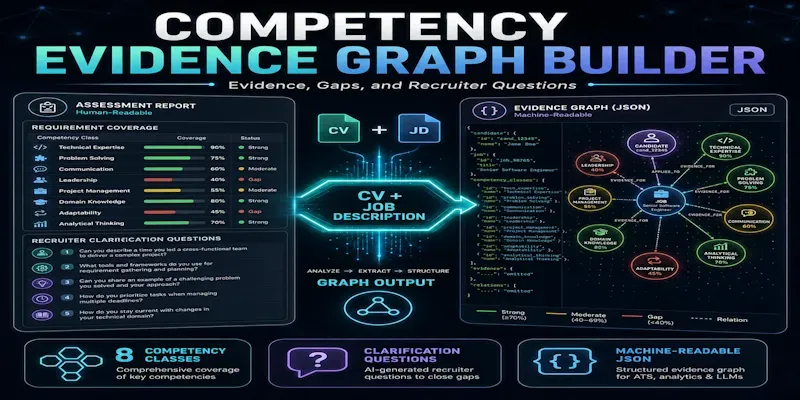
A prompt that reads one CV against one job description and builds an evidence-anchored competency graph across eight skill classes — including named industry frameworks (ITIL, BABOK, PMP, TOGAF, ISO) and a calibrated cross-platform inference protocol for transferable tooling skill. Every finding tied to a quoted passage, graded EVIDENCED / INFERRED / UNKNOWN, with recruiter clarification questions drafted for every gap. Outputs a human-readable report plus a machine-readable JSON graph.
...more
Added over 1 month ago
