

Prompt Details
Model
Chat - (gpt-5.5)
Token size
2,518
Example input
[MY_COMPANY]: WildPack -- premium fresh-cooked dog food, personalized to each dog's age, breed, and activity level. Series A, $24M raised, 24,000 active subscribers, 42 employees, 22% MoM growth.
[INDUSTRY]: DTC premium pet food, US market
[COMPETITORS]: The Farmer's Dog, Ollie, Nom Nom, Spot & Tango
[TARGET_CUSTOMER]: Dog owners aged 28-55 with $100K+ household income who currently feed kibble but are anxious about ingredient quality and willing to spend $4-$6 per day on dog food
[CURRENT_POSITIONING]: WildPack positions as "the personalized fresh dog food that knows your dog -- not a generic recipe." Includes a vet nutritionist consultation with every plan.
Example output
1. Market Landscape
Porter's Five Forces
Threat of New Entrants: Medium -- Formulation, outsourced cooking, DTC tooling, and paid-social acquisition make launching a fresh dog food brand feasible, but cold-chain logistics, recurring subscription operations, food-safety compliance, and CAC payback discipline create real operating barriers. The biggest risk is not another 10-person startup; it is a scaled pet-food incumbent using its retail distribution, manufacturing, and balance sheet to enter fresh, as General Mills is doing with Blue Buffalo fresh products.
Bargaining Power of Buyers: High -- Dog owners can compare The Farmer's Dog, Ollie, Nom Nom, Spot & Tango, Freshpet, Blue Buffalo, premium kibble, and toppers with low switching friction, and subscription cancellation is a constant retention risk. Price sensitivity is meaningful because fresh food commonly costs several dollars per day versus far less for kibble, so even affluent households often use partial plans, toppers, or fresh-dry hybrids to manage cost.
Bargaining Power of Suppliers: Medium -- Proteins, vegetables, packaging, dry ice, refrigerated/frozen freight, and co-manufacturing capacity can pressure margins, especially for emerging brands without owned kitchens or large procurement volumes. Supplier power is partly mitigated by the availability of multiple ingredient sources, but fresh food has less tolerance for fulfillment failures than shelf-stable kibble because late, thawed, or damaged shipments directly threaten churn.
Threat of Substitutes: High -- The customer problem is not “fresh food delivery” narrowly; it is anxiety about kibble quality, digestion, coat health, weight, and longevity. Substitutes include premium kibble, refrigerated Freshpet-style retail food, air-dried/freeze-dried food, raw, toppers, supplements, veterinary diets, and home-cooked recipes with nutrient mixes.
Industry Rivalry: High -- The four named competitors all compete on the same core promise: human-grade or real ingredients, personalization, vet/nutritionist formulation, pre-portioned convenience, and subscription delivery. Rivalry is intensified by heavy introductory discounts, overlapping paid search terms, influencer reviews, retailer partnerships, and large incumbents entering fresh pet food.
Market Maturity: Growth stage moving toward early consolidation -- U.S. pet spending remains large and resilient, with APPA reporting $158B in 2025 pet industry expenditures and 95M U.S. pet-owning households, while fresh pet food is still growing faster than traditional pet food. The category has already attracted strategic acquisitions, including Mars/Royal Canin acquiring Nom Nom and Agrolimen acquiring Ollie, indicating that fresh dog food is no longer experimental but has not yet fully consolidated around one model.
Trends Reshaping Competition
Fresh is being pulled from pure DTC into omnichannel. Nom Nom sells through PetSmart, Chewy, Amazon, and direct subscription, while Blue Buffalo’s fresh launch signals that mass premium pet brands will bring fresh options to retail shelves. The implication for WildPack is that DTC personalization alone will not be enough if consumers can trial fresh food during ordinary pet-store shopping.
The category is splitting between full fresh and affordability bridges. Spot & Tango’s UnKibble starts around $1/day while its fresh plans start around $2/day, directly targeting owners who want less-processed food without freezer dependency or full fresh cost. WildPack’s $4-$6/day target is credible for premium fresh, but it needs an explicit bridge product or partial-plan architecture to avoid losing kibble converters before trial.
Nutrition credibility is moving from “vet-formulated” claims to measurable health proof. The Farmer’s Dog highlights on-staff board-certified nutritionists and a Cornell long-term feeding study, while Ollie is positioning around data-driven Health Check-Ins and AI-powered health screenings. WildPack’s included vet nutritionist consultation is a useful wedge, but without longitudinal outcomes, it remains a high-touch service claim rather than a proven health platform.
Regulatory / Macro Factors
Pet food label modernization and ingredient review changes will raise compliance expectations. AAFCO’s Pet Food Label Modernization project updates model label requirements, and FDA ended its long-standing MOU with AAFCO in 2024, changing how ingredient-definition review processes are handled. WildPack should treat transparent labels and substantiated health claims as a board-level risk area, not a packaging project.
Premium pet spending is resilient but not immune to household pressure. APPA reports growth in total U.S. pet expenditures, but inflation contributes meaningfully to projected growth, and high fresh-food prices create vulnerability to down-trading, toppers, and fresh-dry hybrids. WildPack should assume its target customer is willing to pay more, not willing to ignore value.
2. Competitor Profiles
The Farmer's Dog
Size & Funding: Late-stage category leader by brand visibility and funding. Public secondary-market and private-company sources estimate hundreds of employees and roughly $100M+ to $268M total funding depending on data provider, with a 2021 valuation around $1.47B and later secondary estimates higher; these figures should be treated as directional, not audited.
Estimated Revenue: Likely several hundred million dollars and potentially higher, but exact revenue is private and conflicting. A 2026 market commentary claims $1B+ revenue, while other private-market sources provide valuation and funding but not audited revenue, so a defensible board-grade range is “high hundreds of millions, unverified.”
Founded / HQ: Founded in 2014; headquartered in New York, New York.
Product Offering: The Farmer’s Dog sells gently cooked, human-grade fresh dog food delivered in pre-portioned packs. Plans use dog-specific information such as breed, age, activity level, ideal weight, and other factors to determine portions. The company emphasizes on-staff board-certified veterinary nutritionists and highlights research around healthy aging. It also offers a DIY nutrient mix, giving it a lower-cost/home-cooking adjacency that many fresh-only competitors lack.
Pricing: Fresh plans publicly start at $2.48/day; exact plans vary by dog size, calorie needs, and recipe.
Target Segments: Affluent dog owners, health-anxious kibble switchers, older-dog owners concerned about longevity, and owners willing to pay for pre-portioned convenience.
GTM Approach: Heavy DTC quiz/subscription funnel, national performance marketing, emotionally resonant brand storytelling, customer reviews, vet/nutrition credibility, and phone-assisted conversion. The DIY nutrient mix also creates an education-led funnel for owners considering home-cooked diets.
Top Strengths:
Strongest brand salience among DTC fresh dog food players.
Deep nutrition credibility through on-staff board-certified nutritionists and published study messaging.
Scale advantage in acquisition learning, logistics operations, customer support, and retention systems.
Top Weaknesses:
Premium pricing creates churn risk and pushes some households toward toppers or cheaper fresh-dry alternatives.
Frozen/refrigerated delivery still creates operational pain points such as late deliveries, thaw risk, and storage burden.
Personalization is strong at the plan/portion level but can feel algorithmic rather than consultative.
Recent Strategic Moves:
Elevated veterinary credibility through public-facing content on board-certified nutritionists and healthy aging research.
Expanded adjacent education/products through DIY nutrient mix, giving cost-conscious or home-cooking owners a non-subscription entry path.
Customer Sentiment: Praise -- ingredient quality, visible dog enjoyment/health improvements, clear portions, and helpful service; Complaints -- high cost, delivery issues, billing/subscription friction, and occasional digestive upset or picky-dog rejection.
Ollie
Size & Funding: Scaled fresh dog food brand recently acquired by Agrolimen; Reuters reported the transaction in February 2026 at a valuation above $600M, with Ollie maintaining U.S. leadership and operations. Earlier private-company sources estimate roughly $46M-$118M raised depending on provider, so the acquisition is the clearest proof point of scale and strategic value.
Estimated Revenue: Private and not audited publicly; directional third-party estimates suggest tens of millions to low hundreds of millions. Given a reported $600M+ acquisition valuation, Ollie is materially larger and more mature than WildPack, even if exact revenue is undisclosed.
Founded / HQ: Founded in 2016 by Gabby Slome, Alex Douzet, and Randy Jimenez; headquartered in New York City.
Product Offering: Ollie sells fresh, human-grade dog food through a personalized subscription model. It positions around real science, data, and “Health Check-Ins” designed to keep plans aligned with dog wellbeing over time. Its plans include fresh, baked, mixed, and half-fresh options, giving it more price architecture than a single full-fresh plan. The Agrolimen acquisition may give Ollie access to broader pet-food know-how, capital, and operating discipline while preserving its U.S. brand.
Pricing: Fresh dog food starts under $4/day for small dogs and averages around $8/day for fully customized meal plans; reviewers report larger dogs can reach $8-$9/day or more.
Target Segments: Dog-obsessed urban/suburban owners, premium wellness buyers, customers who want fresh but need plan flexibility, and owners who value digital check-ins.
GTM Approach: DTC subscription funnel, aggressive first-box discounts, health/wellness content, Trustpilot reputation management, retail backup availability through pet retailers, and now strategic-owner support from Agrolimen.
Top Strengths:
Acquisition by Agrolimen validates strategic value and provides potential capital and infrastructure support.
Strong customer review footprint, with Trustpilot showing 4.6/5 across roughly 11K reviews and high negative-review response rate.
Broader plan architecture than pure fresh-only models, supporting value segmentation.
Top Weaknesses:
Still expensive relative to kibble and many hybrid alternatives.
Less clearly differentiated than The Farmer’s Dog on brand fame or Nom Nom on science/Mars ecosystem.
Integration with a strategic owner could slow experimentation if governance becomes more conservative.
Recent Strategic Moves:
Acquired by Agrolimen in February 2026 at a reported $600M+ valuation.
Advanced health-tech positioning through Health Check-Ins and AI-powered health screenings.
Customer Sentiment: Praise -- strong service recovery, dogs liking the food, perceived health improvements, and convenient plan management; Complaints -- high monthly cost, shipment issues, freezer/storage burden, and some dogs not tolerating or preferring recipes.
Nom Nom
Size & Funding: Strategic-owned fresh pet food platform acquired by Mars/Royal Canin in January 2022, reportedly around $1B according to third-party market sources. The Mars Petcare ecosystem is a major scale advantage because Mars has global pet nutrition, veterinary care, diagnostics, wearable health, DNA testing, and pet welfare assets.
Estimated Revenue: Private after acquisition; third-party estimates vary from roughly $29M to $150M, making exact revenue unreliable. The more important competitive fact is ecosystem-backed maturity rather than stand-alone revenue precision.
Founded / HQ: Founded in 2015; based in Nashville, Tennessee.
Product Offering: Nom Nom sells fresh, gently cooked dog food formulated and scientifically evaluated by board-certified veterinary nutritionists and PhD animal nutritionists. It uses a proprietary nutrient blend and prepares food in its own Nashville kitchen. Nom Nom also offers probiotics and sells through both subscription and retail channels such as Chewy, PetSmart, and Amazon, giving it more omnichannel reach than DTC-only brands. Its Mars/Royal Canin ownership gives it access to scientific credibility and potential channel leverage that WildPack cannot match today.
Pricing: Product pages show individual recipes starting as low as $9.99 through retail channels; subscription pricing varies by dog and plan.
Target Segments: Science-oriented premium owners, digestive-health-focused owners, omnichannel buyers who want fresh food without committing only to DTC, and customers who trust larger pet nutrition institutions.
GTM Approach: Subscription personalization, retail freezer presence, Chewy/PetSmart/Amazon distribution, nutrition education, probiotics, celebrity/influencer campaigns, and parent-company credibility.
Top Strengths:
Strongest strategic ecosystem due to Mars/Royal Canin ownership.
Science-forward formulation with veterinary nutritionists, PhD animal nutritionists, and proprietary nutrient blend.
Omnichannel distribution lowers trial friction versus frozen DTC-only delivery.
Top Weaknesses:
Ownership by a large incumbent may weaken insurgent-brand authenticity for some DTC customers.
Retail presence can make personalization feel less premium or less tailored than pure subscription brands.
Public pricing is less transparent before quiz/subscription, adding friction for comparison shoppers.
Recent Strategic Moves:
Expanded retail availability and product formats, including recipes sold through Chewy and PetSmart.
Continued digestive-health adjacency through probiotics sold via subscription and marketplaces.
Customer Sentiment: Praise -- natural ingredients, customer service, delivery schedule management, digestive tolerance, and ease of feeding; Complaints -- premium price, recipe preference issues, concerns about carbohydrate/synthetic nutrient content from some critics, and occasional retail availability friction.
Spot & Tango
Size & Funding: Scaled challenger with reported funding around $39M-$59M depending on source; CB Insights reports $58.95M raised and a $38.5M Series B in March 2022. A 2026 Inc. profile reports the company reached $100M in annual revenue after record 2025 sales, making it materially larger than WildPack but less institutionally scaled than The Farmer’s Dog or Mars-backed Nom Nom.
Estimated Revenue: Approximately $100M annual revenue reported by Inc.; third-party estimates also place revenue in the $50M-$100M range.
Founded / HQ: Founded in 2018; U.S.-based with owned manufacturing in Allentown, Pennsylvania.
Product Offering: Spot & Tango offers both fresh dog food and UnKibble, a shelf-stable “Fresh Dry” product positioned as a less-processed alternative to traditional kibble. Plans are personalized through a quiz and delivered on recurring schedules. The company emphasizes human-grade ingredients, vet-developed nutrition, supplements, dental chews, snacks, and owned U.S. manufacturing. Its strongest product distinction is not fresh food alone but the bridge between kibble affordability/convenience and fresh-food ingredient expectations.
Pricing: UnKibble starts at about $1/day; fresh plans start at about $2/day; plans include free shipping and vary by dog needs and recipe.
Target Segments: Cost-conscious premium buyers, fresh-curious kibble users, owners without freezer capacity, multi-dog households, and convenience-oriented subscribers.
GTM Approach: DTC subscription quiz, strong price-led conversion through UnKibble, content comparisons versus kibble/raw/fresh alternatives, performance marketing, and a 2026 larger brand push after reaching reported $100M revenue.
Top Strengths:
Best affordability/convenience bridge through UnKibble.
Owned facility improves control over production, quality, and supply reliability.
Broader product ladder across fresh, Fresh Dry, snacks, supplements, and dental chews.
Top Weaknesses:
Fresh-food credibility may be diluted by the UnKibble hero product for consumers seeking fully fresh diets.
Some reviewers describe fresh recipes as limited and relatively expensive versus alternatives.
Customer-service and shipping complaints appear in review ecosystems, which matter because subscription food has low tolerance for fulfillment misses.
Recent Strategic Moves:
Launched its largest-ever marketing push after record 2025 sales and reported $100M annual revenue.
Invested in owned Allentown, Pennsylvania manufacturing, strengthening supply-chain control and tariff resilience.
Customer Sentiment: Praise -- affordability versus full fresh, convenience of shelf-stable UnKibble, real ingredients, and dog palatability; Complaints -- expensive versus kibble, limited fresh recipes, slower shipping/customer service issues, and picky-dog rejection.
3. SWOT Matrices
WildPack -- SWOT
Strengths:
22% MoM growth and 24,000 active subscribers show real early demand, not just a concept claim.
Vet nutritionist consultation with every plan creates a sharper personalization promise than most quiz-only competitors.
$24M Series A gives enough capital to test a wedge strategy, build retention infrastructure, and improve operational reliability.
Weaknesses:
At 42 employees, WildPack lacks the scale, logistics depth, and brand memory of The Farmer’s Dog, Ollie, Nom Nom, and Spot & Tango.
“Personalized fresh dog food that knows your dog” is directionally differentiated but not yet proven through measurable health outcomes, published studies, or retention evidence.
The $4-$6/day willingness-to-pay band is narrower than actual full-fresh costs for many medium and large dogs, creating risk that the target customer loves the promise but churns after price discovery.
Opportunities:
Own the “nutrition consult” wedge for anxious kibble switchers who need reassurance, not just a subscription quiz.
Build a partial-plan/topping product for the first 90 days of conversion to reduce sticker shock and freezer burden.
Publish anonymized dog-health progress benchmarks from consultations, reorders, weight outcomes, stool/skin/energy check-ins, and veterinary feedback.
Threats:
The Farmer’s Dog can outspend WildPack on education, content, paid media, and retention offers.
Ollie and Nom Nom now have strategic-owner support, which can improve capital access, procurement, retail relationships, and scientific credibility.
Spot & Tango can intercept price-sensitive kibble switchers with UnKibble before they ever consider full fresh.
The Farmer's Dog -- SWOT
Strengths:
Category-leading brand awareness and late-stage scale.
Strong nutrition credibility through on-staff board-certified nutritionists and healthy-aging research messaging.
Mature DTC engine with broad content, reviews, customer service, and acquisition learning.
Weaknesses:
Premium price and frozen logistics create recurring churn triggers.
Personalization is largely algorithmic and portion-based; high-touch consultation is not the core proposition.
Large-brand visibility increases exposure to complaints about billing, delivery, or customer experience.
Opportunities:
Extend into health monitoring, diagnostics, and personalized longevity plans.
Expand DIY nutrient mix into a lower-cost acquisition and retention tool.
Use scale to pursue vet partnerships and clinical proof faster than smaller players.
Threats:
Incumbents such as Blue Buffalo and Freshpet can normalize fresh in retail and reduce DTC differentiation.
Spot & Tango-style fresh-dry products can undercut full-fresh cost and storage burden.
Any food-safety or delivery failure would receive outsized attention because of brand scale.
Ollie -- SWOT
Strengths:
Agrolimen acquisition validates strategic value and gives potential operating support.
Strong customer review base and service response proof.
Flexible plan formats allow better price segmentation than full-fresh-only brands.
Weaknesses:
Less distinctive brand idea than The Farmer’s Dog or Spot & Tango’s UnKibble.
Premium fresh plans remain expensive for medium and large dogs.
Strategic ownership could create integration complexity or slower brand moves.
Opportunities:
Convert Health Check-Ins into a differentiated ongoing wellness platform.
Use Agrolimen’s pet-food portfolio to build supply-chain and formulation advantages.
Expand hybrid fresh/baked plans for value-conscious customers.
Threats:
The Farmer’s Dog can dominate emotional fresh-food storytelling.
Nom Nom/Mars can win science-oriented buyers through deeper institutional credibility.
WildPack could selectively out-position Ollie on human consultation if it proves outcomes.
Nom Nom -- SWOT
Strengths:
Mars/Royal Canin ownership provides unmatched ecosystem credibility and potential distribution leverage.
Science-forward formulation with board-certified veterinary nutritionists, PhD animal nutritionists, and proprietary nutrient blend.
Omnichannel availability through DTC, Chewy, PetSmart, Amazon, and retail freezers.
Weaknesses:
Strategic-owner brand may feel less founder-led or insurgent than DTC-native alternatives.
Retail SKUs can dilute the perception of deep personalization.
Subscription pricing transparency is less immediate than simple per-day claims.
Opportunities:
Bundle fresh food with probiotics, diagnostics, vet care, and Royal Canin science assets.
Use retail to lower trial friction and then migrate repeat buyers into subscription.
Own digestive health and microbiome positioning more credibly than smaller brands.
Threats:
DTC-native competitors can move faster in brand experimentation and customer experience.
Retail fresh competition from Blue Buffalo and Freshpet can crowd freezer space.
Premium owners may prefer brands perceived as less “big pet food.”
Spot & Tango -- SWOT
Strengths:
UnKibble provides a clear affordability and convenience wedge against full fresh.
Owned manufacturing improves supply-chain control.
Reported $100M revenue indicates meaningful scale and category traction.
Weaknesses:
Fresh-food differentiation is less pure because the brand’s standout product is shelf-stable Fresh Dry.
Fresh recipe variety appears narrower than some competitors.
Shipping and customer-service complaints can damage trust in a replenishment category.
Opportunities:
Position UnKibble as the default upgrade path from premium kibble.
Build bundles that combine Fresh Dry, fresh toppers, dental chews, and supplements.
Use owned facility to defend price stability and quality control.
Threats:
Blue Buffalo, Freshpet, and premium kibble brands can launch similar “less processed” bridges.
The Farmer’s Dog and Ollie can attack UnKibble as not truly fresh.
Ingredient or manufacturing issues would directly undermine the owned-facility advantage.
4. Positioning Map
Axes: X = Personalization depth / Y = Affordability-convenience -- These axes matter because the WildPack target is moving from kibble to fresh and must be convinced on both relevance to their dog and practical feasibility. In this market, “fresh” is becoming table stakes; the winning battleground is whether the brand feels specifically right for the dog without becoming too expensive, inconvenient, or operationally risky.
Placements
WildPack: High personalization / Medium affordability-convenience -- The vet nutritionist consultation supports a credible high-personalization position, but scale and operational proof are still emerging.
The Farmer's Dog: Medium-high personalization / Medium affordability-convenience -- Strong portion personalization and nutrition credibility, but the model remains full-fresh DTC with premium pricing and freezer logistics.
Ollie: Medium-high personalization / Medium affordability-convenience -- Health Check-Ins and plan flexibility support ongoing personalization, but differentiation is less sharp than WildPack’s consultative claim.
Nom Nom: Medium personalization / Medium-high affordability-convenience -- Science and omnichannel access are strong, but retail formats weaken the perception of one-to-one personalization.
Spot & Tango: Medium personalization / High affordability-convenience -- UnKibble gives the clearest affordability and storage advantage, though personalization is more quiz/portion-led than consultative.
White Space
High personalization / High affordability-convenience: A consultative fresh-entry plan that combines nutritionist guidance, partial fresh/toppers, and clear $4-$6/day budgeting for kibble switchers.
High science proof / High owner simplicity: A plan that converts nutrition consultations into simple monthly health signals, not complex medical language or generic “human-grade” messaging.
Alternative Axes: Use “Clinical proof of health outcomes” vs. “Trial friction” to separate brands with substantiated results from brands relying mainly on ingredient and personalization claims.
5. Feature / Capability Matrix
Label Key: Proven scale = externally supported by scale, ownership, revenue, distribution, or large review base; Built / scaling = available and supported by some adoption but not market-leading; Claimed / unproven = product or marketing claim exists but lacks scale/outcome proof; Limited = partial or weaker evidence; Absent = not evident from public information.
Capability WildPack The Farmer's Dog Ollie Nom Nom Spot & Tango
Fresh-cooked meal subscription Built / scaling Proven scale Proven scale Proven scale Proven scale
Dog-specific portion personalization Built / scaling Proven scale Proven scale Proven scale Built / scaling
Human vet/nutrition consultation Claimed / unproven Limited Limited Limited Limited
Board-certified / PhD nutrition formulation Claimed / unproven Proven scale Built / scaling Proven scale Built / scaling
Health tracking / ongoing check-ins Limited Limited Built / scaling Limited Limited
Omnichannel retail availability Absent Limited Built / scaling Proven scale Limited
Affordable bridge product below full fresh Absent Built / scaling Built / scaling Built / scaling Proven scale
Owned / controlled manufacturing proof Unknown Limited Limited Proven scale Proven scale
My Advantages
WildPack’s clearest defensible advantage is the included vet nutritionist consultation, because it addresses the exact anxiety of kibble feeders who distrust ingredient quality but need reassurance before changing diet.
WildPack’s 22% MoM growth and 24,000 active subscribers prove early product-market pull; this is enough to justify a focused wedge, but not enough to claim category leadership.
My Gaps
WildPack lacks the proven scale signals that competitors have: The Farmer’s Dog’s brand/funding maturity, Ollie’s strategic acquisition, Nom Nom’s Mars ecosystem, and Spot & Tango’s reported $100M revenue.
WildPack does not yet appear to have a credible affordability bridge, retail trial path, or published outcomes engine, all of which are becoming more important as fresh food moves beyond early adopters.
6. Pricing & Value Analysis
Player Entry Mid-Tier Top-Tier
WildPack Target $4/day fresh entry or partial plan Target $4-$6/day personalized fresh plan Vet-consult-led plan; likely above $6/day for larger dogs unless subsidized
The Farmer's Dog Starts at $2.48/day Full fresh plan varies by dog size and calories Higher for medium/large dogs; premium full-fresh subscription
Ollie Under $4/day for small dogs Around $8/day average for fully customized fresh plans Larger-dog full fresh can reach roughly $8-$9/day or higher
Nom Nom Retail recipes starting as low as $9.99 Subscription varies by dog and recipe Full personalized subscription plus add-ons such as probiotics
Spot & Tango UnKibble about $1/day Fresh plans from about $2/day Fresh plus snacks, supplements, dental chews, and larger-dog calorie needs
Pricing Strategy Classification
WildPack: Premium consultative personalization; currently exposed to sticker shock without a proven bridge.
The Farmer's Dog: Premium full-fresh subscription with credibility-led justification.
Ollie: Premium fresh with flexible plan architecture and heavy introductory discounting.
Nom Nom: Science-backed premium omnichannel model with subscription and retail entry points.
Spot & Tango: Good-better-best ladder anchored by affordable Fresh Dry and upgraded fresh.
Value-for-Money Assessment: WildPack’s value proposition is strongest for owners who are not just buying food, but buying confidence: “Tell me what my dog specifically needs and help me transition safely.” That is a real willingness-to-pay driver, but the board-level concern is that competitors already offer fresh, personalization, and nutritionist formulation at far greater scale; WildPack must prove that its consultation improves conversion, retention, health confidence, or outcomes. Without that proof, the consultation risks becoming a costly service feature rather than a value moat.
Pricing Opportunities
Launch a “Fresh Start” partial-plan at $2-$3/day that combines 25%-50% fresh with current kibble and a nutritionist transition plan.
Guarantee a monthly cost ceiling during onboarding for the $4-$6/day target customer, then upsell only after measurable dog-specific improvements.
Bundle the vet consultation into a paid premium tier after the first plan refresh, preserving the onboarding hook while protecting gross margin.
7. Opportunity Gaps (Ranked by Impact)
Gap 1 -- Consultative Kibble-to-Fresh Transition
Who it serves: Affluent kibble feeders anxious about ingredient quality but worried about digestive upset, cost, and whether fresh is “too much.”
Why it exists: Competitors rely heavily on quizzes, content, and broad nutritionist claims; few make a human consult the centerpiece of the transition experience.
Feasibility: High
Impact: High
Gap 2 -- Budget-Controlled Fresh Personalization
Who it serves: Owners willing to spend $4-$6/day but unwilling to discover after the quiz that their actual plan is much higher.
Why it exists: Fresh pricing varies by dog size and calories, and the industry often hides exact pricing behind quizzes, creating distrust among comparison shoppers.
Feasibility: High
Impact: High
Gap 3 -- Proof-Based Dog Health Progress
Who it serves: Owners who want evidence that fresh food is improving weight, stool quality, coat, energy, or digestion.
Why it exists: Most brands claim health benefits, but few provide consumer-friendly, dog-specific progress reporting based on structured check-ins and nutritionist review.
Feasibility: Medium
Impact: High
Gap 4 -- Breed-and-Life-Stage Micro-Programs
Who it serves: Owners of breeds with common concerns: allergies, weight gain, sensitive stomachs, senior mobility, picky eating, or puppy growth.
Why it exists: Competitors personalize portions but often market broad fresh-food benefits; breed/life-stage programs can make WildPack feel more specific to the dog.
Feasibility: Medium
Impact: Medium
Gap 5 -- Vet-Clinic and Trainer Referral Loop
Who it serves: Owners who trust local experts more than DTC ads when changing food.
Why it exists: Large competitors have brand reach, but local vets, trainers, and groomers can still influence anxious premium owners at the moment of concern.
Feasibility: Medium
Impact: Medium
8. Threat Assessment
Most Dangerous Competitor: The Farmer's Dog -- It is the most dangerous because it combines brand salience, nutritionist credibility, scale, content depth, and a mature DTC subscription engine. Its scale means it can copy WildPack’s most resonant messaging faster than WildPack can copy its brand trust, logistics depth, or media efficiency. Even if WildPack’s consultation is more personal, The Farmer’s Dog can blunt that advantage by adding optional nutritionist sessions, AI-assisted consults, or stronger vet-reviewed onboarding.
Emerging Entrants to Watch
Blue Buffalo Fresh / General Mills: Blue Buffalo’s fresh launch brings trusted premium pet-food brand equity and retail shelf access to a category previously led by DTC insurgents.
Chewy-native or retailer-backed fresh products: Retailers with autoship data, freezer infrastructure, and existing pet-parent relationships can attack subscription convenience without paying the same CAC as DTC brands.
Substitutes That Could Disrupt
Fresh-dry, air-dried, and freeze-dried products: These products promise better ingredients than kibble without frozen shipping, freezer space, or daily thawing.
Premium kibble plus toppers/supplements: This can satisfy ingredient anxiety at a lower cost, especially for medium/large dogs and multi-dog households.
Likely Competitive Responses If We Gain Traction
The Farmer’s Dog and Ollie will add or promote nutritionist access, transition coaching, and health check-ins to neutralize WildPack’s consultation wedge.
Spot & Tango will target WildPack’s price band with UnKibble/fresh hybrid bundles and messaging around convenience without freezer dependence.
Nom Nom will lean into Mars-backed science, probiotics, and retail availability to frame WildPack as less proven and less accessible.
9. Strategic Recommendations
Differentiation Strategy
WildPack should not try to outspend The Farmer’s Dog, out-science Mars/Nom Nom, or out-convenience Spot & Tango. The winning wedge is to become the most trusted transition brand for premium kibble feeders who are ready to upgrade but need dog-specific reassurance before changing food. Position the vet nutritionist consultation not as a perk, but as the operating system: assessment, transition plan, first 30-day adjustment, and proof-based progress review. Make the promise narrower and more defensible: “Fresh food personalized with a real nutrition review for your dog’s first 30 days.” Then use data from 24,000 subscribers to prove that consultative onboarding improves trial conversion, reduces early churn, and increases owner confidence.
Quick Wins -- Next 90 Days
Reframe the homepage around “from kibble anxiety to a nutritionist-guided fresh plan” rather than generic fresh personalization.
Launch a $4-$6/day calculator before the quiz so price-qualified customers understand plan options before investing time.
Create a 30-day transition protocol with stool, appetite, energy, and weight check-ins reviewed by the nutrition team.
Segment acquisition campaigns by dog concern: sensitive stomach, picky eater, overweight, senior dog, puppy, allergies/coat.
Publish anonymized first-party benchmarks from current subscribers, such as average plan adjustments, top reasons for consults, and 30-day reported improvements.
Build a win-back offer for price-sensitive churn: partial fresh, topper plan, or reduced-frequency consult-supported plan.
Medium-Term Plays -- 6-12 Months
Develop a partial fresh/topping tier specifically for premium kibble switchers who are not ready for full fresh.
Partner with 100-250 boutique vets, trainers, groomers, and dog daycares in high-income ZIP codes with referral codes and nutrition consult vouchers.
Operationalize a customer health data loop that turns check-ins into plan changes, retention triggers, and outcome reporting.
Test one shelf-stable or refrigerator-light bridge product to reduce freezer and travel friction without abandoning fresh positioning.
Codify breed/life-stage playbooks that sales, lifecycle, and nutrition teams can use consistently.
Long-Term Moats to Build
Accumulate proprietary longitudinal dog nutrition data from consultations, check-ins, plan changes, and reorder behavior.
Prove consultative onboarding economics by showing lower first-60-day churn and higher LTV versus quiz-only cohorts.
Create a certified nutrition advisor network that competitors cannot instantly replicate without changing their cost structure.
Secure manufacturing and cold-chain redundancy before scaling paid media aggressively.
Build trusted expert distribution through vets and pet-care professionals rather than relying only on auction-based CAC.
What NOT to Do
Do not claim category leadership; the evidence supports “emerging high-growth challenger,” not leadership.
Do not attack incumbents as generic or low-quality; their nutrition credentials, funding, and scale are real.
Do not chase retail freezer distribution prematurely before proving repeat purchase, margin, and operational reliability in DTC.
Do not make the consultation unlimited or overly manual without tiering; it could become a margin drag.
Do not compete primarily on discounts; Spot & Tango and scaled incumbents can pressure price more safely.
10. Monitoring Dashboard
Monthly Signals to Track
WildPack CAC, first-order conversion, and CAC payback by dog concern segment.
Trial-to-second-box conversion and first-60-day churn by full fresh versus partial fresh.
Consultation completion rate, plan-adjustment rate, and post-consult NPS.
Competitor first-box discounts, offer depth, and landing-page messaging changes.
Share of search for “fresh dog food,” “Farmer’s Dog alternative,” “Ollie vs,” “fresh dog food cost,” and breed/condition terms.
Review sentiment by brand: delivery complaints, price complaints, digestive issues, customer-service praise.
Retail expansion signals from Nom Nom, Freshpet, Blue Buffalo, Chewy, PetSmart, and Petco.
Protein, packaging, dry ice, and cold-chain cost trends affecting gross margin.
Sources & Tools for Ongoing CI
Track competitor websites, quizzes, emails, SMS flows, and first-box offers using a monthly mystery-shop panel.
Monitor Trustpilot, BBB, Reddit, ConsumerAffairs, Amazon, Chewy, PetSmart, and app/social reviews for sentiment shifts.
Use Similarweb, SEMrush, Google Trends, Meta Ad Library, and TikTok Creative Center to track acquisition channels and creative angles.
Review APPA, Petfood Industry, GlobalPETS, FDA, AAFCO, and Freshpet SEC filings for market, regulatory, and incumbent signals.
Set alerts for funding, M&A, retail launches, recalls, new facilities, and executive hires across fresh pet food.
Trigger Events Forcing Strategy Reassessment
The Farmer’s Dog or Ollie launches included nutritionist consultations or a structured 30-day health program.
Spot & Tango pushes UnKibble aggressively into the $4-$6/day premium kibble-converter segment.
Blue Buffalo, Chewy, Petco, or Freshpet launches a personalized fresh subscription with retail pickup.
WildPack’s first-60-day churn exceeds target despite consultations, indicating the wedge is not translating into retention.
Regulatory changes require major label, claim, ingredient, or substantiation updates before the current roadmap can absorb them.


Or get it with Select10 Select prompts/mo — under $2 each
Learn more
 Instant access
 Commercial use
 Money‑back
By purchasing this prompt, you agree to our terms of service
1
Favorites
12
Views
GPT-5.5


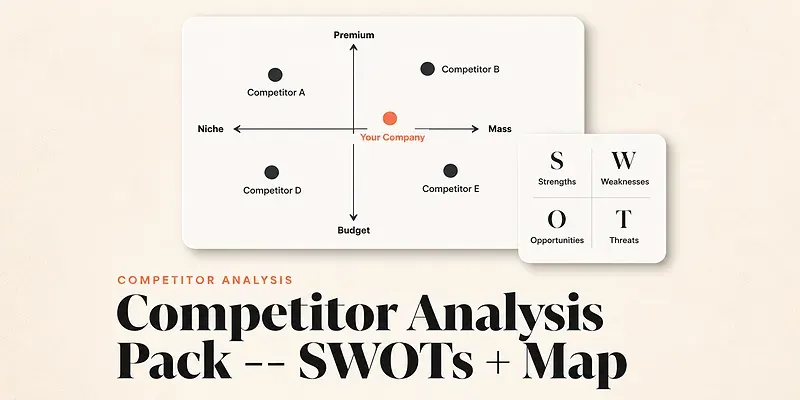
Generates a complete competitor analysis deliverable in one pass: industry context with growth-stage and 3 trends, SWOT for each named competitor (and your company) with severity ratings, a 2-axis positioning map with quadrant analysis, capability comparison matrix across 8 dimensions, opportunity gaps with prioritization, recommended positioning shift, and a 30/60/90 day action plan. Every assessment is justified.
...more
Added over 1 month ago
