


Prompt Details
Model
(claude-5-sonnet)
Token size
1,541
Example input
[SCHEMA_PACK]: Table: billing_invoices Columns: - invoice_id (bigint, PK) — "Unique invoice identifier, system-generated." - account_id (bigint, FK → accounts.account_id) — "The billing account this invoice belongs to." - amount_due_cents (int) — "Total amount owed, in US cents, before any partial payment is applied." - status (varchar) — "Current invoice status. Enum: DRAFT, SENT, PAID, OVERDUE, VOID." - issued_date (date) — no comment supplied - paid_date (date, nullable) — no comment supplied
[SAMPLE_DATA_PACK]: 5 rows shown. status values across the 5 rows: SENT, PAID, PAID, OVERDUE, DRAFT. paid_date is null for the DRAFT, SENT, and OVERDUE rows; populated for both PAID rows. issued_date is always populated and always earlier than or equal to paid_date when paid_date exists.
Example output
SOURCE INVENTORY
6 columns supplied, 4 with explicit definitions (invoice_id, account_id,
amount_due_cents, status), 2 with no comment (issued_date, paid_date).
5 sample rows supplied, sufficient to observe a pattern between status
and paid_date.
COLUMN REGISTER
C001 invoice_id — bigint, PK
Meaning: unique invoice identifier, system-generated.
Evidence class: DOCUMENTED. Basis: exact supplied comment.
C002 account_id — bigint, FK → accounts.account_id
Meaning: the billing account this invoice belongs to.
Evidence class: DOCUMENTED. Basis: exact supplied comment.
C003 amount_due_cents — int
Meaning: total amount owed, in US cents, before any partial payment applied.
Evidence class: DOCUMENTED. Basis: exact supplied comment.
Note: the phrase "before any partial payment" implies partial payments
are possible and tracked somewhere — no column here shows a paid amount
or remaining balance. That's a gap worth flagging, not resolving.
C004 status — varchar
Meaning: current invoice lifecycle status.
Evidence class: DOCUMENTED (the field's role) with a PATTERN-INFERRED
addendum. The comment documents the enum (DRAFT, SENT, PAID, OVERDUE,
VOID) — that part is DOCUMENTED. What is PATTERN-INFERRED / HIGH: the
apparent lifecycle order (DRAFT → SENT → then either PAID or OVERDUE →
possibly VOID), which is not stated anywhere but is consistent with the
sample and typical invoicing logic. Basis: sample-value co-occurrence
with paid_date nullability.
Known-value-set: DRAFT, SENT, PAID, OVERDUE, VOID — DOCUMENTED (from
comment), not just observed, so this one is stated exhaustively by the
source, not merely OBSERVED SET.
C005 issued_date — date
Meaning: the date the invoice was issued/sent to the account.
Evidence class: PATTERN-INFERRED / HIGH. Basis: column name plus the
observed pattern that issued_date is always ≤ paid_date across the
sample where both exist — consistent with "issued" meaning the invoice
was generated/sent before payment. No comment confirms this.
C006 paid_date — date, nullable
Meaning: the date the invoice was paid in full, if it has been.
Evidence class: PATTERN-INFERRED / HIGH. Basis: null exactly on the
three non-PAID-status rows in the sample (DRAFT, SENT, OVERDUE) and
populated on both PAID rows — a clean, consistent correlation across
the full sample, which is why this sits at HIGH rather than MEDIUM
despite having no comment at all.
TABLE-LEVEL PURPOSE SUMMARY
PATTERN-INFERRED / HIGH: this table tracks individual billing invoices
per account through a lifecycle from creation to payment or voiding,
with amount owed tracked but not amount actually paid (see the C003
gap note). The "HIGH" tier applies to the general purpose statement;
individual column meanings vary in evidence class as detailed above —
this summary does not average those into one blended confidence.
RELATIONSHIP AND GRAIN RECONSTRUCTION
Grain: PATTERN-INFERRED / HIGH — one row per invoice, consistent with
invoice_id as a declared primary key and no sample evidence of
duplicate invoice_ids.
Relationship: account_id → accounts.account_id is a declared foreign
key, implying one account can have many invoices (one-to-many,
account-to-invoice direction). This cardinality direction is
PATTERN-INFERRED / HIGH from the FK declaration and ordinary invoicing
domain logic — not independently confirmed by anything in the accounts
table itself, which wasn't supplied.
QUALITY GATE
G1 PASS — no inferred label was upgraded to DOCUMENTED; C004's enum
value list is genuinely DOCUMENTED from the comment, the lifecycle
ORDER is separately and correctly kept at PATTERN-INFERRED.
G2 PASS — every column has exactly one evidence class assigned
(C004's dual DOCUMENTED+PATTERN-INFERRED note is scoped to two
different facts about the same column, not an ambiguous single label).
G3 PASS — all PATTERN-INFERRED rows name a concrete basis (sample
correlation, FK declaration + domain logic).
G4 PASS — no embedded instructions found in this input; nothing to flag.
G5 PASS — table purpose summary tagged PATTERN-INFERRED / HIGH, not
overstated as documented fact.
OVERALL: DICTIONARY DRAFT — REVIEW REQUIRED
TOP QUESTIONS
1. Is there a separate table or column tracking partial payments
against amount_due_cents, or does this table only ever reflect
full-invoice status?
2. Does issued_date represent generation, sending, or something else —
the comment gap here is the single highest-value confirmation
available given how confidently the rest of the table reads.
3. Can an invoice move from OVERDUE back to SENT (e.g., a payment plan
restart), or is the lifecycle strictly one-directional as assumed?
4. Is paid_date ever populated for a partial payment, or only on full
payment (ties directly back to question 1)?
5. What triggers VOID — none of the 5 sample rows show it, so its
relationship to the other four statuses is entirely undemonstrated
here.


 Instant access
 Commercial use
 Money‑back
By purchasing this prompt, you agree to our terms of service
1
Favorites
20
Views
CLAUDE-5-SONNET


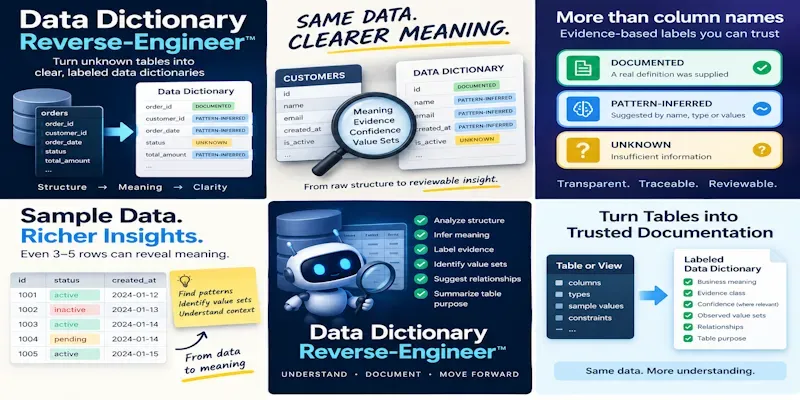
Turn an undocumented table or view into a labeled data dictionary — with
every label tagged by how it was actually derived, not presented as if
all labels carry equal certainty. This does not connect to a live
database, run profiling queries, or verify anything against real data.
It works from whatever metadata and sample values you supply.
**Refused inference, by design:** this tool will not upgrade a
plausible-sounding column-name guess into a stated fact.
...more
Added over 1 month ago
