

Prompt Details
Model
(claude-5-sonnet)
Token size
3,642
Example input
[DECISION_DESCRIPTION]: Change the default weekly project-status email template from a three-section format to a two-section format for one internal operations team.
[DECISION_CONTEXT]: The template is stored in the team's collaboration platform and can be changed by the operations manager at any time. No external customers receive it. No automated systems depend on its structure. If the change creates confusion, the previous template can be restored immediately. The team plans to test it for two weekly cycles before deciding whether to keep it.
Example output
DECISION: Change weekly project-status email template from three-section to two-section format (operations team)
├─ FRAMING
│ ├─ Specific decision under review: Modify the internal weekly project-status email template used by one operations team, reducing it from three sections to two
│ ├─ Decision authority: Operations manager (stated to be able to change the template at any time)
│ ├─ Decision horizon: Not stated — team plans a two-cycle test before deciding whether to keep it, implying near-term implementation with a review point roughly two weeks out
│ └─ Bundled decisions detected: None. This is a single, narrow formatting change — not a bundle of distinct decisions with different reversibility profiles
│
├─ REVERSAL MECHANICS (Phase 3 — all PROVISIONAL)
│ ├─ Technical Reversal Cost: 0 — DOCUMENTED — The previous template can be restored immediately; the change lives entirely in the team's collaboration platform with no external dependency
│ ├─ Time-to-Detect: 1 — INFERRED — A weekly-cadence artifact surfaces problems (confusion, missing info) within one cycle at most; team is explicitly watching for this over two cycles, so detection is fast and intentional
│ ├─ Cascading Dependency: 0 — DOCUMENTED — No automated systems depend on the template's structure, and no external customers receive it, so nothing downstream is being built on top of the two-section format before reversal would be possible
│ └─ Exit Cost Asymmetry: 0 — DOCUMENTED — Reverting is stated to be immediate and costs essentially the same as the original change; no cancellation penalties, sunk costs, or reputational exposure identified
│
├─ REVERSIBILITY RATING
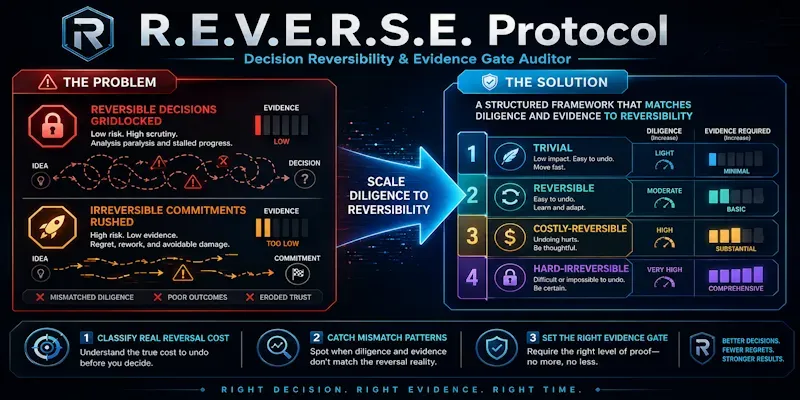
│ ├─ Rating: TRIVIAL
│ ├─ Driving components: All four components independently support this — none show any friction, cost, or delay in reversal
│ ├─ Rationale: Every reversal-mechanics factor is at the floor: reversal is instant and same-party, detection happens within a single weekly cycle, nothing external or automated is built on the format, and there is no asymmetry between the cost of making the change and the cost of undoing it. There is no plausible pathway by which this becomes effectively costly to reverse — it's an internal document format with a stated built-in undo
│ └─ Mismatch pattern: NONE IDENTIFIED — the decision was not described as "reversible" in a way that overstates ease relative to hidden mechanics; stated ease and actual mechanics agree
│
├─ REQUIRED EVIDENCE GATE (Phase 5)
│ ├─ Tier requirements: Standard diligence — name one person accountable; proceed on reasonable judgment; no formal evidence-gate required
│ ├─ Currently satisfied: Accountable owner is named (operations manager); the team has already defined an informal review point (two weekly cycles) and a success/failure lens (whether to keep it) — exceeding the TRIVIAL bar
│ └─ Currently missing: Nothing required at this tier
│
├─ STABILITY CHECK (Phase 6)
│ └─ Result: STABLE — Reassessing the four components in reverse order (Exit Cost Asymmetry → Cascading Dependency → Time-to-Detect → Technical Reversal Cost) produces the same TRIVIAL rating. No component was scored ambiguously enough to anchor the outcome; all four independently floor out regardless of evaluation order
│
├─ ADVERSARIAL REVIEW (Phase 7)
│ └─ Defect found and corrected: None found. Checked specifically for a hidden Cascading Dependency (e.g., other reports or dashboards parsing the three-section structure) — evidence explicitly states no automated systems depend on it, so this concern doesn't survive contact with the supplied evidence. No urgency was stated in the input, so no urgency-driven downgrade risk existed to guard against
│
├─ EVIDENCE GAPS
│ └─ One soft gap: whether any team member manually copies data out of the email into another format (a *manual* downstream dependency wouldn't show up under "automated systems depend on it"). This is UNKNOWN and not treated as zero risk, but given the trivial stakes of an internal status email, it does not move the rating — it would only matter if it turned out unfavorable, and even then the cost is a minor communication hiccup, not a structural reversal problem
│
└─ METHOD NOTE
└─ Ratings are provisional decision aids scaled to available evidence, not predictions of outcome. This tool classifies how carefully to move — it does not replace the accountable human decision on whether to move at all. Contract, legal, or regulatory claims in supplied evidence remain unverified unless independently confirmed.
VERDICT: PASS

 Instant access
 Commercial use
 Money‑back
By purchasing this prompt, you agree to our terms of service
1
Favorites
62
Views
CLAUDE-5-SONNET


Most organizations get this backwards: trivial decisions get gridlocked in committee, and genuinely irreversible ones get made on the same evidence bar as a coin flip. This tool fixes the mismatch. It rates a decision's real reversibility across four mechanics — technical reversal cost, time-to-detect a bad call, cascading downstream dependency, and exit-cost asymmetry — then maps that rating directly to exactly how much evidence and review the decision needs before anyone commits.
...more
Added 3 weeks ago
