

Prompt Details
Model
Chat - (gpt-5.6)
Token size
1,868
Example input
[DELEGATION SOURCE MATERIAL]: Delegate weekly client status emails to an account coordinator. The coordinator may collect updates, prepare the email, answer routine progress questions, and schedule follow-ups. The supplied tone guide must be followed. Any change involving scope, price, contractual commitments, or delivery dates requires account-owner approval. Emails must be stored in the CRM. Escalate complaints or threatened cancellation to the account owner immediately.
Example output
# Delegation Authority Brief
## 1. Delegation Decision
**DELEGATE WITH CONTROLS**
The weekly client-status email workflow is suitable for delegation because the delegate may collect updates, draft communications, answer routine progress questions, and schedule follow-ups. However, scope, price, contractual commitments, delivery-date changes, complaints, and threatened cancellations remain controlled or escalated actions.
The source does not identify the owner, delegate, client accounts, weekly deadline, CRM system, acceptance authority, or approval-response process.
---
## 2. Delegation Object
* **Responsibility being transferred:** Preparation and coordination of weekly client status emails
* **Observable outcome:** A client status email is prepared using collected updates, follows the supplied tone guide, is sent or otherwise processed through the authorized workflow, and is stored in the CRM
* **Due date or cadence:** Weekly
* **Included scope:**
* Collecting updates
* Preparing the email
* Answering routine progress questions
* Scheduling follow-ups
* Storing emails in the CRM
* **Explicit non-goals:**
* Approving or communicating scope changes independently
* Approving or communicating price changes independently
* Making contractual commitments
* Changing delivery dates independently
* Independently resolving complaints or threatened cancellations
* **Owner:** NOT PROVIDED
* **Delegate:** Account coordinator
* **Affected stakeholders:** Clients and account owner; additional stakeholders NOT PROVIDED
---
## 3. Accountability Boundary
* **Execution owner:** Account coordinator
* **Outcome accountable party:** Account owner
* **Approval authorities:** Account owner for scope, price, contractual commitments, and delivery-date changes
* **Evidence custodian:** NOT PROVIDED; CRM storage is required
* **Stakeholders to inform:** Relevant clients and account owner when escalation or approval is required
Delegating execution does not transfer contractual, financial, client-relationship, managerial, or risk accountability from the account owner.
---
## 4. Authority Matrix
| Action or decision | Authority level | Evidence state | Supported limit | Supporting source | Required record | Who must be involved |
| ------------------------------------------------------------------------- | ---------------------- | ---------------- | ------------------------------------------------------------------------------------------------ | -------------------------------------------------------------- | ------------------------------------------ | -------------------------------------------------- |
| Collect updates for the weekly email | MAY DECIDE | CONFIRMED | Limited to obtaining information needed for the status email | Coordinator may collect updates | Collected updates or source references | Account coordinator; update providers as needed |
| Prepare the weekly client status email | MAY DECIDE | CONFIRMED | Must follow the supplied tone guide | Coordinator may prepare the email; tone guide must be followed | Email draft and final email | Account coordinator |
| Answer routine progress questions | MAY DECIDE | CONFIRMED | Limited to routine progress information that does not change scope, price, commitments, or dates | Coordinator may answer routine progress questions | Email or CRM communication record | Account coordinator and client |
| Schedule follow-ups | MAY DECIDE | CONFIRMED | Follow-up commitments must not change delivery dates or create contractual obligations | Coordinator may schedule follow-ups | Calendar, email, or CRM record | Account coordinator and relevant participants |
| Interpret unclear or incomplete project updates before communicating them | MUST CONSULT | PROPOSED CONTROL | Consultation advised where factual accuracy cannot be verified | No consultation procedure supplied | Clarification record | Relevant update owner; account owner when material |
| Change project scope | MUST GET APPROVAL | CONFIRMED | Explicit account-owner approval required | Any scope change requires account-owner approval | Written approval and related email record | Account owner |
| Change price or communicate a revised price | MUST GET APPROVAL | CONFIRMED | Explicit account-owner approval required | Any price change requires account-owner approval | Written approval and related email record | Account owner |
| Make a contractual commitment | MUST GET APPROVAL | CONFIRMED | Explicit account-owner approval required before commitment | Contractual commitments require approval | Written approval and commitment record | Account owner |
| Change or promise a delivery date | MUST GET APPROVAL | CONFIRMED | Explicit account-owner approval required | Delivery-date changes require approval | Written approval and updated communication | Account owner |
| Respond substantively to a complaint without escalation | PROHIBITED OR RESERVED | CONFIRMED | Complaint must be escalated immediately | Escalate complaints immediately | Complaint and escalation record | Account owner |
| Respond substantively to threatened cancellation without escalation | PROHIBITED OR RESERVED | CONFIRMED | Threatened cancellation must be escalated immediately | Escalate threatened cancellation immediately | Cancellation threat and escalation record | Account owner |
| Grant discounts, credits, refunds, remedies, or concessions | PROHIBITED OR RESERVED | NOT PROVIDED | No authority supplied | NOT PROVIDED | NOT PROVIDED | Account owner or other authority NOT PROVIDED |
| Change CRM records beyond storing the communication | PROHIBITED OR RESERVED | NOT PROVIDED | No broader CRM authority supplied | NOT PROVIDED | NOT PROVIDED | NOT PROVIDED |
---
## 5. Decision Envelope
The account coordinator:
* **May act independently when** collecting updates, drafting weekly status emails, answering routine progress questions, scheduling follow-ups, following the supplied tone guide, and storing communications in the CRM.
* **Must pause and consult when** information is unclear, contradictory, unsupported, or could materially misrepresent project status.
* **Must obtain approval before** communicating or accepting changes to scope, price, contractual commitments, or delivery dates.
* **Must not** independently handle complaints, threatened cancellations, contractual negotiations, price concessions, or unapproved delivery commitments.
* **Authority expires or returns to the owner when** a complaint, threatened cancellation, controlled change, material conflict, or matter outside routine progress communication arises.
Financial, legal, customer, reputational, and delivery boundaries are limited to those expressly stated above. Additional limits are NOT PROVIDED.
---
## 6. Operating Path
1. **Receive or request current account updates** — IMPLIED BY SUPPLIED FACTS
2. **Verify that updates are complete and suitable for client communication** — PROPOSED CONTROL
3. **Access the supplied tone guide** — DOCUMENTED
4. **Access the required client, project, and CRM records** — IMPLIED BY SUPPLIED FACTS
5. **Prepare the weekly status email** — DOCUMENTED
6. **Separate routine updates from matters involving scope, price, contractual commitments, delivery dates, complaints, or cancellation risk** — DOCUMENTED
7. **Obtain account-owner approval for restricted changes** — DOCUMENTED
8. **Escalate complaints or threatened cancellation immediately** — DOCUMENTED
9. **Send or release the email through the authorized process** — NOT PROVIDED
10. **Store the email in the CRM** — DOCUMENTED
11. **Schedule required follow-ups** — DOCUMENTED
12. **Confirm acceptance of the weekly communication cycle** — NOT PROVIDED
---
## 7. Approval Gates
### Gate 1: Scope Change
* **Trigger:** Proposed or requested change to project scope
* **Action paused:** Communication or commitment concerning the change
* **Required approver:** Account owner
* **Evidence submitted:** Requested change, source, impact, and proposed wording
* **Approval form:** NOT PROVIDED; written approval is a PROPOSED CONTROL
* **Maximum waiting period:** NOT PROVIDED
* **Safe fallback:** NOT PROVIDED
### Gate 2: Price Change
* **Trigger:** Proposed, requested, or implied price change
* **Action paused:** Communication, quotation, concession, or commitment
* **Required approver:** Account owner
* **Evidence submitted:** Requested price change, reason, source, and proposed wording
* **Approval form:** NOT PROVIDED; written approval is a PROPOSED CONTROL
* **Maximum waiting period:** NOT PROVIDED
* **Safe fallback:** NOT PROVIDED
### Gate 3: Contractual Commitment
* **Trigger:** Language or request that could bind the organization contractually
* **Action paused:** Sending or accepting the commitment
* **Required approver:** Account owner
* **Evidence submitted:** Proposed commitment, context, and draft response
* **Approval form:** NOT PROVIDED; written approval is a PROPOSED CONTROL
* **Maximum waiting period:** NOT PROVIDED
* **Safe fallback:** NOT PROVIDED
### Gate 4: Delivery-Date Change
* **Trigger:** Request, proposal, or statement changing a delivery date
* **Action paused:** Communicating or promising the revised date
* **Required approver:** Account owner
* **Evidence submitted:** Existing date, proposed date, reason, and impact
* **Approval form:** NOT PROVIDED; written approval is a PROPOSED CONTROL
* **Maximum waiting period:** NOT PROVIDED
* **Safe fallback:** NOT PROVIDED
---
## 8. Escalation Rules
**IF** a client raises a complaint,
**THEN** acknowledge receipt without promising a remedy and pause the substantive response,
**ESCALATE TO** account owner,
**BRING** the client message, account history, relevant status facts, and any prior commitments,
**WHILE WAITING** NOT PROVIDED.
**IF** a client threatens cancellation,
**THEN** stop routine handling and escalate immediately,
**ESCALATE TO** account owner,
**BRING** the exact client wording, account status, unresolved issues, and prior commitments,
**WHILE WAITING** NOT PROVIDED.
**IF** a requested response changes scope, price, contractual commitments, or delivery dates,
**THEN** pause the affected communication,
**ESCALATE TO** account owner,
**BRING** the request, source, impact, and proposed response,
**WHILE WAITING** continue unrelated routine preparation where safe.
**IF** supplied updates conflict,
**THEN** do not select or merge a version without verification,
**ESCALATE TO** named role NOT PROVIDED,
**BRING** the conflicting statements and their sources,
**WHILE WAITING** exclude the disputed claim or hold the affected email section.
**IF** required CRM access fails,
**THEN** preserve the email and prevent loss of the record,
**ESCALATE TO** named role NOT PROVIDED,
**BRING** the access error, timestamp, and affected client record,
**WHILE WAITING** permitted temporary storage method NOT PROVIDED.
**IF** the weekly email cannot be prepared on time,
**THEN** identify the missing input and expected impact,
**ESCALATE TO** account owner,
**BRING** the draft, missing information, responsible source, and timing impact,
**WHILE WAITING** NOT PROVIDED.
**IF** evidence shows the expected client update is no longer accurate or achievable,
**THEN** stop the affected statement from being sent,
**ESCALATE TO** account owner,
**BRING** the supporting evidence, affected commitment, and proposed correction,
**WHILE WAITING** continue only verified portions of the workflow.
---
## 9. Checkpoints Without Micromanagement
### Checkpoint 1: Exception Review Before Release
* **Trigger or timing:** Before sending an email containing a scope, price, contractual, delivery-date, complaint, or cancellation matter
* **Evidence reviewed:** Draft email, source request, impact, and required approval
* **Owner’s review question:** “Does this wording create or communicate a restricted commitment?”
* **Decisions retained by the delegate:** Routine update collection, drafting, formatting, tone-guide compliance, and follow-up scheduling
* **Conditions that activate intervention:** Restricted change, complaint, threatened cancellation, unsupported commitment, or material factual conflict
### Checkpoint 2: Evidence Review After Weekly Cycle
* **Trigger or timing:** After the weekly email cycle
* **Evidence reviewed:** Final email, CRM record, approvals, escalations, and scheduled follow-ups
* **Owner’s review question:** “Were all controlled matters approved or escalated, and is the client record complete?”
* **Decisions retained by the delegate:** Routine communication choices within the documented authority boundary
* **Conditions that activate intervention:** Missing CRM record, missing approval, unresolved escalation, repeated factual correction, or unauthorized commitment
---
## 10. Completion and Acceptance Evidence
Completion requires observable evidence that:
* Current status information was collected from identifiable sources.
* The email content reflects the collected updates.
* The supplied tone guide was followed.
* Routine progress questions were answered without exceeding delegated authority.
* Any scope, price, contractual, or delivery-date change has an account-owner approval record.
* Complaints and threatened cancellations have an immediate escalation record.
* The final email and related communication are stored in the CRM.
* Required follow-ups are recorded in the appropriate calendar, CRM, or communication system.
* The email was sent, approved for sending, or accepted through the authorized process; the exact acceptance method is NOT PROVIDED.
---
## 11. Assumptions, Conflicts, and Open Questions
### Supplied Facts
* The work concerns weekly client status emails.
* The delegate role is account coordinator.
* The coordinator may collect updates.
* The coordinator may prepare the email.
* The coordinator may answer routine progress questions.
* The coordinator may schedule follow-ups.
* The supplied tone guide must be followed.
* Scope changes require account-owner approval.
* Price changes require account-owner approval.
* Contractual commitments require account-owner approval.
* Delivery-date changes require account-owner approval.
* Emails must be stored in the CRM.
* Complaints must be escalated to the account owner immediately.
* Threatened cancellations must be escalated to the account owner immediately.
### Conflicts
* No conflicts were supplied.
### Decision-Critical Questions
1. Who is the named account owner?
2. Who is the named account coordinator?
3. Which clients or accounts are included?
4. What day and time must each weekly email be sent?
5. May the coordinator send the email independently, or only prepare it for owner review?
6. Where is the authoritative tone guide stored, and which version applies?
7. What sources are authoritative for project status?
8. What qualifies as a “routine progress question”?
9. What form of account-owner approval is valid?
10. What should the coordinator tell a client while a complaint or cancellation threat is awaiting owner action?
11. What is the fallback when the account owner is unavailable?
12. Which CRM must be used, and what fields or attachments are required?
13. Who verifies that the CRM record is complete?
14. What evidence constitutes final acceptance of the weekly email cycle?
15. What security or confidentiality rules apply to client information?
---
## 12. Residual Risk
| Risk | Why it remains | Current control | Who accepts the remaining risk | Status |
| ------------------------------------------------- | --------------------------------------------------------------- | ----------------------------------------------------------------- | ------------------------------ | ---------------- |
| Inaccurate client update | Authoritative sources and verification rules are not defined | Collect updates before drafting | NOT PROVIDED | NOT PROVIDED |
| Coordinator unintentionally creates a commitment | The boundary of “routine” communication is not fully defined | Approval required for scope, price, contracts, and delivery dates | Account owner | CONFIRMED |
| Slow complaint response damages the relationship | No waiting-period or interim-response rule is supplied | Immediate escalation | Account owner | CONFIRMED |
| Email is sent without required review | Sending authority is not defined | Clarify release authority before operation | NOT PROVIDED | PROPOSED CONTROL |
| CRM evidence is incomplete | Required CRM fields and ownership are not defined | Store emails in the CRM | NOT PROVIDED | NOT PROVIDED |
| Tone-guide noncompliance | Guide location, version, and validation method are not supplied | Tone guide is mandatory | NOT PROVIDED | CONFIRMED |
| Approval delay causes missed weekly communication | Approver availability and fallback are not defined | Escalation to account owner | NOT PROVIDED | NOT PROVIDED |
| Sensitive information is exposed | Confidentiality and access rules are not supplied | No control supplied | NOT PROVIDED | NOT PROVIDED |
---
## 13. Confirmation Note
The account coordinator will execute the weekly client status email workflow by collecting updates, preparing the email under the supplied tone guide, answering routine progress questions, scheduling follow-ups, and storing communications in the CRM.
The account coordinator owns execution. The account owner remains accountable for the client outcome and retains authority over scope, price, contractual commitments, delivery-date changes, complaints, and threatened cancellations.
The coordinator may independently handle routine progress communication within these limits. Account-owner approval is required before communicating or accepting any scope, price, contractual, or delivery-date change.
The first checkpoint occurs before releasing any email containing a restricted matter. Complaints and threatened cancellations must be escalated immediately to the account owner.
Completion evidence includes the final email, CRM record, required approval records, escalation records, and documented follow-ups.
Please reply with ACCEPTED or list the exact correction required. This brief records the working delegation agreement but does not independently grant legal, financial, security, HR, procurement, or regulatory authority.

 Instant access
 Commercial use
 Money‑back
By purchasing this prompt, you agree to our terms of service
2
Favorites
22
Views
GPT-5.6


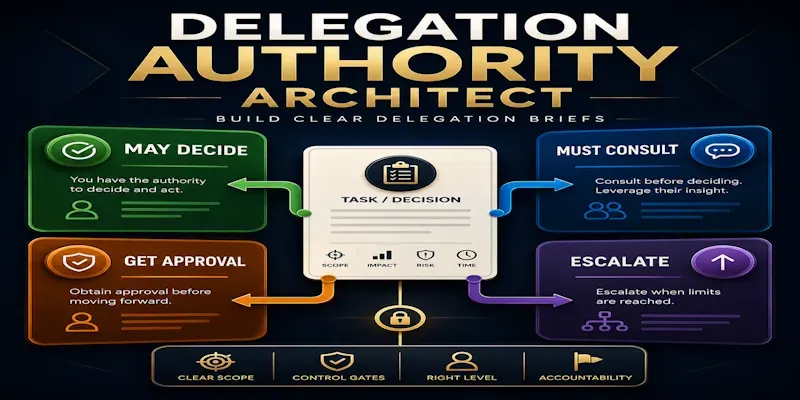
Turn any responsibility into a decision-ready delegation agreement with clear authority levels, approval gates, escalation triggers, checkpoints, accountability boundaries, and objective completion evidence.
Use it to prevent micromanagement, unauthorized decisions, hidden assumptions, unclear ownership, and “I thought you approved it” failures.
...more
Added 3 weeks ago
