

Prompt Details
Model
Chat - (gpt-5.6)
Token size
2,913
Example input
[BUSINESS_MODEL_AND_CURRENT_STATE]: A private-label skincare brand operating through Shopify and generating approximately $80,000 in monthly sales. The company has a five-person team and uses a third-party fulfillment provider. Inventory planning, supplier communication, customer-support triage, campaign reporting, and weekly management reporting still require substantial manual work. Shopify apps, spreadsheets, email, and several disconnected reporting tools are currently used.
[TARGET_MARKET_PRODUCTS_AND_GOALS]: US and UK consumers buying skincare products, bundles, and recurring-purchase items. The company wants to grow toward $250,000 in monthly sales while reducing operational workload, preventing stockouts, improving customer retention, consolidating reporting, and avoiding unnecessary software complexity.
Example output
# E-Commerce Automation Operating Blueprint
**Assessment:** The constraint is not storefront capacity. It is **operational fragmentation**: Shopify, spreadsheets, email, 3PL data, and reporting tools require humans to reconcile information and initiate routine actions. Scaling that operating model from ~$80K to $250K/month would likely increase coordination burden faster than headcount efficiency. **Highly likely.**
The correct architecture is therefore **not “add more AI.”** It is: consolidate authoritative data → automate deterministic workflows → introduce AI for classification/analysis → keep inventory commitments, financial decisions, supplier commitments, and consequential customer exceptions human-controlled. This follows the supplied operating principle of reliable automation, explicit systems of record, exception handling, and controlled AI authority.
## 1. Business System Diagnosis
| Area | Current State | Bottleneck | Automation Potential | AI Potential | Control |
| ----------- | ------------------------------ | ---------------------------------------- | -------------------------- | ------------------------- | ------------------------------ |
| Commerce | Shopify | Not identified as bottleneck | High integration potential | Low | Automated |
| Inventory | Manual planning + spreadsheets | Forecast/reorder workload | High | High for risk forecasting | Human approval |
| Suppliers | Email/manual | Follow-up and status tracking | High | Medium | Human approval for commitments |
| Fulfillment | 3PL | Cross-system visibility | High | Low | Exception-based |
| Support | Manual triage | Staff classify/reroute cases | High | High | Escalate sensitive cases |
| Marketing | Disconnected reporting | Analysis/reconciliation | High | High | Human campaign decisions |
| Retention | Recurring products/bundles | Opportunity not systematically exploited | High | Medium–High | Controlled automation |
| Reporting | Multiple tools + spreadsheets | Manual consolidation | Very high | High for summaries | Human review |
| Finance | Insufficient detail supplied | Unknown | Medium | Low–Medium | Human-controlled |
**Confirmed:** manual work exists in inventory planning, supplier communication, support triage, campaign reporting and weekly management reporting.
**Highly likely:** reporting fragmentation is producing duplicated work and inconsistent operational visibility.
**Plausible:** stockout prevention and replenishment automation could become one of the highest-value interventions, but SKU velocity, lead times, safety stock, MOQ and inventory-history data are required before that can be validated.
The prompt explicitly requires diagnosis before automation and prohibits inventing missing operational facts.
---
# 2. Automation Opportunity Map
### AUTOMATE
**Management reporting**
Shopify + marketing + support + 3PL data → scheduled ingestion → standardized metrics → dashboard/data layer → weekly management report.
Human involvement should move from **assembling the report** to **reviewing exceptions and making decisions**.
**Supplier status workflow**
Reorder/PO status → scheduled supplier follow-up → structured status capture → inventory record update → alert only when late, incomplete or inconsistent.
Do not allow the automation to autonomously accept pricing changes, MOQ changes or material supplier commitments.
**Support routing**
New ticket → deterministic preprocessing + AI classification → category/priority → queue assignment → response suggestion or approved automated response → escalation when required.
**Operational alerts**
Inventory risk, fulfillment delay, integration failure, unusual refund movement and synchronization failure → detection rule → owner notification → tracked resolution.
### AI-ASSIST
Use AI for:
* support classification and summarization;
* weekly management summaries;
* campaign-performance analysis;
* customer/review theme extraction;
* inventory-risk identification;
* supplier-email extraction;
* customer segmentation;
* anomaly explanation.
AI should produce **recommendations or classifications**, not become the authoritative record.
### HUMAN CONTROL
Keep human approval over:
* purchase orders and material inventory commitments;
* supplier negotiations;
* pricing changes;
* unusual refunds/compensation;
* major campaign-budget changes;
* financial reconciliation exceptions;
* legal/privacy decisions;
* high-risk customer disputes.
### DO NOT AUTOMATE YET
Defer:
* autonomous dynamic pricing;
* sophisticated custom ML demand forecasting;
* enterprise CDP implementation without demonstrated need;
* custom order-management platform;
* replacing the 3PL without evidence it is a bottleneck;
* complex multi-agent architecture;
* autonomous supplier purchasing.
---
# 3. Target Architecture
```text
CUSTOMERS
↓
SHOPIFY
│
├── Orders / Customers / Products
├── Inventory Signals
└── Subscription / Purchase Events
↓
INTEGRATION LAYER
↓
┌───────────┼─────────────┐
↓ ↓ ↓
3PL SUPPORT MARKETING
↓ ↓ ↓
Fulfillment AI Triage Lifecycle Automation
↓ ↓ ↓
Tracking Escalation Customer Actions
└───────────┼─────────────┘
↓
REPORTING DATA LAYER
↓
CONTROL TOWER
↓
┌───────────┴────────────┐
│ │
Alerts AI Analysis
│ │
Human Owners ← Recommendations
```
### Systems of record
**Orders / customer commerce events:** Shopify.
**Fulfillment status:** 3PL system, synchronized to Shopify where appropriate.
**Accounting records:** accounting platform—not spreadsheets or AI.
**Marketing execution:** selected lifecycle/marketing platform.
**Support cases:** helpdesk.
**Management analytics:** consolidated reporting layer.
**Inventory:** requires a design decision. Shopify may remain sufficient initially, but if supplier lead times, purchasing and multi-location inventory exceed its operational requirements, a dedicated inventory system becomes justified.
The source architecture specifically requires authoritative systems of record and warns against duplicating responsibilities without justification.
---
# 4. Technology Stack
Specific vendor selection should follow workflow requirements rather than adding applications first. Current pricing and integration capabilities should be verified before procurement, as required by the supplied specification.
| Function | Solution Type | Candidate | Stage | Complexity | Main Limitation |
| ----------- | ------------------------- | ----------------------------------------------------------- | ---------- | ---------- | --------------------------------------- |
| Commerce | Commerce platform | Shopify | Essential | Existing | Not full operational ERP |
| Integration | Workflow orchestration | Shopify-native integrations / Make / n8n | Essential | Medium | Requires monitoring/error handling |
| Lifecycle | Email/SMS automation | Klaviyo-class platform | Essential | Medium | Data/segmentation quality |
| Support | Central helpdesk | Gorgias-class platform | Essential | Medium | Automation requires escalation rules |
| Reporting | Consolidated BI/reporting | Lightweight warehouse/BI or consolidated reporting platform | Essential | Medium | Metric definitions must be standardized |
| Inventory | Inventory/planning layer | Shopify first; specialist system if validated | Next stage | Medium | Extra system can increase complexity |
| Accounting | Accounting system | Existing/professional-accountant-selected platform | Essential | Medium | Jurisdiction/accounting requirements |
| AI | LLM/API layer | Classification + summarization + analysis | Next stage | Medium | Nondeterministic output |
| Monitoring | Workflow observability | Orchestrator logs + alerting | Essential | Low–Medium | Often neglected |
The objective should be **fewer authoritative systems connected well**, rather than another layer of disconnected SaaS.
---
# 5. AI Decision Layer
### Support triage
Ticket → classify intent/severity → confidence gate → route/respond → human escalation.
**AI may automatically:** categorize, summarize, route, retrieve approved information.
**Human approval:** unusual refunds, legal threats, safety-related skincare complaints, chargeback-sensitive cases and policy exceptions.
### Inventory risk
Sales + stock + incoming inventory + lead-time data → identify projected risk → produce reorder recommendation → operations review → approved PO.
AI should **not independently place material purchase orders**.
### Campaign intelligence
Campaign metrics → detect significant movement → summarize likely contributing signals → recommended investigation/action → marketer review.
AI should not assert causal explanations from correlation alone.
### Management reporting
Operational data → structured weekly analysis → anomalies + unresolved exceptions + decisions required → management review.
This converts AI from a generic “report writer” into an **exception-compression layer**.
The supplied design requires each AI component to specify input, task, recommendation, confidence, review and action, while preserving oversight for consequential decisions.
---
# 6. Highest-Leverage Customer Lifecycle
```text
Traffic
→ Capture
→ First Purchase
→ Product Education
→ Replenishment
→ Cross-Sell / Bundle
→ Repeat Purchase
→ Retention
→ Win-Back
```
For this business, replenishment deserves particular attention because skincare contains naturally recurring consumption patterns.
| Workflow | Trigger | Action | Exit | KPI |
| ---------------- | ----------------------------- | ------------------------------- | -------------------- | ------------------------ |
| Welcome | Subscriber/customer captured | Education + conversion sequence | Purchase/unsubscribe | Conversion |
| Cart abandonment | Qualified abandoned cart | Recovery sequence | Purchase/expiry | Recovered carts |
| Post-purchase | Fulfilled order | Product-use guidance | Next lifecycle stage | Repeat purchase |
| Replenishment | Expected replenishment window | Reminder/reorder path | Purchase | Replenishment conversion |
| Cross-sell | Product/order eligibility | Complementary product/bundle | Purchase/expiry | Cross-sell conversion |
| Win-back | Defined inactivity | Reactivation sequence | Purchase/expiry | Reactivation |
Actual timing should be derived from **product consumption and repeat-purchase data**, not invented benchmarks.
---
# 7. Inventory & Supplier Engine
This should become a major operational subsystem.
```text
Sales Velocity
+
Available Stock
+
Committed Stock
+
Inbound Inventory
+
Supplier Lead Time
+
Safety Stock Rules
↓
Inventory Risk Engine
↓
NORMAL / WATCH / REORDER / CRITICAL
↓
Recommended Action
↓
Human Approval
↓
Supplier Workflow
↓
PO / Confirmation / ETA
↓
Monitoring
```
### Exception path
Supplier delay detected
→ recalculate projected availability
→ identify affected SKUs/bundles
→ flag expected stockout exposure
→ recommend mitigation
→ operations owner decides.
**Missing data required before implementation:** SKU-level historical demand, current inventory accuracy, supplier lead-time distribution, MOQ, inbound-stock visibility, purchasing rules and promotion calendar.
Without these variables, precise reorder points or ROI estimates would be fabricated.
---
# 8. Control Tower
Do **not** create another dashboard containing dozens of vanity metrics.
Use a decision-oriented operating view:
| Metric | Purpose | Management Action |
| ----------------------- | ----------------------------- | ----------------------------------- |
| Revenue | Scale trajectory | Investigate material deviation |
| Contribution margin | Quality of growth | Review cost/acquisition/product mix |
| Repeat purchase rate | Retention health | Adjust lifecycle/offer strategy |
| Stockout risk | Revenue/operations protection | Review purchasing |
| Automation failure rate | System reliability | Repair workflows |
Secondary drill-down metrics can include conversion, AOV, CAC/MER where appropriate, refunds, fulfillment time and support volume.
The source explicitly requires every KPI to connect metric → source → alert → management action and prohibits invented benchmarks.
---
# 9. Critical Exception System
**Inventory risk** → threshold breach → operations alert → purchasing review.
**Supplier delay** → expected delivery exceeds committed date → recalculate inventory exposure → escalate.
**Fulfillment backlog** → SLA-derived threshold → 3PL/operations escalation.
**Refund anomaly** → abnormal movement relative to established internal baseline → investigation, not automatic causal conclusion.
**Integration failure** → unsuccessful synchronization → retry/idempotency check → alert after defined failure condition.
**AI low confidence** → no autonomous action → human queue.
**Data synchronization failure** → freeze decisions dependent on stale data → restore synchronization → reconcile.
Every mission-critical workflow needs detection, fallback, recovery and ownership rather than only a happy path.
---
# 10. Implementation Roadmap
### PHASE 1 — FOUNDATION
**Canonical metric definitions** | Remove conflicting reporting logic | Owner: Ops/management | Effect: trusted reporting | Completion: one agreed metric dictionary.
**System-of-record map** | Establish ownership of customer/order/inventory/fulfillment/finance data | Completion: every critical entity has one authoritative source.
**Integration map** | Document Shopify → 3PL → marketing → support → reporting flows | Completion: triggers, owners and failure paths documented.
**Reporting consolidation** | Replace manual weekly compilation | KPI: manual reporting effort + data exceptions.
### PHASE 2 — HIGH-LEVERAGE AUTOMATION
Implement:
1. weekly reporting pipeline;
2. support triage;
3. inventory-risk alerts;
4. supplier follow-up/status workflow;
5. fulfillment exception monitoring.
### PHASE 3 — AI AUGMENTATION
Introduce:
* management summaries;
* ticket classification;
* campaign-analysis assistant;
* review/customer-feedback analysis;
* inventory recommendations.
Every model-mediated action gets confidence/failure/escalation logic.
### PHASE 4 — SCALE
Only after operational evidence justifies it:
* advanced demand forecasting;
* stronger inventory-planning platform;
* richer customer segmentation;
* experimentation infrastructure;
* expanded UK/US reporting requirements;
* more sophisticated profitability analysis.
This sequencing matches the requested foundation → automation → AI → optimization progression.
---
# FINAL OPERATING BLUEPRINT
## AUTOMATE NOW
**1. Reporting consolidation** — eliminates repeated data assembly.
**2. Support triage** — machines classify/reroute; humans handle consequential exceptions.
**3. Inventory alerts** — convert spreadsheet monitoring into exception-driven operations.
**4. Supplier follow-up** — automate routine status collection and escalation.
**5. Fulfillment exception monitoring** — surface problems instead of manually checking orders.
## AI-ASSIST
Campaign analysis → management summaries → customer-support classification → inventory-risk interpretation → customer/review intelligence.
## KEEP HUMAN-CONTROLLED
Purchase commitments → supplier negotiations → material campaign-budget changes → unusual refunds → accounting/tax decisions → consequential customer exceptions.
## DEFER
Custom ML forecasting → enterprise CDP → complex ERP migration → multi-agent operating architecture → autonomous purchasing → additional platforms without demonstrated workflow need.
## CRITICAL SYSTEMS
```text
Shopify
+
3PL
+
Lifecycle Marketing
+
Helpdesk
+
Accounting
+
Automation/Integration Layer
+
Consolidated Reporting
+
Monitoring
```
AI sits **above these systems as a controlled intelligence layer**, not underneath them as the source of truth.
## TOP 5 WORKFLOWS
Inventory risk → Supplier coordination → Support triage → Management reporting → Fulfillment exceptions.
## TOP 5 KPIs
Contribution margin → Repeat purchase rate → Stockout risk → Fulfillment performance → Automation failure rate.
## TOP 5 FAILURE RISKS
Stale inventory data → duplicate workflow execution → integration outage → incorrect AI classification → missing/late supplier information.
# NEXT 30-DAY EXECUTION PLAN
**Days 1–7:** map systems of record, metric definitions, current workflows, APIs/integrations and data gaps.
**Days 8–14:** build consolidated reporting pipeline and management control tower; establish automation logging and failure alerts.
**Days 15–21:** implement support triage and supplier-status automation with explicit human escalation.
**Days 22–30:** implement inventory-risk and fulfillment-exception workflows; then layer AI summaries/recommendations over the now-structured operational data.
**Completion condition:** management can operate the business primarily from exceptions and decision queues rather than manually collecting information across Shopify, spreadsheets, email, the 3PL and reporting tools.
**Architecture principle:** `$80K → $250K/month` should not mean **3.1× more operational coordination**. The target system converts routine execution into automation while preserving humans at consequential decision points—the central objective of the supplied E-Commerce Automation Operating System Architect.

$29.99-25%
$22.49
SPECIAL PROMOTION — Offer ends 12 October


Get this prompt + 9 more with SelectFrom $14/mo · Cancel anytimeFrom $14/mo · Cancel anytime
View Select
 Instant access
 Commercial use
 Money‑back
By purchasing this prompt, you agree to our terms of service
2
Favorites
23
Views
GPT-5.6


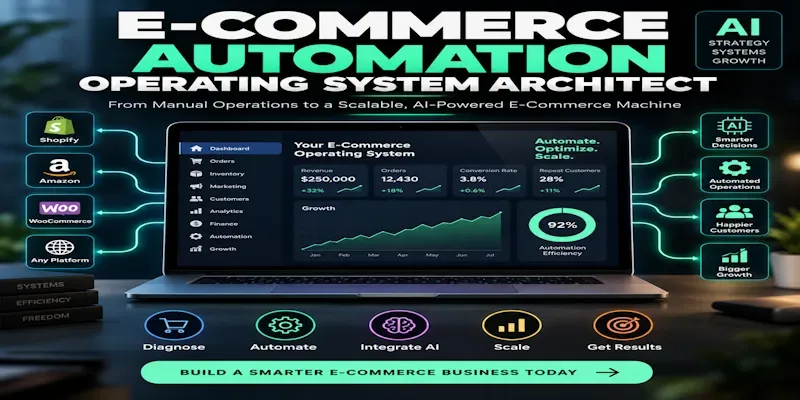
E-commerce Automation Operating System Architect
This prompt diagnoses operational bottlenecks, identifies high-value automation opportunities, designs integrated workflows, maps AI decision points, defines human oversight, recommends the required technology architecture, and creates a prioritized implementation roadmap.
Instead of generating a generic list of e-commerce tools, it produces an actionable operating blueprint covering marketing, inventory, fulfillment, customer experience, finance
...more
Added 3 weeks ago
