

Prompt Details
Model
(claude-4-6-sonnet)
Token size
4,143
Example input
[SPECIALTY]: Custom Claude prompt systems for content production at digital marketing agencies
[CLIENT_TYPE]: Digital marketing agency, 8–25 employees, serving 10–30 client accounts simultaneously
[PROJECT_SCOPE]: Build a 20-prompt content engine covering blog drafts, social captions, email sequences, and ad copy — tested against their 3 most common client verticals
[PROJECT_RATE]: $2,400 flat fee
Example output
# AI PROMPT ENGINEER — CLIENT WIN SYSTEM v2.0
### Custom Claude Prompt Systems for Digital Marketing Agencies
---
## REASONING PROTOCOL — PRE-RUN
**Context:** A digital marketing agency, 8–25 people, managing 10–30 client accounts across verticals simultaneously. Production pressure is constant; quality consistency is the recurring failure point.
**Pain:** They're using Claude or ChatGPT already. Results are inconsistent across account managers, across verticals, and across content types. Every piece still needs heavy editing before it sounds like the client's brand.
**Build target:** A 20-prompt content engine — blog drafts, social captions, email sequences, ad copy — tested against their 3 most common verticals. Flat fee, $2,400.
**Success metric:** A complete, client-ready proposal with planning depth, objection handling, and operational infrastructure to close and deliver this project.
---
## SECTION 1 — AUTHORITY POSITIONING (3 Variations)
**Variation 1**
Marketing agencies using Claude without a structured prompt system spend an average of 40–60% of their AI-generated output time on editing rather than production — and the fix isn't a better tool. It's a better architecture. I build prompt systems that produce first drafts your account managers can actually use, not rewrite from scratch.
**Variation 2**
I've built Claude-based content systems for agencies managing 15+ client accounts simultaneously — the specific constraint where generic prompting breaks down fastest. Each system is built around the agency's actual client verticals, not the average use case. If your team is still editing AI output more than the client brief, the prompt system is the problem.
**Variation 3**
Agencies that use AI without vertical-specific prompting get average output for an above-average price. I build prompt libraries that know the difference between a dental practice and a SaaS startup before the first sentence is written — because the brief alone doesn't carry that weight.
---
## SECTION 2 — CLIENT PAIN DIAGNOSIS
**Surface Problem**
The agency thinks the AI output is inconsistent — sometimes good, sometimes unusable — and that the fix is better prompting by individual account managers. They've probably shared tips internally, maybe written a loose guide, maybe bought a ChatGPT prompt pack. The output is still inconsistent.
**Underlying Problem**
The output is inconsistent because the prompting is individual. Each account manager brings their own style, their own understanding of the client's brand, and their own workarounds. There's no shared architecture — just 8–25 people running variations of the same request and getting 8–25 different results. The surface complaint is "the AI gives us bad drafts." The actual problem is that the agency has no content production system. It has a collection of individual habits.
**90-Day Cost of Not Fixing This**
If each account manager spends 3 hours per week on AI-assisted content that requires significant revision before it can be used, a 12-person team loses 36 hours weekly to rework. At a blended rate of $55/hour {UNCONF}, that's approximately $1,980/week in hidden production cost — or roughly $23,000 over 90 days — in time spent fixing output that should have been usable on first draft. Separately: every inconsistent output that goes to a client with minor edits missed is a brand risk that doesn't show up in time-tracking but shows up in renewals.
**Root Cause**
Off-the-shelf AI tools and generic prompt libraries weren't built for an agency managing 10–30 client accounts across multiple verticals simultaneously. They're built for a single brand, a single voice, a single output type. The agency problem is different: the system has to know how to write for a home services client at 9am and a B2B software client at 11am, produced by two different account managers, both at the same quality bar. Generic prompting can't hold that variable set. A vertical-specific prompt architecture can.
---
## SECTION 3 — SOLUTION ARCHITECTURE
**Phase 1 — Discovery & Audit**
*What I actually do:* Interview 2–3 account managers using a structured questionnaire to map current workflow: which content types cause the most rework, which client verticals expose the widest quality gap, and what "good" looks like versus what's actually being shipped. I review 10–15 real samples of AI-generated content the agency has already produced — approved and rejected.
*Deliverable:* A written Content Gap Report — a one-page document that names the 3 verticals to build against, ranks the 4 content types by rework intensity, and identifies the 3 core failure patterns in the current prompting approach.
*Time estimate:* 3 working days
*Success metric:* Agency signs off on the Gap Report before build begins. If they can't confirm the failure patterns, discovery repeats until they can.
---
**Phase 2 — Build & Test**
*What I actually do:* Build all 20 prompts to spec — structured for Claude, organized by content type, with vertical-specific parameters for each of the 3 client verticals identified in Phase 1. Each prompt is tested across a minimum of 5 real inputs drawn from the agency's actual client work, not synthetic examples. Prompts that fail the quality bar are revised before delivery.
*Deliverable:* A tested 20-prompt library, organized by content type and vertical, with a pass/fail log for each prompt showing test inputs, outputs, revision triggers, and final status.
*Time estimate:* 7 working days
*Success metric:* Each prompt produces a usable first draft — defined as requiring fewer than 15 minutes of editing before client submission — across all 5 test inputs. Anything below that threshold is revised before the file is handed off.
---
**Phase 3 — Handoff & Documentation**
*What I actually do:* Deliver the prompt library with a usage guide written specifically for non-technical account managers. Run a 60-minute team session focused on the 3 most complex use cases in the library — the ones most likely to break without context. Build a one-page troubleshooting reference the team can use when output drifts.
*Deliverable:* A complete Agency Prompt Operations Pack — the tested library, the account manager usage guide, the team session recording, and the troubleshooting reference — delivered as a single organized folder the agency can hand to any new hire.
*Time estimate:* 3 working days
*Success metric:* Account managers can run any prompt in the library without asking for help after the handoff session. Verified informally on the call.
---
## SECTION 4 — COMPLETE PROPOSAL (Ready to Send)
---
### A — Opening Hook
Marketing agencies using Claude without a structured prompt system spend an average of 40–60% of their AI-assisted production time on editing rather than creating — and the fix isn't a better tool. It's a better architecture. I build prompt systems that produce first drafts your account managers can actually use, not rewrite from scratch.
---
### B — About This Work
I specialize in building Claude-based prompt systems for digital marketing agencies — specifically the content production problem: blog drafts, social captions, email sequences, and ad copy, at the speed and volume multi-account agencies actually need. My work focuses on vertical-specific prompt architecture, because a generic system that can't tell the difference between a home services client and a B2B SaaS client isn't a production tool — it's a starting point. {Result placeholder — insert your strongest real outcome here.} My approach is to build and test against real client inputs before delivery, not hand over a file and call it done.
---
### C — What I Understand About Your Situation
Your team is producing AI-assisted content every day, but the output isn't consistent enough to reduce editing time the way you expected. Account managers have developed their own prompting habits — some of them work, some don't, and there's no shared system that produces the same quality bar across the team. You've probably already tried sharing prompt examples internally, maybe pulled a prompt pack from somewhere, and the results were marginal. The underlying issue is that none of those approaches were built around your specific client verticals. A home services brief and a professional services brief don't prompt the same way, and the account manager shouldn't have to compensate for that gap manually every time. The distance between where you are and where you need to be isn't a tool upgrade — it's a production architecture that actually holds across verticals, content types, and team members.
---
### D — What I'll Build For You
This is a three-phase project built specifically for a 20-prompt content engine across your 3 most common client verticals — not a template pulled from a drawer and renamed.
Phase 1 is discovery. Before anything is built, I map your actual content workflow — where the rework happens, which verticals create the most inconsistency, and what "usable first draft" means for your team specifically. That becomes the build brief.
Phase 2 is build and test. All 20 prompts are written for Claude, organized by content type, and tested across a minimum of 5 real inputs per prompt drawn from your actual client work. Prompts that don't pass get revised before they're in the library. You receive a pass/fail log alongside the prompts — not just the file.
Phase 3 is handoff. I run a 60-minute session with your team focused on the use cases most likely to drift without context, and deliver a full Agency Prompt Operations Pack your team can use and hand to new hires without me in the room.
---
### E — Deliverables
1. **Content Gap Report** — Written findings from discovery: 3 verticals confirmed for build, 4 content types ranked by rework intensity, 3 core failure patterns identified in current prompting
2. **20-Prompt Content Library** — Organized by content type (blog drafts, social captions, email sequences, ad copy) with vertical-specific parameters for each of the 3 client verticals
3. **Prompt Test Log** — Pass/fail record for every prompt, showing test inputs, output samples, revision triggers, and final status
4. **Account Manager Usage Guide** — Step-by-step, written for non-technical users, covering how to run each prompt, when to adjust inputs, and what to do when output drifts
5. **60-Minute Team Handoff Session** — Live walkthrough of the 3 most complex use cases; recorded and included in the deliverable pack
6. **Troubleshooting Reference** — One-page guide covering the 5 most common output problems and how to correct them without rewriting the prompt
7. **Agency Prompt Operations Pack** — Single organized folder containing all of the above, structured so any new account manager can onboard from it without additional explanation
---
### F — Investment
**Full Production System + Priority Access — $3,400**
Includes: All 7 deliverables above + a second 60-minute team session at Day 30 (post-live-use review based on actual production data) + priority scheduling (project starts within 5 business days of signing)
Timeline: 18 working days
Terms: 50% on signing, 50% on final delivery
---
**Core Build + 30-Day Check-In — $2,800** ← Recommended
Includes: All 7 deliverables above + one revision round at Day 30 based on actual usage data from your team
Timeline: 15 working days
Terms: 50% on signing, 50% on final delivery
---
**Core Build — $2,400**
Includes: All 7 deliverables above
Timeline: 13 working days
Terms: 50% on signing, 50% on final delivery
---
Note: The recommended option includes the 30-day revision round because the highest-value adjustments happen after the prompts are running in your actual workflow — not during testing. The core build is complete and tested; the check-in captures what live use reveals that controlled testing doesn't.
---
### G — Why Not a Cheaper Option
**1. Template sellers**
There are $19–$49 prompt packs that include 50 or 100 "marketing prompts." They're not tested against your verticals, your client briefs, or your team's workflow. They're tested against the seller's idea of a generic agency. You'll spend more time adapting them than it would take to build from scratch — and the adaptation won't hold either.
**2. Generalist AI consultants**
Many AI consultants will scope a project that touches your CRM, your project management tool, your reporting, and your content stack simultaneously. If what's broken is content production, rebuilding your entire AI stack is not the fix. This project has a single scope: a working content engine for the people writing the drafts.
**3. DIY using guides and tutorials**
YouTube tutorials and LinkedIn "prompt engineering" guides are written for individuals producing content for one brand at a consistent volume. The agency problem — 10–30 accounts, multiple content types, multiple team members, multiple verticals — is a different constraint entirely. Guides built for that general case break down fast at your production volume.
**4. Offshore freelancers**
There are freelancers who will build a prompt library for less. The gap is domain knowledge. Building prompt architecture for a content-production agency requires understanding what makes a blog draft for a home services client structurally different from one for a professional services firm, and how to encode that difference into a reusable system rather than a one-off brief. That knowledge doesn't transfer from general prompt work.
**5. In-house experimentation**
Internal experimentation produces results that work for whoever ran the experiment and degrade when that person is out, promoted, or overwhelmed. It also has no accountability structure — when output drifts three months after the initial effort, there's no revision protocol and no one responsible. This project ships with documentation and a troubleshooting reference specifically because institutional knowledge that lives in one person's head isn't a production system.
---
### H — Risk Reversal
If the prompt library doesn't produce usable first drafts — defined as requiring fewer than 15 minutes of editing before client submission — after testing and two revision rounds, I'll refund 50% of the project fee. The revision rounds are included in the project scope at no additional charge. You won't be asked to pay extra to get the system working as described.
---
### I — Call to Action
**Soft:** Want to spend 20 minutes confirming whether this fits where your team is right now? I can walk through the discovery process and you can decide from there.
**Direct:** I have two project slots available this month. If you want to hold one, a 30-minute kickoff call is the next step — which day works?
**Time-bounded:** This project requires a 5-day discovery window at the start. If you'd like to lock a start date before July slots close, reply by July 2.
---
### J — What Happens Next
- Contract and invoice sent within 24 hours of your confirmation
- Kickoff call scheduled within 48 hours
- Discovery questionnaire delivered before the call — 15 minutes to complete, covers current workflow and top client verticals
- Full project timeline and milestone dates shared at kickoff
---
## SECTION 5 — OBJECTION PLAYBOOK
---
**Objection 1: "We can do this ourselves with ChatGPT."**
Acknowledge: Correct — your team is already doing it. That's not in question.
Reframe: The difference between individual prompting and a prompt system is the difference between each account manager cooking from memory and the agency having a kitchen with a tested menu. Both use the same ingredients. One scales; the other depends entirely on who's in the room that day. The consistency problem you're experiencing right now is a direct result of running a production operation with individual habits instead of shared architecture.
Close: The most common thing agencies report after attempting this internally is that the first pass works fine and the system degrades within 60 days as account managers adapt prompts to their own preferences. That drift is what this project is built to prevent.
---
**Objection 2: "This feels expensive for prompts."**
Acknowledge: That's a fair read if you're thinking about what a prompt looks like — a few sentences in a text box.
Reframe: What the $2,400 covers is the discovery, the testing against your actual client inputs, the failure analysis, the revision cycles, and the documentation that makes the system usable by someone who wasn't there when it was built. A prompt that sounds good in isolation but produces inconsistent output in live use costs more in rework over 90 days than the project fee. The fee is for a tested system, not for text.
Close: If each account manager recovers 3 hours per week in rework time, a 10-person team recoups the project fee in under two weeks of production use. {Adjust with actual team size and rate if you have the numbers.}
---
**Objection 3: "How do we know it will work for our specific case?"**
Acknowledge: You don't know that upfront — and anyone offering a guarantee before seeing your actual inputs and verticals is pricing risk into the guarantee, not removing it.
Reframe: Phase 1 exists specifically to answer this. Discovery happens before any building. The prompts are designed around your 3 confirmed verticals and tested against real briefs from your actual client work. If a prompt doesn't pass the quality bar after testing, it gets revised before delivery. The system isn't handed over untested.
Close: Two revision rounds are built into the project fee. If the prompts don't perform after testing and two revision rounds, 50% of the fee is refunded. That's the risk structure.
---
**Objection 4: "Our team isn't technical."**
Acknowledge: Good — this wasn't designed for a technical team.
Reframe: Account managers using this system don't touch any API, don't configure any settings, and don't need to understand how Claude works. They open a prompt, fill in the client brief fields, and run it. The usage guide is written specifically for that workflow. The handoff session uses your team's real client examples, not AI theory.
Close: {Insert a specific example of a non-technical agency team using your system successfully — or use this placeholder: "The account managers using this system at delivery have ranged from 2-year industry veterans to team members who had never used Claude before the training session."}
---
**Objection 5: "We tried AI tools before and got nothing."**
Acknowledge: That's the most common starting point for the agencies that reach out.
Reframe: Generic tools produce generic output because they have no knowledge of your clients, your verticals, or your quality bar. What didn't work before was almost certainly a tool applied without customization — not AI itself. The question isn't whether AI can produce good content. It's whether the system producing the content knows the difference between your clients and everyone else's.
Close: Phase 1 of this project reviews the output your team has already generated — including what failed — and maps the specific gaps before a single new prompt is written. We don't build on top of what broke.
---
**Objection 6: "Can we start with just one prompt to test?"**
Acknowledge: Testing before committing is a reasonable instinct.
Reframe: A single prompt doesn't tell you anything about system performance. It tells you whether that one prompt, run once, produces output you like. That's not the variable that determines whether your team's production workflow improves. What matters is whether the full library produces consistent output across content types, verticals, and account managers — and that only shows up when the system runs together.
Close: The minimum scope for this project is the full 20-prompt engine. Below that, the vertical testing and integration work that makes the library reliable can't be completed properly. If the full scope isn't the right timing, I'm happy to revisit when it is.
---
## SECTION 6 — FOLLOW-UP SEQUENCE (5 Contacts)
---
**Day 1 — Proposal Sent**
Subject: Content engine proposal for [Agency Name]
Sent over the full proposal. One thing worth looking at first: Section D covers how the build and test phase actually works — specifically the pass/fail testing against your real client briefs before delivery. That's the part that's different from what you've probably seen before. I've also attached [one worked example / a short before-and-after from a similar agency setup — insert real asset here].
CTA: "Let me know if you have questions about the testing process — that's where most agencies want to dig deeper before deciding."
---
**Day 3 — Proof**
Subject: How a [similar agency type] cut content rework by [X hours/week]
[Insert one specific result: before/after, hours recovered, rework reduction, account manager feedback — three sentences maximum. Make it specific to the content production problem, not a general AI success story.]
This came up after about 6 weeks of live use — which is roughly when the vertical-specific parameters start paying off at volume.
CTA: "Relevant to what you're working on?"
---
**Day 5 — One Question**
Subject: One question before I move on
Before I close out this proposal, I want to ask the question that usually changes what I'd recommend: of the 4 content types in scope — blog drafts, social captions, email sequences, and ad copy — which one is currently burning the most account manager time in revision? The answer affects how I'd weight the build.
CTA: "One line is fine."
---
**Day 7 — Calendar Signal**
Subject: Booking July slots now
I'm filling project starts for July this week. Not urgency framing — I have two slots and one is likely to close this week. If you want to hold the second, a 30-minute call is the next step. If the timing doesn't work, I'd rather know now than let the slot sit.
CTA: "Let me know either way — happy to schedule or close the loop."
---
**Day 10 — Final Contact**
Subject: Closing the loop on the content engine proposal
Releasing the project slot at end of week. No pressure — if the timing isn't right, it's not right. If circumstances change and you want to revisit in September, I'm happy to reconnect then. The proposal stands as written.
CTA: "If you'd like to pick this back up in September, reply with 'September' and I'll reach out then."
---
## SECTION 7 — CLIENT ONBOARDING CHECKLIST
**Before the Kickoff Call:**
- { } Contract signed and 50% deposit received
- { } Discovery questionnaire sent and returned (cover: team size, top 3 client verticals, current prompting tools, content types by volume, what "good output" looks like for your team)
- { } 10–15 sample AI-generated content pieces collected (mix of approved and rejected, across at least 2 verticals)
- { } Key stakeholders confirmed for kickoff — at minimum: whoever manages production workflow + one account manager who uses AI daily
**Kickoff Call (45 min):**
1. Scope and goals confirmation — 5 min
2. Current workflow walkthrough: how content moves from brief to delivery — 15 min
3. Success criteria: what does "usable first draft" mean, specifically, for this team — 10 min
4. Deliverable review and project timeline — 10 min
5. Communication cadence and revision protocol — 5 min
**During the Project:**
- { } Weekly update sent (Paragraph 1: what was completed this week. Paragraph 2: what happens next week and what is needed from the client, if anything.)
- { } Mid-project check-in completed after first 10 prompts are tested — flag any vertical gaps before finishing the build
- { } Revision requests go through [your preferred channel — Slack, email thread, shared doc], not multiple separate messages
**At Close:**
- { } Full prompt library and documentation delivered in organized folder
- { } 60-minute team handoff session completed and recording shared
- { } Troubleshooting reference confirmed received
- { } Testimonial requested within 48 hours of close
- { } Referral conversation opened: "Is there another agency owner in your network who's dealing with the same production problem?"
---
## SECTION 8 — 90-DAY CLIENT TIMELINE
**Weeks 1–2: Foundation**
Discovery completed and Content Gap Report signed off. First 10 prompts built and tested against real client inputs from the confirmed verticals. Account managers briefed on what's coming and why it's structured differently from what they've used before.
**Weeks 3–4: Live Use**
Full 20-prompt library running in the team's actual production workflow. First real-output data collected — not test samples. Account managers logging friction points: where the prompts work, where they need adjustment, where the vertical parameters aren't holding.
**Weeks 5–8: Adjustment**
Prompts updated based on live production data. Edge cases documented — the brief types that don't fit cleanly into the vertical parameters, and how to handle them. Any additional prompts added if they fall within project scope or are flagged as high-priority by the team.
**Weeks 9–12: Independence**
The system runs without your involvement. Account managers are prompting from the library without needing to ask how. No one is calling the prompts "the AI thing" — they're calling them by content type. At this stage, either a retainer discussion (ongoing maintenance, new verticals, expanded content types) or a Phase 2 proposal is appropriate — based on what the team's actual usage data shows they need, not a default upsell.

$29.99-25%
$22.49
SPECIAL PROMOTION — Offer ends 12 October

 Instant access
 Commercial use
 Money‑back
By purchasing this prompt, you agree to our terms of service
5.0
1 review
4
Favorites
229
Views
CLAUDE-4-6-SONNET


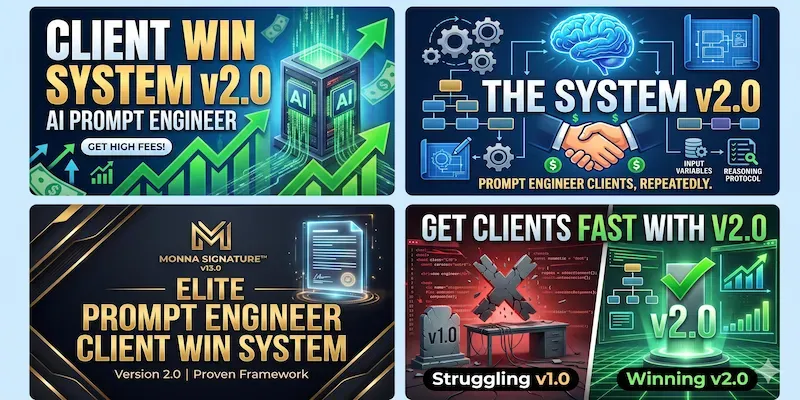
This isn't just a proposal template. It's a full business system:
✅ 3 authority positioning hooks
✅ Complete 10-section proposal (copy-paste ready)
✅ 3-tier pricing structure with psychology
✅ 6 objection handlers for common client pushback
✅ 5-email follow-up sequence with subject lines
✅ 90-day client success timeline
✅ Full onboarding checklist
✅ Freelancer mindset protocol to charge premium rates
...more
Added over 1 month ago

- Reviews for this prompt (1)