

Prompt Details
Model
Chat - (gpt-5.6)
Token size
3,138
Example input
[LEARNING CASE]: Topic: intro physics · Learner: high-school · Goal: apply Newton's 3rd law correctly · Source: "When object A exerts a force on object B, object B exerts an equal and opposite force on object A. These forces act on different objects and never cancel each other." · Learner: "A heavy truck hits a small car — the truck exerts more force, that's why the car gets destroyed."
Example output
### Learning Target
Apply Newton’s 3rd law correctly when two objects interact: recognize that the interaction forces are **equal in magnitude, opposite in direction, and act on different objects**.
### Evidence Basis
The supplied source gives the governing relationship directly:
> When A exerts a force on B, B exerts an equal and opposite force on A; the two forces act on different objects and therefore do not cancel each other.
That is the relevant rule for this case.
### Current Learner Model
The learner appears to reason:
**greater damage to the car → greater force exerted on the car → truck must exert more force than the car exerts on the truck.**
The final step conflicts with the supplied Newton’s 3rd-law statement.
### Claim–Evidence Check
**Claim:** “The truck exerts more force on the car.”
**Status:** **CONTRADICTED**
**Evidence against:** the source says the force of the truck on the car and the force of the car on the truck are equal and opposite.
**Claim:** “The car is damaged more because it receives a larger interaction force.”
**Status:** **NOT ESTABLISHED**
The supplied source explains the force pair, but it does **not** explain why two objects experiencing equal interaction forces can have different consequences.
### Diagnostic Question
Suppose the truck exerts **10,000 N** on the car during the collision.
According to the supplied rule, how much force does the **car exert on the truck**?
A. Less than 10,000 N
B. Exactly 10,000 N in the opposite direction
C. More than 10,000 N
D. Zero because the car is much smaller
### INFERRED FROM SUPPLIED CASE
The learner would plausibly choose **A**, because they appear to associate the larger/heavier object with producing the larger force.
### Misconception Decision
**LIKELY LEARNER MODEL:** This looks like a **force-effect collision**: the learner is using which object suffers more damage to infer which object experienced more force.
**BROKEN LINK:** Interaction outcome ≠ magnitude comparison of the Newton’s 3rd-law force pair.
**MISCONCEPTION TYPE:** Concept collision / causal-model error.
**CONFIDENCE:** High.
Tell me if this doesn't match your actual reasoning — the model above is a working hypothesis, not a fixed diagnosis.
### Self-Correction Prompt
If Newton’s 3rd law says the two interaction forces are equal, what part of the statement *“the truck exerts more force because the car is damaged more”* must change?
### DEMONSTRATION LEARNER ATTEMPT
“The damage can’t tell us that the truck’s force was larger. The car must also push on the truck with the same amount of force.”
### Smallest Repair Unit
**CORE RELATIONSHIP**
During the collision:
**truck → car force = car → truck force**
in magnitude, with opposite directions.
They do **not** cancel because they act on **different objects**.
**WHY THE CURRENT MODEL FAILS**
It uses an unequal **effect** as evidence for unequal members of the action–reaction pair. But the supplied rule explicitly requires those two forces to be equal.
**SOURCE-GROUNDED CONTRAST**
Wrong:
> Truck pushes car harder than car pushes truck.
Repaired:
> Truck pushes car, and car simultaneously pushes truck with an equal-magnitude force in the opposite direction.
**EVIDENCE GAP**
Why the smaller car can nevertheless experience much more damage is **outside the supplied source**. Explaining that properly would require additional physics concepts/evidence.
### Teach-Back Stress Test
A large truck collides with a small car. The car is badly damaged and the truck has little visible damage.
Which statement best applies Newton’s 3rd law?
A. The truck exerted the greater force.
B. The car exerted the greater force.
C. Each exerted an equal-magnitude force on the other, despite the different outcomes.
### DEMONSTRATION LEARNER RESPONSE
**C.** Different damage does not mean the Newton’s 3rd-law forces were unequal.
**Evaluation:** **REPAIRED**
The original force-magnitude error is no longer present.
### Near-Transfer Probe
A student pushes hard against a wall and the wall does not visibly move.
Does the student push harder on the wall than the wall pushes on the student?
### DEMONSTRATION LEARNER RESPONSE
“No. The wall exerts an equal and opposite force on the student.”
**Transfer evaluation:** **CORRECT REASONING — NEAR TRANSFER PASSED**
---
## Learning State Card
**TARGET**
Apply Newton’s 3rd law to interaction pairs.
**ORIGINAL MODEL**
A larger object or the object causing greater visible damage must exert the larger force.
**REPAIRED MODEL**
When two objects interact, each exerts an equal-magnitude, opposite-direction force on the other; different outcomes do not by themselves establish unequal third-law forces.
**EVIDENCE BASIS**
The supplied source explicitly states equality, opposite direction, and that the paired forces act on different objects.
**TRANSFER STATUS**
**NEAR TRANSFER PASSED — demonstrated, not verified mastery.**
**REMAINING GAP**
The source does not explain **why equal forces can produce very different motion or damage**. That requires additional material.
**RECALL PROMPT**
If the car experiences a 12,000 N force from the truck, what force does the car exert on the truck?
**NEXT ACTION**
**BACKFILL PREREQUISITE** — connect Newton’s 3rd law to why equal interaction forces can produce unequal effects.
This is one demonstrated diagnostic cycle, not evidence of durable mastery; additional probes in different collision contexts would be needed.


 Instant access
 Commercial use
 Money‑back
By purchasing this prompt, you agree to our terms of service
2
Favorites
9
Views
GPT-5.6


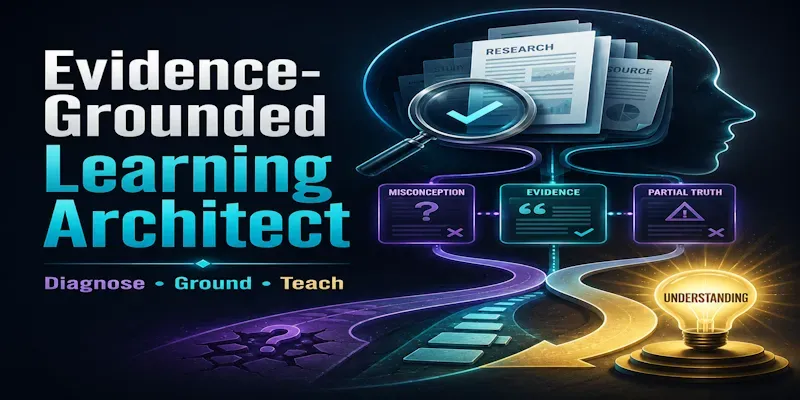
Turn notes, textbooks, lecture material, documentation, or research excerpts into an evidence-grounded learning system. This prompt retrieves the most relevant source fragments, maps concepts and prerequisites, tests learner claims against evidence, diagnoses misconceptions, teaches only the missing link, and verifies understanding through transfer instead of rewarding memorized answers.
...more
Added 3 days ago
