

Prompt Details
Model
(claude-5-sonnet)
Token size
2,244
Example input
[DECISION]: Choose between launching a focused AI meeting-notes tool, building a broader team productivity platform, or postponing launch for three months. Deadline is six weeks. Budget is $25,000.
[OBJECTIVE]: Reach paying customers quickly while minimizing development risk and preserving future expansion opportunities.
[EVIDENCE]: The focused tool prototype is 70% complete. Fifteen target users were interviewed; nine described meeting follow-up as a recurring problem. Three said they would consider paying. The broader platform would require at least four additional major features. No paid acquisition tests have been run.
[CONTEXT]: Small three-person team, limited runway, moderate risk tolerance, strong AI engineering skills, weak distribution.
Example output
# EXECUTIVE DECISION REVIEW
## Executive Dashboard
| Field | Result |
|---|---|
| Recommended Option | Launch focused AI meeting-notes tool |
| Decision Readiness | 52/100 |
| Decision Status | UNDERDEVELOPED |
| Confidence | Medium |
| Winner Stability | Moderately Stable |
| Evidence Coverage | Low |
| Biggest Fault Line | Willingness-to-pay assumption (3/15 interviewees) may not translate to actual conversion |
| Decision Trigger | Confirming ≥2 of 3 interested users will pay within 2 weeks of a paid pilot ask |
| Abort Trigger | Fewer than 5 paying customers by week 5, or CAC exceeds remaining runway |
| Next Best Action | Run a paid-intent test (real payment link or deposit ask) with the 3 interested users this week, before committing further build time |
## 1. Executive Brief
**Decision:** Choose among three paths — launch a focused AI meeting-notes tool, build a broader team productivity platform, or postpone launch three months — within a six-week deadline and a $25,000 budget.
**Options:** (A) Focused meeting-notes tool, (B) Broader productivity platform, (C) Postpone three months.
**Deadline:** 6 weeks. **Stakes:** {GIVEN} Limited runway, three-person team, weak distribution — a wrong bet consumes scarce capital and time with no guarantee of recovery.
**Success definition:** {GIVEN} Reach paying customers quickly while minimizing development risk and preserving future expansion optionality.
**Main constraints:** {GIVEN} $25,000 budget, 6-week window, three people, strong AI engineering / weak distribution, no paid acquisition testing done yet.
**Most important unknowns:** {GAP} Actual willingness-to-pay conversion rate, {GAP} price point tolerance, {GAP} cost and feasibility of customer acquisition given weak distribution, {GAP} whether the "recurring problem" (9/15) maps to urgency-to-buy.
**Decision Complexity: High** — {EST} three divergent paths, a hard deadline, thin market validation, and a distribution weakness that could invalidate any option's economics.
## 2. Decision Readiness Audit
| Category | Score /10 | Rationale |
|---|---:|---|
| Evidence quality | 4 | {GIVEN} 15 interviews with a signal (9/15 problem, 3/15 pay-intent) but no behavioral/paid validation |
| Option coverage | 7 | Three genuinely distinct options with different risk/speed tradeoffs are defined |
| Risk visibility | 5 | Development risk is discussed implicitly; distribution risk is named in context but not quantified |
| Cost visibility | 4 | {GIVEN} $25,000 total budget known, but no cost breakdown by option {GAP} |
| Reversibility clarity | 5 | Prototype completion status is known; sunk-cost and pivot cost not specified |
| Stakeholder alignment | 6 | {GIVEN} Small team, single implied decision-maker context reduces alignment risk, but no explicit stakeholder input given |
| Execution readiness | 7 | {GIVEN} Strong AI engineering skills and a 70%-complete prototype support fast execution on Option A |
| External uncertainty | 3 | {GAP} No paid acquisition tests run; weak distribution is a named but unquantified risk |
**Decision Readiness Score: 52/100 — UNDERDEVELOPED**
The score reflects real but thin evidence: qualitative interview signal exists, but no paid-conversion or acquisition-cost data grounds the central bet (distribution).
## 3. Option Architecture
### Option A — Focused AI meeting-notes tool
- **Primary benefit:** {GIVEN} 70% built already; fastest path to a sellable product within the 6-week window.
- **Direct cost:** {EST} Likely the lowest of the three — remaining 30% of build plus launch costs, well within $25,000.
- **Hidden cost:** {GAP} Distribution/acquisition spend is unbudgeted and untested; could silently consume the runway advantage.
- **Dependencies:** {GIVEN} Converting "considering paying" (3/15) into actual paying customers.
- **Failure modes:** {EST} Market is real but too small or too price-sensitive; meeting-notes category is crowded, making distribution even harder for a weak-distribution team.
- **Second-order effects:** {EST} A narrow, working paid product creates a reference customer base and revenue proof that could later support the platform vision.
- **Opportunity cost:** {EST} Forgoes building broader platform features that might increase deal size per customer.
- **Execution burden:** Low-Medium — {GIVEN} team has strong AI engineering skills and a near-complete prototype.
- **Reversibility:** Mostly Reversible — a scoped product can be repositioned or sunset without large sunk cost.
- **Cost of being wrong:** {EST} Moderate — six weeks and partial budget spent, but team retains a working asset and market learning.
### Option B — Broader team productivity platform
- **Primary benefit:** {GIVEN} Larger addressable use case and higher potential deal size if it lands.
- **Direct cost:** {GIVEN} At least four additional major features required — {EST} this alone plausibly exceeds $25,000 and 6 weeks for a three-person team.
- **Hidden cost:** {EST} Scope creep, unclear which of the four features actually map to validated demand (none were tested).
- **Dependencies:** {GAP} Demand for the broader feature set is entirely untested — only the meeting-notes pain point was interviewed.
- **Failure modes:** {EST} High risk of running out of budget/time before reaching a sellable version; classic broad-platform-before-validation trap.
- **Second-order effects:** {EST} If it fails, team burns most or all runway with nothing shippable — the most damaging outcome among the three options.
- **Opportunity cost:** {EST} Six weeks of focus diverted from the near-complete, validated-enough Option A.
- **Execution burden:** High — {GIVEN} four major features exceed current scope and timeline.
- **Reversibility:** Mostly Irreversible within the deadline — partial platform builds are hard to sell or pivot from cleanly.
- **Cost of being wrong:** {EST} Severe — budget and runway consumed with high likelihood of an unfinished, unsellable product.
### Option C — Postpone launch three months
- **Primary benefit:** {EST} More time to validate willingness-to-pay and test distribution before committing engineering resources.
- **Direct cost:** {EST} Three months of runway consumed with no revenue; opportunity cost of delay.
- **Hidden cost:** {GAP} Competitive risk (unknown — no competitor evidence supplied) and team morale/momentum risk.
- **Dependencies:** {GAP} What would actually be done during the delay is unspecified in the inputs.
- **Failure modes:** {EST} Delay without a defined validation plan simply defers the same uncertainty three months later, burning runway in the process.
- **Second-order effects:** {EST} Given "limited runway" in context, a three-month delay directly threatens the team's ability to operate at all.
- **Opportunity cost:** {EST} Loses the momentum of the 70%-complete prototype and the nine interviews already indicating a live problem.
- **Execution burden:** Low in the near term, but defers all execution risk rather than resolving it.
- **Reversibility:** Two-Way Door on the decision itself, but {GAP} the runway cost may not be reversible.
- **Cost of being wrong:** {EST} High relative to stated stakes — "limited runway" makes idle months expensive.
## 4. Fault-Line Map
| Fault Line | Must Be True | Support | Impact if False | Verdict Change | Validation |
|---|---|---|---|---|---|
| Pay-intent converts to real payment | The 3/15 "would consider paying" convert at a usable rate | Weak | Option A revenue thesis collapses; team needs a pivot or new segment | Yes — favors Option C or a pivot | Ask the 3 for a real payment/deposit this week |
| Weak distribution can still reach paying customers within 6 weeks | Team can find and convert customers without paid acquisition history | Absent | Even a working product fails to reach revenue in time | Yes — favors Option C (buy time to build distribution first) | Run one small paid-acquisition test (e.g., $500 spend) alongside Option A build |
| Runway tolerates a 3-month delay | "Limited runway" doesn't mean near-term insolvency | Absent (context only says "limited," no figure given) | Option C becomes infeasible regardless of its other merits | Yes — eliminates Option C entirely if runway is too short | Confirm actual runway in months against the $25,000 figure |
## 5. Weighted Decision Matrix
Criteria extracted from [OBJECTIVE]: **Speed to paying customers**, **Development risk**, **Preservation of future expansion**.
Weights not supplied by user — proposed and marked {EST}:
| Criterion | Weight {EST} | Option A | Option B | Option C |
|---|---:|---:|---:|---:|
| Speed to paying customers | 45% | 4 | 1 | 1 |
| Development risk (lower risk = higher score) | 35% | 4 | 1 | 3 |
| Preservation of future expansion | 20% | 3 | 4 | 2 |
**Weighted totals (Pass 1 — base interpretation):**
- Option A: (4×0.45)+(4×0.35)+(3×0.20) = 1.80+1.40+0.60 = **3.80**
- Option B: (1×0.45)+(1×0.35)+(4×0.20) = 0.45+0.35+0.80 = **1.60**
- Option C: (1×0.45)+(3×0.35)+(2×0.20) = 0.45+1.05+0.40 = **1.90**
**Pass 2 (optimistic on distribution — assume weak distribution is fixable quickly):**
Option A speed rises to 5, Option C speed stays 1 (delay never reaches customers faster).
- A: (5×0.45)+(4×0.35)+(3×0.20) = 2.25+1.40+0.60 = **4.25**
- B: 1.60 (unchanged)
- C: **1.90** (unchanged)
**Pass 3 (pessimistic on pay-intent — assume 3/15 signal is weak and doesn't convert):**
Option A speed drops to 2 (product ready but no buyers found quickly).
- A: (2×0.45)+(4×0.35)+(3×0.20) = 0.90+1.40+0.60 = **2.90**
- B: 1.60 (unchanged)
- C: **1.90** (unchanged)
**Winner in each pass:** A, A, A
**Score range:** A: 2.90–4.25 | B: 1.60 (flat) | C: 1.90 (flat)
**Winner Stability: Moderately Stable** — A wins in all three passes but its margin narrows sharply if pay-intent doesn't convert (Pass 3), converging toward Option C's score.
## 6. Sensitivity Analysis
| Variable | Current Range | Threshold | Winner Beyond Threshold | Evidence |
|---|---|---|---|---|
| Pay-intent conversion rate | {EST} unknown, base 3/15 signal | If effectively 0 of 15 would pay | Option C (validate before building further) | Weak |
| Time-to-first-customer under weak distribution | {GAP} unmeasured | If >6 weeks even with finished product | Option C | Absent |
| True runway length | {GAP} "limited," no figure | If <3 months remaining | Eliminates Option C, forces A or B | Absent |
**What would need to become true for Option C (second-ranked) to win?** {EST} Either the pay-intent signal proves unreliable (near-zero actual conversion) or distribution proves so weak that even a finished product can't reach paying customers within six weeks — in either case, spending the six weeks validating instead of shipping becomes more valuable than shipping itself. This is not currently supported by evidence and remains speculative.
## 7. Decision Driver Ranking
```
Pay-intent conversion reliability ██████████████
Distribution capability ████████████
Runway length vs. delay cost ██████████
Prototype completion (70%) ███████
Team AI engineering strength █████
```
Bars are comparative indicators, not statistical measurements.
## 8. Expected-Value Comparison
**Option A — Focused tool:**
- Best plausible outcome: {EST} Ship within budget, convert several of the 9 problem-aware users into paying customers, establish revenue base.
- Central plausible outcome: {EST} Ship on time, convert 1–3 paying customers, revenue thesis partially validated, team must then solve distribution.
- Worst plausible outcome: {EST} Ship on time, zero conversions — pay-intent signal was noise.
- Expected value if core assumptions hold: {EST} Positive — near-complete product plus a validated pain point yields at least modest revenue.
- Expected value if the main fault line fails (pay-intent doesn't convert): {EST} Roughly neutral — team still has a shipped asset and clearer negative signal, at low sunk cost.
- Downside exposure: {EST} Limited — most of the budget was already committed to a near-finished product.
- Upside potential: {EST} Moderate — a working, sold product with room to expand toward Option B later.
**Option C — Postpone three months:**
- Best plausible outcome: {EST} Validation work confirms or kills the concept cheaply before further build spend.
- Central plausible outcome: {EST} Three months pass, some learning gained, but runway shrinks with no revenue.
- Worst plausible outcome: {EST} Runway runs out or momentum is lost before any launch occurs.
- Expected value if core assumptions hold: {EST} Only positive if "limited runway" comfortably absorbs three idle months — not confirmed.
- Expected value if the main fault line fails (runway too short): {EST} Strongly negative — delay itself becomes the failure mode.
- Downside exposure: {EST} High relative to stated "limited runway" in context.
- Upside potential: {EST} Modest — better information, but no revenue progress.
## 9. Opportunity Cost
For the leading option (A — Focused tool):
- **Money:** {EST} Forgoes the chance to build toward a higher-ticket platform offering now; temporary, revisitable later.
- **Time:** {GIVEN} Six weeks committed to the narrow product instead of exploration; temporary.
- **Strategic position:** {EST} Narrower initial market position than the platform vision; largely reversible if A succeeds and funds B later.
- **Learning:** {EST} Gains real paying-customer data faster than either alternative — this is a net gain, not a sacrifice.
- **Flexibility:** {EST} Some near-term flexibility given up (team focused on one narrow build); mostly temporary.
- **Brand/reputation:** {GAP} No evidence supplied on brand positioning risk of "starting narrow."
- **Alternative opportunities:** {EST} Broader platform customers who wanted the full feature set now may be temporarily unaddressed; likely recoverable once A is validated.
Most sacrifices here are **temporary**; the main **irreversible** cost would be six weeks and partial budget if the pay-intent fault line fails entirely — but even then a shipped asset remains.
## 10. Reversibility Map
| Option | Door Type | Recovery Cost | Recovery Time | Lock-In Risk |
|---|---|---|---|---|
| A — Focused tool | Mostly Reversible | {EST} Low — pivot or reposition an existing shipped product | {EST} Weeks | Low |
| B — Broader platform | Mostly Irreversible (within deadline) | {EST} High — sunk cost in unfinished, unsold features | {EST} Months | High |
| C — Postpone | Two-Way Door (decision) / runway cost may not be | {EST} Moderate — but runway spent cannot be recovered | {GAP} Unknown, tied to actual runway | Moderate–High |
**Given the uncertainty, evidence favors staged commitment**: ship the near-complete, low-risk option (A) while treating the pay-intent and distribution fault lines as fast, cheap experiments to run in parallel — rather than full delay (C) or a large irreversible bet (B).
## 11. Pre-Mortem
**Assume Option A failed 12 months after commitment.**
- **Initial hidden weakness:** {EST} The 3/15 pay-intent signal was politeness, not real willingness to pay — no deposit or payment was ever collected before build completion.
- **First warning signal:** {EST} Low conversion in the first weeks after launch despite outreach to all 9 "problem-aware" interviewees.
- **Escalation sequence:** {EST} Team burns remaining budget on paid acquisition attempts to compensate for weak distribution, with no clear channel that works; runway shrinks faster than revenue grows.
- **Point of no return:** {EST} Budget exhausted with fewer than 5 paying customers and no repeatable acquisition channel identified.
- **Most likely failure outcome:** {EST} Team has a working but unsellable product and must either pivot the positioning or shut down the effort.
- **Earliest intervention that could have prevented failure:** {EST} Running a real paid-intent test with the 3 interested users *before* finishing the remaining 30% of build — cheap and fast, and directly tests the biggest fault line.
## 12. Killer Questions
1. **Will the 3 "considering paying" users actually pay if asked today?** — Tests the pay-intent fault line directly; a "no" from all three should trigger re-evaluation before further build spend.
2. **What is the team's actual runway in months?** — Tests whether Option C is even feasible; if runway is under ~4 months, C is effectively eliminated regardless of its other merits.
3. **What would a minimal paid-acquisition test cost and yield?** — Tests the distribution fault line; determines whether "weak distribution" is a fixable near-term gap or a structural blocker.
4. **Which of the four "additional major features" for Option B, if any, were mentioned by interviewees?** — Tests whether Option B's scope reflects any real demand signal or is speculative.
5. **Is there a minimum viable price point the 3 interested users would actually accept?** — Tests whether the revenue model behind Option A is economically viable at the team's likely price point.
## 13. Executive Verdict
**Strongest credible argument against Option A:** The pay-intent evidence is thin — 3 out of 15 saying they'd "consider" paying is a soft signal, not a purchase commitment, and the team has weak distribution with zero paid-acquisition testing. Betting six weeks of scarce runway on shipping first and validating demand second could mean discovering, only after the build is finished, that there's no reliable way to reach or convert paying customers — at which point the team has consumed budget without answering the one question that mattered most.
**Does this change the conclusion?** Partially — it does not overturn Option A as the leading choice (it remains the lowest-risk, fastest, most reversible path given the near-complete prototype), but it elevates the priority of testing the pay-intent and distribution fault lines *immediately and in parallel* with finishing the build, rather than only after launch.
## 14. Final Recommendation
Launch the focused AI meeting-notes tool (Option A). It wins on speed, development risk, and reversibility across all three scoring passes, and its lowest-risk path benefits from a 70%-complete prototype and the team's strong AI engineering skills. Confidence is Medium, not High, because the decisive fault line — whether the 3 pay-intent-positive interviewees will actually convert to paying customers given weak distribution — remains unvalidated. The smallest validation step worth completing is asking those 3 users for a real payment or deposit this week, in parallel with finishing the remaining build. The condition that should stop or reverse the decision is if none of the 3 convert and a small paid-acquisition test also fails to surface a viable channel — at that point, the team should pause further spend and revisit whether Option C's validation-first approach was the better call.
## What I Did Not Assume
- I did not assume the "limited runway" mentioned in context translates to a specific number of months — Option C's feasibility depends entirely on this unknown figure.
- I did not assume the 3/15 pay-intent signal will convert at any particular rate.
- I did not invent acquisition costs, pricing, or competitor information — none were supplied.
- I did not assume which specific features Option B would require beyond "at least four additional major features," nor whether any were requested by interviewees.
- I did not assume the team's risk tolerance translates into a specific dollar amount they're willing to lose if Option A's fault line fails.

 Instant access
 Commercial use
 Money‑back
By purchasing this prompt, you agree to our terms of service
1
Favorites
9
Views
CLAUDE-5-SONNET


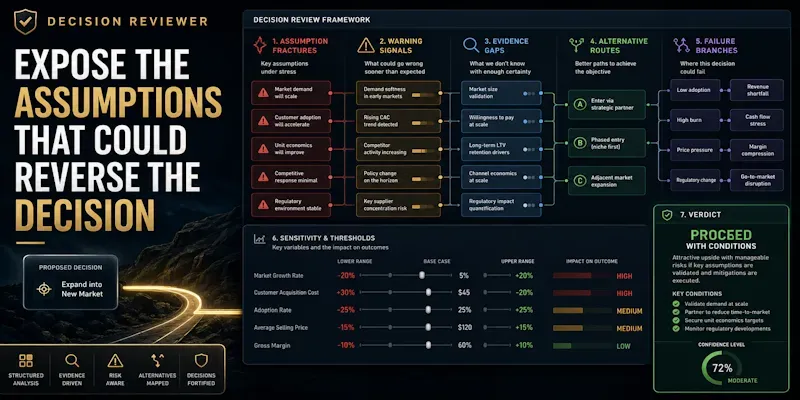
Stress-test a high-stakes decision before committing. This prompt evaluates options, exposes verdict-flipping assumptions, measures decision readiness, analyzes reversibility and opportunity cost, runs sensitivity checks, and produces an executive recommendation with clear validation and abort triggers.
...more
Added 3 weeks ago
