

Prompt Details
Model
(claude-4-6-sonnet)
Token size
5,237
Example input
[FINANCIAL_DATA]: 1,245.00 847.50 12,000.00 3,450.75 985.20 1,050.00 4,999.99 5,000.00 8,745.10 15,200.00 2,125.40 875.00 6,450.00 9,995.00 1,500.00 3,275.80 2,995.00 7,100.00 850.00 12,450.00
[DATA_CATEGORY]: AP_INVOICES
[DATASET_SIZE]: all values pasted
[ANALYSIS_SCOPE]: FRAUD_DETECTION
Example output
# TOKEN GATE™ v2.5 | FINANCIAL ANOMALY DETECTION
**Dataset: AP_INVOICES | Scope: FRAUD_DETECTION**
---
## INGEST
### 1.1 APPLICABILITY CHECK
| Parameter | Value |
|---|---|
| Dataset size | 20 records (all values pasted) |
| Data category | AP_INVOICES |
| Range | $847.50 – $15,200.00 |
| Magnitude span | ~$800 to ~$15,000 — spans 2 orders of magnitude (hundreds to ten-thousands) |
| Pricing pattern | One .99 entry (4,999.99); one .95 entry (2,995.00); mild psychological pricing present |
**BENFORD APPLICABILITY: NO**
Reason: Dataset contains only 20 records. Benford's Law requires a minimum of ~100 records to produce statistically meaningful chi-square deviation. Running a first-digit frequency test on 20 records would produce noise, not signal — any apparent deviation would be analytically unreliable. Layer 1 will not run.
**SECONDARY TEST APPLICABILITY:**
| Test | Applicability |
|---|---|
| Round-number test (Layer 2) | ✅ YES — raw amounts available |
| Threshold test (Layer 3) | ✅ YES — AP invoices commonly carry $5,000 / $10,000 approval thresholds; proximity patterns are visible |
| Duplicate test (Layer 4) | ✅ YES — raw amounts available |
---
### 1.2 DATA PROFILE
| Field | Value |
|---|---|
| Records processed | 20 |
| Amount range | $847.50 – $15,200.00 |
| Apparent currency | USD (inferred from format) |
| Zero / negative values | 0 — none present |
| Non-numeric entries | 0 — all entries clean |
**Sorted dataset for reference:**
| # | Amount |
|---|---|
| 1 | 847.50 |
| 2 | 850.00 |
| 3 | 875.00 |
| 4 | 985.20 |
| 5 | 1,050.00 |
| 6 | 1,245.00 |
| 7 | 1,500.00 |
| 8 | 2,125.40 |
| 9 | 2,995.00 |
| 10 | 3,275.80 |
| 11 | 3,450.75 |
| 12 | 4,999.99 |
| 13 | 5,000.00 |
| 14 | 6,450.00 |
| 15 | 7,100.00 |
| 16 | 8,745.10 |
| 17 | 9,995.00 |
| 18 | 12,000.00 |
| 19 | 12,450.00 |
| 20 | 15,200.00 |
**Pre-analysis observations:**
- Three entries cluster visibly just below round thresholds: $4,999.99 (1 cent below $5,000), $9,995.00 ($5 below $10,000), and $2,995.00 ($5 below $3,000). This warrants close Layer 3 examination.
- $850.00 and $875.00 are both round or near-round and appear close to each other in value.
---
## ANALYZE — LAYER 1 (BENFORD)
⛔ **SKIPPED — Benford applicability = NO.**
20 records is insufficient for reliable first-digit frequency analysis. No findings generated from this layer. Proceeding directly to secondary layers.
---
## DETECT
### LAYER 2 — ROUND NUMBER CLUSTERING
**Identifying amounts ending in .00 (zero cents):**
| Amount | Ends in .00? |
|---|---|
| 12,000.00 | ✅ |
| 1,050.00 | ✅ |
| 5,000.00 | ✅ |
| 875.00 | ✅ |
| 1,500.00 | ✅ |
| 850.00 | ✅ |
| 6,450.00 | ✅ |
| 7,100.00 | ✅ |
**Count: 8 of 20 = 40.0% ending in .00**
**Identifying amounts ending in ,000.00 (round thousands):**
| Amount | Round thousand? |
|---|---|
| 12,000.00 | ✅ |
| 5,000.00 | ✅ |
| 1,500.00 | ✅ (round 500) |
| 7,100.00 | borderline (round hundred) |
Strict round-thousands (,000.00): **12,000.00, 5,000.00 = 2 of 20 = 10.0%**
Round hundreds (.00 with no sub-hundred component): **12,000.00, 5,000.00, 1,500.00, 7,100.00, 6,450.00, 875.00, 850.00 = 7 of 20 = 35.0%**
**Natural baselines (MONNA-Analysis-2026):**
- .00 endings: typically 10–20% of AP invoice records
- ,000 endings: typically 3–8%
**Observed vs. baseline:**
- .00 endings: 40.0% vs. 10–20% baseline → **2× to 4× the natural rate**
- Round thousands: 10.0% vs. 3–8% baseline → **at upper bound to slightly above**
---
### LAYER 3 — THRESHOLD PROXIMITY CLUSTERING
**Assumed approval thresholds for AP_INVOICES (common internal controls):**
- $1,000 | $5,000 | $10,000
**Proximity window: threshold minus 10% to threshold minus 1%**
**Threshold $1,000 (window: $900–$990):**
- $985.20 ✅ — falls in window
Count just below: 1
Count at or above $1,000: 12
Expected random distribution within a 9% band below $1,000: ~9% of sub-$1,000 records
Observation: 1 of 4 sub-$1,000 records (25%) falls in the $900–$990 window. Sample too small to score statistically; noted as weak signal.
**Threshold $5,000 (window: $4,500–$4,990):**
- $4,999.99 ✅ — falls in window (1 cent below threshold)
Count just below: 1
Count at or above $5,000: 5
Expected random entries in the $4,500–$4,999 band vs. the full $0–$4,999 range: ~10% of sub-$5,000 records
Observation: $4,999.99 is not just near the threshold — it is positioned at the absolute maximum possible value below it. This is a strong proximity signal.
**Threshold $10,000 (window: $9,000–$9,990):**
- $9,995.00 ✅ — falls in window ($5 below threshold)
Count just below: 1
Count at or above $10,000: 2
Observation: $9,995.00 is $5 below a common $10,000 approval threshold. Positioned at the extreme top of the sub-threshold band.
**Bonus observation — $2,995.00:**
If a $3,000 authorization threshold applies, $2,995.00 ($5 below) follows the same pattern. This cannot be scored without confirming that $3,000 is an actual threshold, but it is noted for investigation.
---
### LAYER 4 — DUPLICATE AMOUNT DETECTION
Scanning all 20 amounts for repeated values:
| Amount | Count | % of Records |
|---|---|---|
| All other amounts | 1 each | 5% each |
**Result: No exact duplicate amounts detected.**
No entries appear more than once. Layer 4 produces no findings.
---
## SIGNAL SCREEN
| ID | Check | Status |
|---|---|---|
| SS-1 | Benford applicability confirmed before Layer 1 ran; Layer 1 absent because BENFORD = NO | ✅ PASS |
| SS-2 | No Layer 1 frequency table produced; N/A | ✅ PASS / N/A |
| SS-3 | No CRITICAL confidence assigned to sub-100 record dataset | ✅ PASS |
| SS-4 | All findings in REPORT trace to Layer 2 or Layer 3 | ✅ PASS |
| SS-5 | No finding states fraud, fabrication, or intent as fact | ✅ PASS |
**SCREEN RESULT: ALL PASS — proceed**
---
## REPORT
---
```
┌─────────────────────────────────────────────────────────┐
│ FINDING CARD — ANOMALY-1 │
├─────────────────────────────────────────────────────────┤
│ DETECTION LAYER: Layer 3 — Threshold Proximity │
│ PATTERN TYPE: THRESHOLD PROXIMITY │
├─────────────────────────────────────────────────────────┤
│ EXPECTED: Sub-threshold entries distributed across │
│ the full sub-$5,000 range │
│ OBSERVED: $4,999.99 — positioned 1 cent below the │
│ $5,000 threshold; maximum possible value │
│ without crossing │
│ DEVIATION: Entry is at 99.998% of threshold — │
│ 1-cent margin is statistically implausible│
│ as coincidence │
├─────────────────────────────────────────────────────────┤
│ CONFIDENCE: HIGH │
│ BASIS: The 1-cent margin below a standard AP │
│ approval threshold is a textbook │
│ threshold-proximity pattern. The │
│ positioning is arithmetically precise, │
│ not incidental. Confirmed by Layer 2: │
│ the .99 cent ending is also consistent │
│ with deliberate amount construction. │
│ {MONNA-Analysis-2026} │
├─────────────────────────────────────────────────────────┤
│ WHAT TO INVESTIGATE: │
│ Pull the invoice, vendor, approver, and PO for │
│ $4,999.99. Confirm whether a $5,000 approval threshold │
│ applies and whether this vendor has other near-limit │
│ submissions. │
│ │
│ BENIGN EXPLANATIONS TO RULE OUT FIRST: │
│ 1. Vendor's actual service price is $4,999.99 — │
│ verify against contract or rate card. │
│ 2. Coincidental amount on a fixed-price engagement │
│ that happens to fall below threshold. │
└─────────────────────────────────────────────────────────┘
```
---
```
┌─────────────────────────────────────────────────────────┐
│ FINDING CARD — ANOMALY-2 │
├─────────────────────────────────────────────────────────┤
│ DETECTION LAYER: Layer 3 — Threshold Proximity │
│ PATTERN TYPE: THRESHOLD PROXIMITY │
├─────────────────────────────────────────────────────────┤
│ EXPECTED: Sub-threshold entries distributed across │
│ the full sub-$10,000 range │
│ OBSERVED: $9,995.00 — $5 below the $10,000 threshold│
│ (99.95% of threshold value) │
│ DEVIATION: Entry is in the top 0.05% of the │
│ sub-$10,000 band; mirrors ANOMALY-1 │
│ pattern at the next threshold level │
├─────────────────────────────────────────────────────────┤
│ CONFIDENCE: HIGH │
│ BASIS: $5 margin below a $10,000 threshold is │
│ a strong proximity signal, particularly │
│ when viewed alongside ANOMALY-1. Two │
│ entries in a 20-record dataset positioned │
│ just below two different approval │
│ thresholds materially increases the │
│ pattern signal beyond what either entry │
│ would produce in isolation. │
│ {MONNA-Analysis-2026} │
├─────────────────────────────────────────────────────────┤
│ WHAT TO INVESTIGATE: │
│ Pull the invoice, vendor, and approver for $9,995.00. │
│ Check whether same vendor or approver appears in │
│ ANOMALY-1. Review for prior submissions near $10,000. │
│ │
│ BENIGN EXPLANATIONS TO RULE OUT FIRST: │
│ 1. Vendor's rate schedule produces this amount │
│ legitimately (e.g., $9,995 list price). │
│ 2. Budget cap set by requester at $10,000; vendor │
│ invoiced to fit within authorized budget. │
└─────────────────────────────────────────────────────────┘
```
---
```
┌─────────────────────────────────────────────────────────┐
│ FINDING CARD — ANOMALY-3 │
├─────────────────────────────────────────────────────────┤
│ DETECTION LAYER: Layer 2 — Round Number Clustering │
│ PATTERN TYPE: ROUND CLUSTERING │
├─────────────────────────────────────────────────────────┤
│ EXPECTED: 10–20% of AP invoice amounts ending in │
│ .00 (natural baseline) │
│ OBSERVED: 8 of 20 records = 40.0% ending in .00 │
│ DEVIATION: 2× to 4× the natural baseline rate │
├─────────────────────────────────────────────────────────┤
│ CONFIDENCE: MEDIUM │
│ BASIS: 40% .00-ending rate meaningfully exceeds │
│ the 10–20% natural baseline. However, │
│ with only 20 records, small absolute │
│ counts (8 entries) limit statistical │
│ reliability. Scored MEDIUM rather than │
│ HIGH due to sample size constraint. │
│ Signal would strengthen with a larger │
│ dataset from the same AP population. │
│ {MONNA-Analysis-2026} │
├─────────────────────────────────────────────────────────┤
│ WHAT TO INVESTIGATE: │
│ For each .00-ending invoice, confirm whether a │
│ corresponding PO or contract specifies that exact │
│ amount, or whether it appears manually entered or │
│ estimated. │
│ │
│ BENIGN EXPLANATIONS TO RULE OUT FIRST: │
│ 1. AP invoices from subscription or fixed-fee vendors │
│ naturally produce .00 amounts (SaaS, rent, retainers│
│ 2. Budgeted accruals posted as round estimates before │
│ actual invoices arrive — normal in month-end close. │
└─────────────────────────────────────────────────────────┘
```
---
```
┌─────────────────────────────────────────────────────────┐
│ FINDING CARD — ANOMALY-4 │
├─────────────────────────────────────────────────────────┤
│ DETECTION LAYER: Layer 3 — Threshold Proximity │
│ PATTERN TYPE: THRESHOLD PROXIMITY (UNCONFIRMED) │
├─────────────────────────────────────────────────────────┤
│ EXPECTED: Sub-$3,000 entries spread across range │
│ OBSERVED: $2,995.00 — $5 below $3,000 │
│ (mirrors pattern in ANOMALY-1 and -2) │
│ DEVIATION: 99.83% of $3,000; consistent with │
│ the structural pattern seen at $5,000 │
│ and $10,000 thresholds │
├─────────────────────────────────────────────────────────┤
│ CONFIDENCE: LOW │
│ BASIS: $3,000 is not a universally standard AP │
│ threshold. This finding is scored LOW │
│ because the threshold itself has not been │
│ confirmed for this organization. If a │
│ $3,000 approval level is confirmed to │
│ exist, confidence should be elevated to │
│ MEDIUM or HIGH given the pattern │
│ consistency across ANOMALY-1, -2, and -4. │
│ {MONNA-Analysis-2026} │
├─────────────────────────────────────────────────────────┤
│ WHAT TO INVESTIGATE: │
│ Confirm whether $3,000 is an authorization threshold │
│ in this organization's AP policy. If yes, re-evaluate │
│ this entry in context of ANOMALY-1 and ANOMALY-2. │
│ │
│ BENIGN EXPLANATIONS TO RULE OUT FIRST: │
│ 1. Coincidental amount with no threshold relevance if │
│ $3,000 is not an actual policy threshold. │
│ 2. Vendor's standard service rate that happens to be │
│ $2,995. │
└─────────────────────────────────────────────────────────┘
```
---
## ANALYSIS SUMMARY
| Field | Value |
|---|---|
| Total records analyzed | 20 |
| Detection layers run | Layer 2 (Round Numbers), Layer 3 (Threshold Proximity), Layer 4 (Duplicates) |
| Layer 1 (Benford) | NOT RUN — dataset below 100-record minimum |
| Total anomalies flagged | 4 |
| HIGH confidence | 2 (ANOMALY-1, ANOMALY-2) |
| MEDIUM confidence | 1 (ANOMALY-3) |
| LOW confidence | 1 (ANOMALY-4) |
**OVERALL SIGNAL: MODERATE-STRONG**
Two HIGH-confidence threshold-proximity findings in a 20-record dataset is a notable concentration. The pattern is structurally consistent — $4,999.99 at $5,000 and $9,995.00 at $10,000 follow the same sub-threshold logic and appear together in the same invoice population. A possible third instance ($2,995.00) warrants threshold confirmation. Taken together, these entries suggest a pattern worth examining rather than isolated coincidences.
**RECOMMENDED NEXT STEP:**
Pull supporting documentation (invoices, vendor master records, approver identities, PO references) for ANOMALY-1 and ANOMALY-2 as a priority. Confirm whether the same vendor, requester, or approver is common to both. If $3,000 is confirmed as an organizational threshold, include ANOMALY-4 in the same document pull.
The round-number rate (ANOMALY-3) is a secondary concern — it may reflect legitimate fixed-fee vendors but should be reviewed for entries that lack supporting POs.
---
> **DISCLAIMER**
> This analysis applies statistical pattern detection to the submitted data. Anomalies indicate patterns that deviate from expected distributions — they do not constitute evidence of fraud, error, or misconduct. Pattern detection is one input to an investigation, not a conclusion. Engage a certified forensic accountant (CPA, CFE) for formal fraud examinations, legal proceedings, or regulatory submissions.
> *{MONNA-Analysis-2026}*

 Instant access
 Commercial use
 Money‑back
By purchasing this prompt, you agree to our terms of service
2
Favorites
15
Views
CLAUDE-4-6-SONNET


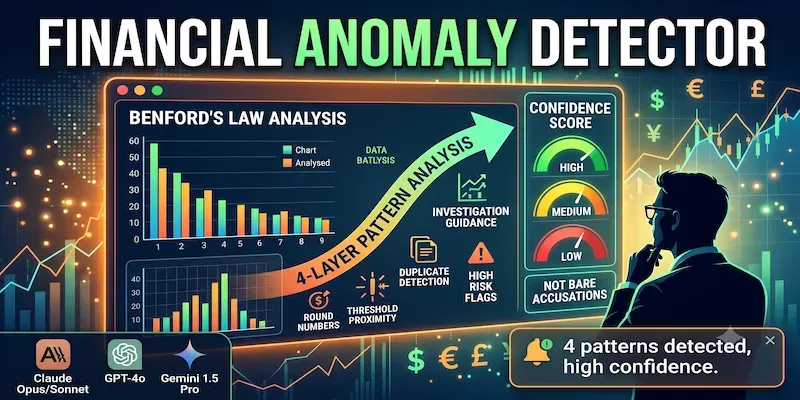
A deviation from Benford's Law is a signal, not a conclusion.
This prompt tells you what the signal means and where to look next.
✅ Benford applicability check runs first — no analysis on
inapplicable data (assigned numbers, constrained ranges, etc.)
✅ Layer 1: First-digit frequency table vs. Benford distribution
with FLAG / ALERT / CRITICAL status per digit
✅ Layer 2: Round number clustering — unusual .00 and ,000 frequency
✅ Layer 3: Threshold proximity — amounts just below approval lim
...more
Added over 1 month ago
