

Prompt Details
Model
(claude-4-6-sonnet)
Token size
1,219
Example input
[PROSPECT_CONTEXT]: Sarah Chen, VP Sales at TechFlow Solutions (150-person Series B SaaS). Hiring 3 SDRs per LinkedIn. Recently promoted from Director.
[YOUR_SOLUTION]: Sales engagement platform. Solves: low reply rates, manual personalization, no attribution. Proof point: customers average 22% reply rate vs. 3% baseline. CTA: 15-minute discovery call.
[SEQUENCE_TONE]: Professional
Example output
## Touch 1: Value Introduction — Day 0
---
**Subject:** SDR ramp + reply rates, TechFlow
Hi Sarah,
Congrats on the VP promotion — and I noticed TechFlow is hiring three SDRs. Scaling a team is one thing; scaling *what they send* is another.
Most SDR teams at your stage see reply rates around 3%. Customers using our platform average 22% — driven by structured personalization and sequence-level attribution that shows which touches actually convert.
As you onboard new reps, the systems they inherit will shape their habits for years. Worth getting that foundation right from day one.
Do you have 15 minutes this Thursday or Friday to compare notes?
— [Your Name]
*P.S. In a few days I'll share how one Series B team cut manual research time by 60% without sacrificing personalization quality.*
---
**Deliverability Audit:**
- Spam triggers: ✅ Clean
- Compliance: ✅ Clean — unsubscribe link + physical address to be added in sending platform
- Format: ✅ Clean — plain text, single CTA, one soft link reference (none embedded)
- Word count: 138 words
---
---
## Touch 2: Different Angle — Day 3
---
**Subject:** The attribution gap new VP Sales face
Hi Sarah,
The SDR hiring makes sense — but here's a problem that often surfaces at your stage: reps send hundreds of touches, pipeline grows, and no one can say *which* messages actually drove the reply.
Without sequence-level attribution, new hires learn from instinct, not data. One Series B team we work with identified their top-performing touch within 30 days of using attribution reporting — then rebuilt their entire onboarding around it.
That single change cut ramp time from 90 days to 60.
Worth a 15-minute conversation if you're evaluating tooling alongside the hiring push?
— [Your Name]
---
**Deliverability Audit:**
- Spam triggers: ✅ Clean
- Compliance: ✅ Clean
- Format: ✅ Clean — no links, single CTA, plain text
- Word count: 118 words
---
---
## Touch 3: Data or Insight — Day 7
---
**Subject:** What the 2025 SDR benchmarks show
Hi Sarah,
One stat from this year's SDR benchmark report worth flagging: teams that personalize at the *sequence* level — not just the first line — see 3× higher reply rates than those personalizing only the opener.
For a new VP inheriting or building a stack, that's a meaningful architectural decision. Personalization baked into rep workflow from day one compounds over time. Bolted on later, it rarely sticks.
No ask here — just curious whether that matches what you're seeing as you scope out the new hires' tooling.
— [Your Name]
---
**Deliverability Audit:**
- Spam triggers: ✅ Clean
- Compliance: ✅ Clean
- Format: ✅ Clean — no links, soft reply CTA only, plain text
- Word count: 107 words
---
---
## Touch 4: Breakup + Final Value — Day 14
---
**Subject:** Closing the loop, Sarah
Hi Sarah,
I've reached out a few times without a response — I'll take the hint and make this my last note for now.
Before I go: here's a one-page framework we put together on building reply-rate benchmarks by SDR tenure level. No form, no follow-up attached. [Resource Link]
If the timing is off, I'm happy to check back in quarterly — just say the word and I'll shift cadences accordingly. No pressure either way.
Wishing TechFlow a strong close to Q2.
— [Your Name]
*P.S. If quarterly works better than silence, just reply "quarterly" and I'll make a note.*
---
**Deliverability Audit:**
- Spam triggers: ✅ Clean
- Compliance: ✅ Clean — unsubscribe + address in footer; explicit opt-down offered in P.S.
- Format: ✅ Clean — one link (resource), plain text, mobile-readable
- Word count: 127 words
---
---
## Behavioral Branching Guide
**If they open but don't reply (Touches 1–2):**
Send Touch 3 as scheduled. Do not accelerate cadence. On the sending platform, tag the contact as "passive-engaged" and A/B test an alternative subject line on Touch 3 using the same body — sometimes the opener is the only blocker.
**If they click a link:**
Move them to a priority queue. Call within 24 hours and reference the specific resource they clicked: *"I saw you pulled up the attribution piece — did it match what you're working through?"* Do not wait for the next scheduled email.
**If they reply "not now":**
Reply within the hour with a single sentence: *"Understood — should I check back in [specific month], or would a different trigger make more sense?"* Log the reactivation date and pause the sequence.
**If they reply "send more info":**
Do not send a brochure or deck unsolicited. Reply with one clarifying question: *"Happy to — what's the priority right now, reply rate improvement or getting new reps ramped faster?"* Then tailor what you send to that answer.
**If no engagement by Touch 4:**
Archive, do not delete. Set a 90-day reactivation trigger tied to a company signal — new funding, a new SDR hire posting, or a leadership change. Re-enter at Touch 1 with a fresh angle. Never re-send a previous email from the same sequence.

$18.99-25%
$14.24
SPECIAL PROMOTION — Offer ends 12 October

 Instant access
 Commercial use
 Money‑back
By purchasing this prompt, you agree to our terms of service
1
Favorites
28
Views
CLAUDE-4-6-SONNET


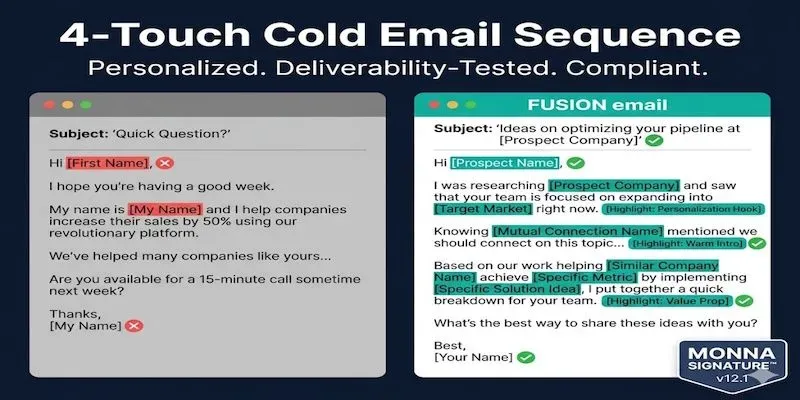
Most cold emails fail because they're templates dressed up as personalization. This prompt does the work the template skips: it maps prospect-specific pain points to your value proposition, engineers each of the 4 touches to add *new* value (not just follow up), and checks every email for spam triggers before it leaves your hands.
✅ Generates a complete 4-touch sequence — initial outreach + 3 strategic follow-ups
✅ Each touch adds different value: insight → case study → free resource → graceful
...more
Added over 1 month ago
