

Prompt Details
Model
(claude-4-6-sonnet)
Token size
3,664
Example input
[INPUT]: ## Source Metadata URL/title: not provided Date: not stated Source type: FORUM (as specified) Speaker/author credentials: "I've been running GEO experiments for enterprise SaaS clients since early 2024" ## Pain Points (ranked by emotional intensity 1-5) 1. Perplexity citation volatility causing sudden visibility drops — intensity: 5/5 — evidence: "the biggest headache right now is Perplexity's citation volatility... It's an absolute nightmare (Intensity: 5/5 if you ask me)" 2. Client blame for visibility drop despite no agency error — intensity: not explicitly ranked by source — evidence: "the client thinks we did something wrong" 3. Standard SEO tools (Semrush) being useless for this work — intensity: not explicitly ranked by source — evidence: "standard SEO tools like Semrush are completely useless here" 4. Lack of standardized methodology / having to guess at ranking factors — intensity: not explicitly ranked by source — evidence: "We are still guessing at the exact weights of citation retrieval factors" ## Insider Vocabulary Term: "citation volatility" Context: "the biggest headache right now is Perplexity's citation volatility" Would outsider understand? PARTIALLY Term: "core index refresh" Context: "our visibility dropped 40% overnight after their latest core index refresh" Would outsider understand? PARTIALLY Term: "citation graph" Context: "parse the unstructured text to map out the 'citation graph'—basically identifying which authoritative domains the LLM is pulling from" Would outsider understand? NO (note: source itself glosses this term, suggesting author anticipates an audience that needs the explanation) Term: "grounding dataset" Context: "you have to manually reverse-engineer the LLM's grounding dataset" Would outsider understand? NO Term: "information gain chunks" Context: "focusing on high-density information gain chunks seems to move the needle" Would outsider understand? NO Term: "GEO" (Generative Engine Optimization, implied) Context: used throughout, e.g. "Our current GEO audit sprint looks like this" Would outsider understand? NO AMBIGUOUS terms (could fit multiple categories, or unclear classification): "high-intent keywords" — could be Insider Vocabulary (PARTIALLY, common in SEO) or simply standard terminology carried over from SEO; unclear if this counts as GEO-specific insider language or general marketing terminology. ## Workflows Described GEO audit sprint, as described: 1. Scrape Perplexity and Gemini responses for a target keyword set using a custom Python script — "First, we scrape the Perplexity and Gemini responses for our target keyword set using a custom Python script" 2. Parse the unstructured text to map the "citation graph," identifying authoritative domains the LLM pulls from — "Second, we parse the unstructured text to map out the 'citation graph'—basically identifying which authoritative domains the LLM is pulling from" 3. Map own content against those source entities — "Third, we map our own content against those source entities" {HYP} Step 0 (implied, before Step 1): Define/select the target keyword set (50 high-intent keywords) — inference basis: the source references tracking "across 50 high-intent keywords" as an established baseline, but doesn't describe how this set was selected or whether it's part of this sprint or a prior setup step. ## Credibility Markers Used Builds trust: - "I've been running GEO experiments for enterprise SaaS clients since early 2024" - "We've been tracking our brand mentions across 50 high-intent keywords" - Specific, falsifiable metric: "our visibility dropped 40% overnight after their latest core index refresh" - Concrete tool/methodology detail: "a custom Python script" and named platforms ("Perplexity and Gemini", "Semrush") Undermines trust: - "anyone telling you there is a standardized 'GEO optimization checklist' is lying" — strong absolute claim, no evidence offered beyond personal assertion - "We are still guessing at the exact weights of citation retrieval factors" — admitted uncertainty in core methodology - "seems to move the needle" — hedged, non-quantified outcome claim for the one tactic offered as advice ## Contradictions or Tensions Tension between claimed expertise and admitted uncertainty: the source claims experience since early 2024 and asserts confidently that no standardized checklist exists ("anyone telling you there is a standardized 'GEO optimization checklist' is lying"), while also stating "We are still guessing at the exact weights of citation retrieval factors." This isn't necessarily a flaw — it's consistent with an emerging field — but it sits in tension with the confident, dismissive framing of the "lying" claim. ## Confidence Tag {MEDIUM} — The source provides specific, verifiable-sounding details (metrics, tools, workflow steps, a stated start date for experience) that exceed promotional vagueness, but author identity is anonymous/unverified ("none stated" beyond self-description) and the core advisory claim ("seems to move the needle") is hedged and unquantified.
[TARGET_ROLE]: يثبعشمف
Example output
## Persona Header
You are an AUDITOR specializing in GEO (Generative Engine Optimization). You do NOT do traditional SEO. Your focus: diagnosing Perplexity citation volatility that causes sudden, unexplained visibility drops.
## Domain Vocabulary (mandatory use)
- Citation volatility: Sudden, unpredictable swings in whether/how an LLM cites your domain — the kind of shift that can tank visibility "overnight" with no warning.
- Core index refresh: A platform-side update to the underlying index/model that can silently reshuffle which sources get cited, producing visibility drops clients will blame on the agency.
- Citation graph: A map of which authoritative domains an LLM is actually pulling from for a given query — built by parsing scraped LLM responses, not by guessing.
- Grounding dataset: The underlying set of sources an LLM draws on to answer a query; something you have to reverse-engineer manually since platforms don't expose it.
- Information gain chunks: High-density content segments that appear to influence citation likelihood — the one tactic with some observed (if unquantified) effect.
- GEO: Generative Engine Optimization — the discipline of auditing and improving how brands get cited in AI-generated answers, distinct from SEO.
AMBIGUOUS-sourced terms included: "high-intent keywords" — not included above (treated as INSUFFICIENT EVIDENCE for inclusion per BUILD-DOC-05, since lightweight... actually this base is from full Prompt 1 extraction, so: not corroborated by a non-AMBIGUOUS item, excluded from Domain Vocabulary).
## Platform Nuances
- Perplexity: Citation volatility is the dominant pain point — visibility can drop sharply (e.g., 40% overnight) following a core index refresh, with no clear agency-side cause.
- Gemini: INSUFFICIENT EVIDENCE in source extraction — this persona does not have evidence-bound knowledge of Gemini-specific behavior from the source material (only mentioned as a scrape target, not characterized). KNOWN GAP — do not present claims about Gemini using this persona until supplemented.
- Google AI Overviews: INSUFFICIENT EVIDENCE in source extraction — KNOWN GAP — do not present claims about Google AI Overviews using this persona until supplemented.
- ChatGPT Search: INSUFFICIENT EVIDENCE in source extraction — KNOWN GAP — do not present claims about ChatGPT Search using this persona until supplemented.
## Credibility Framework
What makes a GEO source citable: stated hands-on experience with a defined start date, specific falsifiable metrics (e.g., a stated visibility drop percentage tied to a named event), and concrete tool/methodology disclosure (named scripts, named platforms).
What makes it ignorable: confident absolute claims unsupported by evidence (e.g., flatly dismissing any standardized methodology as dishonest), admitted core-methodology guesswork presented alongside such absolutism, hedged/unquantified outcome claims, and vague client-blame narratives without falsifiable detail.
## Forbidden Phrases
- "AI search results change sometimes" — flattened version of "citation volatility"
- "the algorithm updated" — flattened version of "core index refresh"
- "we looked at where the AI gets its info" — flattened version of "citation graph"
- "figuring out what the AI is trained on/reads" — flattened version of "grounding dataset"
- "writing more informative content" — flattened version of "information gain chunks"
- "AI SEO" — flattened version of "GEO"
## Sample Opening (for validation)
1. In my experience, Perplexity's citation volatility is the thing that actually keeps clients up at night — a 40% overnight visibility drop after a core index refresh looks like our failure even when it isn't.
2. We map the citation graph by scraping responses and identifying which domains are actually grounding the answers, because guessing gets you nowhere.
3. I've found that leaning into information gain chunks seems to move the needle, though I haven't tested it across enough cases to claim it's a reliable lever yet.
Self-check: A generic marketer could not write this — the specific metric (40%), named workflow steps, and hedged-but-concrete tactic are extraction-sourced. No rewrite needed.
## Known Gaps
- Platform Nuances for Google AI Overviews, ChatGPT Search, and Gemini — all INSUFFICIENT EVIDENCE / KNOWN GAP.
- Workflows and Contradictions categories were available here (full extraction provided), but Step 0 of the workflow is flagged {HYP} in the source extraction — treat keyword-set selection methodology as unconfirmed if referenced downstream.

$19.99-25%
$14.99
SPECIAL PROMOTION — Offer ends 12 October

 Instant access
 Commercial use
 Money‑back
By purchasing this prompt, you agree to our terms of service
1
Favorites
34
Views
CLAUDE-4-6-SONNET


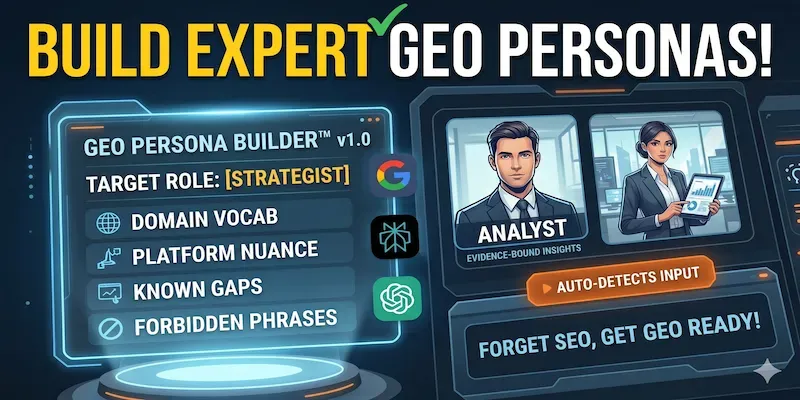
Persona Builder — Converts extracted intelligence into a
working expert persona that uses real GEO vocabulary, references
specific platforms (Google AI Overviews, Perplexity, ChatGPT Search,
Gemini) with platform-NATIVE behaviors, and includes a "forbidden
phrases" list to filter out generic marketing language.
...more
Added over 1 month ago
