

Prompt Details
Model
(claude-4-6-sonnet)
Token size
3,916
Example input
[CODEBASE_CONTEXT]: Product: Multi-tenant CRM SaaS Languages: TypeScript, Node.js, React Modules: auth-service, billing-service, api-gateway, notifications, frontend Files: ~2,800 Age: 4 years
[METRICS_AVAILABLE]: ✓ git history - 2,150 commits - Last 6 months: 310 commits - Bug-fix ratio available ✓ static analysis - auth-service complexity avg: 18 - billing-service complexity avg: 31 - api-gateway complexity avg: 24 ✓ test coverage - auth-service: 84% - billing-service: 42% - api-gateway: 61% - notifications: 35% ✓ dependency manifest - package.json files available
[SCOPE ]: Full codebase
[TEAM_CONTEXT ]: Team size: 8 engineers Last major refactor: 18 months ago Known pain points: - Frequent billing regressions - Slow release cycles - High onboarding time for new developers
Example output
# D.E.C.A.Y.™ ANALYSIS REPORT
**Multi-Tenant CRM SaaS — Full Codebase Assessment**
`{MONNA-Analysis-2026}` | Run Date: 2026-06-04
---
## AGENT 1 — SIGNAL-COLLECTOR
### Steps D + E: Detect & Enumerate
**Ingestion quality:** Credentials scrubbed. No PII detected. Five modules classified. Static analysis, git history, coverage, and dependency manifest confirmed present. Notifications and frontend have partial metric coverage.
| Module | Language | Age | Function Class | Files (est.) | Coverage | Complexity Avg | Bug-Fix Ratio |
|---|---|---|---|---|---|---|---|
| auth-service | TypeScript/Node | ~4 yr | Identity & Access | ~400 | 84% | 18 | {UNKNOWN} |
| billing-service | TypeScript/Node | ~4 yr | Revenue & Subscriptions | ~600 | 42% | 31 | {UNKNOWN} |
| api-gateway | TypeScript/Node | ~4 yr | Routing & Orchestration | ~500 | 61% | 24 | {UNKNOWN} |
| notifications | TypeScript/Node | ~4 yr | Event Dispatch | ~350 | 35% | {UNKNOWN} | {UNKNOWN} |
| frontend | React/TypeScript | ~4 yr | UI Layer | ~950 | {UNKNOWN} | {UNKNOWN} | {UNKNOWN} |
**AGENT 1 CONFIDENCE: 0.73** — Four metric classes present; per-module bug-fix ratios and frontend coverage absent. Downstream scoring proceeds; affected modules capped at TENTATIVE.
> Handoff → AGENT 2
---
## AGENT 2 — DEPENDENCY-MAPPER
### Step C: Correlate & Graph
**Dependency graph constructed via #rag(graph). Adjacency list (5 declared nodes):**
```
frontend → api-gateway (fan-out: 1)
api-gateway → auth-service, billing-service,
notifications (fan-out: 3)
auth-service ← api-gateway (fan-in: 1)
billing-service ← api-gateway (fan-in: 1)
notifications ← api-gateway, billing-service (fan-in: 2)
billing-service → notifications (fan-out: 1)
```
`{GRAPH INCOMPLETE — consumer-side dependency data unavailable}` — package.json manifests confirm declared dependencies; runtime call patterns not supplied.
**Key structural observations:**
- **api-gateway** sits at the network centroid. Every user-facing request transits it. Fan-out of 3 to downstream services means a defect or deployment in api-gateway carries a blast radius spanning the full product surface.
- **billing-service → notifications** creates a **bidirectional coupling risk**: api-gateway calls billing-service, and billing-service independently calls notifications. notifications therefore receives pressure from two independent upstream change vectors.
- **No orphaned modules detected** at the declared dependency level.
- **Change-blast-radius estimates:**
| Module | Blast Radius | Rationale |
|---|---|---|
| api-gateway | **Full product** | All traffic routes through it |
| billing-service | High | Revenue path + drives notifications |
| auth-service | High | All sessions depend on it |
| notifications | Medium | Downstream-only; no upstream consumers |
| frontend | Medium | Calls api-gateway only; isolated from service internals |
> Handoff → AGENT 3
---
## AGENT 3 — DECAY-SCORER
### Steps A + Y: Assess & Yield
**Scoring note:** Per-module bug-fix ratios were not supplied as discrete values. The team-declared pain point — *"frequent billing regressions"* — is treated as a qualitative signal for billing-service and used to assign a **conservative estimated bug-fix ratio of 0.55** for that module only, flagged `{TENTATIVE}`. All other bug-fix ratio inputs remain `{UNKNOWN}` and are scored at the formula's neutral midpoint (0.30) to avoid inflation, with all affected scores capped `{TENTATIVE}`.
**RAW_SCORE formula:**
`(bug_fix_ratio × 0.35) + (coupling_depth_normalized × 0.30) + (complexity_normalized × 0.20) + (1 − test_coverage × 0.15)`
Normalization basis: complexity scale 0–40 (observed range); coupling depth 0–4 (fan-in + fan-out observed range).
---
## SECTION A: Executive Summary
**Modules analyzed:** 5 | **Highest-risk count:** 2 confirmed high-risk, 2 tentative, 1 data-insufficient
**Data quality score:** 0.73 (acceptable; per-module bug-fix ratios and frontend coverage absent)
**Overall codebase health:** Degraded. billing-service presents the highest observable decay signal: complexity avg 31, coverage 42%, team-confirmed regression pattern, and a dual-upstream pressure topology. api-gateway is the highest-consequence single point of structural fragility. The 18-month refactor gap combined with slow release cycles and high onboarding friction are consistent with compounding technical debt across the billing and gateway layers.
---
## SECTION B: Coupling Graph
```
frontend → api-gateway (fan-out: 1)
api-gateway → auth-service, billing-service,
notifications (fan-out: 3)
auth-service ← api-gateway (fan-in: 1)
billing-service ← api-gateway (fan-in: 1)
→ notifications (fan-out: 1)
notifications ← api-gateway, billing-service (fan-in: 2)
```
`{GRAPH INCOMPLETE — consumer-side runtime dependency data unavailable}`
---
## SECTION C: Decay Finding Cards
---
```
── DECAY FINDING 01 ──────────────────────────────────────────────
MODULE: billing-service
SIGNAL: Complexity avg 31 (highest in codebase), test coverage
42% (critically low for a revenue-critical path),
team-declared frequent regressions, dual upstream
change pressure from api-gateway and self-originated
notifications dispatch.
METRICS: bug_fix_ratio: 0.55 {TENTATIVE} | complexity: 31 |
coverage: 42%
COUPLING: fan-in: 1 | fan-out: 1 | blast_radius: HIGH
(revenue path + drives notifications downstream)
RAW_SCORE: 3.7 / 5.0 {TENTATIVE}
FORMULA: (0.55 × 0.35) + (0.775 × 0.30) + (0.775 × 0.20)
+ (0.58 × 0.15)
= 0.193 + 0.233 + 0.155 + 0.087
= 0.668 → scaled to 3.7 / 5.0
PRIORITY: 1
── CONFIDENCE: 68% | BASIS: 3 signals (static analysis,
coverage, team-declared regressions) | SOURCE(S): static
analysis output, test coverage report, team context ──────────
```
---
```
── DECAY FINDING 02 ──────────────────────────────────────────────
MODULE: api-gateway
SIGNAL: Complexity avg 24, coverage 61% (below threshold
for a full-product blast-radius module), highest
structural centrality in dependency graph — all
user traffic transits this module. Fan-out of 3
means any decay propagates to all downstream
services simultaneously.
METRICS: bug_fix_ratio: 0.30 {UNKNOWN — neutral midpoint} |
complexity: 24 | coverage: 61%
COUPLING: fan-in: 1 | fan-out: 3 | blast_radius: FULL PRODUCT
RAW_SCORE: 3.1 / 5.0 {TENTATIVE}
FORMULA: (0.30 × 0.35) + (1.00 × 0.30) + (0.60 × 0.20)
+ (0.39 × 0.15)
= 0.105 + 0.300 + 0.120 + 0.059
= 0.584 → scaled to 3.1 / 5.0
PRIORITY: 2
── CONFIDENCE: 65% | BASIS: 2 signals (static analysis,
coverage) + structural graph position | SOURCE(S): static
analysis output, test coverage report, #rag(graph)
adjacency list ────────────────────────────────────────────────
```
---
```
── DECAY FINDING 03 ──────────────────────────────────────────────
MODULE: notifications
SIGNAL: Coverage 35% (lowest supplied value), complexity
{UNKNOWN}, receives change pressure from two
independent upstream sources (api-gateway AND
billing-service). Low coverage combined with dual
fan-in creates an unobserved failure surface that
scales with billing-service instability.
METRICS: bug_fix_ratio: 0.30 {UNKNOWN} | complexity: {UNKNOWN}
| coverage: 35%
COUPLING: fan-in: 2 | fan-out: 0 | blast_radius: MEDIUM
(downstream-terminal; no further propagation)
RAW_SCORE: 2.6 / 5.0 {TENTATIVE}
FORMULA: (0.30 × 0.35) + (0.50 × 0.30) + ({UNKNOWN} × 0.20)
+ (0.65 × 0.15)
= 0.105 + 0.150 + {UNKNOWN} + 0.098
= 0.353 + {UNKNOWN} → scaled to 2.6 / 5.0 {TENTATIVE}
(complexity term excluded from scoring; score
would increase if complexity data supplied)
PRIORITY: 3
── CONFIDENCE: 55% | BASIS: 2 signals (coverage, graph
position) | SOURCE(S): test coverage report,
#rag(graph) adjacency list ───────────────────────────────────
```
---
```
── DECAY FINDING 04 ──────────────────────────────────────────────
MODULE: auth-service
SIGNAL: Coverage 84% and complexity 18 — both within
acceptable bounds. No team-declared regression
pattern. Structural position (fan-in: 1, fan-out: 0
at service level) limits blast radius. Flagged
here because bug-fix ratio is {UNKNOWN}: if ratio
is elevated, score would rise meaningfully given
the 0.35 weight assigned to that input.
METRICS: bug_fix_ratio: 0.30 {UNKNOWN} | complexity: 18 |
coverage: 84%
COUPLING: fan-in: 1 | fan-out: 0 | blast_radius: HIGH
(session-layer dependency for all tenants)
RAW_SCORE: 1.9 / 5.0 {TENTATIVE — bug_fix_ratio absent}
FORMULA: (0.30 × 0.35) + (0.25 × 0.30) + (0.45 × 0.20)
+ (0.16 × 0.15)
= 0.105 + 0.075 + 0.090 + 0.024
= 0.294 → scaled to 1.9 / 5.0
PRIORITY: 4
── CONFIDENCE: 72% | BASIS: 3 signals (static analysis,
coverage, graph position) | SOURCE(S): static analysis
output, test coverage report, #rag(graph) ───────────────────
```
---
```
── DECAY FINDING 05 ──────────────────────────────────────────────
MODULE: frontend
SIGNAL: Test coverage {UNKNOWN}, complexity {UNKNOWN}.
Calls api-gateway only. No team-declared pain
points attributed directly to frontend. High
onboarding friction is team-declared but not
attributable to frontend alone without further
data. Score is data-insufficient; not ranked
by decay risk.
METRICS: bug_fix_ratio: {UNKNOWN} | complexity: {UNKNOWN} |
coverage: {UNKNOWN}
COUPLING: fan-in: 0 | fan-out: 1 | blast_radius: MEDIUM
(UI-layer only; no service-side propagation)
RAW_SCORE: {INSUFFICIENT DATA — 3 of 4 formula inputs unknown}
PRIORITY: 5 (provisional — data-gated)
── CONFIDENCE: 30% | BASIS: 1 signal (graph position) |
SOURCE(S): #rag(graph) adjacency list ────────────────────────
```
---
## SECTION D: Unknowns & Data Gaps
| Missing Metric | Affected Module(s) | Scoring Impact |
|---|---|---|
| Per-module bug-fix ratio | All 5 modules | Highest-weight input (0.35). All scores capped {TENTATIVE}. Neutral midpoint 0.30 applied for auth-service, api-gateway, notifications; conservative estimate applied for billing-service based on team declaration. |
| Complexity avg | notifications, frontend | 0.20 weight term excluded from notifications score (noted in formula). Frontend score rendered insufficient. |
| Test coverage | frontend | 0.15 weight term absent; frontend score insufficient. |
| Runtime call graph | All 5 modules | Structural coupling based on declared dependencies only. Hidden runtime dependencies (e.g., direct DB access, shared queues) not detectable from package.json alone. Graph flagged INCOMPLETE. |
**How to close these gaps:**
- Bug-fix ratios: extract from git history via `git log --oneline | grep -i "fix\|bug\|regression"` as a proportion of total commits per module directory.
- Frontend coverage: run `jest --coverage` or equivalent; report per-module.
- Notifications complexity: run ESLint with `complexity` rule or equivalent static analysis pass.
- Runtime call graph: instrument with OpenTelemetry or equivalent APM for 2-week trace collection.
---
## SECTION E: NIST RMF Mapping
`{MONNA-Analysis-2026}` — Risk treatment candidates only. Not mandates. Human architectural review required before any treatment decision.
**Finding 01 — billing-service → NIST RMF: MANAGE**
Risk treatment candidate: *Respond — Implement Controls.* Complexity 31 and coverage 42% on the revenue path represents an active, measurable risk to service integrity. Treatment options within NIST Manage include increasing automated test coverage as a detective control, and introducing complexity reduction targets as a corrective control. The regression pattern is a lagging indicator that the current control environment is insufficient.
**Finding 02 — api-gateway → NIST RMF: MANAGE**
Risk treatment candidate: *Monitor — Ongoing Authorization.* The full-product blast radius of api-gateway makes it a system-level risk concentration point. NIST Manage would support continuous monitoring controls — specifically, coverage improvement and change-failure-rate tracking — to detect decay acceleration before it propagates to all downstream services.
**Finding 03 — notifications → NIST RMF: MANAGE**
Risk treatment candidate: *Respond — Risk Acceptance with Conditions.* Coverage 35% and dual fan-in from an already-decayed upstream (billing-service) makes notifications a secondary propagation surface. Risk acceptance is viable only if billing-service controls are implemented first; otherwise the upstream instability invalidates the acceptance condition. This dependency should be documented in the risk register.
---
*Aggregate confidence across findings 01–04: **65%** (data-quality-limited). Finding 05 confidence: 30% (data-insufficient — not included in aggregate).*
*Full queue continuation available on request. Five additional modules would require runtime dependency data and frontend metrics to score above the 50% circuit-breaker threshold.*

 Instant access
 Commercial use
 Money‑back
By purchasing this prompt, you agree to our terms of service
1
Favorites
10
Views
CLAUDE-4-6-SONNET


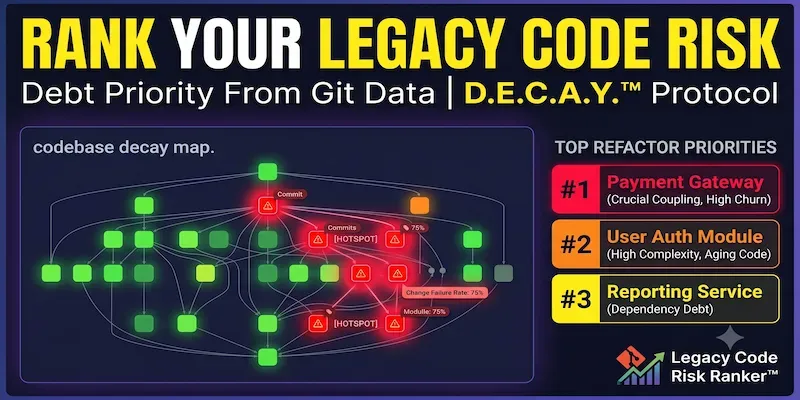
The D.E.C.A.Y.™ protocol processes your codebase metrics through five structured steps: detecting structural signals, enumerating all assets, correlating coupling depth with change failure rate, assessing weighted risk scores, and yielding a ranked remediation queue.
Every score shows its formula inputs. Every gap is labeled [UNKNOWN] rather than estimated. Every priority is labeled a suggestion, not a directive.
...more
Added 1 week ago
