

Prompt Details
Model
(claude-4-6-sonnet)
Token size
857
Example input
[STATE YOUR TOPIC OR ARGUMENT IN 1–2 SENTENCES]: Remote work hasn't killed office culture — bad management did CONTEXT: Organizational consultant, 12 years advising Fortune 500 companies on workplace transformation
[YOUR BACKGROUND, ROLE, OR WHY YOU HAVE AUTHORITY ON THIS TOPIC]: Organizational consultant, 12 years advising Fortune 500 companies on workplace transformation
[COUNTRY, CITY, OR REGION TO ANCHOR EXAMPLES AND DATA — OR "GLOBAL"]: United States
[WHO READS THIS — e.g., "senior marketing executives," "small business owners," "policy makers"]: HR directors and people operations leaders
[WHAT ACTION YOU WANT READERS TO TAKE — e.g., "comment their view," "share with their team," "book a call"]: Comment whether they've seen this pattern in their organizations
Example output
I'll research current data on remote work, office culture, and management trends before writing this piece.I have strong data to work with. Now let me write the piece.
---
**HEADLINE:** The Office Didn't Save Your Culture. Your Managers Already Killed It.
**SUBHEADLINE:** Return-to-office mandates won't fix disengagement. Fixing the people running your teams will.
---
**ARTICLE:**
Somewhere in America right now, a senior VP is standing in front of a whiteboard explaining why everyone needs to come back to the office three days a week. The slides reference "collaboration," "spontaneous innovation," and "belonging." What those slides won't say — because no one has the nerve to put it on a slide — is that the VP hasn't had a meaningful one-on-one with a direct report in six months.
That's not a remote work problem. That's a management problem. And until HR leaders are willing to say so plainly, the organizations they serve will keep treating the symptom while the disease spreads.
The data on return-to-office mandates is damning enough to warrant a conversation that most people operations leaders are avoiding. MIT Sloan Management Review has found that RTO requirements damage employee engagement and increase attrition — specifically among high performers. Yet the mandates keep coming, and a 2024 study of S&P 500 firms found that companies were more likely to issue RTO mandates after their stock prices dipped — not after employee survey scores fell, not after culture audits flagged a problem. After stock prices fell. The office isn't being weaponized for culture. It's being weaponized for optics.
Here's the argument that needs to be made plainly: remote work did not corrode organizational culture in the United States. Managers who were never taught to lead people — only to supervise proximity — were already corroding it. The pandemic didn't create that failure. It just made it visible.
Consider what the pre-pandemic office actually provided. It gave under-skilled managers a set of passive controls: they could see who arrived early, who looked busy, who ate lunch with whom. Culture appeared to "happen" organically because those managers never had to manufacture it deliberately. They free-rode on physical co-presence for years. When co-presence disappeared, so did the illusion of their competence. Nearly half of remote workers — 48% — now believe return-to-office mandates are fundamentally about micromanaging employees rather than genuine cultural concerns. Employees aren't wrong. They lived through the previous version of "culture" and recognize its controlling architecture.
The counterargument goes like this: culture is inherently social and embodied. You can't replicate hallway collisions over Zoom. Psychological safety requires shared physical space. This is not entirely wrong — moving from full-time office work to full-time remote increases reported loneliness by 67%, and less than 10% of company executives believe fully remote companies can sustain strong culture. But notice what this argument quietly assumes: that leadership is incapable of intentionality. That managers cannot be trained to create the connective tissue of culture on purpose rather than by accident. That's a stunning concession about the state of American management, and no one seems to notice they're making it.
GitLab operates with no offices and reports that 86% of its workforce is highly engaged — and research consistently shows that remote workers are most engaged when leadership communication is high quality. Nearly seven in ten managers (69%) in hybrid environments say that flexible work has actually improved their teams' performance. These are not anomalies. They are proof of concept. Culture is a skill, not a square footage requirement.
Research using outcome-focused performance metrics has found significantly stronger correlations with productivity than time-based metrics in distributed work environments — suggesting that trust and autonomy paired with clear goals outperform surveillance-based management models. In plain terms: when you manage for output and trust people to do their jobs, they do their jobs. When you manage for visibility, you get performance theater.
What does this mean for you, as someone responsible for how people operations actually runs in your organization? It means the next time a C-suite leader pitches you an RTO mandate as a culture fix, you need to be the one who asks the harder question: when did we last audit the quality of management at the team level? When did we last measure whether managers are having real development conversations, building psychological safety, or communicating with genuine clarity? 74% of HR professionals report that RTO mandates have led to leadership conflicts within their organizations — which means you are already cleaning up the mess this conversation creates. You might as well get ahead of it.
The organizations that will retain their best people over the next five years won't be the ones with the most amenitized offices. They'll be the ones that invested in building managers who could lead a person they hadn't seen in two weeks with the same intention as one sitting three desks away. That is a training problem, a hiring standards problem, and a promotion criteria problem. All of it is solvable. None of it requires a badge scanner at a turnstile.
Remote work handed American companies an opportunity to finally distinguish between managers who were leading and managers who were just watching. Most chose to call it a crisis instead.
The question worth sitting with: in your organization, have RTO mandates solved a culture problem — or revealed a management one? Drop your honest read in the comments. I'm more interested in the cases that surprised you than the ones that confirmed what you already knew.
---
**WORD COUNT:** 824
**ENGAGEMENT HOOK:** "We're blaming remote work for what bad management broke long before the pandemic — HR leaders, does this pattern sound familiar in your org?"

 Instant access
 Commercial use
 Money‑back
By purchasing this prompt, you agree to our terms of service
1
Favorites
32
Views
CLAUDE-4-6-SONNET


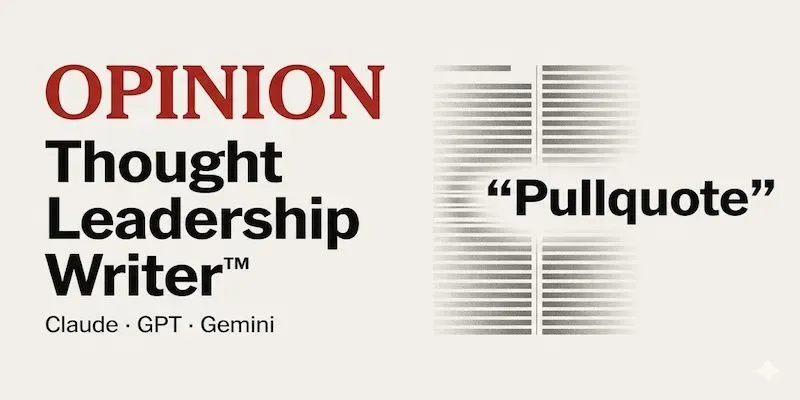
Most opinion pieces fall flat — generic takes, zero evidence, no clear stance. This prompt writes thought-provoking, publication-ready thought leadership articles (750–1,000 words) that stake a real position, back it with facts, and speak directly to your audience.including
gpt prompt
gemini prompt
✅ Stakes a clear, defensible argument
✅ Integrates data, research, and real-world examples automatically
✅ Adapts tone to your industry and geographic context
...more
Added over 1 month ago
