

Prompt Details
Model
(claude-4-8-opus)
Token size
589
Example input
[SYSTEM_TYPE]: Customer support automation
[EXECUTION_MODE]: Hybrid parallel-sequential
[MEMORY_REQUIREMENT]: Long-term persistent
[COMPLEXITY_LEVEL]: High
[INTEGRATION_SCOPE]: ticketing system, knowledge base, billing API
Example output
1️⃣ Agent Role Definition
Intake Classifier
Responsibilities: parse inbound ticket, detect intent, assign severity tier, extract entities (account ID, order ref)
NOT permitted: contact the customer, write to CRM, resolve tickets, access billing API
Knowledge Retrieval Agent
Responsibilities: query knowledge base, rank candidate articles, return top-N with confidence scores
NOT permitted: author new knowledge base content, modify article records, compose customer-facing text
Account Context Agent
Responsibilities: pull CRM history, fetch billing status, surface open tickets and prior escalations
NOT permitted: mutate CRM records, issue refunds, alter billing state
Response Composer
Responsibilities: draft customer reply from retrieval + context payloads, apply tone policy, flag low-confidence drafts
NOT permitted: send messages directly, bypass review gate, invent policy claims not present in retrieved sources
Action Executor
Responsibilities: write ticket updates, apply approved billing adjustments, transition ticket state, log CRM interaction
NOT permitted: act without approved action token, exceed refund authority ceiling, retry destructive writes
Supervisor Agent
Responsibilities: validate composer output against source grounding, enforce authority ceilings, route to human, own escalation
NOT permitted: compose replies, perform retrieval, execute integration writes
Boundaries are enforced so that no single agent can both decide and act — separation of judgment from execution is the primary containment control.2️⃣ Communication Protocol
Message envelope fields:
msg_id, trace_id, parent_msg_id
sender_agent, recipient_agent
intent (request | result | error | escalation)
payload (typed, schema-versioned)
confidence (0.0–1.0)
source_refs[] (grounding citations)
authority_token (scoped, expiring — required for any write)
attempt_count, timestamp, schema_version
State passing logic:
Central ticket state object owned by Supervisor; agents receive read-only snapshots
Agents return deltas, never mutate shared state directly
Supervisor applies deltas and increments state version
Version mismatch on submission → delta rejected, agent re-issued fresh snapshot
Failure escalation path:
Agent-local retry with adjusted parameters
Reroute to sibling agent instance
Degrade to lower-capability fallback path (e.g. generic acknowledgment)
Supervisor holds ticket, marks needs_review
Queue to human support agent with full trace and drafted context
If unclaimed past SLA window → page on-call support lead
3️⃣ Task Routing Logic
Decision tree:
Severity = critical OR churn-risk account → Supervisor → human queue (skip automation)
Intent = billing dispute → Account Context Agent → Supervisor (authority check) → Action Executor
Intent = how-to / informational → Knowledge Retrieval Agent → Response Composer
Intent = account status query → Account Context Agent → Response Composer
Intent = ambiguous, classifier confidence < 0.6 → clarification loop (max 1) → else human queue
Retrieval confidence < 0.5 → suppress draft → human queue
Priority rules:
Human-escalated tickets preempt all automated work
Critical severity outranks queue age
Billing-API-touching tasks serialize per account ID
Tickets nearing SLA breach promoted one tier
Retry attempts inherit original priority, never elevate
Load balancing:
Retrieval and Context agents run as stateless replica pools, least-in-flight dispatch
Action Executor sharded by account ID hash to preserve per-account ordering
Billing API calls pass through a shared token-bucket limiter
Composer pool autoscales on queue depth; overflow drains to human queue rather than degrading grounding
4️⃣ Memory Architecture
Short-term context:
Per-ticket working set: current thread, classifier output, retrieved articles, context payload
Rolling window of last N turns kept verbatim; older turns compressed to summary
Evicted on ticket close, retained 24h for reopen
Long-term storage:
Customer profile store: preferences, tone history, prior resolutions, escalation history
Resolution archive: ticket → action → outcome triples, indexed for retrieval
Vectorized knowledge base with versioned article snapshots (so past answers remain auditable)
Interaction ledger: append-only, immutable, retained per compliance window
Retrieval triggers:
On intake: pull customer profile + last three resolved tickets
On classifier intent assignment: knowledge base semantic query
On billing intent: fetch 90-day billing event history
On repeat contact within 7 days: force-load prior thread verbatim
On composer low confidence: widen retrieval to adjacent intent clusters
5️⃣ Control & Governance Layer
Error detection:
Schema validation on every message envelope
Grounding check — every factual claim in a draft must map to a source_ref
Confidence floor enforcement per agent type
Timeout watchdog per agent invocation
Loop detector: same intent re-routed > 2 times triggers halt
Authority ceiling check before any billing write
Anomaly monitor on refund amounts and action frequency per account
Retry logic:
Immediate retry, identical parameters (transient faults only, max 2)
Retry with exponential backoff against a replica instance
Retry with reduced scope (narrower query, smaller context)
Fallback to degraded path (template acknowledgment, no claims)
Abandon automation, hand to human with full trace
Human-in-the-loop triggers:
Any refund or credit above authority ceiling
Grounding check failure
Composer confidence below threshold
Detected customer distress or legal/regulatory language
Third contact on the same unresolved issue
Any account flagged VIP or churn-risk
Supervisor-detected policy conflict between retrieved sources
6️⃣ Latency & Performance Strategy
Parallel execution:
Knowledge Retrieval and Account Context run concurrently after classification
Billing status fetch parallelized with CRM history pull
Speculative retrieval kicked off on preliminary intent guess, discarded on mismatch
Sequential constraints:
Classification must precede all routing
Composition must follow both retrieval and context completion
Supervisor validation strictly gates execution
Per-account billing writes serialized
Bottleneck risks:
Supervisor validation as a single funnel point
Billing API rate limits under burst load
Knowledge base vector search latency on cold index
Composer queue depth during volume spikes
Throughput optimization:
Cache classifier results for near-duplicate inbound text
Warm knowledge base index, pin hot articles
Batch CRM reads across concurrent tickets
Shard Supervisor validation by severity tier so critical path stays clear
Precompute customer context on inbound channel open, before ticket submission
7️⃣ Risk & Stability Analysis
Cascade failure — knowledge base outage causes composer to emit ungrounded drafts, Supervisor rejects all, queue floods human tier
Mitigation: circuit breaker on retrieval, automatic switch to acknowledgment-only mode, human queue admission control with backpressure to intake
Single-point dependency — Supervisor is the sole validation and authority gate
Mitigation: multi-instance Supervisor with leader election, shared state store, shadow validator running in parallel to detect drift
Resource exhaustion — volume spike saturates composer pool and billing rate limits
Mitigation: per-tier admission control, priority preemption, hard concurrency caps per integration, graceful degradation to templated responses
Grounding drift — knowledge base article updates while a draft is in flight
Mitigation: version-pinned retrieval snapshots, revalidation before send
Authority creep — repeated retries accumulate partial writes
Mitigation: idempotency keys on all executor actions, single-use authority tokens
Poison ticket — malformed or adversarial input loops through routing
Mitigation: loop detector, attempt ceiling, quarantine queue
8️⃣ Scalability Roadmap
Phase 1 — Foundation
Planner count: single Supervisor instance, single Intake Classifier
Executor scale: 2–3 replicas per stateless agent, one Action Executor shard
Governance maturity: manual policy review, human approval on all billing writes, basic audit log
Phase 2 — Consolidation
Planner count: Supervisor cluster with leader election; classifier pool with per-channel specialization
Executor scale: autoscaled retrieval/context pools, Action Executor sharded by account hash, regional replicas
Governance maturity: automated policy engine, tiered authority ceilings, sampled human audit, drift monitoring on grounding rates
Phase 3 — Federation
Planner count: domain-partitioned Supervisors (billing, technical, account) under a meta-router
Executor scale: multi-region executor fleets, dedicated pools per integration, independent scaling per intent cluster
Governance maturity: continuous automated compliance evaluation, policy-as-code with versioned rollout, self-healing retry orchestration, human review reserved for exception classes only
9️⃣ Observability & Monitoring Metrics
Agent-level KPIs:
Classifier: intent accuracy vs. human relabel, confidence calibration curve
Retrieval: top-1 relevance rate, empty-result rate, index freshness lag
Context: fetch completeness, stale-record rate
Composer: grounding pass rate, revision rate, tone policy violations
Executor: write success rate, idempotency collision count
Supervisor: rejection rate by cause, escalation rate, authority-block count
Failure tracking:
Error taxonomy by class (schema, timeout, grounding, authority, integration)
Retry depth distribution — alert on rising tier-3+ usage
Cascade indicator: correlated failure rate across agent types
Human queue inflow rate and cause attribution
Trace completeness — % of tickets with unbroken trace_id chain
Latency benchmarks:
End-to-end intake → send, p50 / p95 / p99
Per-agent invocation latency, same percentiles
Parallel fan-out join wait time
Supervisor validation queue depth and hold time
Integration call latency per system (CRM, ticketing, KB, billing)
SLA breach rate by severity tier
🔟 Executive Architecture Summary
Core Structure: Intake Classifier → [Knowledge Retrieval ∥ Account Context] → Response Composer → Supervisor (validate + authorize) → Action Executor → Human Escalation Queue
Critical Risk: Supervisor is the single validation and authority funnel — its saturation or failure degrades the entire pipeline to human-only handling.
Optimization Priority: Shard Supervisor validation by severity tier and precompute customer context pre-submission, targeting the p95 latency dominated by the serial validate-then-execute gate.

 Instant access
 Commercial use
 Money‑back
By purchasing this prompt, you agree to our terms of service
1
Favorites
3
Views
CLAUDE-4-8-OPUS


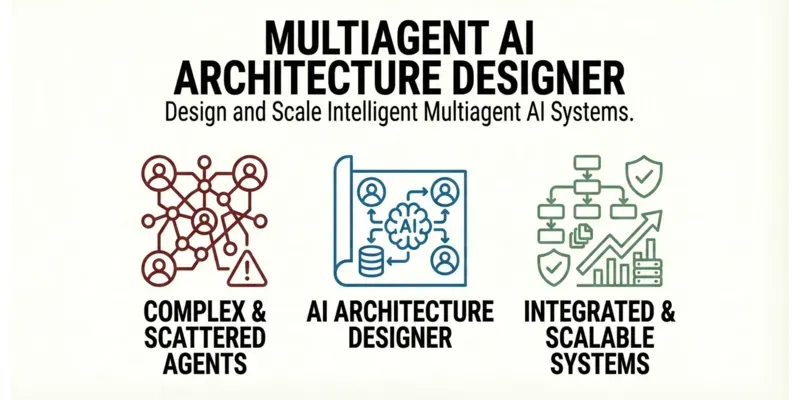
Design production-grade multi-agent AI systems in seconds. Feed in five variables — system type, execution mode, memory needs, complexity, and integration scope — and get a complete 10-section architecture spec: agent roles with hard permission boundaries, message protocols, routing decision trees, memory layers, governance and retry tiers, latency strategy, risk analysis, scaling roadmap, monitoring KPIs, and an executive summary. Vendor-neutral. No code, pure architecture.
...more
Added 17 hours ago
