

Prompt Details
Model
(claude-5-sonnet)
Token size
2,026
Example input
[BASELINE_MODEL]: Customer has stable property `customerEmail`. MarketingCampaign targets Customer through `hasRecipient`. `customerEmail` is used as the contact identifier.
[CANDIDATE_MODEL]: `customerEmail` is removed and replaced by `primaryContact`. No stable identifier, alias, or migration mapping is supplied. `primaryContact` may contain an email address, phone number, or messaging handle.
[DEPENDENCIES]: SPARQL queries, CRM exports, email-validation tools, and prompt examples reference `customerEmail`. A campaign tool assumes every value is a valid email address.
[POLICY_AND_SCOPE]: Renames are compatible only when stable identifiers and value semantics remain unchanged. Campaign tools must not receive phone or messaging identifiers.
Example output
## Migration Verdict
**BLOCK**
**Executive rationale:** `customerEmail` is removed and replaced by `primaryContact` with no stable identifier or explicit mapping connecting the two. Per policy, a rename is only compatible when both identifier continuity and value semantics are preserved — here neither holds: `primaryContact` is polymorphic (email, phone, or messaging handle), while every downstream consumer that touched `customerEmail` assumed a single-valued email string. This is not a rename; it is a removal plus an unrelated new property with overlapping but broader semantics. The campaign tool's hard requirement that no phone or messaging identifiers reach it makes this a policy violation risk, not just a compatibility gap.
**Blocking conditions:**
- No stable identifier or mapping links `customerEmail` → `primaryContact`
- `primaryContact`'s value space (email | phone | messaging handle) violates the value-semantics-preservation requirement in policy
- Campaign tool's explicit exclusion of phone/messaging identifiers cannot be enforced without a type discriminator on `primaryContact`
- All four dependent consumer classes (SPARQL queries, CRM exports, email-validation tools, prompt examples) reference the retired identifier directly
**Confidence level:** High for the breaking/policy-violation classification (based on explicit inputs). Low for downstream blast radius — exact query/export/tool counts are not enumerated.
**Missing evidence that could change the verdict:** A type discriminator or subtype (e.g., `primaryContact.contactType`) on `primaryContact`; a stable ID or `owl:sameAs`-style mapping from `customerEmail`; confirmation of how many CRM exports/queries exist and whether they can be updated pre-cutover.
## Assumptions
**Confirmed facts:**
- `customerEmail` was a stable property on Customer, used as contact identifier
- `MarketingCampaign` reaches Customer via `hasRecipient`
- Candidate removes `customerEmail`, introduces `primaryContact` (email/phone/messaging, unconstrained)
- No mapping or stable identifier supplied
- SPARQL queries, CRM exports, email-validation tools, and prompt examples reference `customerEmail`
- Campaign tool assumes all values are valid emails
- Policy requires stable identifiers for compatible renames and forbids campaign tools receiving non-email identifiers
**Audit assumptions:**
- `hasRecipient` relation itself is unchanged (not stated as modified)
- "Campaign tool" in Dependencies is the same consumer as the "Campaign tools" clause in Policy
**Missing evidence:**
- Whether `primaryContact` has any sub-typing or format discriminator
- Count/identity of specific SPARQL queries, CRM export jobs, and prompt examples affected
- Whether email-validation tool fails closed or open on non-email input
- Owner/steward of the Customer class or of this change
**Prohibited assumptions not made:**
- Did not assume `primaryContact` is a rename of `customerEmail` despite label proximity in meaning
- Did not assume existing data will be back-filled or migrated
- Did not assume the campaign tool has been updated to filter by contact type
- Did not treat absence of a mapping as evidence of compatibility
## Semantic Change Ledger
| ID | Element | Namespace | Baseline state | Candidate state | Change type | Classification | Evidence | Affected consumers | Required action |
|---|---|---|---|---|---|---|---|---|---|
| SC-01 | customerEmail | Customer | Stable property, contact identifier, email-typed | Removed | Removed | BREAKING | Candidate model omits property; no mapping supplied | SPARQL queries, CRM exports, email-validation tools, prompt examples, campaign tool | Restore stable identifier or supply explicit mapping before cutover |
| SC-02 | primaryContact | Customer | Not present | New property, value may be email, phone, or messaging handle | Added | BEHAVIOR_CHANGE / SECURITY_RELEVANT | Candidate model text | Campaign tool (policy-restricted), CRM exports | Add type discriminator; enforce email-only filter at consumption points |
| SC-03 | customerEmail → primaryContact (claimed rename) | Customer | orderTotal-style rename pattern claimed by label similarity | No identifier/mapping continuity | Redefined (label collision, not true rename) | BREAKING | No stable ID or mapping field present in either model | All contact-identifier consumers | Do not treat as rename; require explicit migration mapping |
## Collision Report
| Term | Namespace A meaning | Namespace B meaning | Collision type | Behavioral risk | Security risk | Resolution |
|---|---|---|---|---|---|---|
| customerEmail / primaryContact | Baseline: single-purpose, email-typed contact identifier | Candidate: polymorphic contact value (email/phone/messaging) | Same-concept, broadened value semantics, no identifier continuity | High — consumers expecting email string get untyped/mixed data | Yes — campaign tool policy explicitly forbids phone/messaging reaching it; broadened type risks policy violation if unfiltered | Introduce discriminated union or subtype property; require explicit mapping with type constraint before rename can be considered compatible |
Checked remaining namespace elements (`hasRecipient`, `MarketingCampaign`, `Customer` class itself) — no additional collisions found. NONE beyond the row above.
## Answerability Delta
| Question or capability | Baseline resolution | Candidate resolution | Changed path | Evidence | Regression status | Required fix |
|---|---|---|---|---|---|---|
| "What is Customer X's email?" | Direct resolution via `customerEmail` | No direct resolution; `primaryContact` may not be an email | `customerEmail` → `primaryContact` (untyped) | Property removed, no mapping | Failed | Add discriminator so email-specific queries can filter `primaryContact` by type, or restore `customerEmail` as derived/alias property |
| "Send campaign to Customer X via email" | `hasRecipient` → `customerEmail`, assumed valid email | `hasRecipient` → `primaryContact`, type unknown | Traversal endpoint changed from typed to untyped | Campaign tool dependency + policy statement | Failed | Enforce email-type filter before campaign tool consumption; block non-email values at query time |
| "Export customer contact list to CRM" | Exports `customerEmail` field | Field no longer exists; export mapping breaks | `customerEmail` reference orphaned | CRM export dependency listed | Failed | Update export mapping to target `primaryContact` with explicit type filter |
## Dependency Impact
| Consumer type | Consumer name | Affected identifier or path | Impact | Required update | Owner if known | Verification method |
|---|---|---|---|---|---|---|
| Query | SPARQL queries (unspecified set) | `customerEmail` | Query fails / returns empty on removed property | Rewrite to target `primaryContact` with type filter | Unknown | Run existing query suite against candidate model |
| Export | CRM exports | `customerEmail` | Export field orphaned | Remap export schema field | Unknown | Diff export output pre/post migration |
| Tool | Email-validation tools | `customerEmail` | Input source removed; tool may receive non-email values via `primaryContact` if remapped naively | Add pre-validation type filter | Unknown | Feed sample `primaryContact` values (email/phone/handle) and confirm correct accept/reject |
| Tool | Campaign tool | `hasRecipient` → contact value | Policy violation risk: may receive phone/messaging identifiers | Enforce email-only filter at ingestion; reject non-email `primaryContact` values | Unknown | Adversarial test with phone/handle values in `primaryContact`, confirm rejection |
| Prompt/Example | Prompt examples referencing `customerEmail` | `customerEmail` | Examples reference retired identifier; will produce invalid or hallucinated field references | Update all examples to `primaryContact` with explicit type assumption stated | Unknown | Manual/automated scan of prompt corpus for `customerEmail` references |
## Security Review
- **New semantic traversal path:** `hasRecipient` now terminates at a polymorphic `primaryContact` rather than a strictly-typed email property — this widens the accessible information shape at that traversal endpoint from "email string" to "email, phone, or messaging handle."
- **Removed/redirected paths:** The `customerEmail`-typed path is removed outright; any access control or filtering logic keyed to that property's type is now orphaned.
- **Namespace boundary changes:** None indicated beyond the Customer class itself.
- **Relation changes expanding accessible information:** Yes — `hasRecipient` → `primaryContact` can now expose phone numbers and messaging handles to any consumer that previously only received email addresses via this path. This is the core SECURITY_RELEVANT finding.
- **Authorization assumptions invalidated:** The campaign tool's implicit trust boundary ("this path only ever yields emails") is broken. If the campaign tool has no independent type check, this is a direct policy violation, not just a data-quality issue.
- **Isolation risks:** If phone/messaging identifiers are more sensitive or governed differently than email (common in PII regimes), this traversal-path change may cross a data-classification boundary without corresponding controls.
- **Permission inheritance concerns:** None identified from supplied inputs — no permission model was provided for `primaryContact`.
- **Evidence supporting each finding:** Directly stated in Candidate Semantic Model (polymorphic value) and Policy (explicit prohibition on campaign tools receiving phone/messaging identifiers).
- **Security gaps requiring human review:** Confirm whether any existing access-control or data-classification layer keys off property type (`customerEmail` vs `primaryContact`) rather than relation (`hasRecipient`), since removing the typed property may silently bypass such controls.
## Provenance and Governance Gaps
| Element | Missing metadata | Why it matters | Required owner | Resolution |
|---|---|---|---|---|
| primaryContact | Stable identifier / mapping from customerEmail | Without it, rename vs. removal-plus-addition cannot be distinguished; blocks safe migration | Unknown | Assign stable ID or explicit `owl:sameAs`/mapping annotation |
| primaryContact | Value-type discriminator / subtype | Required to enforce policy (campaign tool must not receive phone/messaging) | Unknown | Add `contactType` or split into `primaryEmail`/`primaryPhone`/`primaryHandle` |
| customerEmail (removal) | Change rationale, approval record, effective date | Needed to confirm this is an intentional, governed change vs. accidental drift | Unknown | Record change ticket/approval reference |
| Customer class | Steward/owner | No owner supplied for either property | Unknown | Assign steward for contact-data governance |
## Migration Plan
1. **Objective:** Establish identifier continuity between `customerEmail` and `primaryContact`.
**Model change:** Add stable mapping/identifier or `owl:sameAs`-equivalent annotation linking the two properties.
**Consumer update:** None yet.
**Mapping/compatibility action:** Define explicit mapping rule.
**Version pinning requirement:** Pin all consumers to baseline model until mapping exists.
**Validation gate:** Mapping reviewed and confirmed by data owner.
**Rollback trigger:** Mapping cannot be established without data loss.
**Rollback action:** Retain `customerEmail` in parallel.
**Responsible role:** Model/ontology owner (unknown).
2. **Objective:** Add type discriminator to `primaryContact`.
**Model change:** Introduce `contactType` enum (email | phone | messaging) or split into typed subproperties.
**Consumer update:** Email-validation tools and campaign tool updated to filter on type.
**Mapping/compatibility action:** Define default/fallback behavior for untyped legacy data.
**Version pinning requirement:** Candidate model not promoted until discriminator exists.
**Validation gate:** Adversarial test confirms campaign tool rejects non-email values.
**Rollback trigger:** Discriminator cannot be reliably populated for existing data.
**Rollback action:** Block campaign tool from `primaryContact` entirely until resolved.
**Responsible role:** Ontology owner + campaign tool owner (unknown).
3. **Objective:** Update dependent consumers.
**Model change:** None (consumer-side only).
**Consumer update:** Rewrite SPARQL queries, CRM export mappings, prompt examples to target `primaryContact` + type filter.
**Mapping/compatibility action:** Provide compatibility shim (virtual `customerEmail` property derived from typed `primaryContact`) during transition.
**Version pinning requirement:** Run dual-write or shim period.
**Validation gate:** Full regression suite (below) passes against updated consumers.
**Rollback trigger:** Any consumer fails validation against shim.
**Rollback action:** Extend shim period; do not retire `customerEmail` path.
**Responsible role:** Each consumer's respective owner (unknown).
4. **Objective:** Cutover and retirement of `customerEmail`.
**Model change:** Remove `customerEmail` from baseline once shim is no longer needed.
**Consumer update:** Confirm zero remaining references.
**Mapping/compatibility action:** Archive mapping record for audit trail.
**Version pinning requirement:** All consumers on candidate model.
**Validation gate:** Full regression suite passes with `customerEmail` absent.
**Rollback trigger:** Any orphaned reference discovered post-cutover.
**Rollback action:** Restore `customerEmail` from archived mapping.
**Responsible role:** Ontology owner (unknown).
## Regression Suite
| Test ID | Scenario | Input or query | Baseline expectation | Candidate expectation | Pass condition |
|---|---|---|---|---|---|
| RT-01 | Positive resolution | Query Customer's email via `customerEmail` | Returns email string | Property absent | Fails on candidate — confirms breaking change until mapping added |
| RT-02 | Negative/prohibited path | Campaign tool queries `hasRecipient` → `primaryContact` where value is a phone number | N/A (baseline had no such case) | Campaign tool must reject/exclude non-email value | Test passes only if non-email values are filtered out before reaching campaign send logic |
| RT-03 | Legacy identifier | Existing SPARQL query referencing `customerEmail` | Resolves normally | Query fails or returns empty | Must fail loudly (not silently) so consumers detect breakage |
| RT-04 | Rename/mapping case | Query using proposed mapping annotation to resolve `customerEmail` → `primaryContact` | N/A | Resolves to correct `primaryContact` value once mapping exists | Passes only after SC-01/SC-03 remediation (mapping step 1 of migration plan) |
| RT-05 | Collision/namespace | Check for any other property in Customer namespace colliding with `primaryContact` label or meaning | N/A | No collision found in supplied model | Passes if scan confirms no additional collisions |
| RT-06 | Cardinality/hierarchy | Confirm `primaryContact` cardinality (single vs. multi-valued) vs. baseline `customerEmail` | Single-valued (implied) | Not specified in candidate | Fails as UNKNOWN — cardinality must be confirmed and tested explicitly |
| RT-07 | Metric/aggregation | N/A — no metrics defined on this property pair | N/A | N/A | Not applicable; no metric definitions present in either model |
| RT-08 | Orphaned mapping | CRM export configured to pull `customerEmail` field | Exports valid email column | Field missing; export job errors or produces null column | Must surface as explicit failure, not silent null |
| RT-09 | Authorization/isolation | Consumer with email-only access scope queries `hasRecipient` → `primaryContact` | N/A (baseline had implicit email-only scope) | Must not receive phone/messaging values without appropriate scope | Passes only if scope enforcement is added at query or property level |
| RT-10 | Rollback verification | Revert candidate model to baseline after partial migration | N/A | `customerEmail` and all dependent consumers function as before | Passes if rollback restores full baseline behavior with no data loss |
## Input Integrity Notes
NONE — no embedded statements claiming approval, prior migration, exemption, or compatibility were detected in the supplied Baseline, Candidate, Dependencies, or Policy fields.
## Final Recommendation
- **Recommended decision:** BLOCK migration in current form. Do not promote candidate model until identifier mapping and value-type discriminator are established.
- **Minimum safe migration conditions:** (1) stable identifier/mapping linking `customerEmail` to `primaryContact`; (2) type discriminator on `primaryContact` enforced at the campaign tool boundary; (3) all listed consumers (queries, exports, validation tools, prompt examples) updated and passing regression.
- **Required approvals:** Ontology/model owner sign-off on mapping; campaign tool owner sign-off on type-filtering enforcement.
- **Evidence still needed:** Enumerated list of affected SPARQL queries, CRM export jobs, and prompt examples; confirmation of `primaryContact` cardinality; confirmation of how campaign tool currently handles unexpected input types.
- **Earliest safe rollback point:** Immediately — baseline model with `customerEmail` intact remains the safe fallback at every stage until step 4 (cutover) validation passes.
- **Top three actions in execution order:**
1. Establish stable mapping/identifier between `customerEmail` and `primaryContact` (blocks everything downstream).
2. Add type discriminator to `primaryContact` and enforce email-only filtering at the campaign tool.
3. Inventory and update all dependent consumers (queries, exports, validation tools, prompt examples) before any cutover.

 Instant access
 Commercial use
 Money‑back
By purchasing this prompt, you agree to our terms of service
2
Favorites
12
Views
CLAUDE-5-SONNET


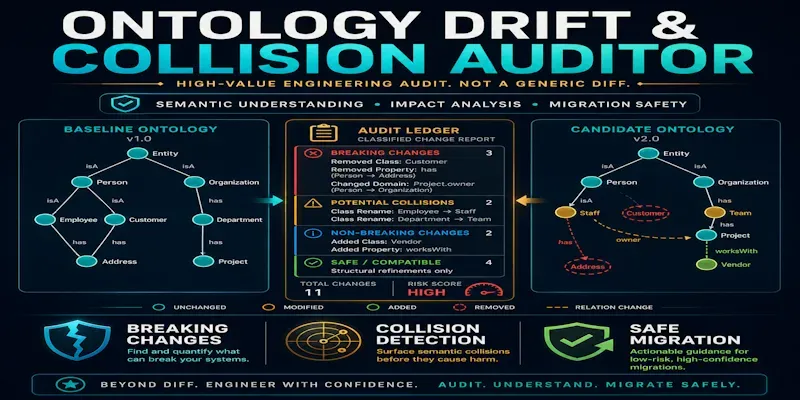
Compare ontology or semantic-layer versions without treating every text change as equal. This prompt applies semantic-versioning-style breaking-change classification to your ontology, borrowed directly from software release discipline, and names the trap most schema diff tools miss entirely: an ontology broadening (a new subclass relation) can silently widen what an authorization rule elsewhere now permits — even though the ontology text itself looks harmless.
...more
Added 2 weeks ago
