

Prompt Details
Model
Chat - (gpt-5.5)
Token size
514
Example input
[DOGMATIC_QUESTION]: What is the distinction between God's essence and his energies, and why does it matter?
[ORTHODOX_METHOD]: the essence-energies distinction
[COMPARATIVE_LENS]: Roman Catholic
[AUDIENCE_LEVEL]: undergraduate theology student
[OUTPUT_FORMAT]: a structured theological essay with an introduction, three argued sections, and a conclusion
Example output
Introduction
Among the most characteristic teachings of Eastern Orthodox theology is the distinction between God’s essence (ousia, οὐσία) and God’s energies (energeiai, ἐνέργειαι). This distinction, articulated with particular clarity by Gregory Palamas and received in the liturgical and doctrinal life of the Orthodox Church, seeks to preserve two truths simultaneously: first, that God in Himself is utterly transcendent and beyond comprehension; second, that human beings truly participate in God and are genuinely united to Him in salvation. The distinction therefore stands at the center of Orthodox theology of revelation, grace, prayer, sacramental life, and theosis (θέωσις), the deification of humanity.
The question matters because Christianity does not proclaim merely moral improvement or symbolic communion with God, but real participation in divine life. Yet if GodΓÇÖs inner being is absolutely inaccessible, how can creatures truly commune with Him? Conversely, if creatures participate directly in the divine essence, does this not abolish the distinction between Creator and creation? The Orthodox doctrine of the essence-energies distinction answers both concerns by teaching that GodΓÇÖs essence remains forever transcendent while His uncreated energies are truly God Himself as He freely manifests and communicates Himself.
This essay will first define the distinction and its theological vocabulary; second, ground the doctrine in Scripture and the Fathers; and third, explain why the distinction matters dogmatically, spiritually, and in comparison with the Roman Catholic tradition. Throughout, the apophatic character of Orthodox theology must remain central: God is not reducible to concepts, and every theological statement ultimately points beyond itself to divine mystery.
I. The Meaning of the Essence-Energies Distinction
The Orthodox tradition distinguishes between GodΓÇÖs essence (ousia) and GodΓÇÖs energies (energeiai). The divine essence refers to what God is in Himself, in His inner being beyond all created comprehension. The divine energies refer to GodΓÇÖs real and uncreated operations, manifestations, and self-communications by which He creates, sustains, illumines, sanctifies, and deifies the world.
The distinction is neither a division in God nor a multiplication of gods. Orthodox theology insists that God is absolutely simple, not composed of parts. The energies are not created intermediaries standing between God and creation, nor are they merely effects external to God. Rather, they are truly God Himself in His living activity. As the Fathers often express it, we know God from His energies, but not in His essence.
This distinction depends upon the broader framework of apophatic theology. Apophaticism, especially associated with Dionysius the Areopagite, teaches that God transcends every created category and concept. God is not merely the highest being among beings but beyond being as creatures understand being. Therefore no created intellect can comprehend the divine essence. This apophatic reserve is not skepticism but reverence before transcendence.
At the same time, Scripture affirms genuine communion with God. The Apostle Peter teaches that Christians become ΓÇ£partakers of the divine natureΓÇ¥ (2 Peter 1:4). Orthodox theology interprets this participation not as participation in the divine essence itself, which would collapse the Creator-creature distinction, but as participation in the divine energies. Through grace, humanity truly encounters God and is transformed by Him without becoming identical with His essence.
Several additional terms clarify the doctrine. Hypostasis (ὑπόστασις) refers to concrete personhood. In Trinitarian theology, the one divine essence subsists in three hypostases: Father, Son, and Holy Spirit. The energies belong to the one God and therefore are common to all three divine Persons. The doctrine does not divide the Trinity.
Likewise, perichoresis (περιχώρησις), the mutual indwelling of the divine Persons, reminds us that all divine action toward creation is the action of the one triune God. When the believer experiences divine grace, he encounters not an impersonal force but the living God Himself.
Finally, theosis is central. Orthodox salvation is not merely juridical acquittal but transformative union with God. As Athanasius of Alexandria famously taught, ΓÇ£God became man so that man might become god.ΓÇ¥ The Fathers consistently understood this ΓÇ£becoming godΓÇ¥ as participation by grace, not by nature. The essence-energies distinction safeguards precisely this possibility.
Dogmatically, the Orthodox Church received the theology of Palamas through the councils held at Constantinople in the fourteenth century (1341, 1347, 1351), especially against the criticisms of Barlaam of Calabria. While these councils are not counted among the seven Ecumenical Councils, the Orthodox Church has broadly received their teaching as authoritative expressions of Orthodox doctrine. What is dogmatically fixed is the real distinction between essence and energies and the uncreated nature of divine grace. Certain philosophical explanations of how the distinction should be articulated remain matters of theologoumenon.
II. Scriptural and Patristic Foundations
The essence-energies distinction did not originate in the fourteenth century. Palamas understood himself not as inventing a doctrine but as defending the inherited tradition of the Church.
The scriptural foundations are substantial. In Exodus 33, Moses asks to see GodΓÇÖs glory. God replies that no one can see His face and live, yet Moses may behold GodΓÇÖs ΓÇ£back.ΓÇ¥ The Fathers frequently interpreted this as indicating a distinction between God in Himself and God as revealed. God remains inaccessible in essence yet truly manifests His glory.
Similarly, in the Transfiguration narratives (Matthew 17; Mark 9; Luke 9), the disciples behold the uncreated light shining from Christ. Palamas identified the light of Tabor not as a created symbol but as the uncreated divine glory manifested through ChristΓÇÖs humanity. The hesychast monks claimed that through purification and prayer the saints participate in this same uncreated light by grace.
The Gospel of John also proves decisive. ΓÇ£No one has ever seen GodΓÇ¥ (John 1:18), yet Christ simultaneously declares, ΓÇ£He who has seen me has seen the FatherΓÇ¥ (John 14:9). The tension between divine invisibility and genuine revelation prepared the ground for later theological articulation.
Among the Fathers, the Cappadocians are especially important. Basil of Caesarea distinguishes between GodΓÇÖs essence and His operations, writing that ΓÇ£we know our God from His energies, but we do not claim that we can approach His essence.ΓÇ¥ This statement became foundational for later Orthodox theology. Gregory of Nyssa similarly insists that the divine nature remains beyond comprehension even while God genuinely reveals Himself.
Maximus the Confessor deepened this tradition through his theology of deification. For Maximus, humanity is called into real participation in God through grace while remaining fully creaturely. The divine logoiΓÇöGodΓÇÖs intentions or principles within creationΓÇömanifest the divine energies and draw creation toward union with God.
The theology of John of Damascus also anticipates Palamas. John repeatedly distinguishes between GodΓÇÖs unknowable essence and what may be known through divine manifestations and activities.
Palamas himself synthesized these patristic themes in response to Barlaam. Barlaam, influenced partly by Western scholastic categories, argued that if God is absolutely simple, then any real distinction in God compromises divine unity. He therefore tended to regard the light experienced by the saints as created. Palamas answered that the distinction between essence and energies is real but not divisive. GodΓÇÖs energies are eternal and uncreated because otherwise communion with God would become communion merely with created effects.
This teaching entered Orthodox liturgical consciousness as well. The Sunday of St Gregory Palamas during Great Lent functions as an extension of the Sunday of Orthodoxy, indicating the ChurchΓÇÖs reception of his theology as protective of authentic Christian experience. Orthodox worship constantly invokes divine illumination, sanctification, and participation in uncreated grace. The ChurchΓÇÖs prayer thus reflects the ChurchΓÇÖs dogma: lex orandi, lex credendi.
III. Why the Distinction Matters: Grace, Theosis, and the Christian Life
The essence-energies distinction matters because it preserves both divine transcendence and genuine salvation. Without the distinction, Orthodox theologians argue, one risks either agnosticism or pantheism.
If GodΓÇÖs essence alone is God, and every divine action toward creation is merely a created effect, then humanity never truly encounters God Himself. Grace would become something less than GodΓÇöperhaps a created habit or supernatural assistanceΓÇöbut not divine life itself. Orthodox theologians often see this as a danger in certain strands of Roman Catholic scholastic theology, especially in the Latin doctrine of gratia creata (created grace).
This contrast must be stated carefully and fairly. Roman Catholic theology also teaches genuine communion with God and affirms that grace is fundamentally rooted in GodΓÇÖs self-gift. Moreover, major Catholic theologians, especially in the twentieth century, have sought formulations closer to Eastern concerns. Nevertheless, classical Thomistic theology generally identifies God with His simple essence in such a way that distinctions like those between essence and energies are often regarded as conceptual rather than real. For Orthodox theology, this risks weakening the realism of deification.
Orthodoxy instead teaches that divine grace is uncreated because it is God Himself in His energies. When believers receive the Holy Spirit in baptism, Eucharist, and prayer, they receive not merely created assistance but true participation in divine life. Yet because participation is in the energies rather than the essence, the Creator-creature distinction remains intact.
This doctrine also safeguards mystical theology. The hesychast tradition, especially the Jesus Prayer, seeks experiential communion with God through purification of the heart. Palamas defended the possibility that the saints may genuinely experience the uncreated light of God. Such experience never comprehends the divine essence; the mystery of God remains inexhaustible. Yet the experience is still authentic communion with God Himself.
The distinction further clarifies Orthodox sacramental theology. In the Eucharist, believers truly commune with Christ. In the mysteries (sacraments), the faithful receive uncreated grace. The Church is therefore not merely a moral society but the sphere of divine-human communion.
Dogmatically, what must be maintained is:
GodΓÇÖs essence is absolutely transcendent and unknowable.
GodΓÇÖs energies are uncreated and truly divine.
Human beings genuinely participate in God through these energies.
This participation constitutes theosis.
Beyond these affirmations, theological explanation varies. Orthodox theologians differ concerning the precise philosophical language suitable for describing the distinction. Some emphasize a stronger real distinction; others prefer more apophatic restraint. Such nuances belong largely to theologoumenon so long as the ChurchΓÇÖs dogmatic core is preserved.
Yet apophatic humility remains essential. The distinction itself does not ΓÇ£solveΓÇ¥ the mystery of God. It marks the boundary between what may and may not be said. The Church confesses that God is both utterly beyond comprehension and truly communicative of Himself. How this is so surpasses created intellect.
Conclusion
The Orthodox doctrine of the essence-energies distinction stands at the heart of the ChurchΓÇÖs understanding of God, salvation, and spiritual life. Rooted in Scripture, articulated by the Fathers, and clarified especially by St Gregory Palamas, it teaches that GodΓÇÖs essence (ousia) remains forever transcendent while His uncreated energies (energeiai) truly communicate divine life to creation.
This distinction matters because Christianity proclaims real union with God. Through grace, the believer does not merely imitate God externally but participates in His life through the Holy Spirit. At the same time, the doctrine protects the infinite difference between Creator and creature. Theosis is therefore neither absorption into the divine essence nor mere moral improvement, but communion by grace.
In the end, the doctrine leads not simply to speculation but to worship. The God whom no mind can comprehend nevertheless illumines the saints, sanctifies the sacraments, and draws humanity into communion with Himself. Orthodox theology therefore ends where it begins: in reverent mystery before the living Trinity, whom the Church knows truly though never exhaustively. The spiritual task of the Christian is purification, repentance, prayer, and participation in the sacramental life, so that by grace the believer may behold, however dimly in this age, the uncreated light of God.

 Instant access
 Commercial use
 Money‑back
By purchasing this prompt, you agree to our terms of service
1
Views
GPT-5.5


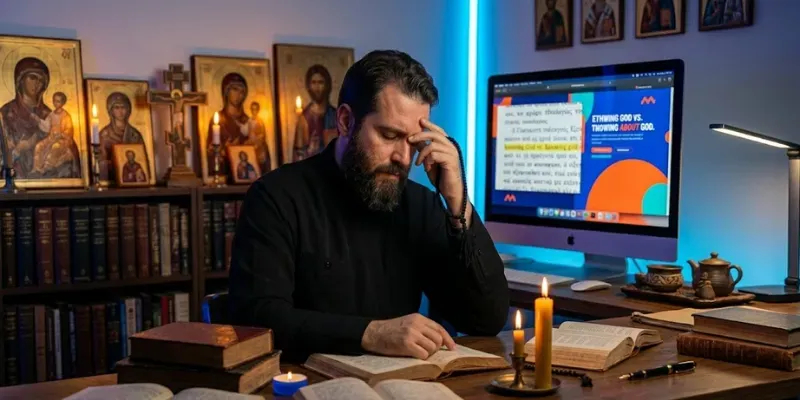
Get rigorous, reverent answers in Eastern Orthodox dogmatic theology, grounded in the Church Fathers, the seven Ecumenical Councils, the essence-energies distinction, apophatic theology, and lex orandi lex credendi. Built for Orthodox students, catechists, clergy, and inquirers. Defines the Greek terms, distinguishes dogma from theologoumenon, contrasts Catholic and Protestant views fairly, and never fabricates sources. Five variables set the question, method, comparison, audience, and format.
...more
Added over 1 month ago
