

Prompt Details
Model
Chat - (gpt-5.5)
Token size
414
Example input
[THEODICY_QUESTION]: If God is all-good and all-powerful, why do innocent children suffer?
[THEODICY_TRADITION]: Hick's Irenaean soul-making theodicy
[EVIL_TYPE]: natural and physical suffering
[AUDIENCE_LEVEL]: undergraduate philosophy student
[OUTPUT_FORMAT]: a structured academic essay with an introduction, three argued sections, and a conclusion
Example output
Introduction
The question of why innocent children suffer poses one of the deepest challenges to classical theism. Classical theism typically defines God as omnipotent (all-powerful), omniscient (all-knowing), and omnibenevolent (perfectly good). The problem becomes especially acute when the suffering in question is not moral evil caused by human wrongdoing, but natural and physical suffering: childhood cancer, famine, earthquakes, congenital disease, or the death of infants. Such suffering appears undeserved, disproportionate, and often spiritually destructive rather than morally educative. The apparent contradiction can be formulated as follows: if God knows about innocent suffering, has the power to prevent it, and is perfectly good, why does such suffering continue to exist?
This essay analyzes that question through the lens of John Hick's Irenaean "soul-making" theodicy. Hick develops and modernizes themes associated with the early Christian theologian Irenaeus, arguing that God created human beings not as morally perfected creatures, but as beings intended to grow into spiritual maturity through struggle, vulnerability, and freedom. The essay will proceed in three stages. First, it will clarify the logical and existential dimensions of the problem and distinguish Hick's approach from Augustinian traditions such as privatio boni and Leibniz's "best of all possible worlds." Second, it will explain how Hick uses natural suffering as a condition for moral and spiritual development. Third, it will present the strongest objection to soul-making in the case of innocent children and evaluate Hick's response, while identifying where the argument reaches an irreducible theological mystery.
The central conclusion will be that Hick offers one of the most philosophically sophisticated attempts to reconcile innocent suffering with belief in God, especially because he takes suffering seriously rather than dismissing it as illusory or merely punitive. Yet the suffering of children remains a severe challenge even for Hick's theory, and at crucial points theodicy appears to approach the limits of human explanation.
I. The Problem of Innocent Suffering and the Irenaean Framework
The suffering of innocent children intensifies the problem of evil because it undermines many traditional explanations of suffering. If suffering were always punishment for wrongdoing, then childhood suffering would appear morally unintelligible. Moreover, natural suffering differs from moral evil because it arises independently of human free choice. Earthquakes, disease, and genetic disorders cannot straightforwardly be explained by appealing to human freedom. Therefore, any adequate theodicy must address not merely why humans commit evil acts, but why the structure of nature itself permits devastating suffering.
Augustine approached this problem through the doctrine of privatio boni, the idea that evil is not a positive substance created by God but a privation or corruption of good. Since all being originates in God and God is good, evil lacks independent ontological status. Evil results from disorder in creation rather than from divine intention. Augustine also linked suffering to the Fall: natural disorder entered the world through human sin. While this preserves divine goodness, it faces difficulties in relation to children and natural evil. Modern knowledge of evolutionary history and natural disasters preceding humanity weakens the claim that all suffering originates from human rebellion.
Leibniz attempted a different solution by arguing that God created "the best of all possible worlds." This does not mean a world without suffering, but a world in which the overall balance of goods is maximized. Certain goods — courage, compassion, perseverance — may logically require the existence of suffering. Leibniz also draws upon the notion of felix culpa ("fortunate fall"), according to which some greater goods become possible through evil and redemption. Similarly, Aquinas argues that the perfection of the universe may require a diversity of created conditions, including corruption and limitation, contributing to the harmony of the whole cosmos. In these traditions, suffering can possess a role within a larger providential order inaccessible to finite human understanding.
Hick inherits some of these themes but shifts the focus decisively. Unlike Augustine, he does not regard humanity as created originally perfect and then corrupted by sin. Instead, following Irenaean themes, Hick argues that humans were created immature and unfinished. The world is not a paradise lost but an environment designed for development. Human beings are created in the "image" of God but must grow into the "likeness" of God through a process of moral and spiritual formation.
This distinction is crucial. If God's purpose is soul-making rather than immediate happiness, then suffering may serve a developmental role. A world without danger, pain, uncertainty, or loss would produce morally trivial creatures incapable of courage, empathy, or sacrificial love. Hick therefore argues that a stable natural order governed by consistent laws is necessary for meaningful moral existence. Fire must really burn, disease must really harm, and actions must have genuine consequences. Without such regularity, human agency and responsibility would collapse into a kind of moral theater.
At this stage, Hick's theory appears strongest when explaining ordinary forms of struggle and adversity. Difficulties can indeed cultivate virtues. Yet the question remains whether extreme suffering — especially the suffering of children incapable of moral reflection — can plausibly be justified in this way.
II. Soul-Making and the Necessity of Natural Suffering
Hick's central claim is that an epistemic distance between God and humanity is necessary for genuine moral growth. If God's presence and purposes were overwhelmingly obvious, humans would respond mechanically rather than freely. Likewise, if the world were structured to prevent all serious suffering, human virtues would never develop authentically.
Natural suffering therefore serves several interconnected functions within Hick's framework. First, it creates a predictable environment governed by natural laws. A world suitable for stable moral action cannot constantly suspend causality whenever danger appears. Gravity, tectonic activity, viruses, and biological processes are conditions of a coherent physical universe. A world without the possibility of injury might also be a world without meaningful embodiment or responsibility.
Second, suffering provides the conditions under which specifically moral virtues emerge. Compassion presupposes suffering persons; courage presupposes danger; generosity presupposes need. Hick argues that a hedonistic paradise would produce morally undeveloped beings rather than mature persons capable of freely chosen goodness. In this sense, suffering is instrumentally connected to spiritual growth.
Third, Hick incorporates evolutionary history into his account. Humanity emerges gradually through a long natural process involving struggle, competition, pain, and death. Unlike Augustinian models that interpret suffering primarily as punishment for sin, Hick treats suffering as structurally embedded within the kind of world required for the emergence of finite moral agents.
The suffering of children enters this framework indirectly. Hick does not usually argue that every individual instance of suffering directly benefits the sufferer in observable ways. Rather, suffering contributes to the overall environment necessary for soul-making across humanity collectively. The suffering of children may evoke compassion, solidarity, medical care, sacrifice, and moral seriousness in others. Furthermore, Hick argues that earthly existence is incomplete. Because many lives appear tragically cut short or morally unfinished, he appeals to an afterlife in which persons continue their spiritual development and receive ultimate redemption.
This eschatological dimension is essential. Without it, the suffering of children would seem morally gratuitous. If a child dies in agony after brief earthly existence, there appears insufficient opportunity for soul-making either for the child or proportionately for others. Hick therefore maintains that divine justice cannot be assessed solely within the temporal boundaries of earthly life. Future fulfillment is required if suffering is ultimately to be redeemed rather than merely endured.
Here Hick converges partly with Leibniz and Aquinas. Human beings lack the perspective necessary to judge the totality of creation. What appears senseless within finite experience may contribute to goods visible only within a larger providential order. However, Hick avoids reducing suffering to a mere abstract component of cosmic harmony. He insists that suffering is genuinely terrible and existentially real.
Still, an important philosophical tension remains. The claim that suffering can produce virtue is plausible in moderate cases, but it becomes less convincing when confronted with horrifying or apparently pointless suffering. This generates the strongest objection to soul-making.
III. The Strongest Objection: Gratuitous Suffering and the Limits of Theodicy
The most powerful criticism of Hick's theodicy concerns disproportionate suffering, especially among children incapable of meaningful moral development. Consider a child who dies painfully from a terminal illness before reaching moral maturity. Such suffering appears excessive relative to any conceivable soul-making benefit. Indeed, severe trauma often destroys rather than builds character. It may produce despair, psychological fragmentation, or moral collapse rather than spiritual growth.
This objection challenges the core proportionality of Hick's account. Even if some suffering contributes to development, why must the world contain such extreme forms? An omnipotent God could presumably create conditions sufficient for moral growth without permitting catastrophic suffering on this scale.
Plantinga's free-will defense is less helpful here because it primarily addresses moral evil resulting from human freedom. It explains why God might permit sinful actions if free will is intrinsically valuable. But natural suffering affecting children cannot straightforwardly be attributed to free human choice. Hick therefore bears the main burden of explanation.
A critic may press further: using innocent children as instruments for the moral development of others appears morally troubling. If a child's agony mainly serves to cultivate compassion in parents or physicians, this risks treating the child as a means rather than an end. Such reasoning seems incompatible with divine goodness.
Hick's response proceeds along several lines. First, he argues that finite humans are epistemically limited. We cannot confidently determine which sufferings are genuinely gratuitous because we lack knowledge of the total structure of reality and eternity. Second, he maintains that earthly life is not the whole of human existence. Children who suffer and die are not abandoned by God but remain participants in an ongoing process of redemption beyond death. Third, Hick insists that virtues of profound depth may require a world containing genuine tragedy rather than merely simulated difficulty.
Yet even these responses do not eliminate the force of the objection. Hick himself recognizes that theodicy cannot provide complete rational transparency regarding suffering. At a certain point, explanation approaches mystery. This is not an intellectual evasion but an acknowledgment of philosophical limits. The attempt to justify every concrete instance of suffering risks moral insensitivity. To explain too much is in danger of trivializing evil itself.
Theologically, this marks a decisive boundary. Hick can argue that a world containing suffering may be necessary for soul-making in general. He can also argue that ultimate redemption may reconcile apparently meaningless suffering within a larger eschatological framework. But he cannot fully demonstrate why any particular child must suffer in precisely the way they do. The individual distribution and intensity of suffering remain resistant to complete rational justification.
This limitation is significant because it preserves intellectual honesty. Some forms of suffering seem irreducibly tragic from the standpoint of human understanding. Theodicy may render belief in God logically and morally possible without dissolving all existential anguish.
Conclusion
The suffering of innocent children presents one of the most formidable objections to classical theism because it combines apparent innocence, vulnerability, and devastating natural harm. Through the lens of Hick's Irenaean soul-making theodicy, suffering is interpreted not primarily as punishment but as part of the developmental conditions necessary for the formation of morally and spiritually mature persons. Drawing on themes associated with Irenaeus, and intersecting with ideas from Augustine, Leibniz, Aquinas, and Plantinga, Hick argues that a stable world governed by natural laws and containing real danger is required for meaningful human freedom and virtue.
This approach possesses considerable explanatory power. It accounts for why God might permit suffering in a world oriented toward growth rather than immediate comfort. It also avoids depicting creation as a ruined perfection corrupted solely by historical sin. Moreover, Hick takes suffering seriously and insists that redemption must extend beyond earthly life if divine justice is to be credible.
Nevertheless, the suffering of children remains a profound challenge even within this framework. Extreme and apparently pointless suffering strains the claim that all suffering contributes proportionately to soul-making. Hick's appeal to eschatological fulfillment and human epistemic limitation offers partial responses, but not complete resolution. At its strongest, the soul-making theodicy shows that belief in an all-good and all-powerful God is not logically incompatible with innocent suffering. It does not, however, remove the tragic and mysterious character of that suffering.
The problem therefore remains philosophically unresolved in an important sense. Hick provides a powerful interpretive framework for understanding suffering within a theistic worldview, yet the suffering of children continues to mark the point at which rational explanation encounters the limits of human comprehension.


Or get it with Select10 Select prompts/mo — under $2 each
Learn more
 Instant access
 Commercial use
 Money‑back
By purchasing this prompt, you agree to our terms of service
1
Favorites
7
Views
GPT-5.5


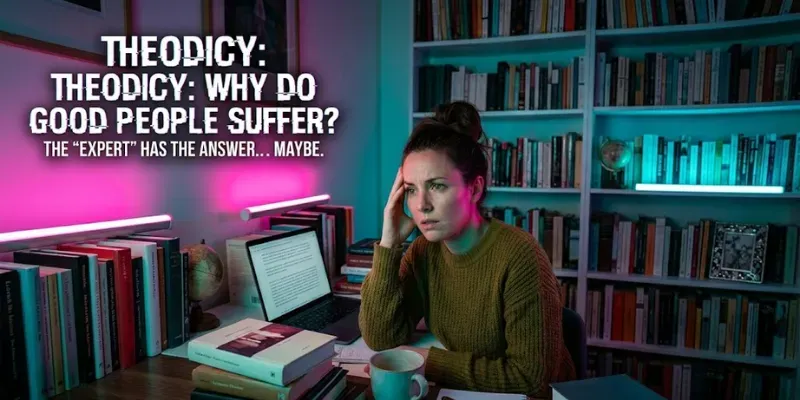
Build rigorous, defensible answers to the hardest question in the philosophy of religion: why a good, all-powerful God permits evil and suffering. Ideal for theology and philosophy students, apologists, debaters, essayists, RE teachers, and podcasters. The prompt locks a fair, citation-safe reasoning structure across the Augustinian, Leibnizian, Thomistic, Plantingian, and Irenaean traditions, while five variables set the question, lens, type of evil, audience, and format.
...more
Added over 1 month ago
