

Prompt Details
Model
(claude-5-sonnet)
Token size
1,658
Example input
[PROBLEM_DESCRIPTION]: One of our services shows an intermittent latency spike — roughly twice a week, lasting a few minutes each time. We've had two senior engineers investigating for three weeks now. Each time they dig in after an occurrence, they find a different plausible contributing factor: once it looked like a garbage-collection pause, another time it looked like a network blip between us and a downstream service, a third time it looked like the downstream service itself was slow. None of these have been reproducible on demand — we can't trigger the spike intentionally to confirm any one theory. We've applied fixes aimed at each theory as we found it (tuned GC settings, added retry logic for the network path, added a timeout to the downstream call) but the spike is still recurring, just as unpredictably as before.
[KNOWN_PRECEDENT]: not provided
Example output
DOMAIN CLASSIFICATION: Complex
EVIDENCE: Three weeks of investigation by two senior engineers have
produced three different plausible causes (GC pause, network blip,
downstream slowness) across separate occurrences, none reproducible on
demand, and fixes targeting each theory in turn have not stopped the
recurrence. This is the defining signature of Complex: genuine expert
effort has been applied and has NOT converged on a stable, confirmed
cause-effect relationship. If this were Complicated, expert analysis
would eventually converge on the actual cause even if it took real
effort — here it has instead kept finding different plausible-but-
unconfirmed factors each time, which points to either multiple
interacting causes or a cause that isn't captured by any single
investigation's snapshot.
CONFIDENCE LABEL: VERIFIED — the input directly demonstrates repeated,
serious expert investigation failing to establish a stable, confirmed
cause across multiple independent occurrences. This isn't an assumption
about difficulty; it's observed investigation history.
RESPONSE PROTOCOL: Complex → run a small, safe-to-fail probe rather than
committing further to any single theory. Concretely: since three
different fixes have already been applied (GC tuning, retry logic,
downstream timeout) without resolving the issue, the next step should
NOT be a fourth targeted fix based on a fourth guess. Instead, instrument
more broadly across all three suspected areas simultaneously during the
NEXT occurrence — capture GC logs, network-path timing, and downstream
response times all at once for that single event — so the next
occurrence itself becomes the probe that reveals which factor (or
combination) is actually present when the spike happens, rather than
theorizing from memory after the fact.
MISMATCH RISK: This problem has almost certainly already been treated as
Complicated for three weeks (bring in experts, analyze, find a cause, fix
it — repeated three times) when the evidence increasingly points to
Complex. The cost of that mismatch: each of the three applied fixes
represents real engineering time spent on a theory that turned out
incomplete, and continuing to apply this Complicated-domain pattern (find
one plausible cause, fix it, move on) risks a fourth cycle of the same
outcome. The team would benefit from explicitly switching modes to
simultaneous multi-factor instrumentation rather than continuing
sequential single-theory investigation.

 Instant access
 Commercial use
 Money‑back
By purchasing this prompt, you agree to our terms of service
1
Favorites
15
Views
CLAUDE-5-SONNET


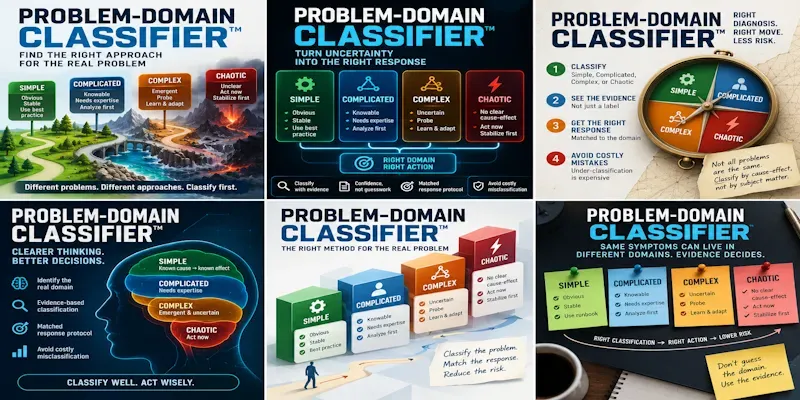
This prompt classifies your problem into one of four domains based on how
predictable cause and effect actually are in your situation — not on how
familiar the problem sounds — and matches it to the response protocol that
domain actually calls for. It also flags the single most expensive
mistake: treating a domain-3+ problem as if it were domain-1.
...more
Added 1 week ago
