

Prompt Details
Model
Chat - (gpt-5.4)
Token size
2,231
Example input
[ASSIGNMENT]: Argumentative research essay (2,500–3,000 words) for an undergraduate Political Science course. Students must select a contemporary policy debate (e.g., universal basic income, carbon taxation, data privacy regulation), develop a thesis-driven argument supported by at least 8 scholarly sources, and address at least one substantive counterargument. The essay must follow APA 7th edition formatting. This is a capstone essay worth 30% of the final course grade.
[AUDIENCE]: Third-year undergraduate Political Science majors at a research university. Students have completed introductory research methods and academic writing courses. They are familiar with scholarly databases, APA citation, and basic argumentation structures but may struggle with advanced synthesis and nuanced counterargument engagement.
[OUTCOMES]: 1. Construct a focused, debatable thesis that addresses a contemporary policy issue with specificity and nuance. 2. Synthesize peer-reviewed and policy sources to build a cohesive evidence-based argument (not merely summarize individual sources). 3. Engage substantively with at least one counterargument, demonstrating intellectual fairness and analytical depth. 4. Demonstrate advanced academic writing conventions including precise discipline-specific vocabulary, logical paragraph structure, and smooth transitions. 5. Apply APA 7th edition formatting accurately for in-text citations, reference list, headings, and document structure.
[WEIGHTING]: Thesis development and argument structure should be the heaviest-weighted criterion (at least 25%) as this is a capstone essay testing higher-order argumentation. Evidence synthesis should be weighted more heavily than simple source quality. Counterargument engagement is a key learning outcome — weight it at least 15%. APA formatting is important but should not dominate — cap it at 10%. Writing quality should be meaningful but secondary to analytical thinking.
[STYLE]: English. Formal academic rubric style suitable for inclusion in a university syllabus. Use professional educator language in the instructor version. The rubric should feel rigorous and precise — this is a high-stakes capstone assessment. Total rubric scale: 100 points.
Example output
Below is a comprehensive, classroom-ready rubric aligned to your assignment brief .
---
# 1. RUBRIC OVERVIEW
## Assignment Summary
This capstone argumentative research essay (2,500–3,000 words) requires students to develop a thesis-driven argument on a contemporary policy issue, supported by at least eight scholarly sources, with substantive counterargument engagement and accurate APA 7 formatting. The assignment emphasizes higher-order thinking: argument construction, synthesis, and evaluation.
---
## Criteria with Bloom’s Alignment
| Criterion | Description | Bloom’s Level |
| ------------------------------------------ | -------------------------------------------------------------------------------------------------------------------------------------------------------------- | ------------- |
| **Thesis & Argument Development** | Evaluates the clarity, specificity, and sophistication of the central claim and how effectively the argument is structured and sustained throughout the essay. | **Create** |
| **Evidence Synthesis & Use of Sources** | Assesses how well scholarly and policy sources are integrated and synthesized to support the argument rather than summarized individually. | **Analyze** |
| **Counterargument Engagement** | Measures the depth, fairness, and analytical rigor with which opposing perspectives are addressed and incorporated. | **Evaluate** |
| **Analytical Depth & Policy Insight** | Examines the complexity of reasoning, use of political science concepts, and ability to draw nuanced conclusions about policy implications. | **Evaluate** |
| **Academic Writing Quality** | Assesses clarity, organization, coherence, transitions, and discipline-appropriate language use. | **Apply** |
| **APA Formatting & Scholarly Conventions** | Evaluates accuracy of APA 7 citation, references, and formatting conventions. | **Apply** |
---
## Weight Distribution
| Criterion | Weight (%) |
| -------------------------------------- | ---------- |
| Thesis & Argument Development | **30%** |
| Evidence Synthesis & Use of Sources | **20%** |
| Counterargument Engagement | **15%** |
| Analytical Depth & Policy Insight | **15%** |
| Academic Writing Quality | **10%** |
| APA Formatting & Scholarly Conventions | **10%** |
| **Total** | **100%** |
---
# 2. DETAILED ANALYTIC RUBRIC
## Criterion 1: Thesis & Argument Development (30%)
**Level 4 — Exemplary (27–30 pts)**
Presents a precise, original, and clearly debatable thesis that addresses a specific policy issue with nuance and scope. The argument is logically structured, with each section contributing directly to advancing the central claim. Paragraphs contain clear topic sentences and cumulative reasoning that builds toward a coherent conclusion. The essay demonstrates a sustained, persuasive line of reasoning with minimal redundancy or drift.
**Level 3 — Proficient (23–26 pts)**
Presents a clear and debatable thesis addressing a defined policy issue. The argument is logically organized, with most paragraphs clearly linked to the central claim. Some sections may rely on predictable structures or slightly uneven development, but overall coherence is maintained. The argument is consistent and understandable, though not fully sophisticated.
**Level 2 — Developing (17–22 pts)**
Presents a thesis that is identifiable but may be overly broad, descriptive, or insufficiently debatable. The argument shows partial organization, with some paragraphs lacking clear connection to the main claim. Reasoning may rely on generalizations or incomplete logical progression. Structural inconsistencies limit overall persuasiveness.
**Level 1 — Beginning (0–16 pts)**
Presents a thesis that is vague, descriptive, or implicit rather than clearly argued. The essay structure is inconsistent or fragmented, with weak or missing connections between paragraphs. Reasoning is underdeveloped, and key claims are not supported through sustained argumentation. The overall argument lacks coherence.
**Key Distinctions**
* 4↔3: Sophistication and originality vs. competent clarity
* 3↔2: Clear argument structure vs. partial or inconsistent structure
* 2↔1: Identifiable argument vs. unclear or missing argument
---
## Criterion 2: Evidence Synthesis & Use of Sources (20%)
**Level 4 — Exemplary (18–20 pts)**
Integrates 8+ scholarly sources seamlessly into the argument through synthesis across multiple texts. Demonstrates clear relationships between sources (e.g., agreement, contrast, theoretical framing). Evidence is consistently interpreted and connected to claims. Sources include recent peer-reviewed literature and relevant policy analysis.
**Level 3 — Proficient (15–17 pts)**
Uses at least 8 scholarly sources appropriately to support claims. Some synthesis is evident, though sections may rely on sequential source discussion. Evidence is generally well integrated, with clear relevance to the argument. Minor lapses in depth of interpretation may occur.
**Level 2 — Developing (11–14 pts)**
Uses sources but relies heavily on summary rather than synthesis. Connections between sources are limited or implicit. Evidence may be unevenly integrated or insufficiently explained. Some sources may lack clear relevance or depth.
**Level 1 — Beginning (0–10 pts)**
Uses few or insufficient scholarly sources or relies on non-scholarly material. Evidence is presented as isolated summaries with little integration. Connections to the argument are weak or unclear. Interpretation of sources is minimal.
**Key Distinctions**
* 4↔3: Integrated synthesis vs. partial synthesis
* 3↔2: Consistent integration vs. summary-heavy use
* 2↔1: Some use of sources vs. minimal or ineffective use
---
## Criterion 3: Counterargument Engagement (15%)
**Level 4 — Exemplary (14–15 pts)**
Presents a well-developed counterargument using credible sources and accurately represents opposing views. Critically evaluates the counterargument and responds with nuanced reasoning. Demonstrates intellectual fairness and strengthens the original thesis through engagement.
**Level 3 — Proficient (11–13 pts)**
Addresses at least one counterargument clearly and responds with relevant reasoning. Representation is generally accurate, though evaluation may lack depth. The response supports the thesis but may not fully integrate into the broader argument.
**Level 2 — Developing (8–10 pts)**
Includes a counterargument but presents it superficially or with limited accuracy. Response may be brief, generalized, or insufficiently supported. Engagement lacks depth or analytical rigor.
**Level 1 — Beginning (0–7 pts)**
Demonstrates minimal engagement with opposing views. Counterargument is unclear, misrepresented, or only briefly acknowledged. Response is limited or disconnected from the thesis.
**Key Distinctions**
* 4↔3: Nuanced evaluation vs. adequate response
* 3↔2: Substantive engagement vs. surface-level mention
* 2↔1: Basic inclusion vs. minimal or unclear engagement
---
## Criterion 4: Analytical Depth & Policy Insight (15%)
**Level 4 — Exemplary (14–15 pts)**
Demonstrates sophisticated analysis using political science frameworks or concepts. Draws nuanced conclusions about policy implications, trade-offs, and broader impacts. Shows original insight and critical evaluation of policy effectiveness.
**Level 3 — Proficient (11–13 pts)**
Demonstrates clear analytical reasoning with relevant disciplinary concepts. Conclusions are logical and supported, though somewhat predictable. Some attention to implications is evident.
**Level 2 — Developing (8–10 pts)**
Demonstrates basic analysis but relies on general statements or limited conceptual application. Conclusions may be simplistic or underdeveloped. Policy implications are briefly addressed.
**Level 1 — Beginning (0–7 pts)**
Demonstrates limited analytical reasoning. Relies on description rather than analysis. Conclusions are vague or unsupported, with minimal attention to policy implications.
**Key Distinctions**
* 4↔3: Original insight vs. competent analysis
* 3↔2: Consistent analysis vs. basic reasoning
* 2↔1: Some analysis vs. primarily descriptive
---
## Criterion 5: Academic Writing Quality (10%)
**Level 4 — Exemplary (9–10 pts)**
Writing is clear, concise, and stylistically sophisticated. Paragraphs are well-structured with smooth transitions and precise discipline-specific vocabulary. Sentences vary in structure and enhance readability.
**Level 3 — Proficient (7–8 pts)**
Writing is clear and generally well-organized. Paragraphs are structured logically, though transitions may occasionally be mechanical. Vocabulary is appropriate but not consistently precise.
**Level 2 — Developing (5–6 pts)**
Writing is understandable but uneven in clarity or flow. Paragraph structure may be inconsistent, and transitions are limited. Language may be repetitive or imprecise.
**Level 1 — Beginning (0–4 pts)**
Writing lacks clarity and coherence. Paragraphs are poorly structured or fragmented. Frequent grammatical or stylistic issues interfere with meaning.
**Key Distinctions**
* 4↔3: Sophisticated style vs. clear competence
* 3↔2: Consistent clarity vs. uneven clarity
* 2↔1: Understandable vs. difficult to follow
---
## Criterion 6: APA Formatting & Scholarly Conventions (10%)
**Level 4 — Exemplary (9–10 pts)**
Demonstrates near-perfect APA 7 formatting, including accurate in-text citations, reference list, headings, and formatting. Sources are consistently cited and formatted correctly.
**Level 3 — Proficient (7–8 pts)**
Demonstrates generally accurate APA formatting with minor errors (e.g., punctuation, italics). Citations and references are mostly consistent.
**Level 2 — Developing (5–6 pts)**
Demonstrates partial adherence to APA formatting. Errors are noticeable and may affect consistency (e.g., missing elements, incorrect structure).
**Level 1 — Beginning (0–4 pts)**
Demonstrates limited understanding of APA formatting. Frequent errors in citations and references reduce clarity and credibility.
**Key Distinctions**
* 4↔3: Near-perfect vs. minor errors
* 3↔2: Mostly correct vs. inconsistent
* 2↔1: Partial vs. minimal adherence
---
# 3. SCORING & GRADING
## Point Calculation Table
| Criterion | Weight | Max Points | Level 4 | Level 3 | Level 2 | Level 1 |
| ------------------ | ------ | ---------- | ------- | ------- | ------- | ------- |
| Thesis & Argument | 30% | 30 | 27–30 | 23–26 | 17–22 | 0–16 |
| Evidence Synthesis | 20% | 20 | 18–20 | 15–17 | 11–14 | 0–10 |
| Counterargument | 15% | 15 | 14–15 | 11–13 | 8–10 | 0–7 |
| Analytical Depth | 15% | 15 | 14–15 | 11–13 | 8–10 | 0–7 |
| Writing Quality | 10% | 10 | 9–10 | 7–8 | 5–6 | 0–4 |
| APA Formatting | 10% | 10 | 9–10 | 7–8 | 5–6 | 0–4 |
| **Total** | 100% | **100** | | | | |
---
## Grade Boundaries (Suggested)
| Score | Grade |
| ------ | ----- |
| 90–100 | A |
| 80–89 | B |
| 70–79 | C |
| 60–69 | D |
| 0–59 | F |
*Note: Adjust according to institutional policy.*
---
## Holistic Override Clause
Instructors may adjust the final score when a single criterion (e.g., academic integrity violation, missing sources, or absent thesis) fundamentally undermines the validity of the entire essay, or when exceptional work demonstrates achievement beyond rubric categories.
---
# 4. STUDENT SELF-ASSESSMENT RUBRIC
## Simplified Criteria (Checklist Example — Thesis)
**Level 4 (Exemplary)**
* My thesis clearly takes a specific, debatable position
* My argument builds logically from paragraph to paragraph
* Every section supports my main claim
(Repeat for all criteria in similar checklist form — abbreviated here for brevity)
---
## Reflective Questions (Example)
**Thesis & Argument**
* If I removed my thesis, could a reader still identify my argument?
* Does each paragraph clearly connect to my main claim?
**Evidence**
* Am I comparing sources or just summarizing them?
* Do I explain how each source supports my argument?
---
## Common Pitfalls
1. **Summarizing instead of synthesizing** → Fix: Compare sources directly
2. **Weak thesis** → Fix: Make it specific and debatable
3. **Ignoring counterarguments** → Fix: Address strongest opposing view
4. **Overreliance on quotes** → Fix: Paraphrase and analyze
5. **APA errors** → Fix: Use a checklist or citation tool
---
# 5. INSTRUCTOR CALIBRATION NOTES
## Inter-Rater Reliability
* Conduct norming sessions with 2–3 sample essays
* Use anchor papers for each level
* Double-score borderline cases
* Discuss discrepancies and refine interpretations
## Modifications
* **Accommodations:** Provide extended descriptors or oral alternatives
* **Draft feedback:** Focus on top 3 criteria
* **Peer review:** Convert descriptors into guided prompts
## LMS Integration
* Canvas: Use rubric builder in SpeedGrader
* Moodle/Blackboard: Import as analytic rubric
* Turnitin: Attach as grading form
* Google Classroom: Convert to scoring rubric manually
---
If you want, I can also turn this into a **fillable grading sheet (Excel/Google Sheets)** or a **Canvas-import format**.



Get this prompt + 9 more with Select$14 your first month, then $19/mo$14 first month, then $19/mo
View Select
 Instant access
 Commercial use
 Money‑back
By purchasing this prompt, you agree to our terms of service
1
Favorites
20
Views
GPT-5.4


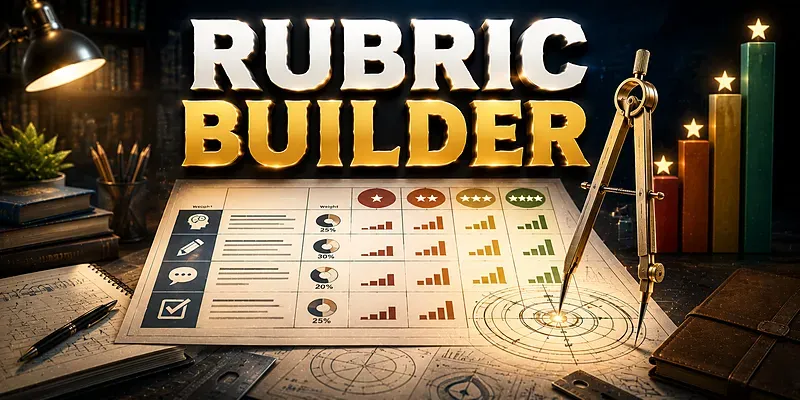
📌Generates detailed, criterion-referenced rubrics with clearly differentiated performance descriptors for any assignment type. Calibrates weightings to your learning priorities automatically.
📐 Custom criteria with weighted scoring
📊 4-level performance descriptors per criterion
🎓 Student-facing self-assessment version included
🔄 Works for essays, projects, labs & presentations
⚙️ Aligned to Bloom's taxonomy & learning outcomes
...more
Added over 1 month ago
