

Prompt Details
Model
(claude-4-6-sonnet)
Token size
971
Example input
[ORGANIZATION]: Fast-growing SaaS customer-support platform
[GROWTH_STAGE]: Market Leadership
[PRESSURE_SIGNALS]: Rapid customer acquisition straining infrastructure and talent; areas — people, technology, operations
[PRIORITY_OUTCOME]: Sustainable Growth
Example output
## S.C.A.L.E.™ DIAGNOSTIC REPORT
**Organization:** Fast-growing SaaS Customer-Support Platform
**Growth Stage:** Market Leadership | **Priority Outcome:** Sustainable Growth
---
## 1. MAP THE GROWTH PICTURE
**Main Strategic Objective**
Sustain leadership position while absorbing rapid customer acquisition without degrading platform reliability, team capability, or operational coherence.
**Growth Trajectory Observations**
1. The platform is at Market Leadership stage, meaning growth is no longer experimental — it is load-bearing. Failures at this stage affect brand credibility, not just internal efficiency.
2. Pressure is registering simultaneously across people, technology, and operations — a multi-front strain pattern that typically signals the organization has outpaced its original architecture in more than one dimension.
3. Customer acquisition pace is the primary driver, but acquisition-led growth in SaaS support platforms carries a multiplier effect: each new customer brings their own ticket volume, integration requirements, and SLA expectations.
4. At Market Leadership, the competitive moat increasingly depends on reliability and scale, not just feature differentiation — which means scaling failures are also positioning failures.
**Key Scalability Considerations**
- The simultaneity of pressure across three resource areas reduces the margin for sequential fixes; interventions likely need to run in parallel.
- Sustainable Growth as the priority outcome means the diagnostic should favor structural interventions over short-term capacity patches.
- A support platform's core product *is* operational reliability — degradation under scale is product degradation, not just an internal problem.
---
## 2. CLASSIFY RESOURCE ELASTICITY
**Resources That Scale Effectively**
| Resource | Why It's Elastic |
|---|---|
| Cloud infrastructure (inferred) | SaaS platforms typically run on scalable cloud services; compute and storage capacity can be provisioned on demand without structural rebuilding |
| Software licensing / tooling spend | Can expand incrementally as customer count grows; unit economics are well-understood in SaaS |
| Self-service and documentation assets | Once built, scale to unlimited users at near-zero marginal cost |
**Resources With Limited Elasticity**
| Resource | Why It's Inelastic |
|---|---|
| Engineering talent | Hiring cycles are long; onboarding takes months before productivity; senior engineers cannot be synthesized on demand |
| Support operations processes | Processes built for an earlier scale tend to be manual, tribal, and brittle — they don't stretch, they snap |
| Organizational knowledge | Institutional knowledge, playbooks, and decision-making norms don't transfer automatically to new hires; they erode under rapid headcount growth |
| Customer onboarding capacity | Each new enterprise customer likely requires configuration, integration work, and white-glove setup — this is largely non-automatable at the current stage *(inferred)* |
**Likely Bottlenecks Under Growth Conditions**
- Talent pipeline for technical and operational roles
- Internal process infrastructure not rebuilt for current scale
- Platform reliability under concurrently growing customer workloads
---
## 3. ASSESS SCALING PRESSURE
**Areas Under Greatest Stress**
- **People:** Rapid acquisition means support, engineering, and customer-success functions are all absorbing demand simultaneously. Hiring alone does not resolve this — integration and ramp time create a productivity lag that compounds with each hiring wave.
- **Technology:** A SaaS support platform under customer acquisition pressure faces compounding infrastructure load: more tenants, more concurrent sessions, more data, more integration endpoints. Systems architected for an earlier tier of scale become fragile.
- **Operations:** Operational processes at Market Leadership stage are frequently the most under-invested area. Processes that worked at Growth stage were likely built fast; they are now running hot.
**Capacity Saturation Risks**
- **People saturation:** If hiring outpaces onboarding quality, team capability per capita declines even as headcount grows. The organization gets larger but not more capable.
- **Technology saturation:** If platform architecture was not designed for multi-tenant scale, customer growth may be approaching a threshold where reliability incidents become frequent rather than exceptional.
- **Operations saturation:** Undocumented or manual processes reach a point where they can no longer absorb volume — response times degrade, errors increase, and escalations multiply.
**Performance Degradation to Watch For**
- Rising time-to-resolution on internal and customer-facing issues
- Increasing error rates or incident frequency on the platform
- Declining onboarding quality for new hires and new customers
- Growing backlog in any function that requires human judgment at scale
---
## 4. LOCATE BOTTLENECKS & DEPENDENCIES
```
┌─────────────────────────────────────────────
│ BOTTLENECK: Engineering & Technical Talent Pipeline
│ Why it limits growth: Technical roles have the longest hiring and
│ ramp cycles. An under-staffed or under-ramped engineering function
│ cannot maintain platform reliability or ship the infrastructure
│ improvements needed to absorb growth.
│ Confidence: High
│ (Directly stated: people under pressure; strongly implied by
│ tech + SaaS context)
└─────────────────────────────────────────────
┌─────────────────────────────────────────────
│ BOTTLENECK: Platform Architecture Headroom
│ Why it limits growth: Customer acquisition adds compounding load.
│ If the technical architecture was not designed with multi-tenant
│ scale explicitly in mind, reliability risk rises non-linearly
│ as the customer base grows.
│ Confidence: Medium
│ (Directly stated: technology under pressure; architectural
│ maturity not confirmed from input)
└─────────────────────────────────────────────
┌─────────────────────────────────────────────
│ BOTTLENECK: Operational Process Maturity
│ Why it limits growth: Processes built during earlier growth stages
│ are typically manual, undocumented, and person-dependent. At
│ Market Leadership scale, they become rate-limiters for every
│ function that depends on them.
│ Confidence: High
│ (Directly stated: operations under pressure)
└─────────────────────────────────────────────
┌─────────────────────────────────────────────
│ BOTTLENECK: Organizational Knowledge Transfer
│ Why it limits growth: In a rapidly hiring organization, institutional
│ knowledge does not distribute automatically. New hires operate below
│ full effectiveness until knowledge is explicitly codified and
│ transferred — slowing every team they join.
│ Confidence: Medium
│ (Inferred from rapid acquisition + people pressure pattern)
└─────────────────────────────────────────────
```
**Scaling Dependency Chain**
```
Customer acquisition growth
→ Platform must absorb increased load reliably
→ Engineering capacity must be sufficient to maintain and scale infrastructure
→ Engineering capacity depends on talent pipeline quality and ramp time
→ Talent pipeline depends on recruiting process maturity and employer brand
→ Recruiting process maturity depends on operational process infrastructure
→ Operational infrastructure depends on documented, scalable processes
→ Scalable processes depend on knowledge codification and organizational design
```
**Expansion-Risk Considerations**
- A break anywhere in this chain creates downstream failure that surfaces as a *product* problem, even if the root cause is operational or organizational.
- At Market Leadership, customers do not tolerate reliability failures with the same patience they might extend to an early-stage vendor. Trust erosion at this stage is harder to reverse.
- Multi-front simultaneous pressure reduces the organization's ability to shift resources to the highest-priority problem — all fronts feel urgent simultaneously.
---
## 5. ENGINEER OPTIMIZATIONS
**Ways to Improve Resource Elasticity**
- **People elasticity:** Invest in structured onboarding programs with explicit ramp milestones. The goal is reducing time-to-productivity, not just time-to-hire. Consider a tiered hiring model that separates senior capacity (judgment, architecture) from execution capacity (delivery, support).
- **Technology elasticity:** Audit current architecture for the specific failure modes associated with multi-tenant SaaS at scale: database connection pooling, rate limiting, tenant isolation, observability coverage. Address structural limits before they become incidents.
- **Operations elasticity:** Identify the five to ten highest-volume recurring operational processes and document, standardize, and automate wherever judgment is not required. The goal is reducing human-in-the-loop dependencies on routine work.
**Capacity-Building Suggestions**
- Build an internal knowledge base that captures decisions, processes, and architecture rationale — not as bureaucracy, but as the operational memory the organization needs at scale.
- Establish SLA and reliability benchmarks that are tracked as leading indicators, not lagging incident reports.
- Invest in a dedicated People Operations function if one does not exist — at this growth rate, talent operations cannot be a side function *(inferred as a gap).*
**Sustainable Scaling Recommendations**
- Prioritize investments that have compounding returns: documentation, automation, and senior engineering capacity all pay forward across multiple growth cycles.
- Avoid the "headcount as solution" default — adding people to broken processes produces larger broken processes.
- Design for the next order of magnitude, not just the current quarter.
---
## 6. STRESS-TEST LONG-TERM SUSTAINABILITY
**Risks From Unmanaged Scaling Pressure**
- **Talent degradation:** Hiring faster than the organization can absorb creates a workforce that is large but thin — high headcount, low institutional depth. This compounds with each wave.
- **Technical debt accumulation:** Under growth pressure, engineering teams default to shipping over refactoring. This is rational short-term and dangerous long-term — technical debt in a support platform eventually surfaces as reliability failures visible to every customer.
- **Operational brittleness:** Undocumented, person-dependent processes create single points of failure at scale. Key departures or team changes cause disproportionate disruption.
- **Culture dilution:** At Market Leadership with rapid hiring, the original culture and operating norms are under passive pressure even without any deliberate change.
**Organizational Resilience Read**
**Current Level: Moderate — Under Active Strain**
The organization has demonstrated the capacity to grow to market leadership, which requires genuine operational capability. However, simultaneous pressure across people, technology, and operations indicates that resilience buffers are thin. The platform is absorbing growth but showing stress signals that suggest limited margin before a degradation event.
**Long-Term Growth-Readiness Considerations**
- The organization's current growth architecture — the systems, processes, and talent structures supporting scale — needs investment proportional to its ambition.
- Market Leadership is not a plateau; it requires active maintenance. Competitors below will attempt to exploit any reliability or capability gap.
- Sustainable Growth as a priority outcome is only achievable if structural capacity investments are made *ahead of* the next growth wave, not in response to it.
---
## 7. BUILD THE ACTION PLAN
**5 Practical Steps to Raise Scalability and Cut Bottlenecks**
| Rank | Action | Why First |
|---|---|---|
| **1** | **Audit and address platform architecture headroom** | Technology failure at Market Leadership is product failure. Identify the specific architectural limits before the next growth wave forces you to find them under incident conditions. |
| **2** | **Rebuild onboarding — for both customers and employees** | The ramp-time problem across people and customer success is compounding with every hire and every new customer acquired. Structured onboarding has the highest compounding return of any people investment. |
| **3** | **Systematize the five highest-volume operational processes** | Pick the processes running hottest. Document, standardize, and automate the routine portions. This reduces operational saturation without requiring headcount. |
| **4** | **Codify institutional knowledge into a living internal knowledge base** | Every process improvement and architectural decision made in steps 1–3 needs to be captured — otherwise it lives in people's heads and the problem regenerates with turnover. |
| **5** | **Build leading-indicator dashboards across all three pressure areas** | You cannot manage what you cannot measure in near real-time. Establish early-warning metrics for platform reliability, hiring pipeline health, and operational backlog — before problems become visible to customers. |
**What to Prioritize First**
Platform architecture headroom and employee onboarding quality should run in parallel as the first interventions — one protects the product, the other protects the organization's capacity to improve the product. Neither can wait for the other.
**How to Sustain Expansion Over Time**
- Treat process documentation and automation as ongoing infrastructure investment, not a one-time project.
- Revisit the elasticity classification in this report at each significant growth stage transition.
- Protect engineering time for structural work — not just feature delivery — as a non-negotiable operational norm.
**Strategic Conclusion**
This platform has the growth profile of a market leader and the internal architecture of a scaling company that has not yet fully caught up with itself. The priority outcome — Sustainable Growth — is achievable, but it requires structural investment now, not optimization later. The critical insight is that all three pressure areas (people, technology, operations) share a common root: the organization's internal systems were built for a previous scale and have not been rebuilt for this one. The action plan above addresses that root, not just the symptoms.


 Instant access
 Commercial use
 Money‑back
By purchasing this prompt, you agree to our terms of service
6
Views
CLAUDE-4-6-SONNET


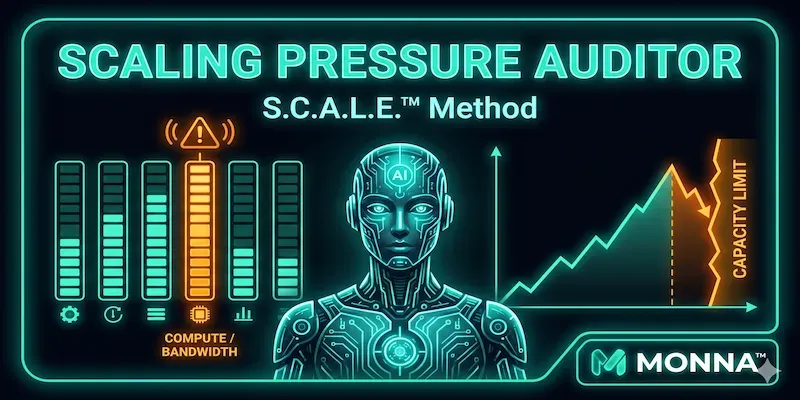
A structured diagnostic that shows which of your resources can absorb growth — and which one breaks first.
...more
Added 2 days ago
