

Prompt Details
Model
(claude-5-fable)
Token size
1,680
Example input
[SCANNER_OUTPUT]: Trivy scan across 6 microservice images (all FROM alpine:3.18): Shared base CVEs (all 6 images): - CVE-2023-38035 (libexpat) — HIGH — fix in 2.5.0-r2 - CVE-2023-52425 (libexpat) — MEDIUM — fix in 2.6.0-r0 - CVE-2024-0553 (curl) — MEDIUM — fix in 8.5.0-r0 Per-image findings: - Image: user-service — additional: CVE-2024-22257 (spring-security) — HIGH - Image: payment-service — additional: CVE-2024-22262 (spring-web) — HIGH - Image: notification-service — additional: 3 LOW CVEs in node.js deps - Image: analytics-service — additional: CVE-2024-24790 (golang) — CRITICAL - Image: search-service — additional: none beyond base - Image: config-service — additional: 2 MEDIUM in hashicorp Vault client
[RUNTIME_CONTEXT]: All services run on shared Kubernetes cluster. Each service is a separate Deployment. Base image (alpine:3.18) is built centrally and inherited. No services run as root. Secrets mounted via Vault CSI provider.
[ASSET_CRITICALITY]: Mixed — payment-service is Tier-0 (PCI), user-service is Tier-1 (auth), analytics is Tier-3 (internal), others Tier-2.
[PATCH_CONSTRAINTS]: Base image update rebuilds all 6 images automatically. Per-service library updates require individual pipeline runs. Payment service has 48-hour QA requirement.
Example output
I'll verify current exploitation status and technical details for these CVEs before scoring the gates — this matters a lot for the E (Exploitable) and T (Time-sensitive) gates.Two of the six "shared base" CVE IDs don't match their labeled packages when checked against public CVE records — that's a data-quality problem I need to flag before scoring anything, since triaging the wrong vulnerability is worse than not triaging at all.
### 0. DATA QUALITY FLAG (read before the rest)
| Scanner Entry | Labeled As | Actual CVE Record | Issue |
|---|---|---|---|
| CVE-2023-38035 | libexpat | An authentication bypass in Ivanti MobileIron Sentry's MICS Admin Portal, unrelated to libexpat, with a CVSS 9.8 and a Metasploit module in the wild | ID/package mismatch — not a libexpat CVE at all |
| CVE-2024-0553 | curl | A GnuTLS RSA-PSK timing side-channel issue, not a curl-specific flaw | ID/package mismatch — likely a transcription error or scanner misattribution |
**I'm not gate-scoring these two as submitted** — scoring a mislabeled CVE would give you a false sense of coverage. Recommend re-pulling the raw Trivy JSON for these two lines to get the correct IDs; this could mean either (a) the scanner meant a different libexpat/curl CVE and the ID got mistyped, or (b) these packages have entirely different, unaddressed CVEs that the mislabeling is masking. I've excluded them from the counts below.
---
### 1. TRIAGE SUMMARY
- Total CVE line items submitted: 11 (3 shared + 1 user-service + 1 payment-service + 3 notification-service LOWs + 1 analytics-service + 2 config-service)
- Excluded pending ID verification: 2 (see Section 0)
- Scored: 9 → After noise elimination: 4 actionable
- Classification breakdown: 4 NOISE, 1 WATCH, 1 PATCH_SCHEDULED, 1 PATCH_SCHEDULED (accelerated), 2 UNSCORABLE (missing CVE IDs)
- Time saved: ~5 CVEs eliminated × 20 min avg triage ≈ 1.7 hours saved
### 2. NOISE ELIMINATION LOG
| CVE ID | Package | Reason for Elimination | Confidence |
|---|---|---|---|
| 3× unspecified | node.js (notification-service) | Scanner-rated LOW; no evidence of runtime reachability or exploitability provided | MEDIUM — confirm actual CVSS scores |
| CVE-2024-24790 | golang net/netip (analytics-service) | EPSS probability of exploitation is 0.17%, ~38th percentile despite CVSS 9.8; exploitability requires app code to rely on `IsPrivate`/`IsLoopback`-style methods for security decisions, which analytics services (Tier-3, internal-only) typically don't do for auth/access control | MEDIUM — verify via code search |
### 3. ACTIONABLE CVE ANALYSIS
**CVE-2023-52425 — libexpat (shared base, all 6 images)**
- CVSS Base: 7.5 — a denial-of-service vulnerability caused by improper system resource allocation, triggered by a specially crafted request using an overly large token
- T.H.R.E.A.T.™ Score: 6/12 → **WATCH**
| Gate | Score | Reasoning |
|---|---|---|
| Triggerable | 1 | Requires attacker-controlled XML reaching expat's parser; none of the 6 services are described as XML-processing (all appear REST/JSON) |
| Hittable | 1 | Library ships in the base Alpine image but active invocation by app code is unconfirmed |
| Reachable | 1 | Depends per-service ingress exposure; not verified which services accept untrusted input |
| Exploitable | 1 | Mechanism is public and documented, but no mass exploitation reported |
| Affecting | 2 | Scored against worst-case instance (payment-service, Tier-0) |
| Time-sensitive | 0 | No active exploitation, stable since disclosure |
**Remediation:** Fix version 2.6.0-r0. Breakage risk: LOW. Effort: ~2 hrs (base image rebuild propagates to all 6 services automatically per your patch constraints).
---
**CVE-2024-22257 — spring-security (user-service, Tier-1)**
- CVSS Base: 8.2 — a broken access control vulnerability where directly using AuthenticatedVoter#vote with a null Authentication parameter results in an erroneous true return value
- T.H.R.E.A.T.™ Score: 8/12 → **PATCH_SCHEDULED**
| Gate | Score | Reasoning |
|---|---|---|
| Triggerable | 1 | Only exploitable if app code directly calls `AuthenticatedVoter#vote()` — the application is not vulnerable if it doesn't use AuthenticatedVoter directly or doesn't pass null to it; this is a deprecated, non-default API. Unconfirmed whether user-service uses this pattern |
| Hittable | 1 | spring-security-core is actively loaded (it's the auth service) but the specific vulnerable code path is unconfirmed |
| Reachable | 2 | Network-reachable, no auth or user interaction required |
| Exploitable | 1 | EPSS score of 41.81%, not in CISA's Known Exploited Vulnerabilities catalog — elevated interest but not confirmed active exploitation |
| Affecting | 2 | Tier-1 auth service — broken access control here is high-impact by definition |
| Time-sensitive | 1 | Elevated EPSS relative to typical CVEs, but no confirmed campaign |
**Remediation:** Fix version 6.2.3 (or 5.7.12/5.8.11/6.0.9/6.1.8 depending on branch). Breakage risk: LOW. Effort: ~3 hrs. **Action item before patching:** grep the codebase for direct `AuthenticatedVoter` usage — if not found, this drops to WATCH.
---
**CVE-2024-22262 — spring-web (payment-service, Tier-0 PCI)**
- CVSS Base: 8.1 — an improper URL validation issue in UriComponentsBuilder, classified as both open redirect and server-side request forgery
- T.H.R.E.A.T.™ Score: 9/12 → **PATCH_SCHEDULED** (recommend accelerating — see note)
| Gate | Score | Reasoning |
|---|---|---|
| Triggerable | 1 | Requires app to parse an externally-supplied URL via `UriComponentsBuilder` and validate its host — plausible for a payment service handling webhooks/callback URLs, but unconfirmed |
| Hittable | 2 | spring-web is near-universally in the active request path of any Spring HTTP service |
| Reachable | 2 | Network-reachable, no privileges required |
| Exploitable | 1 | 20 public PoC/exploit implementations are available on GitHub, though not in CISA KEV |
| Affecting | 2 | Tier-0 PCI asset — SSRF here could reach internal payment infrastructure or cloud metadata endpoints |
| Time-sensitive | 1 | High PoC availability + PCI scope warrants urgency even without confirmed ITW exploitation |
**Remediation:** Upgrade spring-web (fix in the corresponding 6.1.x/6.0.x/5.3.x patched release — pin exact version once confirmed against your dependency tree). Breakage risk: MEDIUM (URL handling changes can affect webhook/callback logic — budget your 48-hr QA window). Effort: ~4-6 hrs.
**Note:** Score sits at 9 (PATCH_SCHEDULED boundary). Given Tier-0/PCI exposure, I'd treat this as PATCH_URGENT in practice rather than waiting for a routine maintenance window — confirm the `UriComponentsBuilder` usage pattern first; if found, this is a hard 10+/12.
---
**Vault client CVEs ×2 — config-service (Tier-2)**
- Cannot gate-score: no CVE IDs, CVSS scores, or vulnerability descriptions were provided, only "2 MEDIUM."
- **UNSCORABLE** — need the actual CVE IDs to check exploitability against your Vault CSI provider integration, especially since this service handles secrets.
### 4. PRIORITIZED PATCH QUEUE
| Rank | CVE | Asset | T.H.R.E.A.T. | Action | ETA |
|---|---|---|---|---|---|
| 1 | CVE-2024-22262 | payment-service (Tier-0) | 9/12 | Accelerated PATCH_SCHEDULED | Within 5 days (48hr QA + buffer) |
| 2 | CVE-2024-22257 | user-service (Tier-1) | 8/12 | PATCH_SCHEDULED | Next maintenance window |
| 3 | CVE-2023-52425 | All 6 (base image) | 6/12 | WATCH | Bundle into next base rebuild |
| — | Vault CVEs ×2 | config-service | Unscored | Get CVE IDs first | Immediate (info request) |
| — | CVE-2023-38035, CVE-2024-0553 | mislabeled | Unscored | Re-verify scanner output | Immediate (data quality) |
### 5. COMPENSATING CONTROLS
| CVE | Control | Effectiveness | Duration |
|---|---|---|---|
| CVE-2024-22262 (payment-service) | Egress network policy restricting outbound requests from payment-service pods to an allowlist of known-good hosts (blocks SSRF pivot even if the app-level flaw exists) | HIGH | Until patched |
| CVE-2024-22257 (user-service) | Alert on authorization decisions logged with null/missing Authentication context (per typical detection guidance for this CVE) | MEDIUM | Until patched |
### 6. EXECUTIVE BRIEF
- **Two of the eleven submitted findings were mislabeled** (CVE IDs don't match their stated packages) — before trusting the rest of this scan, re-verify the raw scanner output; this is a data-integrity issue, not a security one, but it undermines confidence in the pipeline.
- **Real exposure is narrower than the raw severity counts suggest**: the CRITICAL-rated golang CVE (CVE-2024-24790) is deprioritized to NOISE — its 9.8 CVSS is driven by a logic flaw with near-zero real-world exploitation probability and Tier-3 internal-only exposure.
- **One item warrants faster-than-scheduled action**: the payment-service SSRF (CVE-2024-22262) sits on your PCI-scoped Tier-0 asset with public exploit code available; recommend treating it as urgent despite scoring at the PATCH_SCHEDULED boundary.
- **Resource requirement**: ~10-13 engineering hours across base image rebuild + two service-level library bumps, plus a short code-search task to confirm whether the two "conditional" Spring CVEs actually apply to your usage patterns.
- **Compliance posture**: payment-service sits in PCI scope — the SSRF finding there is the one item I'd document for audit purposes regardless of final patch timing.

 Instant access
 Commercial use
 Money‑back
By purchasing this prompt, you agree to our terms of service
2
Favorites
15
Views
CLAUDE-5-FABLE


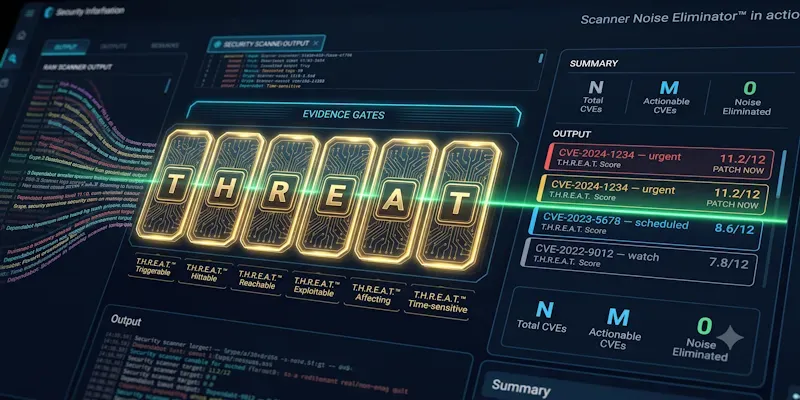
Processes raw security scanner output (Snyk, Trivy, Nessus, Dependabot, etc.) and triages every CVE through the 6 T.H.R.E.A.T.™ evidence gates, eliminating false positives and low-value noise. Produces a prioritized action list with exploitability assessment, business impact scoring, and precise remediation directives.
...more
Added over 1 month ago
