

Prompt Details
Model
(claude-5-opus)
Token size
1,451
Example input
[BUSINESS_TYPE]: boutique residential real estate brokerage
[INFORMATION_TYPE]: property listings and client relationship history
[TEAM_SIZE]: (two agents, one transaction coordinator, one marketing assistant)
[SYSTEM_SCOPE]: lead capture through post-closing follow-up
[PRIMARY_GOAL]: shortening average days-to-close
Example output
1️⃣ KNOWLEDGE STRUCTURE DESIGN
Primary Categories
Inventory Intelligence (active listings, pocket listings, expireds and withdrawns, comparable sales, off-market seller leads)
Client Intelligence (buyer profiles, seller profiles, sphere of influence, past clients, referral partners)
Transaction Intelligence (executed contracts, contingency calendars, escrow files, lender and title contacts, closing disclosures)
Market Intelligence (farm-area absorption rates, price-per-square-foot trends, days-on-market bands, HOA and zoning notes)
Growth Intelligence (listing presentations, marketing assets, lead-source performance, showing scripts, review pipeline)
Secondary Structure
Inventory Intelligence
Active Listings (address, list price, DOM, showing feedback log)
Pocket & Coming Soon (pre-MLS inventory, seller readiness date)
Expired & Withdrawn (prior list price, prior agent, re-list angle)
Comparable Sales Bank (closed comps by subdivision and price band)
Seller Lead Pipeline (valuation requests, equity position, motivation notes)
Client Intelligence
Buyer Profiles (pre-approval amount, must-haves, deal-breakers, timeline)
Seller Profiles (net-proceeds target, move-out constraint, occupancy status)
Sphere of Influence (relationship origin, last touch date, annual touch plan)
Past Clients (closing date, anniversary date, home value tracking)
Referral Partners (lender, inspector, stager, out-of-area agents, split terms)
Transaction Intelligence
Contract Files (offer terms, addenda, earnest money receipt)
Contingency Calendar (inspection, appraisal, financing, title deadlines)
Escrow Communication Log (every request, who owed it, date cleared)
Vendor Coordination (inspector, appraiser, repair contractors, closing attorney)
Blocker Log (appraisal gaps, title defects, repair disputes, lender conditions)
Market Intelligence
Absorption by Farm Area (months of inventory per subdivision)
Pricing Trends (median $/sqft rolling 90-day by price band)
Days-on-Market Bands (DOM by price tier and property type)
HOA & Zoning Notes (dues, rental caps, document turnaround times)
Lender Environment (rate movement, program changes, average clear-to-close days)
Growth Intelligence
Listing Presentation Library (versions by price band and seller type)
Marketing Asset Bank (photo sets, floorplans, video tours, mailer templates)
Lead-Source Performance (cost per lead, lead-to-appointment, appointment-to-signed)
Script Library (price reduction call, expired call, multiple-offer counsel)
Review & Referral Pipeline (post-closing review asks, testimonial log)
Storage Architecture
Google Sheets — "Listing Master" (one row per property), "Comp Bank" (one row per closed sale), "Lead Source ROI" (one row per source per month)
Notion — one workspace page per active transaction, auto-created from the contract template, holding contingency dates, blocker log and document checklist
Follow Up Boss CRM — system of record for every person; all buyer, seller, sphere and referral records live here with tags synced from the sheets
Dropbox — folder tree /Transactions/{Year}/{Address}/ with fixed subfolders: 01-Contract, 02-Disclosures, 03-Inspection, 04-Appraisal, 05-Title, 06-Closing
Google Docs — one running "Listing Appointment Recap" doc per seller lead, one "Buyer Discovery Note" doc per buyer
2️⃣ INFORMATION CAPTURE SYSTEM
Idea Capture
Friday Pipeline Download — Friday, 4:00–4:45pm, all four team members
Showing feedback that changes a price opinion
Seller or buyer motivation shifts heard that week
Off-market whispers, pre-listing conversations, expired-listing intel
Escrow friction that cost days
Lender, inspector or title behaviour worth remembering
Input template: Date | Source | Address or Client | Signal Type | Observation | Action Owner | Next Touch Date
Note-Taking System
Showing Debrief — property address, buyer name, price reaction, top objection, comparison property mentioned, likelihood to offer (1–5)
Listing Appointment Recap — seller motivation, net-proceeds target, timeline trigger, competing agents interviewed, price expectation vs. CMA, objection raised, commission conversation outcome
Buyer Discovery Note — pre-approval amount and lender, monthly payment ceiling, must-haves, deal-breakers, decision-makers involved, move-by date, financing type
Deal Blocker Log — blocker type, date raised, days added to close, who owned resolution, what would have prevented it
Data Storage
Property Records DB — address, subdivision, property type, beds, baths, sqft, year built, HOA dues, list price, price changes, DOM, status, seller name, listing date, contract date, closing date, showing count, feedback score
Contact DB — name, role (buyer/seller/sphere/past client/partner), source, price band, motivation tag, pre-approval status, last touch, next touch, transaction IDs, referral count, anniversary date
Transaction DB — transaction ID, address, side represented, contract date, purchase price, earnest money, inspection deadline, appraisal deadline, financing deadline, title clear date, closing date, days-to-close, blockers logged, gross commission, split
Comp Bank — closed address, subdivision, closed price, $/sqft, closing date, DOM, concessions, condition grade, distance to subject, notes on adjustments
3️⃣ ORGANIZATION FRAMEWORK
Tagging System
Stage — #new-lead #nurturing #appointment-set #actively-showing #under-contract #closed
Property Type — #single-family #condo #townhome #multi-family #new-construction #land
Price Band — #under-400k #400-600k #600-800k #800k-1.2m #1.2m-plus
Farm Area — #northside #riverbend #old-town #lakeview #school-district-7 #county-unincorporated
Motivation — #relocation #downsizing #upsizing #divorce #estate-sale #investor #first-time
Lead Source — #sphere #past-client #open-house #farm-mailer #zillow #agent-referral #sign-call
Deal Risk — #financing-risk #appraisal-gap #title-defect #repair-dispute #hoa-doc-delay #occupancy-conflict
Categorization Logic
By stage — drives the daily action list; anything not moved in 7 days surfaces automatically
By price band — pricing, comps and marketing spend behave differently per band, so all analytics segment here first
By farm area — absorption and DOM are hyper-local; area is the unit that makes market claims defensible
By motivation — motivation predicts speed to close better than price does, so it drives follow-up cadence
By lead source — every dollar of marketing is judged on appointment-to-signed rate by source
By deal risk — risk tags trigger the contingency escalation path and feed the blocker post-mortem
Internal Linking Strategy
Property record → seller contact, comp set used for pricing, marketing asset folder, transaction record, showing debriefs
Contact record → every property shown, transactions closed, referral partner who introduced them, anniversary touch plan
Transaction record → property, both sides' contacts, vendor contacts, blocker log entries, commission line
Comp record → subdivision, every CMA it was used in, condition grade notes
Blocker entry → transaction, vendor responsible, script or checklist item created afterwards
Relational Database
Contact ↔ Property (which buyers have seen this house, and what did each of them say about the price?)
Property ↔ Comp Bank (what evidence supports this list price, and has it aged?)
Transaction ↔ Blocker Log (which deal problems cost us days, and are they repeating?)
Contact ↔ Lead Source (which sources produce clients who actually close, not just call?)
Vendor ↔ Transaction (which lender or inspector consistently adds days to close?)
Past Client ↔ Referral (who has referred, and who has never been asked?)
4️⃣ RETRIEVAL & SEARCH SYSTEM
Quick Access Dashboard
Top pane — deals under contract with days-to-close countdown and next deadline, colour-coded red at 3 days out
Second pane — active listings with DOM, showings in last 7 days, and last price-change date
Third pane — appointments set this week and buyers with no showing in 10 days
Quick links — Listing Master, Comp Bank, current transaction folders, contingency calendar, price-reduction script
Saved views — "Contingency due in 5 days", "DOM over 30", "Pre-approved buyers with no offer written", "Past clients at 11 months since closing"
Search Logic
By address — property record → transaction record → document folder → showing debriefs
By person — contact record → properties shown → transactions → referral chain
By subdivision — comp bank → absorption stats → active competing listings
By deadline — contingency calendar → transaction → responsible vendor → escrow log
By source — lead source table → contacts → appointments → closings → gross commission
By blocker type — blocker log → affected transactions → days added → prevention checklist item
Index Structure
Master Property Index — Address | Subdivision | Price Band | Status | List Date | DOM | Showings | Last Price Change | Seller | Transaction ID
Master Contact Index — Name | Role | Stage | Price Band | Motivation | Source | Last Touch | Next Touch | Linked Properties | Linked Transactions
Master Transaction Index — Transaction ID | Address | Side | Contract Date | Closing Date | Days-to-Close | Blockers | Gross Commission | Coordinator
Master Comp Index — Closed Address | Subdivision | Closed Price | $/sqft | Closing Date | DOM | Used In CMAs
One-Click Retrieval Patterns
"Which contingency deadlines fall in the next five days, and who owes the document?"
"What did every buyer who saw 412 Riverbend say about the price?"
"What is the median $/sqft for three-bedroom homes in Old Town closed in the last 90 days?"
"Which pre-approved buyers have not written an offer in three weeks?"
"Which lead source produced our fastest closings this year?"
"Which past clients hit their one-year anniversary next month and have never been asked for a referral?"
5️⃣ DECISION SUPPORT LAYER
Insight Generation
Weekly Deal Standup — Monday, 8:30–9:15am
Every transaction's next deadline and the single thing that could delay it
Listings with zero showings in 7 days
Buyers with no activity in 10 days
Documents outstanding with escrow
Bi-Weekly Pricing Review — every second Wednesday, 60 minutes
DOM vs. price band benchmark for each active listing
Showing-to-offer ratio and feedback themes
Price reduction decisions, staged in $10k increments
Competing new inventory in the same subdivision
Monthly Market & Source Review — first Tuesday, 90 minutes
Absorption rate change per farm area
Lead source cost per closing and appointment-to-signed rate
Average days-to-close vs. prior month, with blocker breakdown
Vendor performance: lender clear-to-close days, inspector turnaround
Summaries
"[Address] has been listed [number] days at [price], generated [number] showings, and feedback points at [top objection]; comparable homes in [subdivision] are closing at [$/sqft] in [number] days."
"[Client name] is a [motivation tag] [buyer/seller] at [price band], sourced from [lead source], last touched [date], and is [number] days from their stated [move-by date]."
"[Transaction ID] closes in [number] days; [number] contingencies remain, the current blocker is [blocker type], owned by [vendor], and it has added [number] days so far."
Decision Logic Framework
Price Reduction Decision — evaluated on DOM vs. band benchmark, showings per week, showing-to-offer ratio, new competing inventory. Rule: if DOM exceeds the band benchmark by 40% and showings are under 3 per week, reduce by 3% and re-shoot the primary photo the same week.
Buyer Prioritization Decision — evaluated on pre-approval strength, move-by date, showings attended, offers written. Rule: any buyer with a verified pre-approval and a move-by date inside 60 days gets a weekly slot; unverified buyers get an every-other-week nurture touch only.
Listing Acceptance Decision — evaluated on seller price expectation vs. CMA, motivation tag, timeline, exclusivity term offered. Rule: decline or defer any listing where the seller's price exceeds the CMA midpoint by more than 8% and no motivation trigger exists.
Recommendation Engine
If DOM > 30 + showing-to-offer ratio < 1:12 = schedule the price reduction call using the stored script this week
If appraisal contingency is within 5 days + no appraisal ordered = escalate to the lender contact and log a #financing-risk tag
If a buyer is pre-approved + has attended 8 or more showings without an offer = run the deal-breaker re-interview note
If a subdivision's absorption drops below 2.5 months + we hold no listing there = launch the farm mailer for that subdivision
If a past client passes 11 months since closing + has zero referrals logged = trigger the anniversary equity report and referral ask
If a lead source's appointment-to-signed rate falls below 20% for two consecutive months = pause spend and reallocate to the top source
6️⃣ TASK & EXECUTION INTEGRATION
Task Management Structure
90-day execution cycle, reviewed weekly, with one goal, three key results and a task list per key result
Goal: cut average days-to-close from 43 to 34 by the end of the quarter
KR1: contingency documents cleared a median of 3 days before deadline
KR2: zero transactions delayed by missing disclosure packets
KR3: lender clear-to-close averaging under 21 days across all deals
Tasks: build the pre-listing disclosure packet checklist; move all contingency dates into a shared calendar with 5-day alerts; interview three lenders on clear-to-close timelines; standardise the escrow request log
Dependencies: disclosure packet checklist must exist before the listing intake form is revised; lender benchmarking must finish before the preferred-lender recommendation changes
Status values: Not Started | In Progress | Waiting On Third Party | Blocked | Done
Execution Tracking
Project: Pre-Listing Disclosure Packet Standard — due 2026-09-12 [In Progress]
Collect the last 12 disclosure sets and list every missing item — 2026-08-22 [Done]
Draft the seller-facing checklist with plain-language explanations — 2026-08-29 [In Progress]
Add packet completion as a gate on the listing intake form — 2026-09-05 [Not Started]
Train the coordinator and run it on the next two listings — 2026-09-12 [Not Started]
Project: Contingency Calendar Migration — due 2026-09-05 [In Progress]
Export all active contract deadlines into the shared calendar — 2026-08-21 [Done]
Set 5-day and 2-day alerts routed to the coordinator — 2026-08-26 [In Progress]
Backfill the blocker log for the last 10 closed deals — 2026-09-05 [Not Started]
Project: Past-Client Anniversary Engine — due 2026-09-30 [Not Started]
Tag every past client with closing date and anniversary date — 2026-09-08 [Not Started]
Build the equity report template pulling current comp values — 2026-09-19 [Not Started]
Schedule the first 30 anniversary touches — 2026-09-30 [Not Started]
Workflow Integration
Lead captured → qualified → appointment set → agreement signed → listed or actively showing → offer written → under contract → contingencies cleared → closed → post-closing follow-up
Qualified requires: pre-approval or valuation request logged, motivation tag applied, source recorded
Appointment set requires: discovery note started, comp set pulled for the price band
Agreement signed requires: CMA presented, commission terms logged, approval gate — lead agent signs off on any price more than 5% above the CMA midpoint
Under contract requires: contingency dates in the shared calendar, transaction folder created, approval gate — coordinator confirms all six folder sections populated before the file is considered open
Closed requires: closing disclosure filed, commission line reconciled, blocker log completed
Post-closing follow-up requires: review request sent within 5 days, anniversary date set
Task-to-Revenue Mapping
Every task carries the transaction it protects and the commission at risk
Worked example: 726 Lakeview, purchase price $585,000, 2.5% listing side = $14,625 gross commission. The task "order HOA documents on day 2 of contract" protects the full $14,625 and, based on the blocker log, prevents an average 6-day delay. At 43 days average close and 22 closings per year, six days saved per deal frees roughly 132 agent-days annually.
Aggregate: 22 closings at an average $12,800 gross commission = $281,600 gross. Cutting average days-to-close from 43 to 34 adds capacity for an estimated 4 additional closings per year = $51,200 in additional gross commission.
7️⃣ AUTOMATION & OPTIMIZATION
Capture Automation
Showing feedback request auto-texted to the showing agent 30 minutes after the appointment, with replies parsed into the property's feedback log — saves 1.5 hours per week
Contract PDF upload triggers creation of the Notion transaction page and the Dropbox folder tree with all six subfolders — saves 2 hours per week
New CRM contact auto-prompts for source, price band and motivation tags before it can be saved — saves 45 minutes per week
Organization Automation
Stage tag changes in the CRM push status updates to the Listing Master sheet, so one edit updates every view — saves 1 hour per week
Closed sales in the MLS feed append automatically to the Comp Bank with $/sqft calculated — saves 1.25 hours per week
Retrieval Automation
Saved-view links pinned to the dashboard remove all filtering steps for the four most-run queries — saves 1 hour per week
Address search in the CRM returns property, transaction, folder and feedback in a single card — saves 45 minutes per week
Reporting Automation
Monday 7:00am digest emails the week's deadlines, stale listings and inactive buyers to all four team members — saves 1.5 hours per week
Month-end lead-source report builds cost per closing per source from the CRM and commission sheet — saves 2 hours per month
Time-Saving Workflows
One-click CMA assembly pulling the six nearest comps by subdivision, sqft and closing date
Contingency alerts routed to the coordinator rather than the agents, keeping agents in appointments
Repeatable listing launch checklist that fires photo, floorplan, mailer and social tasks the day the agreement is signed
Estimated Efficiency Gains
9.2 hours per week recovered across the team, roughly 2.3 hours per person
478 hours annually, equal to about 0.25 of a full-time role
Average days-to-close reduced 43 → 34, adding an estimated 4 closings per year of capacity worth $51,200 gross commission
8️⃣ CONTINUOUS LEARNING SYSTEM
Knowledge Refinement Cycle
Weekly Blocker Review — Friday, 3:30–4:00pm
Every blocker logged that week, days added, and the checklist item that would have prevented it
Bi-Weekly Script Sharpening — every second Thursday, 45 minutes
Objections heard at listing appointments and showings, and the response that worked
One script rewritten per session
Monthly Comp Calibration — first Friday, 60 minutes
Sale price vs. our pre-listing CMA estimate, per closed deal, with the adjustment error noted
Quarterly Architecture Audit — first week of the quarter, half day
Which fields are never filled, which saved views are never opened, which tags have collapsed into each other
Retire, merge or rewrite; one structural change maximum per quarter
Update Mechanisms
A closed transaction triggers a Comp Bank entry, a blocker log completion and a CMA accuracy note
A price reduction triggers a pricing-model note recording the trigger metric and the outcome 14 days later
A failed listing appointment triggers a script note capturing the objection and the competing agent's pitch
A vendor delay of more than 3 days triggers a vendor performance entry and, at three strikes, removal from the preferred list
A new subdivision entered triggers an absorption baseline and an HOA document turnaround note
Improvement Tracking
Quality metrics — CMA accuracy within 2% of sale price, contingency documents cleared 3+ days early, blocker recurrence rate, showing-to-offer ratio
Learning library — objection responses, pricing triggers that worked, lender behaviour patterns, subdivision quirks, repair negotiation outcomes
Iteration log — "Added HOA documents to the day-2 checklist after three deals lost 6+ days each; next four HOA closings ran on time." | "Moved contingency alerts to the coordinator; agents' weekly appointment count rose from 9 to 12." | "Killed the sign-call source after two months under 20% appointment-to-signed; reallocated spend to farm mailers, which produced 3 listings in 90 days."
9️⃣ SCALABILITY DESIGN
Current Tier — 4 people (two agents, one transaction coordinator, one marketing assistant)
Current state — the coordinator is the single point of knowledge for every open file; agents hold client context in their heads and their phones
Transition steps — move all contract deadlines into the shared calendar; make the transaction folder structure mandatory before a file counts as open; require discovery notes before any second showing; move source and motivation tagging into the CRM save flow
Role definitions — Lead Agent owns pricing decisions and the comp bank; Second Agent owns buyer pipeline and showing debriefs; Coordinator owns the transaction database, contingency calendar and blocker log; Marketing Assistant owns the asset bank, listing launches and lead-source reporting
Onboarding — day 1 dashboard and saved views; day 2 CRM tagging rules; day 3 transaction folder standard; week 2 shadow one full contract-to-close
Governance cadence — Monday standup, bi-weekly pricing review, monthly market and source review, quarterly architecture audit
Estimated time to productivity — 12 working days to independent file handling; 30 days to independent pricing input
Next Tier — 10 to 12 people (five to seven agents, two coordinators, one marketing lead, one operations manager)
Organizational structure — two agent pods, each with a dedicated coordinator; shared marketing and operations functions serving both pods
Role specialization — a dedicated listing agent role separate from buyer agents; a transaction manager overseeing both coordinators; a full-time marketing lead owning the asset bank and lead-source spend
Knowledge ownership — comp bank owned by the listing agent role; contact database governed by the operations manager with mandatory field rules; blocker log owned by the transaction manager and reviewed across pods
Shared governance — weekly pod standups plus a monthly cross-pod pricing calibration; a single tag dictionary with change requests routed to the operations manager; quarterly audit run once for the whole brokerage, not per pod
Expansion Mechanics
Adding a new farm area — pull 24 months of closed sales into the comp bank → establish absorption and DOM baselines → create the area tag and saved view → build the mailer template → assign an owning agent → review after 90 days against appointment count
Adding a new service line such as property management — define the entity type and its fields → add it to the contact database role list → create its own tag family → define its deadline set in the calendar → write the two decision rules that govern it before taking the first client
Adding a new agent — CRM seat and tag training → assigned pod and coordinator → first 10 records reviewed for field completeness → added to the standup rotation
Constraints & Limits
Growth ceiling — the current architecture holds to roughly 12 people and 120 closings per year; beyond that the single contingency calendar becomes the bottleneck
Tool limits — Google Sheets slows noticeably past about 8,000 comp rows; Notion transaction pages become hard to govern past roughly 45 concurrent open files
Structural risks — coordinator dependency, tag drift as agents invent their own values, comp bank decay if closed sales stop syncing, and CMA quality dropping when pricing decisions spread across more than three people without calibration
🔟 SECOND BRAIN BLUEPRINT (FINAL SUMMARY)
Most Important System Component
The contingency calendar tied to the blocker log
Reason — days-to-close is lost almost entirely inside contingency periods, and the calendar is where those days become visible before they are gone
Quantified impact — 9 days per transaction removed from the average close, and 4 additional closings of annual capacity worth $51,200 gross commission
Insight it surfaces, spoken aloud: "Three of our last five deals lost six days each waiting on HOA documents, and every one of them was ordered after day five of the contract."
Biggest Business Benefit
Problem — client and deal knowledge lives in two agents' heads, so every delay is discovered late and no delay is ever learned from
Solution — one contact database, one transaction database, one contingency calendar and a blocker log that turns every delay into a checklist item
Outcome — deadlines cleared a median of three days early, blocker recurrence falling quarter over quarter, and pricing decisions made from a maintained comp bank instead of memory
Financial impact — $51,200 in additional annual gross commission from recovered capacity, plus 478 hours per year returned to appointments
Top Use Case
Scenario — a seller calls on day 22 of a listing asking why there is no offer
Current state — the agent recalls two or three showings, has no written feedback, quotes a market impression, and the call ends in defensiveness with no decision made
With-system state — the agent opens the property record, reads eight logged feedback entries showing the same objection, compares DOM against the price-band benchmark and the subdivision's $/sqft, and runs the stored price-reduction script
Result — a documented 3% reduction agreed on the call instead of a fourth week of drift, with the outcome logged for the next pricing decision
Scalability Potential
From 4 people sharing one calendar → two agent pods each with a dedicated coordinator
From 22 closings per year → 120 closings per year on the same knowledge architecture
From one farm area → five farm areas with independent absorption baselines and owning agents
From an agent-carried client history → a governed contact database where any team member can serve any client
Quick Win
Build this week — export every active contract deadline into one shared calendar with 5-day and 2-day alerts routed to the coordinator, and start the blocker log with the last ten closed deals backfilled
Outcome — within one week every open file has a visible next deadline and a named owner, and the first repeating blocker becomes obvious immediately; expected effort is four hours
System Status: Second brain architecture complete and ready to deploy for a boutique residential real estate brokerage, structured end to end around shortening average days-to-close ✓


 Instant access
 Commercial use
 Money‑back
By purchasing this prompt, you agree to our terms of service
15
Views
CLAUDE-5-OPUS


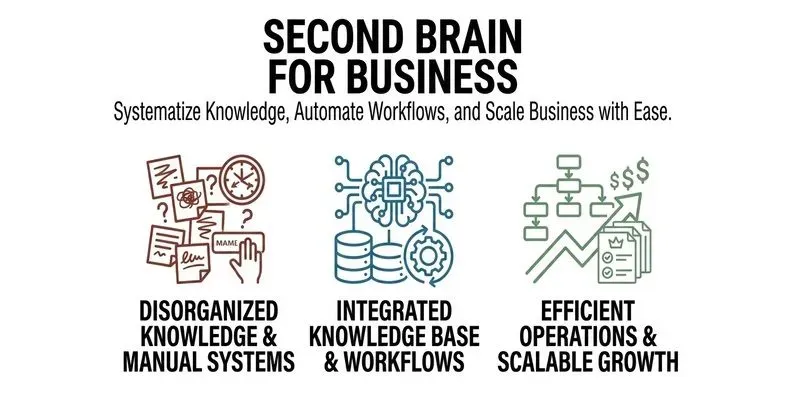
Feed in five details — business type, information type, team size, workflow scope and primary goal — and get a complete second brain architecture back. Ten numbered sections cover knowledge structure, capture routines, tagging, retrieval, decision rules, task-to-revenue mapping, automation with hours saved, learning loops, scaling tiers and a final blueprint with a quick win. Every field and figure uses your own industry's vocabulary.
...more
Added 3 weeks ago
