


Prompt Details
Model
(claude-5-sonnet)
Token size
4,355
Example input
[WORK_ITEMS_AND_BUSINESS_SIGNALS]: Incident INC-104: Checkout API latency increased from normal levels to repeated p95 spikes during peak usage. Three customer-support tickets reference slow checkout. An engineering workshop note says database connections may be saturating, but no query-plan evidence has been collected. Incident INC-108: Password-reset emails are occasionally delayed by 10–20 minutes. Support received six complaints this month. Request REQ-77: Sales asked for a new reporting filter before the next enterprise demo. Email from Head of Customer Success: “Checkout reliability is becoming a recurring customer conversation and we need clarity before the next renewal cycle.” Workshop note: Several engineers suspect connection-pool pressure may also affect order-processing jobs.
[DOMAIN_RISK_FOCUS]: Application Layer, Database, Integration Layer
Example output
Note: this input set has fewer than 12 items, so it runs at full depth with no consolidation pass.
## 1. EXECUTIVE FIX PRIORITY SUMMARY
Four work items were supplied: two incidents (checkout latency, delayed password-reset emails), one feature request (reporting filter), and one supporting workshop note plus one customer-success email, both of which attach to the checkout incident rather than standing alone.
The evidence points to a possible shared root cause — database connection-pool saturation — linking checkout latency (INC-104) to a suspected but unconfirmed effect on order-processing jobs. This is the highest-leverage thread to investigate, but it is currently **PLAUSIBLE, not CONFIRMED**: no query-plan or connection-pool metrics were supplied. INC-108 (password-reset delay) shows a different, unrelated impact pattern (email delivery timing, not API latency) and no evidence ties it to the same mechanism. REQ-77 is a feature request with a business deadline, not a defect, and is sequenced separately.
## 2. BUSINESS PRESSURE & COMMUNICATION SIGNALS
| Signal | Source | What Was Actually Said/Observed | Interpretation | Confidence |
|---|---|---|---|---|
| Customer escalation | 3 support tickets (INC-104) | {CONFIRMED — evidence: "Three customer-support tickets reference slow checkout"} | Customers are noticing and reporting checkout slowness | CONFIRMED |
| Repeated complaint | 6 support tickets (INC-108) | {CONFIRMED — evidence: "Support received six complaints this month"} | Higher volume of complaints than INC-104, but about a different symptom | CONFIRMED |
| Executive/stakeholder attention + trust concern | Email, Head of Customer Success | {CONFIRMED — evidence: "Checkout reliability is becoming a recurring customer conversation and we need clarity before the next renewal cycle"} | A named stakeholder is linking checkout reliability to renewal risk, on a stated timeline | CONFIRMED |
| Sales/delivery pressure | Request REQ-77 | {CONFIRMED — evidence: "Sales asked for a new reporting filter before the next enterprise demo"} | A deadline-bound feature ask, not an incident | CONFIRMED |
| Workshop consensus (partial) | Engineering workshop note | {CONFIRMED — evidence: "Several engineers suspect connection-pool pressure may also affect order-processing jobs"} | This is stated as suspicion ("suspect"), not a confirmed finding | HIGHLY LIKELY (as a hypothesis worth investigating) — not confirmed as fact |
I am not labeling the organization "panicked" or "frustrated" — no supplied text supports that characterization; the Customer Success email is a business-risk warning, not an emotional description.
**Overall climate: MIXED SIGNALS.** {CONFIRMED — evidence: "Checkout reliability is becoming a recurring customer conversation and we need clarity before the next renewal cycle"} shows concentrated pressure specifically on checkout tied to a business deadline (renewal cycle), while INC-108 has higher raw complaint volume but no equivalent executive-level statement attached. REQ-77 adds a separate, unrelated deadline pressure (enterprise demo).
## 3. DOMAIN RISK VIEW
Focus domains requested: Application Layer, Database, Integration Layer.
**INC-104 (Checkout API latency)**
- PRIMARY DOMAIN: Database (suspected — connection saturation) / Application Layer (API latency observed here)
- SECONDARY DOMAIN: Integration Layer (checkout typically integrates payment/order services, but no evidence supplied on this)
- DOMAIN EXPOSURE: {PLAUSIBLE — reasoning: latency symptom is observed at the API/application layer, and the workshop note names database connection saturation as a suspected cause, but no query-plan or pool-metric evidence has been collected}
- POSSIBLE CROSS-DOMAIN PROPAGATION: {PLAUSIBLE — reasoning: if connection-pool saturation is real, it is architecturally capable of affecting any service sharing that pool, which is the basis for the order-processing suspicion below}
- DOMAIN-SPECIFIC RISK: Database connection exhaustion, if real, is a shared-resource risk that can propagate beyond checkout.
**INC-108 (Password-reset email delay)**
- PRIMARY DOMAIN: Integration Layer (email delivery is typically an external/integrated service)
- SECONDARY DOMAIN: NO MATERIAL DOMAIN LINK FOUND to Database — nothing supplied connects reset-email delay to connection-pool pressure.
- DOMAIN EXPOSURE: {UNKNOWN — missing fact: no information on what system sends the reset email (queue, third-party provider, internal job) or why it's delayed}
**REQ-77 (Reporting filter)**
- NO MATERIAL DOMAIN LINK FOUND to Database, Application Layer defect risk, or Integration Layer — this is a net-new feature request, not a fault in an existing domain.
**Order-processing jobs (raised only in workshop note, not its own item)**
- PRIMARY DOMAIN: Database (shared connection pool, per the suspicion)
- DOMAIN EXPOSURE: {PLAUSIBLE — reasoning: "Several engineers suspect connection-pool pressure may also affect order-processing jobs" is a stated suspicion with no independent evidence (no job-failure logs, no timing data) supplied}
## 4. NORMALIZED WORK ITEM REGISTER
**INC-104**
- SOURCE TYPE: Incident
- SYSTEM/COMPONENT: Checkout API; suspected shared database connection pool
- PROBLEM: p95 latency spikes during peak usage
- OBSERVED IMPACT: Repeated latency spikes; 3 customer support tickets citing slow checkout
- AFFECTED USERS/TEAMS: Customers experiencing checkout; Customer Success (per email)
- RECURRENCE: {CONFIRMED — evidence: "repeated p95 spikes during peak usage"} — recurring, tied to peak load
- CURRENT STATUS: Open, unconfirmed root cause
- REQUESTED ACTION: None explicitly requested in the text; implied need for investigation
- RELATED ITEMS: Workshop note (connection-pool suspicion), CS email (renewal-cycle pressure)
- SOURCE EVIDENCE: Incident description, 3 support tickets, workshop note, CS email
- UNCERTAINTIES: No query-plan evidence; no confirmed connection-pool metrics; no confirmed link to order-processing jobs
**INC-108**
- SOURCE TYPE: Incident
- SYSTEM/COMPONENT: Password-reset email delivery
- PROBLEM: Emails delayed 10–20 minutes, occasionally
- OBSERVED IMPACT: {CONFIRMED — evidence: "Support received six complaints this month"}
- AFFECTED USERS/TEAMS: Users attempting password reset
- RECURRENCE: {CONFIRMED — evidence: "occasionally delayed"} — intermittent, not continuous
- CURRENT STATUS: Open
- REQUESTED ACTION: None explicitly stated
- RELATED ITEMS: None identified — no supplied evidence links this to INC-104 or the connection-pool suspicion
- SOURCE EVIDENCE: Incident description, 6 support complaints
- UNCERTAINTIES: Root cause (queue delay? third-party mail provider? internal job scheduling?) not supplied
**REQ-77**
- SOURCE TYPE: Service/Stakeholder Request
- SYSTEM/COMPONENT: Reporting
- PROBLEM: N/A — feature request, not a defect
- OBSERVED IMPACT: None (not yet built)
- AFFECTED USERS/TEAMS: Sales, enterprise demo audience
- RECURRENCE: N/A
- CURRENT STATUS: Requested, not started
- REQUESTED ACTION: {CONFIRMED — evidence: "Sales asked for a new reporting filter before the next enterprise demo"}
- RELATED ITEMS: None
- SOURCE EVIDENCE: Sales request
- UNCERTAINTIES: Demo date not supplied; scope of "filter" not supplied
## 5. TECHNICAL IMPACT MATRIX
| Item | User Impact | Service Impact | Data Impact | Availability | Performance | Reliability | Security | Operability | Recovery | Change/Deploy |
|---|---|---|---|---|---|---|---|---|---|---|
| INC-104 | MEDIUM {CONFIRMED — evidence: "Three customer-support tickets reference slow checkout"} | MEDIUM | UNKNOWN | LOW (no outage evidence) | HIGH {CONFIRMED — evidence: "repeated p95 spikes during peak usage"} | UNKNOWN (no recovery-time data) | UNKNOWN | UNKNOWN | UNKNOWN | UNKNOWN |
| INC-108 | MEDIUM {CONFIRMED — evidence: "six complaints this month"} | LOW-MEDIUM | UNKNOWN | LOW | MEDIUM (10–20 min delay, stated) | UNKNOWN | LOW (no security signal supplied) | UNKNOWN | UNKNOWN | UNKNOWN |
| REQ-77 | N/A | N/A | N/A | N/A | N/A | N/A | N/A | N/A | N/A | N/A |
No HIGH classification above lacks a cited evidence pointer.
## 6. RECURRENCE & PERSISTENCE VIEW
- INC-104: **RECURRING**, tied to peak-usage periods. {CONFIRMED — evidence: "repeated p95 spikes during peak usage"} This is directly evidenced, not inferred from repeated mentions of a single event.
- INC-108: **INTERMITTENT**. {CONFIRMED — evidence: "occasionally delayed by 10–20 minutes"} Directly evidenced.
- REQ-77: N/A (not a fault).
Neither incident's recurrence classification is built from repeated references to one historical event — both describe an ongoing pattern in the source text itself.
## 7. DEPENDENCY & PROPAGATION MAP
Only one chain is supported by supplied evidence, and it is explicitly a suspicion, not a confirmed architecture fact:
```
Database connection pool (suspected saturation)
→ Checkout API latency (INC-104, observed)
→ [SUSPECTED, UNCONFIRMED] Order-processing job slowdown (workshop note only — no job-failure or timing evidence supplied)
→ Business consequence: Customer Success reports renewal-cycle risk tied to checkout reliability
```
I cannot extend this chain to INC-108 — no supplied evidence connects password-reset email delivery to the checkout/database chain. Treating them as related would be inventing a technical root cause.
REQ-77 has no dependency chain — it is additive scope, not a fault propagation.
## 8. RISK OF NOT FIXING
**INC-104**
- SHORT-TERM RISK: MODERATE — recurring peak-time latency continuing to generate support tickets
- MEDIUM-TERM RISK: {HIGH — evidence: "Checkout reliability is becoming a recurring customer conversation and we need clarity before the next renewal cycle"} — a named stakeholder has tied this to renewal risk on a stated timeline
- ACCUMULATION RISK: PLAUSIBLE (reasoning: if connection-pool saturation is real and unaddressed, load growth would worsen it, but no trend data was supplied to confirm "trending worse")
- REPEAT INCIDENT RISK: HIGH — recurrence is confirmed
- CUSTOMER/USER RISK: MEDIUM-HIGH per the CS email and ticket volume
- DELIVERY RISK: UNKNOWN (no delivery-blocking evidence supplied)
- OPERATIONAL BURDEN: MODERATE (3 tickets, one workshop discussion)
- TECHNICAL DEBT AMPLIFICATION: PLAUSIBLE if the suspected pool-sharing with order-processing is real
**INC-108**
- SHORT-TERM RISK: MODERATE — repeated user friction at account-recovery, a sensitive moment
- MEDIUM-TERM RISK: LOW-MODERATE — no stakeholder statement elevates this beyond support-ticket volume
- ACCUMULATION RISK: UNKNOWN
- REPEAT INCIDENT RISK: HIGH — recurrence confirmed (intermittent, ongoing)
- CUSTOMER/USER RISK: MODERATE — 6 complaints, no churn/renewal linkage stated
- DELIVERY RISK: UNKNOWN
- OPERATIONAL BURDEN: MODERATE-HIGH (highest raw complaint count of the two incidents)
- TECHNICAL DEBT AMPLIFICATION: UNKNOWN
Neither item is classified CRITICAL — no evidence of outage, data loss, or security consequence was supplied for either.
## 9. PRIORITY CHALLENGE TEST
- **Is INC-104's urgency evidence-based or stakeholder-volume-based?** Both: 3 tickets (lower volume than INC-108's 6) plus one specific, named-stakeholder statement tying it to renewal risk. The stakeholder statement is the differentiator, not ticket count.
- **Is the database root cause confirmed for INC-104?** No — {PLAUSIBLE, evidence: engineering workshop note states connection saturation "may" be the cause, and explicitly notes "no query-plan evidence has been collected"}. This stays PLAUSIBLE, not CONFIRMED, and that ceiling matters for priority (see Rule 2 below).
- **Could a lower-ranked issue (INC-108) be a symptom of the same root cause as INC-104?** No evidence supports this — different subsystems (email delivery vs. checkout API), no shared-evidence pointer supplied. Treated as independent.
- **Would fixing the suspected database issue resolve multiple items at once?** Possibly INC-104 and the order-processing concern — but the order-processing concern isn't an independently reported item, only a workshop suspicion. This increases INC-104's dependency centrality but doesn't create a second confirmed item to resolve.
- **Is REQ-77 actually competing for the same engineering capacity as the incidents?** Likely yes (same engineering org) but no evidence specifies which team/engineers; sequenced separately in Section 11.
No priority was changed by this test, but the evidence ceiling from the second question directly caps INC-104 below P0 (see below).
## 10. FINAL PRIORITIZATION TABLE
| Priority | Item | Why Now | Technical Risk | Business Pressure | Recurrence | Domain | Evidence Confidence | Dependency Impact | Action |
|---|---|---|---|---|---|---|---|---|---|
| **P1** | INC-104 | Recurring peak-time latency + named-stakeholder renewal-risk statement | HIGH (latency) / root cause PLAUSIBLE | HIGH (concentrated, renewal-tied) | RECURRING | Database/Application Layer | PLAUSIBLE (root cause) | Possible driver of order-processing suspicion | Investigate DB connection pool |
| **P2** | INC-108 | Ongoing complaint volume, no confirmed business-critical linkage | MEDIUM | MODERATE | INTERMITTENT | Integration Layer | UNKNOWN (root cause) | None confirmed | Investigate delivery path |
| **P2** | REQ-77 | Deadline-bound sales ask, not a defect | N/A | MODERATE (demo deadline, no date given) | N/A | N/A | CONFIRMED (request itself) | None | Scope against demo date |
| NEEDS EVIDENCE | Order-processing job impact | Only a workshop suspicion, no independent report | UNKNOWN | UNKNOWN | UNKNOWN | Database | UNKNOWN | Tied to INC-104 if confirmed | Collect job-failure/timing data |
**WHY / EVIDENCE / WHAT WOULD CHANGE PRIORITY / CONFLICT RULE — INC-104:**
- WHY: Confirmed recurring latency plus a confirmed, dated business-pressure statement (renewal cycle) from a named stakeholder.
- EVIDENCE: {CONFIRMED — evidence: "repeated p95 spikes during peak usage"}; {CONFIRMED — evidence: "Checkout reliability is becoming a recurring customer conversation and we need clarity before the next renewal cycle"}
- WHAT WOULD CHANGE PRIORITY: Query-plan or connection-pool metrics confirming saturation → P0. Evidence of actual order-processing job failures → P0 (dependency centrality would strengthen). A stated renewal date within days → P0 (Rule 1, irreversible business consequence).
- CONFLICT RULE APPLIED: **Rule 2** — evidence confidence gates the ceiling. Technical severity for the latency symptom is HIGH and confirmed, and business pressure is HIGH and confirmed, which would suggest P0 — but the *root cause* (the axis the case actually rests on, connection-pool saturation) is only PLAUSIBLE, so the item is capped at P1 until that evidence is collected.
**WHY / EVIDENCE / WHAT WOULD CHANGE PRIORITY / CONFLICT RULE — INC-108:**
- WHY: Confirmed, ongoing complaint pattern with no confirmed connection to a larger system risk.
- EVIDENCE: {CONFIRMED — evidence: "Support received six complaints this month"}
- WHAT WOULD CHANGE PRIORITY: A stakeholder statement tying this to renewal/trust risk (parallel to INC-104's email) → P1. Evidence linking it to the same infrastructure as INC-104 → reclassify jointly.
- CONFLICT RULE APPLIED: No conflict — technical risk (MEDIUM) and business pressure (MODERATE) agree without needing the hierarchy.
**WHY / EVIDENCE / WHAT WOULD CHANGE PRIORITY / CONFLICT RULE — REQ-77:**
- WHY: Legitimate, deadline-bound business request; not a system risk.
- EVIDENCE: {CONFIRMED — evidence: "Sales asked for a new reporting filter before the next enterprise demo"}
- WHAT WOULD CHANGE PRIORITY: A supplied demo date inside the current sprint window → P1.
- CONFLICT RULE APPLIED: No conflict — this item isn't scored on the technical/business risk axes at all; it's sequenced on deadline.
## 11. EXECUTION SEQUENCE
- **FIX FIRST:** INC-104 investigation (collect query-plan and connection-pool metrics) — this is the evidence gap blocking a P0/P1 decision and, per Rule 3 (dependency centrality), potentially unblocks understanding of the order-processing suspicion too.
- **CAN RUN IN PARALLEL:** INC-108 root-cause investigation — no shared component confirmed with INC-104, so no sequencing dependency.
- **CAN RUN IN PARALLEL:** REQ-77 scoping/estimation — separate team surface (reporting), doesn't block or get blocked by the incidents.
- **BLOCKED BY:** Any fix to the "order-processing slowdown" is blocked by confirming it's real — currently just a suspicion, not an actionable item.
- **DEFER UNTIL:** REQ-77 build work, until the demo date is known and weighed against INC-104/108 engineering capacity.
- **MONITOR ONLY:** None at this time — both incidents have active, recent complaint signals.
## 12. EVIDENCE GAPS
| Missing Evidence | Why It Matters | Decision Blocked | How to Collect | Priority Impact if Confirmed |
|---|---|---|---|---|
| Query-plan / connection-pool utilization data for checkout DB | Root cause of INC-104 is currently only PLAUSIBLE | Whether INC-104 is P0 or P1 | Pull DB connection-pool metrics during a peak-window spike; capture slow query log | Could move INC-104 to P0 (Rule 1) |
| Order-processing job failure/timing logs | Determines if the workshop suspicion is a real, second affected system | Whether order-processing is a separate NEEDS EVIDENCE item to prioritize or can be closed as unrelated | Pull job success/failure/duration logs for the same time windows as INC-104 spikes | Could elevate INC-104's dependency centrality and create a new confirmed item |
| Password-reset email pipeline architecture (queue vs. third-party provider) | Determines INC-108's actual domain and whether it's even in scope of the requested domain focus | Where to route the INC-108 investigation | Trace one delayed reset email end-to-end through the sending pipeline | Could reclassify INC-108's domain and technical risk |
| Renewal-cycle date(s) referenced in the CS email | Determines how time-boxed the INC-104 business pressure actually is | Whether INC-104 should be P0 under Rule 1 | Ask Head of Customer Success for the specific renewal date(s) at risk | Could move INC-104 to P0 if the date is near-term |
| REQ-77 demo date | Determines REQ-77's actual sequencing urgency | Whether REQ-77 competes with incident work for the same sprint | Ask Sales for the demo date | Could move REQ-77 to P1 |
## 13. VALIDATION & EXIT CRITERIA
**INC-104**
- FIX OBJECTIVE: Eliminate peak-time p95 latency spikes in checkout API
- VALIDATION SIGNAL: p95 latency stays within normal baseline during at least one subsequent peak-usage window
- EXPECTED IMPROVEMENT: Reduction in checkout-related support tickets
- FAILURE SIGNAL: Spikes recur despite the connection-pool fix, indicating a different or additional root cause
- REGRESSION RISK: Changes to connection-pool sizing/config could affect other services sharing the pool (including the suspected order-processing jobs) — monitor those alongside checkout
- OBSERVATION REQUIRED: At least one full peak-usage cycle post-fix before declaring resolution
**INC-108**
- FIX OBJECTIVE: Reset emails delivered within a defined SLA (target TBD — not supplied)
- VALIDATION SIGNAL: Delivery-time measurements across a sample of resets post-fix
- EXPECTED IMPROVEMENT: Reduction in support complaints about reset delay
- FAILURE SIGNAL: Delays persist or worsen
- REGRESSION RISK: UNKNOWN — depends on where in the pipeline the fix is applied
- OBSERVATION REQUIRED: Delivery-time sampling over at least the current complaint window (one month) post-fix
I am not claiming either fix has succeeded — no post-fix evidence has been supplied.
## 14. SOFTWARE FIX PRIORITY PACK
**FIX NOW**
*(None qualify as P0 — see Evidence Gaps; both incidents require investigation before a fix can be scoped.)*
**FIX NEXT**
- **INC-104**: Reason — recurring, confirmed latency plus confirmed renewal-tied business pressure. Evidence — support tickets + CS email + workshop note (root cause unconfirmed). First action — pull DB connection-pool metrics and slow-query logs during next peak window.
**INVESTIGATE FIRST**
- **INC-104 root cause**: connection-pool saturation is PLAUSIBLE, not CONFIRMED.
- **Order-processing job impact**: currently a workshop suspicion only, no independent evidence.
- **INC-108 root cause**: pipeline stage causing delay is UNKNOWN.
**DEFER / MONITOR**
- **REQ-77**: Legitimate but non-defect, deadline unspecified — defer until demo date is known and weighed against incident-investigation capacity.
**CROSS-CUTTING ROOT ISSUE**
NO SHARED ROOT ISSUE CONFIRMED between INC-104 and INC-108. A possible shared mechanism exists *within* INC-104 (connection pool → checkout + order-processing), but this itself is PLAUSIBLE, not confirmed.
**BUSINESS PRESSURE SIGNAL**
Concentrated, renewal-cycle-linked pressure on checkout reliability (INC-104) from a named stakeholder; separate, deadline-bound sales pressure on REQ-77; ongoing but less escalated complaint volume on INC-108.
**DOMAIN RISK SIGNAL**
Within the requested focus (Application Layer, Database, Integration Layer): INC-104 is the only item with a plausible Database-layer mechanism; INC-108 sits in Integration Layer with unknown specifics; REQ-77 has no material link to any focus domain.
**FIRST ENGINEERING ACTION**
Pull checkout-service database connection-pool utilization metrics and slow-query logs for the next peak-usage window (and, if feasible, the most recent past spike if logs are retained).
**FIRST EVIDENCE ACTION**
Same as above — this single dataset resolves the largest number of open uncertainties (INC-104 root cause, order-processing linkage, P0/P1 determination).
**REPRIORITIZE WHEN**
Connection-pool/query-plan evidence is collected, OR a specific near-term renewal date is confirmed, OR order-processing job failures are independently reported.
**STATUS**
READY WITH EVIDENCE GAPS
## 15. MACHINE-READABLE PRIORITY PACK
```json
{
"generated_from": "3 items (2 incidents + 1 request), 0 CONFIRMED-only items, 1 needs-evidence sub-item (order-processing linkage)",
"items": [
{
"item_id": "INC-104",
"priority": "P1",
"why_now": "Recurring peak-time checkout latency confirmed; renewal-tied business pressure confirmed via named-stakeholder email",
"evidence_confidence": "HIGHLY_LIKELY",
"conflict_rule_applied": "2",
"technical_risk": "HIGH",
"business_pressure": "HIGH",
"recurrence": "RECURRING",
"primary_domain": "Database",
"dependency_impact": {
"blocks": ["order-processing-job-linkage-determination"],
"blocked_by": [],
"fix_together_with": []
},
"sequencing": "FIX_FIRST",
"first_action": "Pull DB connection-pool utilization metrics and slow-query logs during next peak window",
"validation_signal": "p95 latency within baseline across a subsequent peak-usage window",
"failure_signal": "Latency spikes recur after connection-pool remediation"
},
{
"item_id": "INC-108",
"priority": "P2",
"why_now": "Ongoing, confirmed complaint volume; no confirmed link to a broader system risk",
"evidence_confidence": "CONFIRMED",
"conflict_rule_applied": "none",
"technical_risk": "MEDIUM",
"business_pressure": "MODERATE",
"recurrence": "INTERMITTENT",
"primary_domain": "Integration Layer",
"dependency_impact": {
"blocks": [],
"blocked_by": [],
"fix_together_with": []
},
"sequencing": "CAN_RUN_IN_PARALLEL",
"first_action": "Trace a delayed reset email end-to-end through the sending pipeline",
"validation_signal": "Delivery-time sampling shows resets within target SLA",
"failure_signal": "Delays persist or worsen after pipeline fix"
},
{
"item_id": "REQ-77",
"priority": "P2",
"why_now": "Deadline-bound sales request, not a defect; demo date not yet known",
"evidence_confidence": "CONFIRMED",
"conflict_rule_applied": "none",
"technical_risk": "UNKNOWN",
"business_pressure": "MODERATE",
"recurrence": null,
"primary_domain": null,
"dependency_impact": {
"blocks": [],
"blocked_by": [],
"fix_together_with": []
},
"sequencing": "DEFER_UNTIL",
"first_action": "Get enterprise demo date from Sales",
"validation_signal": "Filter delivered and functional before demo date",
"failure_signal": "Demo date arrives without feature delivered"
},
{
"item_id": "ORDER-PROCESSING-LINKAGE",
"priority": "NEEDS_EVIDENCE",
"why_now": "Workshop suspicion only; no independent report of job failures or delays",
"evidence_confidence": "PLAUSIBLE",
"conflict_rule_applied": "none",
"technical_risk": "UNKNOWN",
"business_pressure": "INSUFFICIENT_EVIDENCE",
"recurrence": "UNKNOWN",
"primary_domain": "Database",
"dependency_impact": {
"blocks": [],
"blocked_by": ["INC-104"],
"fix_together_with": []
},
"sequencing": "MONITOR_ONLY",
"first_action": "Pull job success/failure/duration logs for same windows as INC-104 spikes",
"validation_signal": null,
"failure_signal": null
}
],
"cross_cutting_root_issue": null,
"reprioritize_when": "Connection-pool/query-plan evidence collected, OR near-term renewal date confirmed, OR order-processing job failures independently reported",
"status": "READY_WITH_EVIDENCE_GAPS"
}
```


 Instant access
 Commercial use
 Money‑back
By purchasing this prompt, you agree to our terms of service
5.0
1 review
1
Favorites
83
Views
CLAUDE-5-SONNET


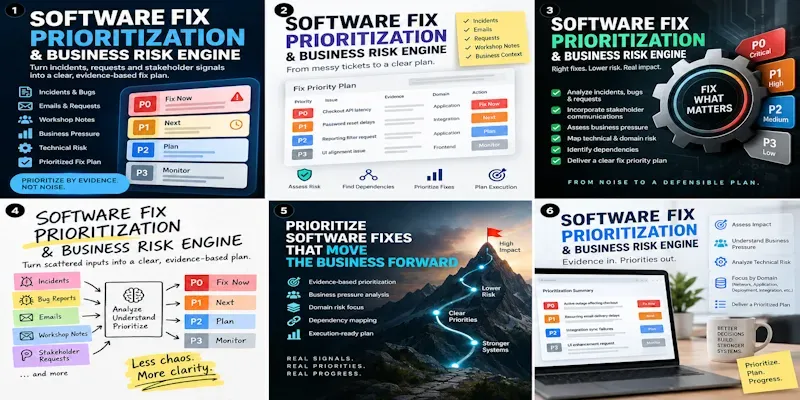
Software Fix Prioritization & Business Risk Engine
Turn incidents, bugs, requests, emails, workshop notes, and stakeholder signals into an evidence-based software fix priority plan. This prompt separates technical severity from business pressure, identifies recurrence and dependency risk, applies optional domain-focused risk analysis, challenges weak priorities, and produces a ranked remediation plan with execution sequence, evidence gaps, and validation criteria.
...more
Added 3 weeks ago

- Reviews for this prompt (1)