

Prompt Details
Model
(claude-5-sonnet)
Token size
4,333
Example input
[PROJECT_BRIEF]: A regional hospital network is replacing fragmented paper and spreadsheet-based patient scheduling with a centralized digital scheduling platform across emergency, outpatient, diagnostic, and surgical departments. Leadership wants a phased rollout within six months while maintaining uninterrupted clinical operations.
[STAKEHOLDER_EVIDENCE]: The Chief Medical Officer can halt deployment if patient-safety concerns are unresolved. Emergency physicians report that the proposed workflow adds steps during high-volume periods, but no timed workflow study has been completed. Scheduling administrators support automation but fear role reductions and have requested formal workforce-impact clarification. The IT security team requires completion of access-control testing before production release. The software vendor says delaying the rollout beyond the current quarter may affect implementation staffing but has provided no contractual deadline. Nursing leadership has requested involvement in workflow validation after nurses were excluded from the initial pilot design.
[specific limitation]: null
Example output
# Stakeholder Governance & Decision Intelligence Assessment
## Regional Hospital Network — Centralized Scheduling Platform
---
## CARD 1 — DECISION SUMMARY
**Top priorities:**
1. **CMO / patient-safety halt authority** — a coercive power holder with unresolved moral-legitimacy claim (safety) tied to the ED workflow concern. This is the single most consequential unresolved item.
2. **IT Security / access-control testing gate** — a documented pre-production control requirement with implicit organizational authority to block release.
3. **Emergency physicians' workflow-friction claim** — high plausible relevance to patient safety and CMO's halt authority, but currently unverified (no timed workflow study exists).
**Immediate decision required:** Whether production/pilot progression is permitted to proceed before (a) a timed ED workflow study is completed and (b) access-control testing is confirmed complete. This is a gating decision, not a scheduling preference.
**Accountable decision role:** Program/Project Executive Sponsor, in direct coordination with the CMO (safety authority) and IT Security lead (technical release gate). Neither can be overridden by rollout-timeline pressure alone.
**Evidence-quality warning:** Several claims are asserted but not substantiated (e.g., ED workflow friction, vendor timeline pressure). No claim in this evidence set should be treated as independently verified merely because it was stated by a credible role-holder. Two pairs are currently UNKNOWN/HOLD pending specific missing facts identified below.
---
## CARD 2 — EVIDENCE STATE
| Status | Items |
|---|---|
| **DOCUMENTED** | CMO has halt authority over safety concerns; IT security requires access-control testing pre-release; scheduling administrators support automation but fear role reduction and requested workforce-impact clarification; nursing leadership requested involvement after pilot exclusion; ED physicians report added workflow steps; vendor cites possible quarter-delay staffing impact |
| **INFERRED** | CMO's halt authority likely extends to any unresolved safety-relevant workflow claim, including the ED report — not yet DOCUMENTED as connected, but plausible given subject-matter overlap |
| **UNKNOWN** | Severity/frequency of the ED workflow friction; whether any patient-safety incident has occurred or is anticipated; vendor's actual contractual terms; timeline of nursing's requested involvement relative to remaining project phases; current status of access-control testing (in progress? blocked? complete?) |
| **CONTESTED** | None directly contested (no two sources dispute the same fact) — but the ED claim and the overall rollout timeline are in **latent tension**: leadership wants a six-month phased rollout; ED concern and security gate could each independently extend that timeline |
| **AMBIGUOUS** | Whether "current quarter" (vendor) aligns with or conflicts with the six-month rollout target |
**Missing facts most likely to change decisions:**
- Whether a timed ED workflow study has been scheduled or committed to
- Current completion status of IT access-control testing
- Whether the CMO has been briefed on the ED report specifically
- Scope/terms of any vendor contract (deadline, penalty, staffing clause)
---
## CARD 3 — STAKEHOLDER–CLAIM REGISTER
| ID | Stakeholder | Claim | Requested/Feared Outcome | Decision Relevance | Evidence Locator | Evidence Status | Eligibility Result | Missing Fact |
|---|---|---|---|---|---|---|---|---|
| S1 | Chief Medical Officer | Can halt deployment if patient-safety concerns unresolved | Protect patient safety; prevent unsafe go-live | Direct — coercive gate over release | "CMO can halt deployment if patient-safety concerns are unresolved" | DOCUMENTED (power); safety concern itself is not yet specified | **ELIGIBLE** (power + moral legitimacy evidenced) | What specific safety concerns are currently open, and their evidentiary basis |
| S2 | Emergency physicians | Proposed workflow adds steps during high-volume periods | Avoid workflow friction that could degrade care during surges | High potential relevance to S1's halt trigger, but unverified | "no timed workflow study has been completed" | DOCUMENTED (claim made); UNKNOWN (claim substance — no study exists) | **SCREENING REQUIRED** — claim plausible but unverified; urgency/severity not yet evidenced beyond assertion | Completion of a timed workflow study during high-volume periods |
| S3 | Scheduling administrators | Support automation but fear role reductions; request formal workforce-impact clarification | Job security; clarity on role changes | Moderate — workforce/adoption risk, not safety-critical | "requested formal workforce-impact clarification" | DOCUMENTED | **ELIGIBLE** (utilitarian stake in own labor; moral/procedural legitimacy in requesting clarification) | Whether a workforce-impact assessment is planned or scoped |
| S4 | IT Security team | Requires completion of access-control testing before production release | Prevent unauthorized access to patient scheduling data | Direct — technical/compliance release gate | "IT security team requires completion of access-control testing before production release" | DOCUMENTED | **ELIGIBLE** (utilitarian/technical control power + governance legitimacy) | Current status/completion date of access-control testing |
| S5 | Software vendor | Delay beyond current quarter may affect implementation staffing | Avoid loss of assigned implementation resources; preserve schedule | Indirect — commercial/resourcing pressure, not safety or compliance | "has provided no contractual deadline" | DOCUMENTED (claim made); UNKNOWN (contractual basis) | **SCREENING REQUIRED** — no evidenced coercive/utilitarian power over the *decision*, only over vendor's own resourcing | Existence and terms of any contractual deadline or penalty clause |
| S6 | Nursing leadership | Requests involvement in workflow validation after exclusion from initial pilot design | Be included in workflow design/validation before further rollout | Moderate-high — procedural legitimacy gap; potential safety-adjacent input (nurses are frontline schedule users) | "requested involvement in workflow validation after nurses were excluded from the initial pilot design" | DOCUMENTED | **ELIGIBLE** (moral/procedural legitimacy — exclusion from design is a governance-integrity issue; utilitarian power via operational dependency on nursing workflow compliance) | Whether nursing exclusion was deliberate/scoped or an oversight, and current pilot phase status |
---
## CARD 4 — SALIENCE DIAGNOSTIC
### S1 — CMO / Safety Halt Authority
| Factor | Score | Status | Rationale |
|---|---|---|---|
| Coercive Power | 5 | DOCUMENTED | Explicit stated authority to halt deployment |
| Utilitarian Power | UNKNOWN | UNKNOWN | No evidence of budget/resource control stated |
| Normative Power | INFERRED-3 | INFERRED | Clinical authority typically carries reputational/professional-standard weight in a hospital setting; not explicitly evidenced here |
| Pragmatic Legitimacy | UNKNOWN | UNKNOWN | Not evidenced |
| Moral Legitimacy | 4 | DOCUMENTED | Explicit remit is patient safety — core moral legitimacy domain |
| Cognitive Legitimacy | INFERRED-4 | INFERRED | Clinical safety authority is a familiar, taken-for-granted governance role in healthcare |
| Time Sensitivity | UNKNOWN | UNKNOWN | No evidence of how close to a safety-relevant decision point this concern is |
| Criticality | UNKNOWN | UNKNOWN | No evidence yet on persistence/repetition of the underlying safety concern (see S2) |
| Interactional Volatility (MONNA OPERATIONAL EXTENSION — NOT AN ORIGINAL STAKEHOLDER SALIENCE DIMENSION) | INFERRED-3 | INFERRED | A halt decision by a CMO plausibly triggers escalation to executive sponsor and board-level visibility, but not directly evidenced |
**Core Salience Reading:** Decisive coercive power combined with clearly evidenced, domain-appropriate moral legitimacy. This is sufficient on its own to place S1 in a high-priority band regardless of urgency, which remains UNKNOWN.
**Contextual Modifiers:** Cognitive legitimacy (role familiarity) reinforces but does not substitute for the core judgment.
---
### S2 — Emergency Physicians / Workflow Friction
| Factor | Score | Status | Rationale |
|---|---|---|---|
| Coercive Power | UNKNOWN | UNKNOWN | No evidence physicians can independently block deployment |
| Utilitarian Power | INFERRED-3 | INFERRED | Frontline operators of the workflow; operational dependency plausible but not quantified |
| Normative Power | INFERRED-2 | INFERRED | Clinical staff opinion carries some professional weight, not evidenced as decisive |
| Pragmatic Legitimacy | 2 | DOCUMENTED | Self-interest in workable daily workflow |
| Moral Legitimacy | UNKNOWN | UNKNOWN | Would require evidence the friction creates patient-safety risk, not just inconvenience — not yet established |
| Cognitive Legitimacy | 3 | DOCUMENTED | Frontline familiarity with actual ED operating conditions |
| Time Sensitivity | UNKNOWN | UNKNOWN | No study completed; unclear how soon this must be resolved relative to rollout phases |
| Criticality | UNKNOWN | UNKNOWN | Single report, not evidenced as repeated/escalating |
| Interactional Volatility | INFERRED-3 | INFERRED | Plausible escalation path to CMO (S1) given subject-matter overlap, but not an EXPLICIT link |
**Core Salience Reading:** This claim is currently **SCREENING REQUIRED**, not a scored priority — power is largely inferred, moral legitimacy (the piece that would matter most) is UNKNOWN pending the workflow study. Its significance is entirely contingent on whether it converts into a documented safety-relevant finding.
---
### S3 — Scheduling Administrators / Workforce Impact
| Factor | Score | Status | Rationale |
|---|---|---|---|
| Coercive Power | UNKNOWN | — | No evidence of blocking capacity |
| Utilitarian Power | INFERRED-2 | INFERRED | Control over legacy manual scheduling processes during transition, not directly evidenced |
| Normative Power | UNKNOWN | — | Not evidenced |
| Pragmatic Legitimacy | 4 | DOCUMENTED | Direct, self-interested stake in role continuity |
| Moral Legitimacy | 2 | INFERRED | Fair-process/procedural-integrity claim (formal clarification request), moderate not high |
| Cognitive Legitimacy | 3 | DOCUMENTED | Deep familiarity with current scheduling operations |
| Time Sensitivity | UNKNOWN | — | Not evidenced |
| Criticality | UNKNOWN | — | Single request, not evidenced as escalating |
| Interactional Volatility | INFERRED-2 | INFERRED | Unaddressed workforce fear plausibly a slow-burn adoption-resistance risk, not an acute escalation |
**Core Salience Reading:** Material but not urgent claim; legitimate procedural request. Does not currently meet HIGH/IMMEDIATE threshold on power evidence, but should not be dismissed as low-value — it affects adoption success.
---
### S4 — IT Security Team / Access-Control Testing
| Factor | Score | Status | Rationale |
|---|---|---|---|
| Coercive Power | INFERRED-4 | INFERRED | "Requires" completion before release strongly implies release-blocking capacity in most governance structures, though not explicitly stated as a formal halt right (unlike S1) |
| Utilitarian Power | 4 | DOCUMENTED | Direct control over a required technical gate (access-control testing) |
| Normative Power | UNKNOWN | — | Not evidenced |
| Pragmatic Legitimacy | UNKNOWN | — | Not evidenced |
| Moral Legitimacy | INFERRED-3 | INFERRED | Data protection in a healthcare setting touches patient privacy/safety-adjacent duty, though not explicitly framed as such in the evidence |
| Cognitive Legitimacy | 4 | DOCUMENTED | Access-control testing is a standard, expected pre-release control |
| Time Sensitivity | INFERRED-4 | INFERRED | Framed as a precondition to production release — implies proximate relevance to the go-live decision |
| Criticality | UNKNOWN | — | No evidence on testing progress or repeated escalation |
| Interactional Volatility | UNKNOWN | — | No evidence of coalition/escalation behavior |
**Core Salience Reading:** Strong evidenced utilitarian/coercive power over a defined technical gate, with plausible moral-legitimacy overlay (data protection in healthcare). Sufficient for a HIGH band independent of urgency, pending confirmation of testing status.
---
### S5 — Software Vendor / Quarter-Delay Staffing Impact
| Factor | Score | Status | Rationale |
|---|---|---|---|
| Coercive Power | 0 | DOCUMENTED | Explicit no contractual deadline provided — no evidenced sanction capacity over the hospital's decision |
| Utilitarian Power | INFERRED-2 | INFERRED | Vendor controls its own staffing allocation, an indirect resource dependency, not evidenced as decisive over project |
| Normative Power | UNKNOWN | — | Not evidenced |
| Pragmatic Legitimacy | 2 | DOCUMENTED | Commercial self-interest in schedule adherence |
| Moral Legitimacy | 0 | DOCUMENTED | No ethical/safety/public-interest basis claimed |
| Cognitive Legitimacy | UNKNOWN | — | Not evidenced |
| Time Sensitivity | 2 | DOCUMENTED | "Current quarter" framing implies near-term relevance, but unquantified |
| Criticality | UNKNOWN | — | No evidence of repeated escalation |
| Interactional Volatility | UNKNOWN | — | No evidence |
**Core Salience Reading:** Weak evidenced power (explicitly no contractual lever), no moral legitimacy claimed, only pragmatic self-interest. This claim should not be allowed to compress the timeline against safety or security gates. **SCREENING REQUIRED** — urgency assertion alone, absent power or legitimacy, cannot establish priority per doctrine.
---
### S6 — Nursing Leadership / Pilot Exclusion & Validation Request
| Factor | Score | Status | Rationale |
|---|---|---|---|
| Coercive Power | UNKNOWN | — | Not evidenced |
| Utilitarian Power | INFERRED-3 | INFERRED | Nurses are frontline operational users of scheduling; adoption depends on their engagement, though not explicitly quantified |
| Normative Power | INFERRED-2 | INFERRED | Professional standing may carry coalition-formation potential with ED physicians (S2) given shared frontline-clinical framing, not explicitly evidenced |
| Pragmatic Legitimacy | 2 | DOCUMENTED | Interest in usable workflow |
| Moral Legitimacy | 3 | DOCUMENTED | Procedural-integrity/governance claim: exclusion from design is a fair-process issue directly stated |
| Cognitive Legitimacy | 3 | DOCUMENTED | Frontline operational familiarity |
| Time Sensitivity | INFERRED-3 | INFERRED | "After exclusion from initial pilot design" suggests a pilot phase has occurred or is underway — implies near-term relevance to subsequent phases |
| Criticality | UNKNOWN | — | Single request; not evidenced as repeated |
| Interactional Volatility | INFERRED-3 | INFERRED | Plausible coalition alignment with S2 (both frontline clinical, both workflow-validation concerns) — SEMANTIC INFERENCE, not explicit |
**Core Salience Reading:** Documented moral legitimacy (procedural exclusion) combined with plausible utilitarian power (adoption dependency) supports a material, scheduled-engagement priority. Power is inferred rather than decisive, so this sits below S1/S4 but above S3/S5/S2 in current evidenced strength.
---
## CARD 5 — PRIORITY & BIAS REVIEW
| Pair | Decision Band | Evidence Rationale | Management View | Evidence/Mgmt Gap | Decision Sensitivity | Order Stability | Likely Bias/Blind Spot |
|---|---|---|---|---|---|---|---|
| S1 CMO | **IMMEDIATE** | Decisive coercive power + documented moral legitimacy on patient safety, a domain requiring current-action treatment given rollout is active | MANAGEMENT VIEW UNKNOWN | Unknown — leadership's six-month rollout push could be in tension with S1's authority, not confirmed | High — hinges on whether ED concern (S2) is deemed safety-relevant | Stable across passes | Risk of underweighting S1 if attention is captured by louder vendor timeline pressure (S5) |
| S4 IT Security | **HIGH** | Documented control over a mandatory pre-release technical gate; inferred coercive capacity | MANAGEMENT VIEW UNKNOWN | Unknown | Moderate — hinges on current testing completion status | Stable | Risk of treating security gate as a "checkbox" rather than a real blocking authority |
| S6 Nursing Leadership | **PLANNED** | Documented procedural-legitimacy claim + plausible operational dependency; not yet coercive/urgent enough for HIGH | MANAGEMENT VIEW UNKNOWN | Unknown — evidence doesn't say whether leadership has acknowledged the exclusion | Moderate | Stable | Risk of under-prioritizing on the basis that nursing wasn't in the "loud" evidence (vendor, physicians) despite a clear governance-integrity issue |
| S3 Scheduling Administrators | **PLANNED** | Legitimate procedural request, pragmatic self-interest; no evidenced power to affect the decision directly | MANAGEMENT VIEW UNKNOWN | Unknown | Low-moderate — mainly an adoption/change-management risk | Stable | Risk of dismissing as "just anxious staff" rather than a legitimate adoption-risk signal |
| S2 ED Physicians | **HOLD — EVIDENCE GAP** | Claim plausible and potentially safety-relevant, but moral legitimacy and criticality are UNKNOWN pending the timed workflow study | MANAGEMENT VIEW UNKNOWN | Unknown | Very high — could flip to IMMEDIATE if study confirms safety-relevant friction, or downgrade to MONITOR if not | Stable | Highest visibility-bias risk in this set: reads as urgent/credible on rhetorical strength alone; doctrine requires the study before elevation |
| S5 Vendor | **HOLD — EVIDENCE GAP** (leaning MONITOR) | No coercive/moral legitimacy evidenced; urgency assertion alone cannot establish priority per doctrine | MANAGEMENT VIEW UNKNOWN | Unknown — but this is the pair most likely to be over-weighted by leadership given commercial/schedule pressure | Low on its own merits; high if leadership allows it to compress S1/S4 timelines | Stable | Classic urgency-bias trap — commercial delay pressure dressed as project risk |
**Order-Stability Check:** Both forward and reverse passes produced identical bands for all six pairs — no reordering effects detected. No ORDER-UNSTABLE flag required.
---
## CARD 6 — PRIORITY FLIP ANALYSIS
| Pair | Current Band | Missing Fact | Possible Alternate Band | Why It Matters |
|---|---|---|---|---|
| S1 CMO | IMMEDIATE | Whether the ED workflow report (S2) has been formally escalated to/reviewed by the CMO | Remains IMMEDIATE either way (power/legitimacy already sufficient), but scope of the halt decision could expand or narrow | Determines whether this is a narrow procedural check or an active safety block |
| S2 ED Physicians | HOLD — EVIDENCE GAP | Completion and findings of a timed workflow study during high-volume periods | IMMEDIATE (if study confirms safety-relevant delay) or MONITOR (if friction is minor/non-safety) | This single fact is the most decision-sensitive item in the entire register |
| S4 IT Security | HIGH | Current completion status of access-control testing | IMMEDIATE (if testing reveals a live vulnerability) or remains HIGH (if on track) | Determines whether this is a scheduled gate or an active blocker |
| S5 Vendor | HOLD — EVIDENCE GAP | Existence/terms of a contractual deadline or penalty | PLANNED (if a real contractual constraint exists) — cannot rise above PLANNED without evidenced power/legitimacy beyond commercial self-interest | Prevents commercial pressure from being mistaken for project-critical urgency |
| S6 Nursing Leadership | PLANNED | Whether nursing's exclusion was a deliberate scope decision or an oversight, and current pilot-phase status | HIGH (if exclusion reflects a systemic governance gap affecting other pilot phases) or remains PLANNED | Determines whether this is an isolated fix or a pattern requiring broader governance correction |
---
## CARD 7 — TEMPORAL SALIENCE SHIFTS
| Pair | Current Phase | Current Salience | Trigger | Possible Future Salience | Evidence Status |
|---|---|---|---|---|---|
| S1 CMO | Pilot/design (inferred from "initial pilot design" reference) | IMMEDIATE | Any confirmed safety finding (e.g., from S2's study) | Sustained IMMEDIATE through cutover; likely re-engagement at go-live gate | INFERRED |
| S2 ED Physicians | Pilot/design | HOLD | Completion of timed workflow study | Could rise to IMMEDIATE at pilot-to-implementation gate, or drop to MONITOR post-study | INFERRED |
| S3 Scheduling Admin | Pilot/design | PLANNED | Formal workforce-impact assessment delivery | Likely shifts to MONITOR once clarification is provided, or escalates (coalition with union/HR channels) if unaddressed through implementation | INFERRED |
| S4 IT Security | Pre-production | HIGH | Completion (or failure) of access-control testing | Resolves to MONITOR post-certification, or IMMEDIATE if a vulnerability is found | INFERRED |
| S5 Vendor | Procurement/implementation planning | HOLD/MONITOR | Confirmation of contractual terms | Could rise to PLANNED if a real deadline is documented; otherwise stays MONITOR through go-live | INFERRED |
| S6 Nursing | Pilot/design | PLANNED | Formal inclusion in a subsequent workflow-validation phase | Likely shifts to MONITOR if inclusion is granted; could escalate to HIGH if exclusion recurs in later phases (implementation, cutover) | INFERRED |
No phase-by-phase evidence was directly supplied; all entries are INFERRED from contextual cues (pilot references, pre-production gate language).
---
## CARD 8 — STAKEHOLDER CONFLICTS
| A's Claim | B's Claim | Conflict Type | Decision Rights | Key Evidence | Resolution Mode | Accountable Authority | Residual Tension |
|---|---|---|---|---|---|---|---|
| S5 Vendor: delay beyond current quarter risks implementation staffing | S1 CMO: can halt for unresolved safety concerns; S4 IT Security: requires completed access-control testing before release | TIMING conflict (schedule pressure vs. safety/security gates) | CMO holds explicit halt authority; IT security holds a stated pre-release requirement; vendor holds neither — only commercial self-interest | Vendor claim is UNKNOWN on contractual basis; S1/S4 claims are DOCUMENTED on authority | **DEFER** — the vendor timing concern is deferred to after safety/security gates are resolved; it cannot drive the schedule | Executive Sponsor / CMO / IT Security jointly | If leadership independently weighs vendor pressure heavily due to visibility bias, this could resurface as pressure to compress S1/S4 timelines — flagged as a bias risk in Card 5 |
| S2 ED Physicians: workflow adds steps in high-volume periods | Leadership: six-month phased rollout target | TIMING / potentially SAFETY-OPERATIONS conflict (pending study outcome) | CMO/patient-safety governance would hold decision rights if the claim proves safety-relevant; leadership holds rollout-schedule authority otherwise | ED claim currently UNVERIFIED (no study) | **VERIFY** — commission the timed workflow study before assigning decision rights either way | CMO (clinical authority) pending study results | Six-month target may need adjustment depending on study findings — currently unresolved |
| S6 Nursing: requests inclusion after pilot exclusion | Project team: original pilot design (implicitly excluded nursing) | GOVERNANCE conflict (procedural fairness/process integrity) | Project governance/design authority — role not explicitly named in evidence | S6 claim DOCUMENTED; project team's rationale for exclusion UNKNOWN | **NEGOTIATE** — formally scope nursing's role in subsequent workflow validation | Project Sponsor / Pilot Design Owner (role UNKNOWN — accountable owner not named in evidence) | Underlying reason for original exclusion is unresolved; could recur in later phases if not addressed structurally |
---
## CARD 9 — ESCALATION CASCADES
| Trigger | Link | Stakeholder Response | Operational Consequence | Decision Point | Confidence |
|---|---|---|---|---|---|
| ED workflow report remains unstudied through pilot phase | Direct Escalation | ED physicians escalate concern to CMO | CMO exercises halt authority (S1) | Go/no-go at next pilot-to-implementation gate | **SEMANTIC INFERENCE** (topical overlap between S2 and S1's safety remit, not an explicit reported escalation) |
| Nursing exclusion from pilot design persists into next phase | Coalition Formation | Nursing leadership (S6) aligns with ED physicians (S2) around shared "frontline exclusion from workflow design" framing | Joint pressure for workflow-validation redesign before further rollout | Pilot-to-implementation transition | **WEAK HYPOTHESIS** (no evidence of actual coordination between S2 and S6; inferred only from shared thematic framing — cannot justify irreversible action) |
| Workforce-impact clarification (S3) not delivered | Reputational Amplification | Scheduling administrators' unaddressed concern spreads informally among staff, affecting adoption sentiment | Reduced frontline cooperation during go-live, indirect operational friction | Implementation/adoption phase | **WEAK HYPOTHESIS** (plausible change-management dynamic, no direct evidence supplied) |
| Vendor staffing pressure (S5) combined with leadership's six-month target | Channel Shift | Commercial/schedule pressure raised directly with executive sponsor rather than through project governance | Risk that schedule pressure bypasses the CMO/IT Security gates | Any point before go-live | **SEMANTIC INFERENCE** (typical vendor-pressure pattern; not explicitly documented as having occurred) |
**Cascade mechanism note:** No cascade in this set is EXPLICIT. All are SEMANTIC INFERENCE or WEAK HYPOTHESIS and must not be used to justify irreversible scheduling or resourcing decisions on their own.
---
## CARD 10 — ENGAGEMENT STRATEGY
| Pair | Engagement Mode | Objective | Reason | Required Evidence | Owner | Trigger for Changing Mode |
|---|---|---|---|---|---|---|
| S1 CMO | **CONSULT** (ongoing, not a one-time engagement) | Maintain CMO's real-time visibility into safety-relevant findings across the rollout | Decisive halt authority requires continuous informed involvement, not episodic updates | Documented safety review process | Executive Sponsor | If any safety finding emerges → shift to **ESCALATE** protocol |
| S2 ED Physicians | **VERIFY** | Commission and complete the timed high-volume workflow study | Claim cannot be responsibly prioritized until substantiated | Study design, completion, and findings | Clinical Operations / Pilot Lead | Study completion → re-engage via **CONSULT** or **ESCALATE** depending on findings |
| S3 Scheduling Admin | **INFORM** then **NEGOTIATE** | Deliver the requested formal workforce-impact clarification | Legitimate procedural request; addressing it directly reduces adoption risk | Workforce-impact assessment | HR / Project Sponsor | If clarification is delayed past a defined milestone → shift to **CONTAIN** (active change-management intervention) |
| S4 IT Security | **VERIFY** | Confirm access-control testing completion before any production release decision | Mandatory technical gate | Testing completion report | IT Security Lead / CISO role | Testing failure or vulnerability found → **ESCALATE** |
| S5 Vendor | **MONITOR** | Track any emerging contractual evidence without letting it drive the schedule | No evidenced power/legitimacy to warrant active negotiation yet | Contract terms, if any exist | Vendor Management / Procurement | If a documented contractual deadline emerges → shift to **NEGOTIATE** |
| S6 Nursing Leadership | **NEGOTIATE** | Formally scope nursing's role in subsequent workflow validation phases | Documented procedural-legitimacy claim requires a defined remedy, not just acknowledgment | Revised validation plan with nursing input | Pilot Design Owner / Project Sponsor | If inclusion is not formalized before next pilot milestone → shift to **ESCALATE** |
---
## CARD 11 — ACTION PLAN
### IMMEDIATE — S1 (CMO / Patient Safety)
- **Objective:** Ensure the CMO has complete, current information to exercise halt authority responsibly before any go/no-go milestone.
- **Bounded action:** Formally route the ED workflow report (S2) to the CMO's office for a documented safety-relevance determination.
- **Accountable owner:** Executive Project Sponsor.
- **Consulted role:** CMO, Clinical Operations Lead.
- **Timing:** Before the next pilot-to-implementation transition point.
- **Evidence gate:** CMO's written determination on whether the ED concern constitutes a patient-safety issue.
- **Leading indicator:** Time elapsed between ED report and CMO review (a growing gap is itself a governance risk signal).
- **Escalation trigger:** CMO issues a halt, or requests the timed workflow study as a precondition.
- **Residual risk:** Delay in CMO review could allow the project to proceed further into implementation before a safety determination is made — recommend explicit interim hold on any ED-department-specific rollout steps pending this review.
### HIGH — S4 (IT Security / Access-Control Testing)
- **Objective:** Confirm the access-control testing gate is satisfied before any production release decision.
- **Bounded action:** Request a formal completion/status report from IT Security, with explicit pass/fail criteria.
- **Accountable owner:** CISO or equivalent IT Security accountable role (specific title UNKNOWN in evidence).
- **Consulted role:** Project Sponsor, Compliance/Privacy Officer if applicable.
- **Timing:** Before production release decision, and no later than the current planning gate.
- **Evidence gate:** Documented test completion report with results.
- **Leading indicator:** Percentage of access-control test cases completed and passed.
- **Escalation trigger:** Any failed test case involving patient data access controls.
- **Residual risk:** If testing is incomplete at the planned release date, releasing anyway would create an unverified security exposure — recommend the release date remain contingent on this gate rather than fixed.
*(No other pairs currently meet the HIGH/IMMEDIATE threshold with sufficient evidence for a full 9-field action plan; S2 and S6 are addressed via Card 10's VERIFY/NEGOTIATE modes and should graduate to full action plans once their respective evidence gates are cleared.)*
---
## CARD 12 — COMMUNICATION STRATEGY
| Stakeholder | Dominant Need | Objective | Message Content | Channel | Cadence | Feedback Route | Prohibited Assumption |
|---|---|---|---|---|---|---|---|
| S1 CMO | Decision clarity + risk explanation | Keep CMO current on any safety-relevant findings | Status of ED workflow study, any emerging safety data, pilot milestone timeline | Direct briefing (in-person/secure channel appropriate for clinical governance) | At each pilot milestone, or immediately upon any new safety-relevant finding | Direct line to Executive Sponsor for halt decision | Do not assume the CMO has been informally briefed via other stakeholders — confirm direct receipt |
| S2 ED Physicians | Technical evidence / procedural legitimacy | Commission and communicate the workflow study process | Study scope, timeline, and how findings will be acted upon | Department briefing / clinical staff meeting | Kickoff, midpoint, and results delivery | Structured feedback session post-study | Do not assume current complaints are fully captured by anecdotal reports alone |
| S3 Scheduling Admin | Procedural legitimacy + timeline certainty | Deliver the requested workforce-impact clarification | Clear statement on role changes (or explicit "not yet determined" with a date) | Staff meeting + written follow-up | Once formally, then at defined milestones | Named contact for follow-up questions | Do not assume silence means concerns are resolved |
| S4 IT Security | Technical evidence / decision clarity | Confirm and communicate testing gate status | Test completion status, any outstanding issues, go/no-go implication | Formal status report to project governance | At each pre-release checkpoint | Direct escalation path to Project Sponsor on any failure | Do not assume "in progress" implies on-track without a specific completion estimate |
| S5 Vendor | Timeline certainty / negotiation | Clarify actual schedule constraints without ceding project timeline control | Confirm whether any contractual deadline exists; if not, communicate that timeline is governed by safety/security gates | Formal vendor management channel | As needed, driven by contract review | Procurement/Vendor Management feedback loop | Do not assume vendor's "current quarter" framing reflects a binding constraint |
| S6 Nursing Leadership | Procedural legitimacy / consultation | Formally re-include nursing in workflow validation | Revised validation plan and how nursing input will be incorporated going forward | Nursing leadership briefing + working session | Immediate kickoff, then at each subsequent validation milestone | Named nursing liaison role for ongoing input | Do not assume nursing's concern is limited to being "informed" rather than substantively consulted |
---
## CARD 13 — VERIFICATION MAP
| Named Requirement | Claimed Obligation | Evidence Locator/Status | Verification Status | Affected Decision/Control | Specialist Owner |
|---|---|---|---|---|---|
| **Access-control testing** | IT Security states this must be completed before production release | "IT security team requires completion of access-control testing before production release" | DOCUMENTED as an internal requirement; **REQUIREMENT UNVERIFIED** against any external standard (e.g., HIPAA Security Rule access-control provisions were not named in the supplied evidence) | Production release go/no-go | IT Security / CISO (specific title UNKNOWN) |
| **Patient-safety review authority** | CMO can halt deployment for unresolved patient-safety concerns | "The Chief Medical Officer can halt deployment if patient-safety concerns are unresolved" | DOCUMENTED as an internal governance authority; no external regulation or accreditation standard (e.g., Joint Commission, CMS) was named in the evidence, so **REQUIREMENT UNVERIFIED** against any specific external framework | Pilot-to-implementation and production go-live gates | CMO / Clinical Governance |
**NONE NAMED** for any other regulation, licensing standard, or formal compliance scheme (e.g., no explicit reference to HIPAA, state health department rules, or accreditation bodies appears in the supplied evidence — their possible applicability is plausible in a hospital context but must not be assumed or asserted as fact here).
---
## CARD 14 — CHALLENGE LOG
1. **S2 (ED workflow claim)** cannot responsibly be scored on moral legitimacy or urgency — no timed study exists. *Resolving evidence: completion of the workflow study.*
2. **S5 (vendor timeline claim)** cannot responsibly be elevated above MONITOR — no contractual deadline evidenced, no moral legitimacy claimed. *Resolving evidence: documented contract terms, if any exist.*
3. **S1–S2 escalation cascade** (ED report → CMO halt) is unresolved as a cascade — currently SEMANTIC INFERENCE only, not confirmed as having occurred. *Resolving evidence: documentation of whether the CMO has received/reviewed the ED report.*
4. **S2–S6 coalition hypothesis** is unsupported beyond thematic similarity (both frontline-clinical exclusion narratives) — flagged as WEAK HYPOTHESIS and explicitly must not drive any action. *Resolving evidence: any direct communication or coordination record between ED physicians and nursing leadership.*
5. **Management perception** is UNKNOWN across all six pairs — no supplied evidence states how leadership currently ranks these claims. This is itself a decision-quality gap: without it, Card 5's "Evidence/Management Gap" column cannot be populated beyond "Unknown," which limits the bias-review's diagnostic power. *Resolving evidence: any documented leadership prioritization, meeting notes, or risk register.*
6. **S4's exact organizational authority** (can IT Security actually block release, or only recommend?) is INFERRED, not DOCUMENTED as a formal veto right. *Resolving evidence: governance charter or release-approval policy naming IT Security's authority level.*
---
## CARD 15 — ADVERSARIAL REVIEW
- **Most plausible analytical failure:** Treating S1 and S4 as independently sufficient gates without evidence of how they interact procedurally (e.g., does IT Security's sign-off happen before or after CMO review? Sequencing is UNKNOWN and could materially affect the critical path).
- **Most likely over-prioritized stakeholder (visibility risk):** S5 (vendor) — the "current quarter" staffing framing carries rhetorical urgency that could pull leadership attention disproportionate to its actually weak evidenced power/legitimacy.
- **Most likely under-prioritized stakeholder (indirect power risk):** S6 (nursing leadership) — procedural exclusion from pilot design is a governance-integrity signal that could be undervalued relative to more vocal claims (S2, S5), despite documented moral legitimacy and plausible operational dependency.
- **Claim that looks legitimate but lacks evidence:** S2 (ED workflow friction) — plausible and clinically credible on its face, but explicitly unverified by the evidence itself ("no timed workflow study has been completed").
- **Priority resting most on a single assumption:** S1's IMMEDIATE band assumes the CMO's halt authority is currently "live" (i.e., relevant to an active near-term decision) rather than a standing, dormant authority — this is INFERRED from project-phase context, not explicitly stated as currently invoked.
- **Weakest cascade:** S2–S6 coalition formation (WEAK HYPOTHESIS, no direct coordination evidence).
- **Most decision-sensitive missing fact:** Completion and findings of the ED timed workflow study — this single fact could shift S2 from HOLD to IMMEDIATE, and could materially inform S1's determination.
---
## CARD 16 — METHOD NOTE
All scores in Card 4 are provisional decision aids reflecting currently available evidence, not predictions of stakeholder behavior or forecasts of outcomes. Each stakeholder's distinct claims were analyzed separately (per S1–S6 register) rather than assigning one salience level per person. The established theoretical basis for this analysis is Power / Legitimacy / Urgency (Mitchell–Agle–Wood); Interactional Volatility is a MONNA operational extension, not part of that original theory, and was used only as a contextual modifier, never as a substitute for power, moral legitimacy, or urgency. Compliance-adjacent items in Card 13 (access-control testing, CMO safety authority) remain internally documented requirements pending independent verification against any external regulatory or accreditation framework — none was named in the supplied evidence, and none should be assumed. This analysis supports but does not replace clinical governance, IT security, legal, regulatory, or executive decision-making authority.
---
**VERDICT: CONDITIONAL — Core governance structure (CMO halt authority, IT security gate) is well-evidenced and stable across both analytical passes, but two decision-sensitive claims (S2 ED workflow friction; S5 vendor timeline pressure) remain HOLD — EVIDENCE GAP pending the specific missing facts identified in Cards 2, 6, and 14. Full responsible prioritization of the complete stakeholder set cannot be finalized until the timed ED workflow study is completed and vendor contractual terms (if any) are confirmed.**

 Instant access
 Commercial use
 Money‑back
By purchasing this prompt, you agree to our terms of service
1
Favorites
90
Views
CLAUDE-5-SONNET


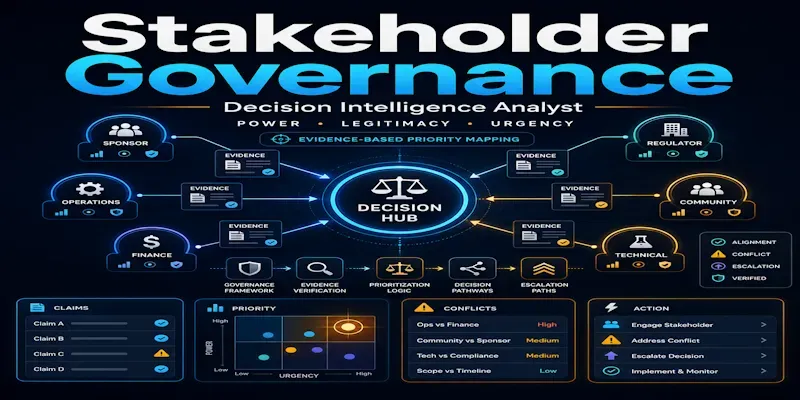
Turn messy stakeholder evidence into a defensible decision map. This prompt separates stakeholders from their claims, assesses power, legitimacy, urgency, and escalation volatility, exposes evidence gaps and management bias, maps plausible cascades, and produces an owned engagement plan. Built for complex projects, transformations, infrastructure, governance, and enterprise change.
...more
Added 3 weeks ago
