

Prompt Details
Model
(claude-5-5-sonnet)
Token size
3,060
Example input
[SUPPLIER_AND_EVIDENCE]: A manufacturer buys 80% of a specialized sensor from one supplier. Delivery performance has been stable, but the sensor is produced at one facility. The supplier has not shared a documented continuity plan. A second supplier exists but has not completed technical qualification.
[BUSINESS_CONTEXT_AND_CONSTRAINTS]: The sensor is required for a major product line. Inventory covers six weeks. Qualification of another supplier takes approximately four months. The company wants to avoid unnecessary supplier replacement but is concerned about single-source exposure.
Example output
# Supplier Risk Dossier: Specialized Sensor Supplier
*Both inputs were supplied, so this is not a demonstration output. Facts below come only from the inputs. Where a variable is missing, it is flagged rather than assumed.*
---
# 1. EXECUTIVE SUPPLIER VERDICT
**Supplier:** Sole-source sensor supplier (~80% of volume)
**Business criticality:** CRITICAL (sensor is required for a major product line; no operationally ready substitute)
**Overall exposure:** HIGH on failure exposure; LOW observed operational risk; HIGH uncertainty
**Evidence confidence:** Moderate on dependency facts, weak on supplier resilience
**Primary recommendation:** **DIVERSIFY**
**Decision rationale:**
Delivery performance is stable, so there is no performance case for replacement. The exposure is structural. One facility supplies 80% of volume, and the supplier has shared no continuity plan. Inventory covers about 6 weeks (~26 weeks is not the figure; four months is roughly 17 weeks), while qualifying another source takes about 17 weeks, so a continuity gap exists of roughly 11 weeks. The second supplier is only identified, so it provides no immediate protection. Replacement is not justified because nothing shows the current supplier is failing. Continuing with conditions alone would leave the 11-week gap unaddressed, so qualification of the second source must start now, alongside verification and buffer actions.
---
# 2. SUPPLIER DEPENDENCY MAP
| Dependency | Current State | Business Consequence | Evidence Status |
|---|---|---|---|
| Volume concentration | ~80% from one supplier | Remaining 20% source unspecified; cannot absorb a full outage | CONFIRMED (share); UNKNOWN (where the other 20% comes from) |
| Single-source exposure | Specialized sensor, one supplier dominant | Hard to substitute quickly | CONFIRMED |
| Geographic concentration | One production facility | Site-level event stops supply | CONFIRMED |
| Qualification time | ~4 months for another supplier | Longest-lead recovery path | CONFIRMED (approximate) |
| Inventory coverage | ~6 weeks | Buffer shorter than switch time | CONFIRMED |
| Technical qualification | Second supplier not yet qualified | No immediate alternative | CONFIRMED |
| Continuity maturity | No documented plan shared | Recovery capability unverifiable | CONFIRMED (absence of plan); **Evidence gap — requires verification** on whether a plan exists but was not shared |
| Proprietary tooling / specs / IP | Not stated | Could extend switching time | UNKNOWN |
| Contract terms | Not stated | Supply guarantees, exclusivity, and remedies unknown | UNKNOWN |
| Financial stability | Not stated | Insolvency risk unassessable | UNKNOWN |
**Hardest to replace:** the qualified single production source itself, because qualification time (about 17 weeks) exceeds buffer. Hidden concentration risk: the other 20% of supply is unidentified, and if it sits upstream with the same facility or common components, true concentration is higher than 80%.
---
# 3. EVIDENCE REGISTER
| Material Claim | Evidence | Confidence | Decision Relevance | Required Verification |
|---|---|---|---|---|
| Supplier provides ~80% of volume | Buyer input | CONFIRMED | High | Confirm basis (volume vs. spend) and the source of the other 20% |
| Delivery performance is stable | Buyer input, no data supplied | HIGHLY LIKELY | Moderate | On-time-in-full history, lead-time variance over 12+ months |
| Single production facility | Buyer input | CONFIRMED | High | Confirm no secondary site or toll-manufacturing arrangement |
| No continuity plan shared | Buyer input | CONFIRMED (not shared) | High | Formally request plan; determine whether none exists |
| Inventory covers ~6 weeks | Buyer input | CONFIRMED | High | Validate against current demand forecast and in-transit stock |
| Qualification takes ~4 months | Buyer input | HIGHLY LIKELY | High | Engineering estimate with test plan; confirm no regulatory or customer re-approval adds time |
| Second supplier exists, not qualified | Buyer input | CONFIRMED (identified only) | High | Capacity, technical fit, commercial terms |
| Supplier financial health | None | UNKNOWN | High | Financial review or credit report |
| Quality performance | None | UNKNOWN | Moderate | Defect and return data |
| Sub-tier dependencies | None | UNKNOWN | High | Sub-supplier map for critical materials |
| Absence of incidents implies low risk | Inference only | **Not accepted** | High | Stable delivery is not evidence of resilience |
---
# 4. PRIORITY RISK REGISTER
| Risk | Likelihood | Impact | Evidence Strength | Current Control | Risk Priority |
|---|---|---|---|---|---|
| Single-facility outage (fire, power, flood, equipment, labor) | Low–Medium (unquantified) | Severe | Moderate (facility concentration confirmed; likelihood not) | ~6 weeks inventory | **Critical** |
| Buffer shorter than recovery or switch time | High (arithmetic) | Severe | Strong | None beyond inventory | **Critical** |
| Unverified continuity maturity | Unknown | Severe | Weak | None | **High** |
| Capacity constraint under demand surge or partial outage | Unknown | High | Unknown | None | **Unresolved** |
| Supplier financial failure | Unknown | Severe | Unknown | None | **Unresolved** |
| Sub-tier or logistics disruption | Unknown | High | Unknown | None | **Unresolved** |
| Delivery reliability degradation | Low (observed stable) | High | Moderate | Inventory | **Moderate** |
| Quality failure or lot rejection | Unknown | High | Unknown | Unknown | **Unresolved** |
**Risk vs. uncertainty:** observed operational risk is low; uncertainty is high; failure exposure is unacceptable. The severe-impact items with weak evidence are retained as Unresolved because they require investigation, not dismissal.
---
# 5. FAILURE SCENARIOS
**Scenario A: Facility outage (single site)**
**Trigger:** Fire, flood, power loss, equipment failure, or labor stoppage at the sole production site.
**Time to business impact:** About 6 weeks (inventory runout), less if the outage lasts through consumption of in-transit stock only.
**Operational consequence:** Major product line production stops after buffer depletion.
**Current protection:** ~6 weeks inventory only.
**Recovery path:** Supplier site restoration (duration unknown, no plan shared) or accelerated second-source qualification (~17 weeks).
**Residual exposure:** Gap of ~11 weeks if the outage exceeds inventory and qualification has not started.
**Scenario B: Capacity constraint or allocation**
**Trigger:** Supplier prioritizes other customers or cannot meet demand growth.
**Time to business impact:** Gradual, from weeks to inventory depletion.
**Operational consequence:** Partial shortfalls on the major product line.
**Current protection:** Inventory; contract allocation rights unknown.
**Recovery path:** Negotiate allocation; use the unqualified second source only after qualification.
**Residual exposure:** Elevated, since contract terms and supplier capacity headroom are unknown.
**Scenario C: Quality failure or lot rejection**
**Trigger:** Defect escape or process drift on a specialized sensor.
**Time to business impact:** Immediate for affected lots; up to ~6 weeks if good inventory remains.
**Operational consequence:** Production hold, rework, or recall exposure.
**Current protection:** Unknown (quality data not supplied).
**Recovery path:** Supplier corrective action; there is no qualified alternate.
**Residual exposure:** Unresolved; **Evidence gap — requires verification.**
**Scenario D: Supplier insolvency or financial distress**
**Trigger:** Financial deterioration (no financial data supplied).
**Time to business impact:** Variable; could be abrupt.
**Operational consequence:** Supply stops with no managed transition.
**Current protection:** None identified.
**Recovery path:** Second-source qualification (~17 weeks); tooling or IP access depends on unknown contract terms.
**Residual exposure:** Severe and unassessed. Plausible only because financial status is unverified, not because distress is indicated.
---
# 6. CONTINUITY GAP ANALYSIS
| Variable | Value | Status |
|---|---|---|
| Available buffer | ~6 weeks | CONFIRMED |
| Alternative qualification time | ~4 months (~17 weeks) | HIGHLY LIKELY |
| Alternative readiness stage | IDENTIFIED only | CONFIRMED |
| Supplier recovery time (site restoration) | Unknown | **Evidence gap — requires verification** |
| Capacity of second supplier | Unknown | UNKNOWN |
**Continuity gap: YES.** Buffer (~6 weeks) < switching time (~17 weeks). The shortfall is about 11 weeks, and it widens if qualification has not started, since the 4 months begins only at kickoff. The second supplier will not reach volume capacity immediately after qualification, so the practical gap may be longer.
Note on the other 20%: if that share comes from a different source, it may partially extend the buffer, but this is unverified, so no credit is taken for it.
---
# 7. ALTERNATIVE SUPPLY READINESS
| Alternative | Readiness Stage | Key Gap | Estimated Role | Next Step |
|---|---|---|---|---|
| Second supplier (identified) | IDENTIFIED | Technical qualification not complete; capacity, commercial terms, and lead time unverified | Future second source; not a current continuity option | Start technical qualification; confirm capacity and commercial terms |
| Source of existing ~20% volume | Unknown | Identity, site, and relationship to primary supplier unknown | Possibly partial buffer | Identify and verify independence from primary facility |
**Treat no alternative as operationally ready.**
---
# 8. MITIGATION PLAN
### IMMEDIATE
1. **Verify critical evidence**
- Purpose: Replace assumptions with facts on continuity, contract, and sub-tier exposure.
- Owner type: Procurement with supplier-quality function.
- Evidence required: Written continuity plan or confirmation none exists; contract review; facility and sub-tier disclosure.
- Completion: Evidence register gaps closed or formally accepted as unresolved.
2. **Start second-supplier technical qualification**
- Purpose: Begin the longest-lead item, since delay widens the gap one-for-one.
- Owner type: Engineering with procurement.
- Evidence required: Qualification plan and timeline.
- Completion: Qualification kickoff confirmed.
3. **Confirm true inventory position**
- Purpose: Validate the 6-week figure against forecast and in-transit stock.
- Owner type: Supply planning.
- Evidence required: Reconciled inventory and demand data.
- Completion: Signed-off coverage figure.
### NEAR TERM
4. **Increase visibility and monitoring**: Establish regular reporting on supplier output, lead times, and site events. Owner: Procurement. Completion: Monitoring cadence in place.
5. **Strengthen supplier controls**: Negotiate continuity-plan commitment, notification obligations, and allocation priority. Owner: Procurement and legal. Completion: Contract terms or amendment agreed.
6. **Increase temporary buffer**: Evaluate additional safety stock, weighing carrying cost against disruption cost. Owner: Supply planning and finance. Completion: Documented buffer decision.
### STRUCTURAL
7. **Qualify alternative supply to approval and operational readiness**: Progress through TECHNICALLY QUALIFIED, COMMERCIALLY APPROVED, and OPERATIONALLY READY. Owner: Engineering, procurement. Completion: Alternative demonstrated at agreed volume.
8. **Assess design standardization**: Determine whether the sensor specification can accommodate multiple sources. Owner: Engineering. Completion: Feasibility conclusion.
9. **Allocate risk contractually**: Review remedies, tooling ownership, and business-interruption coverage. Owner: Legal, risk management. Completion: Documented risk allocation.
**Replacement is not recommended**, since current performance does not justify it.
---
# 9. DECISION GATES
| Gate | Result | Evidence | Required Action |
|---|---|---|---|
| 1. Evidence Sufficiency | **CONDITIONAL** | Dependency facts confirmed; financial, quality, contract, and sub-tier evidence missing | Complete verification items |
| 2. Continuity Exposure | **FAIL** | Single facility, 80% share, 6-week buffer, critical product line | Buffer and diversification actions |
| 3. Recovery Capability | **FAIL** | ~6 weeks buffer vs. ~17 weeks switch time; supplier recovery plan absent | Start qualification; obtain recovery plan |
| 4. Alternative Readiness | **FAIL** | Second supplier only IDENTIFIED | Advance through readiness stages |
| 5. Residual Risk | **CONDITIONAL** | Acceptable only if mitigations are completed and verified | Re-evaluate after controls are in place |
Failures in Gates 2, 3, and 4 drive the DIVERSIFY verdict. ESCALATE is not selected because the decisive facts are sufficiently supported to act. CONTINUE WITH CONDITIONS is insufficient because the gap cannot be closed by supplier assurances alone.
---
# 10. CONTINUITY PLAYBOOK
### EARLY WARNING SIGNALS
- Lead-time increases or delivery slippage
- Reduced responsiveness or reluctance to share continuity information
- Site events or regional disruptions near the facility
- Quality drift or increased deviations
- Signs of capacity strain or customer allocation
- Changes in the supplier's ownership or management
### ESCALATION TRIGGERS
- Any confirmed disruption at the production facility
- Continuity plan refused or confirmed non-existent
- Verified financial concern
- Qualification schedule slipping against the buffer
- Recurring quality escapes
### ACTIVATION TRIGGERS
- Facility outage or loss of production: protect inventory, notify planning and customer-facing teams, expedite second-source qualification, and trigger engineering review
- Allocation or shortfall: invoke contract allocation rights and reprioritize production
- Quality hold: segregate stock, start supplier corrective action
### EXIT TRIGGERS
- Supplier insolvency or loss of ability to supply
- Sustained failure to meet commitments after corrective action
- Refusal to provide continuity transparency after repeated escalation
- Verified loss of ability to meet quality or regulatory requirements
No numerical thresholds are set, as none were supplied. They should be defined with business owners.
---
# 11. FINAL ACTION PACK
### DO NOW
- Start second-supplier technical qualification
- Reconcile the true inventory position and demand forecast
- Formally request the continuity plan and facility details
### VERIFY
- Whether a continuity plan exists
- Contract terms (allocation, exclusivity, tooling, IP, notification)
- Supplier financial health
- Source and independence of the other ~20% of supply
- Sub-tier and logistics dependencies
- Quality performance history
- Second supplier capacity and commercial terms
### PREPARE
- Safety-stock option with cost estimate
- Customer communication approach for a shortage
- Engineering contingency for design or specification flexibility
- Defined thresholds for the playbook triggers
### DECIDE LATER
- Final volume split across suppliers, after qualification results and capacity are known
- Whether to retain, reduce, or restructure the primary supplier share, after verification
- Any replacement decision, only if verified evidence shows unacceptable residual risk
---
# 12. FINAL QUALITY CHECK
Passed. No supplier facts were invented, and unknowns are marked. The identified alternative is not treated as ready. Criticality and the failing gates drive the DIVERSIFY verdict. One calculation note: the executive rationale contains a garbled phrase in its buffer sentence. The correct figures are buffer ~6 weeks, switch time ~4 months (~17 weeks), gap ~11 weeks.


 Instant access
 Commercial use
 Money‑back
By purchasing this prompt, you agree to our terms of service
1
Favorites
19
Views
CLAUDE-5-5-SONNET


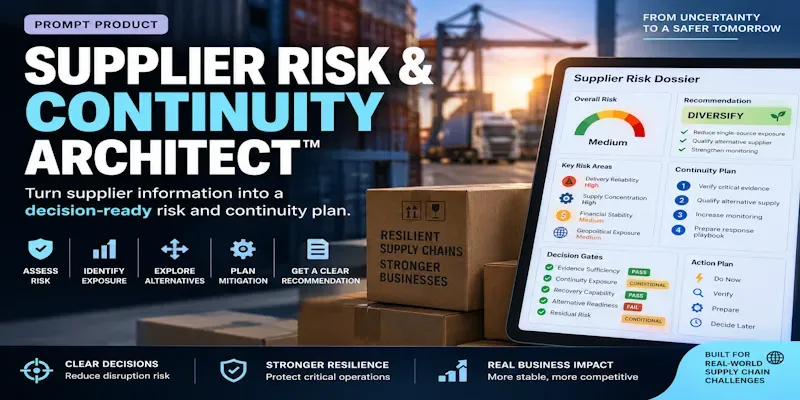
Turn supplier information into a decision-ready risk and continuity plan. Assess operational dependency, evidence quality, failure exposure, alternatives, mitigation, and escalation rules. The system separates verified facts from assumptions and produces a Supplier Risk Dossier with clear CONTINUE, CONDITIONAL, DIVERSIFY, REPLACE, or ESCALATE recommendations.
...more
Added 3 days ago
