


Prompt Details
Model
(claude-5-sonnet)
Token size
1,618
Example input
[ARCHITECTURE_OR_SYSTEM_DESCRIPTION]: We run a single primary PostgreSQL database with no automatic failover — if it goes down, promoting a replica requires a manual process that has historically taken 45 minutes or more when we've had to do it. Separately, our application layer sits behind an auto-scaling load balancer, and that combination has successfully handled three unplanned 5x traffic spikes over the past year — each time it scaled out within about 90 seconds and scaled back down afterward with no manual intervention needed. We also have a third-party payment API integration, but we honestly don't know how it behaves if that provider has an outage on their end — we've never had it happen and haven't tested for it.
[STRESS_SCENARIO]: not provided
Example output
FRAGILITY HEAT-MAP
| Component | Class | Confidence |
|---|---|---|
| Primary database (no auto-failover) | FRAGILE | VERIFIED |
| Application layer + auto-scaling load balancer | ANTIFRAGILE | VERIFIED |
| Third-party payment API integration | UNTESTED | UNTESTED |
Evidence basis: the database is classified FRAGILE because stress (a
primary failure) directly and disproportionately harms availability — a
45-plus-minute manual recovery is a severe, disproportionate response to
a single failure event, which is the definition of fragile behavior
under stress, not merely "has a single point of failure" as a separate
observation. The application layer is classified ANTIFRAGILE, not just
Robust, because the input describes it doing more than merely surviving
stress — it demonstrably adapted (scaled out) in response to three
separate real stress events and returned to baseline afterward each
time, which is adaptive improvement under disorder, the specific
definition of antifragile used here. The payment API is UNTESTED because
the input states directly that its behavior under the relevant stress
(provider outage) is unknown — this is not classified as Robust by
default; absence of a known failure is not evidence of resilience.
VIA-NEGATIVA RECOMMENDATIONS (removal-first, ranked by single-point-of-
failure risk)
1. HIGHEST PRIORITY: The primary database's lack of automatic failover
is the single most significant point of failure identified. The
removal-first question is not "should we add a hot standby" (an
addition) but "can this single point of failure be structurally
removed" — e.g., by removing the assumption that manual promotion is
acceptable at all, restructuring toward an architecture where failover
is not a discrete fragile event requiring 45 minutes of human process,
but a property the system has by default. This is a design-level
removal of a fragile dependency, not a bolt-on fix.
2. SECOND PRIORITY: The payment API integration's untested status is
itself a hidden single point of failure risk — not because it's known
to be fragile, but because its behavior under stress is simply
unknown, which is its own category of risk. The removal-first
framing here: is there unnecessary tight coupling to this specific
provider that could be removed (e.g., a hard dependency on a
synchronous call at checkout time that could instead be decoupled),
independent of whether a backup provider is ever added.
SECONDARY ADDITION NOTES (only after the above removal analysis)
Only after addressing the database's structural single point of failure
directly, a secondary addition worth considering is automated failover
tooling — but this is explicitly secondary to the removal-first question
above, not the first recommendation. For the payment integration, adding
a fallback provider is a reasonable secondary step, but only after
confirming through actual testing (see below) that the current
integration's failure behavior is understood — adding a fallback to an
unknown failure mode risks building redundancy around the wrong problem.
UNTESTED COMPONENTS FLAG
The payment API integration is UNTESTED. Recommendation: before deciding
on any structural change, run a controlled test simulating the
provider's outage (e.g., a sandboxed failure injection or a scheduled
test during low-traffic hours) to actually observe behavior, rather than
guessing whether it would degrade gracefully or fail hard. This
observation should happen before further architectural decisions are
made about this component specifically.
```


 Instant access
 Commercial use
 Money‑back
By purchasing this prompt, you agree to our terms of service
1
Favorites
24
Views
CLAUDE-5-SONNET


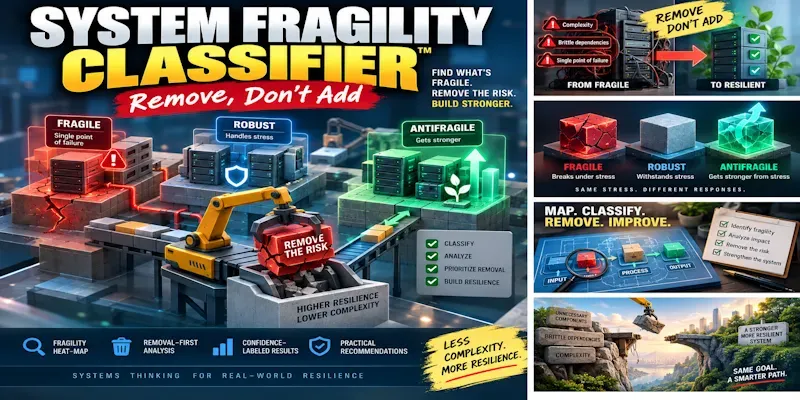
This prompt classifies each component of your system against a
fragile/robust/antifragile spectrum based on how it actually responds to
stress, then applies removal-first analysis: what single point of
failure or brittle dependency should come OUT, before anything gets
added. It works from your description, not live telemetry, and says so
plainly.
...more
Added over 1 month ago
