

Prompt Details
Model
(claude-5-sonnet)
Token size
1,678
Example input
[SYSTEM_OR_PIPELINE_DESCRIPTION]: Our deploy pipeline has four stages in sequence: code review, then an automated CI test suite, then manual QA sign-off, then deploy. Each stage has to fully complete before the next one starts — no parallelization currently.
[LOAD_OR_TICKET_DATA]: Pull requests sit in code review for an average of 4 hours before a reviewer picks them up. The CI test suite itself runs in 12 minutes once triggered. Manual QA sign-off has a queue that has grown from same-day turnaround to a 2-day turnaround over the last month, and this coincided with a 30% increase in PR volume from a recent hiring push. Deploy itself, once QA approves, takes about 5 minutes. When we asked the reviewers directly, they said the review queue "isn't that bad" from their side — but PRs are visibly piling up waiting to enter QA. ```
Example output
DEPENDENCY-CHAIN MAP
Stage 1: Code review — capacity: reviewers self-report as not
bottlenecked; average wait 4 hours
Stage 2: CI test suite — capacity: 12 minutes fixed runtime, automated,
no indication of queuing
Stage 3: Manual QA sign-off — capacity: turnaround has grown from
same-day to 2-day over the past month
Stage 4: Deploy — capacity: 5 minutes, no indication of queuing
Dependency: strictly sequential, each stage must fully complete before
the next starts (as stated).
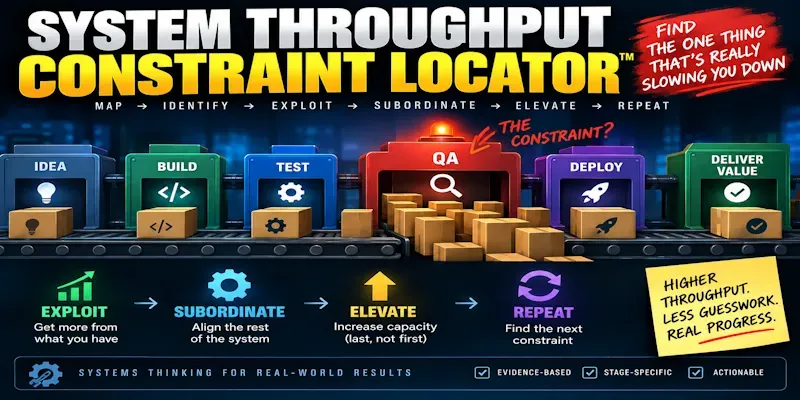
BINDING CONSTRAINT: Stage 3 — Manual QA sign-off
CONFIDENCE LABEL: VERIFIED. The evidence directly shows queuing at this
specific stage: turnaround time has doubled-plus (same-day to 2-day) over
a defined period, coinciding with a stated 30% PR volume increase, and
the input explicitly states PRs are "visibly piling up" before QA. This
is direct backlog evidence at a named stage, not an inference from
general slowness. By contrast, code review's 4-hour wait is NOT flagged
as the constraint despite sounding slow — the reviewers themselves report
no backlog pressure, and no queuing evidence is given for that stage,
only a wait-time figure that may simply reflect how the process normally
runs.
EXPLOIT / SUBORDINATE / ELEVATE PLAN
EXPLOIT (get more from QA sign-off as it currently exists, no added
headcount): identify whether all PRs currently require the same depth of
manual QA sign-off, or whether some categories (e.g., documentation-only
changes, previously-reviewed patterns) could use a lighter-weight check
within the existing QA process — this increases effective throughput of
the same QA capacity without adding people.
SUBORDINATE (what everything else should defer to QA's pace): code
review should NOT be further sped up right now — a 4-hour review wait
feeds directly into an already-backlogged QA stage, so shrinking the
4-hour wait to 1 hour would only make PRs arrive at QA faster without
QA's capacity increasing, worsening the visible pile-up rather than
helping it. This is a concrete case of a stage that looks improvable but
should NOT be optimized while it isn't the constraint. Similarly, deploy
automation improvements (already fast at 5 minutes) are not worth
engineering time right now.
ELEVATE (only after exploit and subordinate, if still insufficient):
consider adding QA sign-off capacity (additional reviewer, or splitting
sign-off duties) only if the exploit step (differentiated QA depth by
change type) doesn't close the gap. This is the last resort here, not the
first move, precisely because it costs headcount or budget that the
other two steps might make unnecessary.
REPEAT NOTE: once QA sign-off capacity matches current PR volume, watch
for the constraint to shift — likely back to code review, given its
4-hour wait is currently tolerated only because it isn't yet the binding
constraint. Re-run this analysis once QA's queue is resolved rather than
assuming the pipeline is now fully unconstrained.
```

 Instant access
 Commercial use
 Money‑back
By purchasing this prompt, you agree to our terms of service
1
Favorites
16
Views
CLAUDE-5-SONNET


This prompt takes your pipeline or on-call load description and locates
the one binding constraint — not a list of everything that's slow — then
walks the full sequence: exploit the constraint, subordinate everything
else to it, and only then consider elevating capacity. It flags when your
evidence doesn't clearly isolate a single constraint, rather than naming
one anyway.
...more
Added 1 week ago
