

Prompt Details
Model
Chat - (gpt-5.6)
Token size
2,130
Example input
[TECHNICAL_DECISION]: A SaaS platform running AI-generation jobs must decide whether to continue using its Redis-backed background-job queue or migrate the asynchronous workload to Kafka.
[CONSTRAINTS_AND_GOALS]: The engineering team has five developers and limited DevOps capacity. Jobs are bursty, independent, and may take 5–30 seconds. Reliable retries and worker scaling are required. The current system has no stated requirement for long-term event replay, multiple independent consumer groups, or event-stream processing. The team wants to support substantially higher generation volume without introducing unnecessary operational complexity.
Example output
## 1. DECISION SUMMARY
**Decision:** Whether to retain the Redis-backed background-job queue for AI generation or migrate this workload to Kafka in anticipation of higher future volume.
**Current evidence position:** **READY WITH CONDITIONS.**
The supplied requirements establish a need for reliable delivery, retries, backlog visibility, and independent worker scaling. They do **not** establish a current requirement for Kafka-specific capabilities such as durable event replay, multiple independent consumer groups, or stream processing.
The expected increase in volume is **CONFIRMED** as a planning concern, but the actual future throughput, backlog characteristics, Redis saturation point, and current queue headroom are **UNKNOWN**.
Therefore, migration to Kafka is not currently justified by supplied evidence alone.
---
## 2. REAL DECISION BEHIND THE QUESTION
**Surface question**
> Should the AI-job queue migrate from Redis to Kafka?
**Real decision**
> How should the platform support substantially higher asynchronous AI-generation volume while preserving reliable job processing and keeping operational burden compatible with a five-engineer team?
This distinction matters because increasing worker throughput does not automatically require replacing the messaging substrate.
**Decision owner:** Engineering / architecture owner — **UNKNOWN** specifically.
**Affected system:** AI-generation job dispatch, worker processing, retry handling, backlog management, observability, and recovery.
**Time horizon:** Higher scale expected next year — exact horizon and growth magnitude **UNKNOWN**.
**Material consequences:** Reliability, worker scalability, engineering capacity, operational complexity, migration risk, and future architecture flexibility.
**Reversibility requirement:** **HIGHLY LIKELY** to matter because current evidence does not establish that a major messaging-platform commitment is necessary.
---
## 3. HARD / SOFT / UNKNOWN CONSTRAINTS
### HARD CONSTRAINTS
| Constraint | Evidence |
| --------------------------------------- | --------- |
| Reliable job delivery | CONFIRMED |
| Retry handling | CONFIRMED |
| Backlog visibility | CONFIRMED |
| Independent worker scaling | CONFIRMED |
| Support growing generation volume | CONFIRMED |
| AI jobs remain independently executable | CONFIRMED |
### SOFT CONSTRAINTS
| Constraint | Evidence |
| ------------------------------------------- | ------------- |
| Minimize unnecessary operational complexity | CONFIRMED |
| Avoid excessive DevOps burden | CONFIRMED |
| Preserve architectural flexibility | HIGHLY LIKELY |
| Avoid unnecessary migration work | HIGHLY LIKELY |
### UNKNOWN CONSTRAINTS
Current peak jobs/sec, arrival burst distribution, queue depth, queue latency, Redis CPU/memory/network utilization, worker saturation, failure/retry rates, required recovery objectives, acceptable backlog duration, expected growth multiple, current Redis topology, managed Kafka availability/cost, and existing Kafka expertise are **UNKNOWN**.
These unknowns materially limit any claim that the existing queue cannot meet future demand.
---
## 4. OPTION ARCHITECTURE
### OPTION A — Retain Redis-backed queue
**What changes:** Scale and instrument the existing architecture as required.
**What remains:** Current producer → Redis queue → worker model.
**Required capabilities:** Reliable enqueueing, retry policy, failure handling, backlog telemetry, worker autoscaling/scaling controls.
**New dependencies:** Potentially none.
**Migration requirement:** Minimal.
---
### OPTION B — Retain Redis while strengthening the queue architecture
This is materially different from simply “doing nothing.”
**What changes:** Improve capacity measurement, backlog observability, retry/dead-letter behavior where needed, worker scaling controls, and load testing.
**What remains:** Redis-backed job transport.
**Required capabilities:** Explicit operational limits and telemetry.
**New dependencies:** Monitoring/scaling components may be required depending on current implementation.
**Migration requirement:** Incremental.
---
### OPTION C — Migrate AI jobs to Kafka
**What changes:** Producers publish jobs/events to Kafka; workers consume through Kafka semantics.
**What remains:** AI worker execution may remain substantially unchanged depending on implementation.
**Required capabilities:** Kafka deployment/managed service, topic design, consumer management, retry/error strategy, observability, operational expertise.
**New dependencies:** Kafka infrastructure and associated operational tooling.
**Migration requirement:** Material.
---
## 5. FEASIBILITY MATRIX
| Option | Constraint Fit | Evidence Support | Blocker | Classification |
| --------------------------------- | --------------------- | ---------------------------------------------------------- | ----------------------------------------- | -------------------------- |
| A — Keep current Redis design | Potentially strong | Current requirements align | Capacity/headroom unknown | **VIABLE WITH CONDITIONS** |
| B — Strengthen Redis architecture | Strong | Directly addresses known requirements and unknown capacity | Requires measurement | **VIABLE NOW** |
| C — Kafka migration | Technically plausible | Future scale concern supports investigation, not migration | Need for Kafka capabilities unestablished | **PREMATURE** |
Kafka is not classified **NOT SUPPORTED** because future measurements or requirements could justify it.
---
## 6. TRADE-OFF REGISTER
| Dimension | Redis Path | Kafka Path |
| ------------------------- | --------------------------------------- | ---------------------------------------------------------------------------------- |
| Implementation complexity | Lower change from existing architecture | Migration and integration required |
| Operational complexity | Existing operational model | Additional distributed-system operational surface |
| Failure surface | Existing known queue mechanisms | Broker, partitions, consumers, offsets and integration behavior add considerations |
| Team burden | Lower incremental burden | Potentially greater; exact burden UNKNOWN |
| Dependency exposure | Existing Redis dependency | Kafka/service dependency |
| Performance | Current capability UNKNOWN | Capability cannot be inferred to be necessary from supplied workload |
| Scalability | Limit not measured | Designed for distributed event streaming, but relevance depends on workload |
| Maintainability | Existing knowledge likely reusable | New operational knowledge may be required |
| Security | Existing controls continue | Additional infrastructure/access controls required |
| Reversibility | High if improvements are incremental | Lower after producers/contracts/operations become Kafka-dependent |
The key uncertainty is not whether Kafka can scale. It is whether the workload requires the architectural properties Kafka introduces.
---
## 7. HIDDEN COST MAP
| Hidden Cost | Cause | Absorbed By | Appears | Reversibility | Evidence |
| ----------------------- | --------------------------------------------------- | --------------- | -------------------- | -------------------- | ---------------------------------- |
| Migration engineering | Queue replacement | Engineering | Migration | Sunk effort | CONFIRMED consequence of migration |
| Dual-system period | Controlled migration may require coexistence | Engineering/Ops | Transition | Temporary | PLAUSIBLE |
| Operational learning | New infrastructure model | Team | Adoption + incidents | Partially reversible | HIGHLY LIKELY |
| Observability expansion | New broker/consumer layer | Engineering/Ops | Deployment onward | Reversible | HIGHLY LIKELY |
| Testing expansion | Changed delivery semantics | Engineering | Migration | Reversible | HIGHLY LIKELY |
| Retry redesign | Kafka failure handling differs from many job queues | Engineering | Design | Reversible with work | HIGHLY LIKELY |
| Contract coupling | Producers/consumers adopt Kafka-specific structures | Engineering | Over time | Potentially costly | PLAUSIBLE |
| Rollback complexity | Jobs may exist across systems during transition | Engineering/Ops | Migration | Potentially costly | PLAUSIBLE |
Exact monetary and implementation costs are **UNKNOWN**.
---
## 8. FAILURE CONSEQUENCE MATRIX
| Option | Failure Mechanism | Operational Effect | Consequence | Detection | Recovery |
| ------ | --------------------------------------------- | -------------------------------------------------------------------- | ---------------------------------- | ----------------------------------------- | --------------------------------------------------- |
| Redis | Queue capacity becomes inadequate | Backlog/latency rises | AI generations delayed | Queue-depth and latency telemetry | Scale/tune architecture or reopen platform decision |
| Redis | Worker capacity inadequate | Backlog rises despite healthy queue | Delayed generations | Worker utilization + queue age | Increase/optimize workers |
| Redis | Retry behavior inadequate | Failed jobs accumulate or disappear depending on implementation | Missing/delayed results | Retry/failure metrics | Repair retry/dead-letter handling |
| Kafka | Migration semantic defect | Jobs duplicated, delayed, or incorrectly handled depending on defect | Processing reliability degradation | Consumer/job reconciliation | Rollback or repair consumers |
| Kafka | Operational capability insufficient | Longer diagnosis/recovery | Service degradation | Broker/consumer monitoring | Managed support/runbooks/rollback |
| Kafka | Added architecture without useful requirement | Permanent complexity with little workload benefit | Engineering capacity consumed | Architecture review + operational metrics | Consolidation/migration back |
The last case is a **normal architectural trade-off**, not necessarily a catastrophic failure.
---
## 9. REVERSIBILITY & LOCK-IN MAP
### Redis improvement path
**Classification:** EASY TO REVERSE to REVERSIBLE WITH MIGRATION.
**Point of commitment:** Minimal while improvements remain queue-interface compatible.
**Reversal cost driver:** Future coupling to Redis-specific behavior.
**Data/contract consequence:** Potentially limited if queue semantics remain abstracted.
**Recovery path:** Replace transport behind a stable producer/worker contract.
### Kafka migration
**Classification:** REVERSIBLE WITH MIGRATION.
**Point of commitment:** Producers, consumers, operational tooling, retry mechanisms, and contracts becoming Kafka-dependent.
**Reversal cost driver:** Integration depth and accumulated operational/process dependencies.
**Data/contract consequence:** Topic/event schemas and consumer semantics may become architectural contracts.
**Recovery path:** Introduce replacement transport and migrate producers/consumers again.
Kafka should not be described as inherently “structurally locking,” but deeper adoption increases reversal cost.
---
## 10. DECISION CONDITIONS
**Choose Redis continuation if:**
Measured queue capacity remains above required workload; backlog remains within acceptable limits; delivery/retry requirements can be satisfied; and worker scaling—not message transport—is the primary scaling mechanism required.
**Choose strengthened Redis if:**
The architecture appears adequate but capacity, backlog behavior, retry reliability, or observability is insufficiently measured.
**Choose Kafka if:**
Measured Redis/queue limitations materially constrain required workload **or** requirements emerge for capabilities such as durable replay, multiple independent consumer groups, broader event distribution, or stream-oriented processing—and Kafka's operational burden is acceptable.
**Do not choose Kafka merely because:**
“Volume will be much higher next year.”
Higher volume is a reason to measure capacity requirements, not sufficient evidence for a messaging-platform migration.
**Reopen the decision if:**
Measured queue saturation approaches required workload, backlog recovery becomes unacceptable, event replay becomes necessary, independent consumers multiply, or the workload evolves toward event-stream architecture.
---
## 11. CURRENTLY JUSTIFIED PATH
**Strengthen and benchmark the existing Redis-backed architecture before committing to Kafka.**
Evidence status: **HIGHLY LIKELY justified from supplied constraints.**
Why:
The current workload consists of independent long-running jobs requiring retries, backlog visibility, and scalable workers.
No Kafka-specific capability is currently required.
The team has limited DevOps capacity.
Most importantly, no evidence has been supplied showing that Redis is currently—or predictably will become—the binding constraint.
The decision should therefore move from:
> Redis vs. Kafka
to:
> Can the current queue satisfy a defined future workload envelope with acceptable reliability and operational cost?
---
## 12. EXECUTION SEQUENCE
**1. Establish current baseline**
Measure job arrival rate, peak bursts, queue depth, oldest-job age, processing throughput, retries/failures, worker utilization, and Redis resource behavior.
**Validation:** Identify whether queue transport, workers, AI-provider latency, or another component constrains throughput.
**Rollback:** None; observational.
---
**2. Define target workload envelope**
Convert “significantly higher scale” into testable workload conditions.
**Validation:** Target workload and acceptable backlog/recovery behavior become explicit.
**Abort condition:** Do not make a platform migration decision while target workload remains undefined.
---
**3. Load-test existing architecture**
Reproduce target/burst conditions without changing queue technology.
**Validation:** Determine where degradation begins and what component saturates first.
---
**4. Test lowest-cost remediation**
If workers saturate first, scale workers.
If Redis/queue behavior becomes limiting, test appropriate Redis/queue changes before replacing the transport where practical.
**Validation:** Determine whether required workload can be supported without architectural migration.
---
**5. Evaluate Kafka only against demonstrated gaps**
If measurable requirements remain unmet, evaluate Kafka against those specific deficiencies rather than against generic scalability claims.
---
## 13. VALIDATION GATE
| Measure | Expected Signal | Failure Signal | Decision Consequence |
| ------------------------------ | ------------------------------------------------- | --------------------------------------- | ------------------------------------------------------- |
| Queue latency / oldest-job age | Remains within defined target | Sustained unacceptable increase | Investigate queue/worker bottleneck |
| Backlog recovery | Queue drains within required recovery envelope | Backlog persists beyond requirement | Capacity architecture insufficient |
| Worker scaling | Added workers increase throughput appropriately | Throughput stops improving | Find upstream/downstream constraint |
| Redis resource behavior | Remains within defined operating envelope | Measured saturation/degradation | Redis architecture requires remediation/reconsideration |
| Retry reliability | Failed jobs follow intended recovery path | Jobs lost/stuck/retried incorrectly | Reliability design must change |
| Operational burden | Team can operate system within agreed constraints | Required intervention becomes excessive | Reassess architecture |
**Validation status: NOT YET PERFORMED.**
No supplied evidence demonstrates production validation at the expected future workload.
---
## 14. REVISIT TRIGGERS
Reopen the Kafka decision when one or more of these occurs:
* Measured Redis/queue saturation prevents meeting defined workload requirements.
* Worker scaling ceases to produce required throughput because queue infrastructure becomes the constraint.
* Required backlog recovery cannot be achieved economically or operationally.
* Durable historical event replay becomes a requirement.
* Multiple independent consumer groups need the same event stream.
* Event-stream processing becomes a product/platform requirement.
* Engineering/DevOps capacity materially expands.
* Reliability or recovery requirements change.
* Measured infrastructure economics materially change the trade-off.
Each trigger invalidates an assumption supporting continued Redis use rather than automatically selecting Kafka.
---
## 15. DECISION-READY ACTION PACK
**DECISION**
Continue with the Redis-backed queue while instrumenting and testing it against a defined future workload envelope. Kafka remains a conditional future option.
**WHY**
Current requirements align with a job-queue architecture, while no supplied evidence demonstrates either Redis saturation or a requirement for Kafka-specific event-stream capabilities.
**DO NOT DO**
Do not migrate to Kafka solely because higher future volume is anticipated. Do not assume Redis will handle that volume either; its capacity remains unverified.
**FIRST ACTION**
Instrument and establish the current queue/worker performance baseline.
**NEXT 3 ACTIONS**
1. Define the future workload and acceptable backlog/recovery envelope.
2. Load-test the existing Redis/worker architecture against that envelope.
3. If requirements fail, identify the measured bottleneck and compare targeted remediation against Kafka migration.
**MEASURE**
The decisive evidence is whether the existing queue architecture can sustain the required arrival/burst workload while maintaining acceptable queue age, backlog recovery, retry reliability, and worker scalability.
**ABORT IF**
The team cannot define the target workload or obtain reliable measurements; an infrastructure migration would then be based primarily on assumptions.
**REVERSAL COST**
Redis improvements have relatively low commitment when queue interfaces remain abstracted. Kafka reversal becomes progressively more expensive as producers, consumers, retry semantics, schemas, monitoring, and operations become Kafka-specific.
**REVISIT WHEN**
Measured queue limitations emerge or requirements expand to durable replay, multiple independent consumer groups, or event-stream processing.
**STATUS**
**READY WITH CONDITIONS**

$19.99-25%
$14.99
SPECIAL PROMOTION — Offer ends 12 October


Get this prompt + 9 more with SelectFrom $14/mo · Cancel anytimeFrom $14/mo · Cancel anytime
View Select
 Instant access
 Commercial use
 Money‑back
By purchasing this prompt, you agree to our terms of service
1
Favorites
101
Views
GPT-5.6


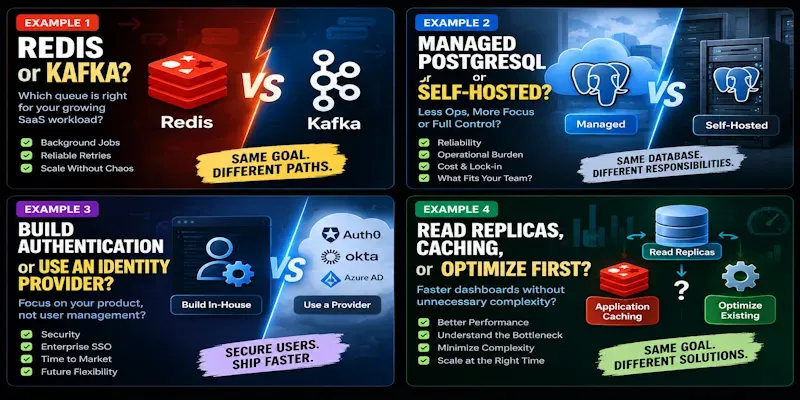
Turn a difficult technical choice into a decision-ready action package. This prompt reconstructs the decision, separates hard constraints from assumptions, compares viable options, exposes hidden costs and failure risks, evaluates reversibility, and defines exactly when each option makes sense. The final output includes the decision conditions, execution path, validation gate, abort criteria, and revisit triggers.
...more
Added 3 weeks ago
