

Prompt Details
Model
(claude-4-6-sonnet)
Token size
1,982
Example input
[PROCESS_DOMAIN]: manufacturing
[PROCESS_DESCRIPTION]: Injection molding plant, 4 stages: raw material prep → molding (6 machines) → QC inspection (2 inspectors) → packaging (3 lines). WIP piles up before QC every afternoon. Molding runs at 95% utilization. QC inspectors do overtime most days. Packaging lines sit idle ~30% of shift.
[PAIN_SIGNALS]: Orders shipping 2-3 days late, QC team burning out, customer complaints rising
[MODE]: full
Example output
# ToC Diagnostic Report
---
## Process Map
**Raw Material Prep** → **Molding (6 machines)** → **QC Inspection (2 inspectors)** → **Packaging (3 lines)**
*Assumptions:* Molding feeds QC in batches (not continuous flow). QC inspects 100% of output. Packaging is manual or semi-automated. No rework loop was described — assumed defective parts are scrapped or held separately.
---
## The Constraint
**Stage:** QC Inspection
**Type:** Physical (capacity — 2 inspectors against 6 machines of molding output)
**Evidence:**
1. WIP accumulates *in front of QC* every afternoon — the textbook signal of a capacity ceiling
2. QC inspectors are on overtime most days — running at or beyond 100% utilization
3. Packaging sits idle ~30% of shift — it is starved for input, which means QC is not releasing work fast enough to feed it
**Why NOT the obvious symptom:** Late shipments and customer complaints are *downstream noise*. They feel like the problem, but they are the result of QC being unable to clear the queue Molding generates. Molding itself, despite running at 95% utilization, is not the constraint — it is actually *overproducing* relative to what QC can process, which is why WIP piles up between the two stages.
---
## Focusing Step 1 — IDENTIFY ✓
Constraint confirmed: **QC Inspection**. Two inspectors cannot match the throughput of six molding machines. Every other problem in this plant flows from this single mismatch.
---
## Focusing Step 2 — EXPLOIT
*Squeeze more throughput from QC without adding headcount or capital.*
1. **Eliminate non-inspection tasks from inspectors' time.** If inspectors are currently logging results, moving parts, printing labels, or doing administrative work, pull those tasks to a support role or to packaging staff during their idle time. Every minute an inspector spends not inspecting is throughput lost at the constraint.
2. **Implement statistical sampling at QC for stable, high-confidence mold runs.** If a mold has run clean for N consecutive cycles, shift from 100% inspection to AQL sampling. This does not reduce quality accountability — it reallocates inspection effort to where defect risk is actually highest. Calculate your defect history per mold and apply accordingly.
3. **Stage and pre-sort WIP before it reaches inspectors.** If parts arrive at QC mixed, unsorted, or in awkward batch containers, inspectors lose time handling and orienting parts rather than inspecting them. Dedicated presentation fixtures or pre-staged trays — built and maintained by molding operators — can cut per-part handling time materially.
4. **Protect QC from interruptions during peak hours.** If inspectors are pulled for meetings, line walks, or ad hoc requests in the afternoon (when WIP is peaking), those interruptions are disproportionately expensive. The constraint's time is the most valuable time in the plant. Guard it.
---
## Focusing Step 3 — SUBORDINATE
*Every other stage must now serve the constraint's pace, not its own efficiency metrics.*
- **Molding:** This is the hardest subordination to enforce because molding at 95% utilization *looks* productive. It is not — it is building the WIP queue that buries QC every afternoon. Consider two interventions: (a) stagger molding machine start times so output arrives at QC in a smoother flow rather than a midday surge; (b) if WIP in front of QC exceeds a defined buffer limit (set this number — e.g., 2 hours of QC capacity), pause one or two molding machines until QC clears the queue. Molding operators will resist this. They will feel like they are being told to be "unproductive." That feeling is correct from a local efficiency view and wrong from a system throughput view. Idle molding time that prevents QC overload *increases* total plant output.
- **Raw Material Prep:** Release material to molding only at the rate molding needs to feed the QC buffer — not faster. If prep is outrunning molding, it is building unnecessary WIP upstream for no throughput benefit.
- **Packaging:** Currently idle 30% of shift because QC is the starved feeder. Do not attempt to solve packaging's idle time by giving packaging staff other work that removes them from availability. When QC releases a batch, packaging must be ready to run immediately. Use idle packaging time for setup, maintenance, and the support tasks removed from inspectors in Step 2 above.
**Expected pushback:** Molding supervisors will object to being asked to slow down or stop machines. Their utilization metrics will suffer. This is the correct outcome. Local efficiency metrics at non-bottleneck stages are actively misleading in a ToC system. If management incentivizes molding on machine utilization rather than system throughput, that incentive structure must change — it is a *policy constraint* running alongside the physical one.
---
## Focusing Step 4 — ELEVATE
*Only pursue this after Exploit and Subordinate have been fully implemented and the constraint persists.*
1. **Add a third QC inspector (shift coverage or dedicated role).** Cost: one FTE fully loaded. Benefit: approximately 50% increase in QC throughput, which should be more than enough to match molding output and fully load packaging. This is the most direct lever if sampling and task-stripping in Step 2 are insufficient.
2. **Introduce automated optical inspection (AOI) for dimensional and surface defect checks.** Capital cost varies widely (roughly $40–150K for a basic vision system in injection molding), but can inspect at machine speed, eliminating the human capacity ceiling entirely for qualifying defect types. Human inspectors shift to exception review and complex defect classification. Evaluate ROI against ongoing overtime cost plus latepshipment penalties.
3. **Cross-train packaging staff as certified QC inspectors.** Lower capital cost than AOI. Packaging's 30% idle time becomes a reserve QC capacity buffer. Requires investment in training and qualification time, and must meet your quality system's inspector certification requirements.
---
## Focusing Step 5 — REPEAT
Once QC inspection is no longer the constraint, the next bottleneck will most likely be:
**Molding capacity** — because once QC can process everything molding produces, the six machines running at 95% utilization will become the ceiling on total plant throughput. At that point, the questions become machine cycle time optimization, tooling changeover reduction (SMED), and whether a seventh machine or second-shift expansion is warranted. Packaging at 3 lines has demonstrated it has headroom (~30% idle), so it is unlikely to be the next constraint unless product mix shifts significantly toward labor-intensive pack formats.
---
## Jonah Questions
**Q1 — What to change?**
The utilization mismatch between six molding machines and two QC inspectors. QC cannot clear what molding produces. Everything else is a symptom.
**Q2 — What to change to?**
A system where QC inspection throughput matches or exceeds molding output rate, achieved first through exploitation (sampling, task removal, flow smoothing) and subordination (molding pacing), then through elevation (third inspector or AOI) if needed.
**Q3 — How to cause change?**
In sequence: (1) Remove non-inspection tasks from QC immediately. (2) Define a WIP buffer limit in front of QC and give molding supervisors explicit authority — and instruction — to pause machines when that limit is breached. (3) Audit inspection procedures for sampling eligibility by mold/part history. (4) Measure QC throughput per shift for two weeks. (5) If throughput has not met packaging's demand rate, initiate the elevation options.
---
## Monday Morning Actions
1. **Today:** Walk the QC station and list every task inspectors perform that is not physically inspecting a part. Assign each non-inspection task to another role by end of week.
2. **This week:** Set a physical WIP cap in front of QC — a marked floor area or a part count. Brief molding supervisors: when the cap is full, designated machines go to planned downtime. Run this for two weeks and measure QC throughput before and after.
3. **This month:** Pull defect rate data by mold tool and part number. Identify candidates for AQL sampling instead of 100% inspection. Implement sampling protocol for the top three qualifying part numbers and measure throughput impact.
---
## What NOT to Do
- **Do not add a packaging line or optimize packaging efficiency.** Packaging is idle because it is starved by QC, not because it is slow. Investing in packaging capacity right now does precisely nothing for throughput and generates a false sense of progress.
- **Do not push molding to 100% utilization.** Every additional part molding produces beyond QC's capacity to inspect simply deepens the WIP pile, extends lead time, and accelerates inspector burnout. Higher molding utilization under current conditions makes shipment delays *worse*, not better. This is the most seductive mistake available to you right now — resist it.
- **Do not treat inspector overtime as a permanent solution.** Overtime at the constraint buys short-term throughput at the cost of inspector fatigue, error rates, and turnover risk. If you lose an inspector, you go from two to one and the system effectively halts.

 Instant access
 Commercial use
 Money‑back
By purchasing this prompt, you agree to our terms of service
9
Views
CLAUDE-4-6-SONNET


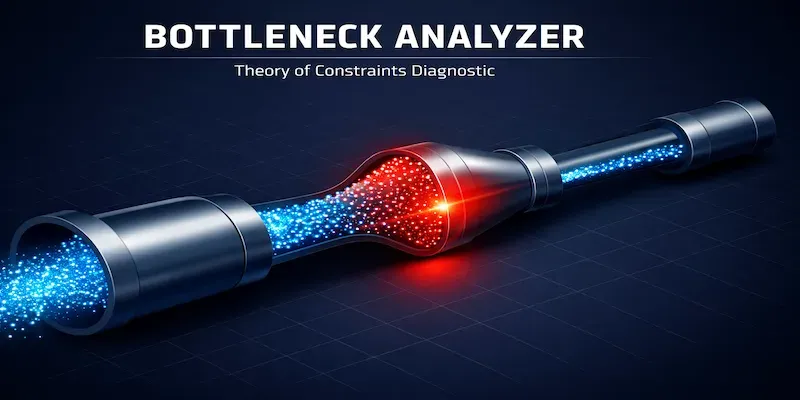
Theory of Constraints Diagnostic
Most process improvement fails because teams optimize non-bottleneck steps — making the wrong stage faster while the real constraint stays invisible. This prompt applies Eliyahu Goldratt's Theory of Constraints (the framework behind *The Goal*) as a structured diagnostic, not motivational theory.
Feed it your process. Get the actual bottleneck, the 5 Focusing Steps applied to your specific situation, and a ranked action plan you can run Monday morning.
...more
Added 3 days ago
