

Prompt Details
Model
Chat - (gpt-5.6)
Token size
1,858
Example input
[CURRENT_SYSTEM_AND_SCALE]: Next.js, Node.js, PostgreSQL, Redis, Docker, object storage, modular monolith. 3,000 registered users, approximately 150 peak concurrent users. One API deployment and two background workers.
[GROWTH_TARGETS_AND_CONSTRAINTS]: The business expects significant growth over the next 12 months. Five-person engineering team, limited DevOps capacity, moderate infrastructure budget. Avoid unnecessary microservices.
Example output
# 1. EXECUTIVE SCALE DIRECTION
**Status: HARDEN BEFORE GROWTH**
The current modular-monolith architecture is not presently disproven by the supplied scale.
The strongest near-term strategy is:
**KEEP THE MODULAR MONOLITH → ESTABLISH CAPACITY BASELINES → HARDEN DATABASE / WORKER / DEPENDENCY BEHAVIOR → ENABLE HORIZONTAL API SCALING WHEN MEASURED SATURATION REQUIRES IT → SCALE WORKERS INDEPENDENTLY → INTRODUCE DATABASE READ SCALING OR SERVICE EXTRACTION ONLY WHEN specific workload evidence justifies them.**
3,000 registered users and approximately 150 peak concurrent users do **not** establish CPU, throughput, database, worker, or storage limits.
The main current risk is therefore not insufficient architecture complexity. It is **insufficient capacity evidence combined with single-deployment concentration**.
Microservices, sharding, specialized databases, and complex orchestration should be deferred.
---
# 2. CURRENT ARCHITECTURE & CAPACITY FACTS
## CURRENT FACTS
### User-facing compute
* Next.js application.
* Node.js application layer.
* One API deployment.
* Modular-monolith architecture.
### Stateful services
* PostgreSQL.
* Redis.
* Object storage.
### Background processing
* Two background workers.
### Deployment
* Docker-based deployment.
### Scale
* 3,000 registered users.
* Approximately 150 peak concurrent users.
### Team constraints
* Five-person engineering team.
* Limited DevOps capacity.
* Moderate infrastructure budget.
* Explicit preference to avoid unnecessary microservices.
## CURRENT RISKS
1. **Single API deployment concentration**
* Potential availability and compute bottleneck.
* Actual saturation is UNKNOWN.
2. **Database concentration**
* PostgreSQL may eventually become a shared contention point across synchronous requests and background jobs.
* No current evidence shows this is happening.
3. **Worker capacity uncertainty**
* Two workers exist, but arrival rate, processing rate, queue age, retries, and utilization are unknown.
4. **Operational concentration**
* A small team could be harmed more by premature distributed-system complexity than by temporary infrastructure constraints.
5. **Insufficient scaling telemetry**
* Current capacity cannot be inferred from registered users or concurrency alone.
## UNKNOWN CAPACITY PARAMETERS
* API request rate.
* Request mix.
* p50 / p95 / p99 latency.
* CPU utilization.
* Memory utilization.
* event-loop delay.
* database query latency.
* database connection utilization.
* lock contention.
* cache hit rate.
* worker utilization.
* job arrival rate.
* job processing rate.
* queue depth.
* oldest-job age.
* retry rate.
* dead-letter rate.
* storage growth.
* object-transfer volume.
* external dependency latency.
* external dependency rate limits.
* deployment resource limits.
---
# 3. UNKNOWN CAPACITY VARIABLES
The following must be measured before architecture escalation decisions:
| Variable | Why It Matters |
| -------------------------------------- | ---------------------------------------------- |
| Requests/sec by endpoint | Determines compute demand |
| Concurrent in-flight requests | Reveals actual runtime pressure |
| p95/p99 latency | Detects degradation before outright failure |
| CPU/memory saturation | Indicates application resource constraints |
| Node.js event-loop delay | Detects blocking or runtime saturation |
| DB active connections | Reveals pool pressure |
| Slow-query distribution | Identifies database bottlenecks |
| DB lock/wait time | Detects contention |
| Read/write ratio | Determines whether read scaling may help |
| Cache hit/miss rate | Determines whether Redis is useful |
| Job arrival/completion rate | Determines worker capacity |
| Queue age | Shows whether backlog is operationally harmful |
| Retry/dead-letter rate | Detects hidden processing failure |
| Object-storage throughput | Identifies transfer bottlenecks |
| External dependency latency/error rate | Detects non-local constraints |
| Growth rate of stored data | Supports storage/data-layout planning |
---
# 4. WORKLOAD MODEL
The current workload model is incomplete.
## Interactive workload
Measure:
**REQUEST ARRIVAL RATE**
→ requests per second by route.
**CONCURRENCY**
→ simultaneous requests and open connections.
**REQUEST COST**
→ CPU, database queries, external calls, cache calls, and object transfers per request class.
**LATENCY**
→ p50 / p95 / p99 by endpoint.
## Database workload
Measure:
* reads/sec;
* writes/sec;
* connection-pool utilization;
* expensive queries;
* table/index growth;
* transaction duration;
* lock waits;
* buffer/cache behavior.
## Background workload
Measure:
* jobs created/time;
* jobs completed/time;
* oldest pending job;
* average and tail processing time;
* worker CPU/memory;
* retries;
* dependency waits;
* failed jobs.
## Storage workload
Measure:
* new objects/time;
* stored bytes growth;
* upload/download volume;
* object size distribution.
## External workload
Measure:
* calls by provider;
* latency;
* error rate;
* timeout rate;
* rate-limit events.
---
# 5. SCALING DOMAIN ASSESSMENT
## API / COMPUTE
**Current state:** One API deployment.
**Assessment:** Potential future scaling boundary, but insufficient evidence exists to justify additional replicas solely from user count.
**Priority:** Instrument first, then prepare stateless horizontal scaling.
---
## BACKGROUND PROCESSING
**Current state:** Two workers.
**Assessment:** Must be treated separately from API capacity.
Two workers may be excessive, adequate, or insufficient depending on job arrival rate and processing duration.
**Priority:** Measure queue age and processing capacity.
---
## DATABASE
**Current state:** Single PostgreSQL data platform assumed from supplied description.
**Assessment:** Highest-probability shared scaling dependency over time, but no current bottleneck evidence exists.
**Priority:** Query visibility, connection management, indexing, transaction analysis.
---
## CACHE
**Current state:** Redis exists.
**Assessment:** Existing infrastructure should not automatically receive more responsibility.
Measure whether Redis materially reduces repeated database or computational work.
---
## STORAGE
Object storage is already an appropriate abstraction for binary/static artifacts.
No architectural change currently justified.
---
## SEARCH
No dedicated search requirement or bottleneck supplied.
**Status: NO CHANGE JUSTIFIED**
---
## EXTERNAL DEPENDENCIES
Potential scaling limits may appear outside the application.
Track provider:
* latency;
* quotas;
* throttling;
* failures;
* timeout behavior.
---
## OBSERVABILITY
Currently the biggest architectural prerequisite.
Scaling decisions cannot be evidence-driven without consistent metrics.
---
## DEPLOYMENT
Docker is sufficient as an application packaging mechanism.
No evidence currently justifies Kubernetes or a more complex orchestration platform.
---
## OPERATIONS TEAM
The five-person team is a primary architectural constraint.
The architecture should minimize:
* services;
* deployment units;
* stateful technologies;
* bespoke infrastructure;
* operational runbooks;
* cross-service debugging.
---
# 6. ARCHITECTURE EVOLUTION LADDER
## STAGE 0 — CURRENT MODULAR MONOLITH
Next.js
→ Node.js modular monolith
→ PostgreSQL
→ Redis
→ object storage
→ background workers
### Purpose
Establish actual system capacity.
### Exit evidence
Observed saturation, reliability weakness, or operational bottleneck.
---
## STAGE 1 — HARDEN CURRENT ARCHITECTURE
Add:
* request metrics;
* structured tracing;
* database query visibility;
* worker/queue metrics;
* dependency metrics;
* resource dashboards;
* timeout policies;
* retry boundaries;
* idempotency where required.
### Trigger
Current architecture lacks sufficient evidence for safe scaling decisions.
### Validation
Baseline load + endurance tests.
---
## STAGE 2 — HORIZONTAL API SCALING
Potential move:
**ONE API INSTANCE → MULTIPLE STATELESS API INSTANCES**
### Trigger
Sustained or recurring API saturation correlated with unacceptable latency/error behavior after application-level inefficiencies are addressed.
**Threshold:** BASELINE-RELATIVE THRESHOLD REQUIRED.
### Preconditions
* stateless request handling;
* shared session/state moved appropriately;
* safe database connection pooling;
* health checks;
* load balancing.
---
## STAGE 3 — INDEPENDENT WORKER SCALING
Increase worker concurrency or worker count independently of API compute.
### Trigger
Job arrival rate persistently exceeds completion capacity or queue age violates operational requirements.
### Validation
Queue saturation and recovery test.
---
## STAGE 4 — DATABASE OPTIMIZATION
Sequence:
query analysis
→ indexes
→ connection tuning
→ transaction/data-access changes
→ resource adjustment
### Trigger
Database metrics show measurable contribution to request or worker latency.
---
## STAGE 5 — SELECTIVE READ SCALING
Potential addition:
**PostgreSQL primary + read replica(s)**
### Trigger
Read workload materially contributes to primary database saturation after query and schema optimization.
### Do not introduce if
writes, locking, poor query design, or connection pressure are the actual bottleneck.
---
## STAGE 6 — DATA PARTITIONING
Potential:
* table partitioning;
* workload-specific data segmentation.
### Trigger
Demonstrated data volume/access-pattern problem not adequately solved through query/index/schema/resource improvements.
No current justification.
---
## STAGE 7 — SELECTIVE SERVICE EXTRACTION
Extract only a workload with a specific independent operational requirement.
Possible future candidates might include:
* heavy background processing;
* document/media processing;
* high-volume notification handling.
No candidate can presently be classified as justified from the supplied evidence.
---
# 7. SCALING TRIGGER MATRIX
| Signal | Measurement | Trigger Condition | Action | Why | Trade-off | Validation | Reversibility |
| ------------------------- | -------------------------------------- | ---------------------------------------------------------------- | ---------------------------------------- | ---------------------------------- | ----------------------------------------- | ------------------------ | ------------- |
| API saturation | CPU, memory, event-loop delay, latency | Sustained resource pressure correlates with unacceptable latency | Add API replicas | Increase compute capacity | More deployment/load-balancing complexity | Load + autoscaling test | High |
| Growing API latency | p95/p99 by route | Latency worsens with load and compute is limiting | Horizontal scale or optimize hotspot | Address actual constraint | More infrastructure | Comparative load test | High |
| DB latency | query latency + waits | DB dominates critical request latency | Optimize queries/indexes | Cheapest DB scaling move | Index/write overhead | DB load test | High |
| DB connection pressure | pool utilization | Connection waits contribute to latency/errors | Tune pooling / concurrency | Prevent connection exhaustion | Pool tuning risk | Saturation test | High |
| Read-heavy DB saturation | reads, CPU, I/O | Optimized read workload still limits primary | Add read replica | Separate eligible reads | Replication lag + routing complexity | Read-load test | Medium |
| Worker backlog | queue age/depth | Arrival persistently exceeds completion | Increase workers/concurrency | Match processing capacity | More compute/dependency pressure | Queue saturation test | High |
| Dependency throttling | rate-limit events | Provider limits constrain workload | Rate limiting / buffering / backpressure | Protect downstream dependency | Added latency | Dependency simulation | High |
| Cache inefficiency | hit/miss + workload cost | Repeated expensive reads have measurable reuse | Adjust caching strategy | Reduce repeated work | Consistency/invalidation complexity | Cache effectiveness test | High |
| Data-access concentration | workload distribution | One bounded workload independently drives scaling | Consider extraction | Independent scale/failure domain | Distributed-system overhead | Isolated workload test | Medium |
| Availability risk | deployment failures/outages | Single instance materially violates required availability | Add redundancy | Remove single application instance | Higher infrastructure cost | Failure/recovery test | High |
All numeric trigger values require baseline-derived thresholds.
---
# 8. DATABASE EVOLUTION PLAN
## STEP 1 — QUERY OPTIMIZATION
Collect:
* slow-query logs;
* execution plans;
* query frequency;
* latency distribution.
Move further only if database pressure remains material.
---
## STEP 2 — INDEXES
Add indexes where actual access patterns justify them.
Validate:
* read improvement;
* write overhead;
* index size;
* maintenance cost.
---
## STEP 3 — CONNECTION MANAGEMENT
Measure:
* active connections;
* idle connections;
* queue/wait duration;
* API vs worker connection demand.
Avoid solving connection pressure by simply increasing pool sizes without validating PostgreSQL behavior.
---
## STEP 4 — SCHEMA / DATA ACCESS
Investigate:
* N+1 patterns;
* unnecessarily wide queries;
* high-frequency joins;
* long transactions;
* excessive round trips;
* inefficient pagination.
---
## STEP 5 — RESOURCE SCALING
Increase database resources only if workload measurements demonstrate resource saturation.
---
## STEP 6 — CACHING
Use Redis selectively for:
* frequently reused;
* sufficiently stable;
* expensive-to-obtain data.
Do not cache merely because Redis already exists.
---
## STEP 7 — READ REPLICAS
Introduce only if:
1. reads are a dominant source of pressure;
2. queries are already optimized;
3. replication lag is acceptable;
4. read-after-write semantics are understood.
---
## STEP 8 — PARTITIONING
Require evidence of:
* large-table operational impact;
* access locality;
* maintenance problems;
* query patterns benefiting from partition elimination.
---
## STEP 9 — SPECIALIZED STORES
Add only when PostgreSQL is demonstrably mismatched to a specific workload.
No evidence currently supports this move.
---
# 9. WORKER / QUEUE EVOLUTION
Current worker count: **2**
Capacity conclusion: **UNKNOWN**
Required model:
**ARRIVAL RATE**
vs.
**PROCESSING RATE**
vs.
**OLDEST JOB AGE**
Observe:
* queue depth;
* job age;
* worker utilization;
* processing duration;
* retries;
* dead letters;
* dependency waits.
## Evolution sequence
### A. Optimize worker processing
Remove unnecessary serial work or expensive repeated operations.
### B. Adjust worker concurrency
Only where dependency and database capacity permit it.
### C. Increase worker replicas
When processing demand requires parallel capacity.
### D. Introduce workload separation
Separate queues only when workloads differ materially in:
* urgency;
* resource consumption;
* retry policy;
* dependency behavior;
* isolation requirements.
### E. Add backpressure
Prevent workers from overwhelming PostgreSQL or external providers.
---
# 10. SERVICE DECOMPOSITION TEST
## API modules
**Extraction driver:** none currently demonstrated.
**Current evidence:** modular monolith already provides internal boundaries.
**Benefit:** limited without independent scaling/deployment need.
**New complexity:**
* network calls;
* deployment coordination;
* tracing;
* distributed failure;
* versioning;
* operational ownership.
**STATUS: NOT JUSTIFIED**
---
## Background processing
**Extraction driver:** potentially different compute and scaling profile.
**Current evidence:** two workers exist, but no workload pressure data.
**Benefit:** possible independent scaling and fault isolation.
**New complexity:** separate deployment and operational surface.
**STATUS: PREPARE ONLY**
---
## High-load future bounded context
**Extraction driver:** independent scaling or operational ownership.
**Current evidence:** none supplied.
**STATUS: NOT JUSTIFIED**
---
# 11. RELIABILITY EVOLUTION
Before scaling compute, establish:
## REDUNDANCY
Multiple API instances when availability requirements or saturation justify them.
## TIMEOUTS
Explicit boundaries around:
* database work;
* external calls;
* worker dependencies.
## RETRIES
Retry only transient failures.
Use bounded retries with backoff.
## IDEMPOTENCY
Required for retry-sensitive operations such as:
* payments;
* order mutation;
* notifications;
* background jobs.
## QUEUE DURABILITY
Ensure accepted jobs survive worker restarts where business semantics require it.
## RECOVERY
Document restoration and restart behavior.
## ROLLBACK
Deployments must allow application rollback while respecting schema compatibility.
## LOAD SHEDDING
Protect critical paths during overload rather than permitting total resource exhaustion.
## GRACEFUL DEGRADATION
Potentially degrade:
* non-critical enrichment;
* analytics;
* secondary notifications;
* optional asynchronous work
before core transactional functionality.
---
# 12. OBSERVABILITY REQUIRED FOR SCALING
Minimum instrumentation:
### API
* request rate;
* error rate;
* p50/p95/p99;
* CPU;
* memory;
* event-loop lag.
### PostgreSQL
* query latency;
* slow queries;
* connections;
* lock waits;
* transaction duration;
* CPU/I/O.
### Redis
* hit rate;
* miss rate;
* memory;
* evictions;
* latency.
### Workers
* arrival rate;
* completion rate;
* processing duration;
* queue depth;
* oldest-job age;
* retries;
* failures.
### External dependencies
* latency;
* failures;
* timeouts;
* rate-limit events.
### Deployment
* deployment frequency;
* failed deployments;
* rollback events;
* resource utilization by release.
---
# 13. COST & OPERATIONAL COMPLEXITY
## Harden current system
**Infrastructure:** low incremental increase.
**Operational burden:** low.
**Monitoring burden:** moderate.
**Team expertise:** existing stack.
**New failure modes:** limited.
**Recommendation:** immediate.
---
## Multiple API instances
**Infrastructure:** additional compute/load balancing.
**Operational burden:** low to moderate.
**Monitoring:** per-instance + aggregate.
**New failure modes:** instance routing and state assumptions.
**Reversibility:** high.
---
## More workers
**Infrastructure:** additional compute.
**Operational burden:** low.
**Risk:** increased pressure on PostgreSQL and external services.
**Reversibility:** high.
---
## Read replicas
**Infrastructure:** additional database capacity.
**Operational burden:** moderate.
**New failure modes:**
* replication lag;
* stale reads;
* routing errors.
**Reversibility:** medium.
---
## Microservices
**Infrastructure:** materially higher.
**Operational burden:** high.
**Monitoring:** distributed tracing and service-level telemetry required.
**Team expertise:** distributed systems and deployment coordination.
**Failure modes:** substantially expanded.
**Current cost/benefit:** unsupported.
---
## Sharding
**Operational burden:** very high.
**Failure modes:** routing, rebalancing, cross-shard operations, migrations.
**Current need:** unsupported.
---
# 14. SCALE VALIDATION TESTS
## BASELINE LOAD TEST
Purpose:
Determine current throughput/latency/resource relationships.
Supports decisions about:
* API replicas;
* DB optimization;
* connection management.
---
## STRESS TEST
Increase workload beyond normal operating range until degradation occurs.
Determine:
* first bottleneck;
* degradation shape;
* recovery behavior.
---
## SPIKE TEST
Rapidly increase request volume.
Validate:
* queueing;
* connection management;
* overload behavior;
* recovery.
---
## ENDURANCE TEST
Run sustained representative workload.
Detect:
* memory leaks;
* pool exhaustion;
* queue accumulation;
* gradual database degradation.
---
## DATABASE LOAD TEST
Replay representative query mixes.
Validate whether:
* indexes;
* query changes;
* pooling;
* resource changes
actually improve the limiting workload.
---
## QUEUE SATURATION TEST
Increase job production above worker processing capacity.
Observe:
* queue growth;
* age;
* recovery;
* retries;
* dependency pressure.
---
## DEPENDENCY FAILURE TEST
Introduce:
* slow responses;
* transient failures;
* rate limiting.
Validate:
* timeouts;
* retry boundaries;
* backpressure;
* graceful degradation.
---
## HORIZONTAL-SCALE TEST
Run the same workload against one and multiple API instances.
Confirm whether additional replicas materially increase useful capacity before relying on horizontal scaling.
---
## RECOVERY TEST
Terminate:
* API instance;
* worker;
* dependency connection.
Verify recovery without duplication, data corruption, or uncontrolled retry storms.
---
# 15. CHANGES TO DEFER
Defer:
* microservices;
* Kubernetes solely for expected growth;
* database sharding;
* multiple specialized databases;
* event-driven decomposition across every module;
* complex service mesh infrastructure;
* dedicated search infrastructure without a search requirement;
* multi-region deployment without corresponding availability requirements;
* aggressive autoscaling without validated workload signals.
These changes increase complexity before the supplied evidence demonstrates a need.
---
# 16. ARCHITECTURE EVOLUTION HANDOFF
## KEEP
* Modular monolith.
* Next.js.
* Node.js.
* PostgreSQL.
* Redis.
* Object storage.
* Docker.
* Separate background-worker execution.
## HARDEN
* Application statelessness where horizontal scaling may be required.
* Database query visibility.
* Connection management.
* worker retry/idempotency behavior.
* timeout and dependency-failure handling.
* deployment recovery.
* API availability strategy.
## MEASURE
* request rate;
* concurrency;
* tail latency;
* CPU/memory;
* event-loop lag;
* database query and connection pressure;
* cache effectiveness;
* worker arrival/completion rate;
* queue age;
* external dependency behavior;
* storage growth.
## NEXT EVOLUTION
**Build the capacity-observability baseline and harden the existing architecture before introducing another architecture tier.**
If application compute subsequently proves to be the first constraint, the smallest likely next architectural move is:
**ONE API DEPLOYMENT → MULTIPLE STATELESS API REPLICAS**
without decomposing the modular monolith.
## DO NOT ADD YET
* microservices;
* sharding;
* specialized data stores;
* service mesh;
* complex orchestration solely for anticipated growth;
* read replicas without measured read pressure.
## REVISIT TRIGGER
Reopen architecture evolution when measured workload demonstrates a persistent constraint such as:
* API saturation correlated with unacceptable latency/errors;
* worker arrival rate exceeding processing capacity;
* queue-age SLA violation;
* database pressure remaining material after optimization;
* independent workload requiring distinct scaling or isolation.
Where no existing baseline defines acceptable limits:
**BASELINE-RELATIVE THRESHOLD REQUIRED**
## STATUS
**HARDEN BEFORE GROWTH**
No supplied evidence demonstrates that the current architectural model has reached its scalability limit.
Scalability has **not** been validated because no load-test or production-capacity evidence was supplied.

$19.99-25%
$14.99
SPECIAL PROMOTION — Offer ends 12 October

 Instant access
 Commercial use
 Money‑back
By purchasing this prompt, you agree to our terms of service
1
Favorites
18
Views
GPT-5.6


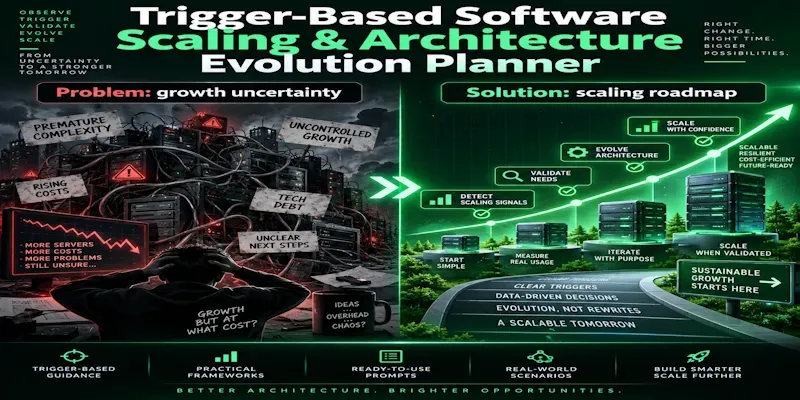
Plan how software architecture should evolve as traffic, workload, data, and operational complexity grow—without premature microservices or infrastructure sprawl. Builds a workload model, scaling domains, evolution ladder, measurable trigger matrix, database and worker strategy, reliability implications, validation tests, and a clear next architectural move.
...more
Added 3 weeks ago
