

Prompt Details
Model
Chat - (gpt-5.5)
Token size
316
Example input
[Set Target Niche]: Micro-Investing and Digital Assets for Beginners
[Set Target Audience]: Gen-Z and Millennials looking for defensive passive income models
Example output
Below is a 30-day YouTube content architecture package built specifically for micro-investing + digital assets beginners who want defensive passive income models, not hype-driven gambling.
This strategy should position the channel as: “the calm beginner’s guide to building small, automated, low-drama digital wealth systems.”
1. Predictive Trend Analysis
Micro-Trend 1: “Little & Often” Investing Is Becoming a Beginner Identity
More young investors are interested in small recurring investments rather than waiting until they have large capital. The Investment Association reported that Gen Z and Millennials are the groups most likely to consider regular small investments in 2026, especially in the £10–£50 range.
Psychological Trigger:
Young people feel priced out of traditional wealth paths. Small automated investing gives them a sense of control, progress, and identity: “I may not be rich yet, but I am building.”
Content Opportunity:
Create videos around micro-portfolios, weekly auto-investing, $5/$10/$25 investing experiments, and defensive allocation systems. The channel should avoid “get rich quick” language and instead own the phrase:
“Build quietly. Automate slowly. Avoid stupid risk.”
Micro-Trend 2: Defensive Digital Assets Are Replacing Crypto Hype
Digital assets are maturing beyond meme coins and speculation. Stablecoins, tokenized assets, and real-world asset tokenization are getting more attention in 2026, with major discussion around stablecoin infrastructure and tokenized financial products.
Psychological Trigger:
Beginners are still curious about crypto, but they are tired of volatility, scams, and emotional trading. They want the upside of digital finance without feeling like they are gambling.
Content Opportunity:
Position the channel around defensive digital assets, explaining things like stablecoins, tokenized treasuries, Bitcoin ETFs, crypto savings risks, and “cash-like” blockchain assets in beginner language.
Your advantage: most crypto channels sell adrenaline. This channel sells calm control.
Micro-Trend 3: Passive Income Is the New Freedom Fantasy
Recent coverage shows passive income is becoming a modern dream for younger workers seeking autonomy, time freedom, and alternatives to traditional career paths. But many attempts fail because people underestimate the upfront work, risk, and competition.
Psychological Trigger:
Gen Z and Millennials are not just asking, “How do I get rich?” They are asking, “How do I become less dependent on one paycheck?”
Content Opportunity:
Build content around defensive passive income ladders, where viewers understand that “passive” means automated, risk-managed, and boring — not effortless.
Your content should repeatedly contrast:
Bad Passive Income: hype, gambling, leverage, unverified yields.
Good Passive Income: automation, diversification, cash flow, risk caps, emergency reserves.
2. The 30-Day Content Calendar Grid
Week 1 Master Video
Working Video Title
I Built a $25/Week Defensive Digital Asset Portfolio for Beginners
The 30-Second Hook
“Most beginner investing advice says: buy crypto, buy stocks, or just save cash. But what if you only had $25 a week and wanted a portfolio that doesn’t panic every time the market drops? In this video, I’ll build a beginner-friendly defensive digital asset portfolio from scratch — with rules, percentages, and the mistakes I would avoid.”
Core Value Proposition
Viewers subscribe because this video gives them a clear starter framework instead of vague motivation. It makes investing feel possible, structured, and emotionally safer.
Timeline Retention Architecture
00:00–00:30 — Pain Hook
Open with the “$25/week problem”: small money, big anxiety, too many risky options.
00:30–01:15 — Stakes Setup
Explain why beginners lose money: no rules, too much crypto exposure, chasing yield, panic selling.
01:15–02:30 — The Defensive Portfolio Principle
Introduce the framework: cash buffer first, broad-market exposure second, digital assets third, speculation last.
02:30–04:00 — The Sample Allocation
Break down a beginner model, for example:
60% broad index or ETF-style exposure
20% cash or high-liquidity reserve
10% Bitcoin/large-cap digital asset exposure
10% learning/speculative sandbox
04:00–05:30 — The Weekly Automation System
Show how $25/week becomes a habit: auto-transfer, recurring buy, portfolio review once per month.
05:30–06:30 — Risk Rules
Explain beginner guardrails: no leverage, no random coins, no all-in trades, no investing emergency money.
06:30–07:30 — “What Could Go Wrong?” Segment
Address market crashes, exchange risk, crypto volatility, and emotional mistakes.
07:30–08:30 — Beginner Action Plan
Give viewers a 3-step setup: pick amount, pick allocation, automate for 30 days.
08:30–09:00 — Subscribe Trigger
Promise the next video: “Next week, I’ll compare stablecoins, Bitcoin ETFs, and tokenized assets for beginners.”
Week 2 Master Video
Working Video Title
Stablecoins Explained: The Beginner’s Guide to Defensive Digital Cash
The 30-Second Hook
“Stablecoins sound safe because they are called ‘stable’ — but that does not mean risk-free. In the next few minutes, I’ll show you what stablecoins actually are, how beginners use them, where the hidden risks are, and why defensive investors should treat them like digital cash, not magic passive income.”
Core Value Proposition
This video builds authority because it corrects a dangerous beginner misconception: stable does not mean guaranteed.
Timeline Retention Architecture
00:00–00:30 — Myth Bust Hook
“Stablecoin does not mean no risk.”
00:30–01:30 — Simple Definition
Explain stablecoins as digital tokens designed to track a currency like the U.S. dollar.
01:30–02:45 — Why Beginners Care
Use cases: parking value, transfers, earning potential, digital asset entry point.
02:45–04:00 — The 3 Main Risks
Issuer risk, platform risk, regulatory risk.
04:00–05:30 — Stablecoin vs Savings Account vs Cash
Explain the difference without overpromising yield.
05:30–06:45 — Defensive Use Case
Show how a cautious beginner might use stablecoins only as a small liquidity layer, not a full portfolio.
06:45–08:00 — Red Flags
Unrealistic yields, unknown platforms, unclear reserves, pressure to lock funds.
08:00–09:00 — Beginner Checklist
Before using a stablecoin: understand issuer, storage, fees, exit path, tax implications.
09:00–09:30 — Retention Bridge
Tease Week 3: “Now let’s compare digital assets that feel passive vs assets that actually build long-term wealth.”
Week 3 Master Video
Working Video Title
Passive Income or Trap? 7 Digital Asset Yields Beginners Must Understand
The 30-Second Hook
“Every beginner eventually sees the same promise: earn passive income from crypto, staking, stablecoins, DeFi, dividend apps, or tokenized assets. But not all yield is the same. Some yield is compensation for real risk. Some is just a trap with better branding. Today, I’ll rank 7 digital asset income models from defensive to dangerous.”
Core Value Proposition
Viewers subscribe because the video gives them a risk-ranking mental model. It helps them avoid scams and understand why high yield usually means hidden risk.
Timeline Retention Architecture
00:00–00:30 — Curiosity Hook
“High yield is not free money. It is usually a risk receipt.”
00:30–01:15 — The Yield Rule
Explain: every passive income source has a payer, a mechanism, and a risk.
01:15–02:00 — Ranking System
Create a simple scale: Defensive, Moderate, Aggressive, Avoid.
02:00–03:00 — Yield Type 1: Cash Interest / Money Market-Style Products
Explain as the most understandable beginner model.
03:00–04:00 — Yield Type 2: Dividend ETFs / Income Funds
Connect traditional passive income to micro-investing.
04:00–05:00 — Yield Type 3: Stablecoin Yield
Explain platform and counterparty risk.
05:00–06:00 — Yield Type 4: Staking
Explain lockups, validator risk, asset price risk.
06:00–07:00 — Yield Type 5: DeFi Lending
Explain smart contract risk and liquidation risk.
07:00–08:00 — Yield Type 6: Liquidity Pools
Explain impermanent loss in beginner language.
08:00–09:00 — Yield Type 7: “Guaranteed” High-Yield Platforms
Label as major red flag.
09:00–10:00 — Final Ranking Recap
Give a simple defensive ladder: understand cash first, ETFs second, stablecoins cautiously, DeFi only after education.
10:00–10:30 — Subscribe Trigger
“Next week, we’ll build a full 30-day beginner system you can actually follow.”
Week 4 Master Video
Working Video Title
The 30-Day Beginner System: Micro-Investing, Digital Assets & Passive Income Rules
The 30-Second Hook
“If you are new to investing, the problem is not that you need more apps. The problem is that you need rules. So in this video, I’ll give you a complete 30-day beginner system: what to learn, what to automate, what to avoid, and how to build your first defensive passive income foundation.”
Core Value Proposition
This becomes the channel’s “starter guide” video. It turns the previous three videos into a complete beginner operating system.
Timeline Retention Architecture
00:00–00:30 — System Hook
“Beginners do not need more predictions. They need a system.”
00:30–01:30 — The 4-Part Wealth Stack
Cash buffer, micro-investing automation, defensive digital assets, income education.
01:30–02:30 — Week 1 Action: Stabilize
Track income, expenses, emergency fund, debt awareness.
02:30–03:30 — Week 2 Action: Automate
Set a weekly investing amount and recurring transfer.
03:30–04:30 — Week 3 Action: Learn Digital Assets Safely
Study stablecoins, Bitcoin ETFs, custody, fees, tax basics.
04:30–05:30 — Week 4 Action: Build Passive Income Rules
Define risk limits, yield limits, allocation caps.
05:30–06:30 — The Beginner Mistake Map
List emotional mistakes: FOMO, app hopping, influencer copying, panic selling.
06:30–07:30 — The Defensive Investor Checklist
Only invest money you can leave alone, diversify, understand the risk, automate slowly.
07:30–08:30 — 30-Day Review Ritual
Once per month: review contributions, allocation, fees, and emotional behavior.
08:30–09:30 — Channel Positioning CTA
Invite viewers to subscribe for “boring systems that help beginners avoid expensive mistakes.”
3. 30-Day Release Roadmap
Week 1
Main Video Title:
I Built a $25/Week Defensive Digital Asset Portfolio for Beginners
Shorts/Reels Angle 1:
“Why $25/week is enough to build the investing habit”
Shorts/Reels Angle 2:
“The 10% crypto rule for beginners”
Shorts/Reels Angle 3:
“Don’t invest before you have this cash buffer”
Community Post Idea:
Poll: “If you had $25/week to invest, where would you put it first? Cash buffer, ETFs, Bitcoin, stablecoins, or I’m not sure.”
Week 2
Main Video Title:
Stablecoins Explained: The Beginner’s Guide to Defensive Digital Cash
Shorts/Reels Angle 1:
“Stablecoin does not mean risk-free”
Shorts/Reels Angle 2:
“Stablecoins vs savings accounts in 30 seconds”
Shorts/Reels Angle 3:
“3 stablecoin red flags beginners must avoid”
Community Post Idea:
Question post: “What confuses you most about stablecoins: safety, yield, taxes, wallets, or where to buy them?”
Week 3
Main Video Title:
Passive Income or Trap? 7 Digital Asset Yields Beginners Must Understand
Shorts/Reels Angle 1:
“High yield is usually a risk signal”
Shorts/Reels Angle 2:
“Staking explained without crypto jargon”
Shorts/Reels Angle 3:
“Why guaranteed passive income is a red flag”
Community Post Idea:
Poll: “Which passive income model do you want explained next? Dividends, staking, stablecoin yield, tokenized assets, or DeFi lending.”
Week 4
Main Video Title:
The 30-Day Beginner System: Micro-Investing, Digital Assets & Passive Income Rules
Shorts/Reels Angle 1:
“The 4-layer beginner wealth stack”
Shorts/Reels Angle 2:
“The monthly review habit every beginner needs”
Shorts/Reels Angle 3:
“Stop chasing apps. Build rules.”
Community Post Idea:
Challenge post: “30-Day Defensive Investor Challenge: choose one weekly amount, one rule, and one mistake you will avoid this month.”
4. Distribution & Sustainability Tip
Batch-produce this calendar as one connected “beginner wealth system,” not four separate videos.
Start by writing one master document called:
Defensive Beginner Investor Framework
Inside it, create reusable sections:
1. Beginner Pain Points
Small budget, fear of losing money, confusion about crypto, passive income hype.
2. Core Channel Rules
No leverage, no hype coins, no guaranteed yield, no emergency-money investing, automate slowly.
3. Reusable Visuals
Portfolio pie chart, risk ladder, passive income ranking scale, 30-day checklist.
4. Reusable CTAs
“Subscribe for calm investing systems.”
“Build slowly. Avoid expensive mistakes.”
“Small money still needs smart rules.”
Then film all 4 main videos in one batch using the same structure:
Hook → Beginner Problem → Simple Framework → Risk Warning → Step-by-Step System → Action Checklist → Next Video Bridge
For Shorts, do not create new ideas from scratch. Extract them from the strongest retention moments:
The myth-bust becomes Short 1.
The checklist becomes Short 2.
The red flag becomes Short 3.
For each long video, produce:
1 long-form YouTube video
3 Shorts/Reels
1 carousel/community post
1 newsletter-style recap
1 pinned comment with beginner checklist
This turns 4 master videos into at least 24 pieces of content without changing the core research.
Final positioning line for the channel:
“Micro-investing and digital assets for beginners who want passive income without gambling their future.”

 Instant access
 Commercial use
 Money‑back
By purchasing this prompt, you agree to our terms of service
8
Views
GPT-5.5


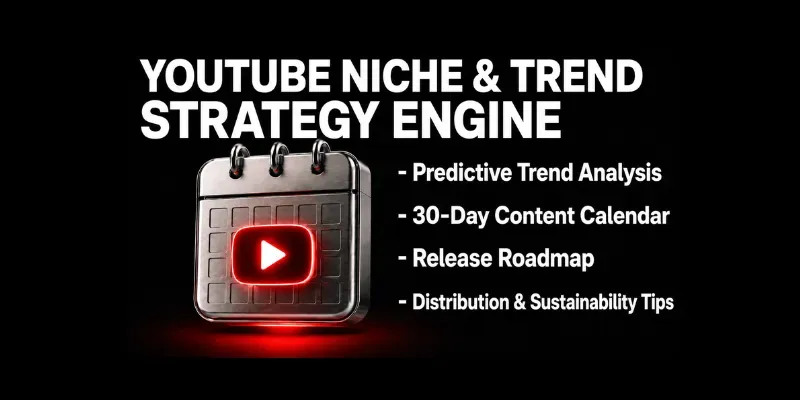
⭐ High-logic text prompt that acts as an elite YouTube Trend Forecaster & Growth Architect.
📈 **Trend Intelligence:** Detects 3 rising micro-trends and the core user psychology in your niche.
🚀 **30-Day Multi-Format Map:** Generates high-CTR video titles, hooks, Shorts, and community posts.
📱 **Zero Format Chaos:** Mobile-friendly list-based output ready to copy-paste cleanly into Notion.
🎁 **BONUS INCLUDED:** 10 custom niche optimization tags inside!
...more
Added 4 weeks ago
