

Skill Details
Runtime
Any model
Example user message
[userMessage]: REQUIRED INPUTS BRAND_NAME: MamaLearn INDUSTRY: Primary Education & Parenting Support AUDIENCE: Busy mothers of primary school children (ages 5-10) who want to help their kids learn without feeling overwhelmed or starting an argument. CHANNELS: YouTube descriptions, Email Newsletters, Instagram captions. ON_BRAND_SAMPLES: Sample 1: "We know homework time can feel like a battleground. Take a deep breath, mama. Today's 5-minute worksheet turns fractions into a fun kitchen game using everyday snacks. You've got this!" Sample 2: "Learning shouldn't mean tears at the kitchen table. Our new printable schedule helps you and your little one build a calm, focused routine. Let's make learning feel like play again." Sample 3: "Are mornings feeling chaotic? Try this simple checklist method. It gives your child a sense of independence and buys you five minutes to actually drink your coffee while it's hot." OFF_BRAND_SAMPLES: Sample 1: "To optimize pedagogical outcomes, guardians must enforce stri
Example agent response
# Brand Voice Calibrator™ — W1-16
**MamaLearn | Primary Education & Parenting Support**
---
## PHASE 1 — INPUT QUALIFICATION
```
INPUT STATUS: CALIBRATABLE
On-brand samples: 3
Off-brand samples: 2
Channels: YouTube descriptions, Email Newsletters, Instagram captions
→ PROCEED
```
All required fields present. Both archetype and competitor context supplied — these will inform drift detection and differentiation framing. Chain 1 proceeds with full contrast calibration enabled.
---
## PHASE 2 — CHAIN 1: TONE ANALYSIS
**Pre-emit gate active** — each score is anchored to a quoted phrase from the samples before scoring.
---
**FORMALITY** — Score: **3/10**
Evidence bracket: LOW (1–3) — contractions used freely; first-name address; colloquialisms present; fragment sentences acceptable.
Quote: *"Take a deep breath, mama"* — direct first-name address ("mama"), imperative register, zero formal distance. *"...to actually drink your coffee while it's hot"* — casual, everyday imagery confirms conversational register throughout.
**Off-brand contrast:** Off-brand Sample 1 scores ~9/10 — *"guardians must enforce strict compliance with daily curriculum parameters"* uses institutional titles, passive-adjacent constructions, and zero contractions. Off-brand Sample 2 swings to ~2/10 but in an undisciplined direction ("Hey guys!") — colloquial but without warmth or intention.
---
**ENERGY** — Score: **5/10**
Evidence bracket: MEDIUM (4–6) — varied sentence length; occasional emphasis; moderate pacing; no exclamation overload.
Quote: *"You've got this!"* — the single exclamation mark lands as encouragement, not hype. Sentence lengths vary meaningfully: the longer setup sentence (*"Today's 5-minute worksheet turns fractions into a fun kitchen game using everyday snacks"*) is followed by the short punchy close. Energy is present but controlled — it reassures rather than agitates.
**Off-brand contrast:** Off-brand Sample 2 scores ~10/10 — *"Smash that subscribe button!"* is performative urgency with no grounding. On-brand energy is earned through calm momentum, not manufactured excitement.
---
**HUMOR** — Score: **3/10**
Evidence bracket: LOW-LIGHT (2–4) — no wordplay or jokes, but warmth and mild wit present in everyday imagery.
Quote: *"...buys you five minutes to actually drink your coffee while it's hot"* — not a joke, but a knowing, wry observation that signals "I see your life." Humor is not a tool MamaLearn deploys; relatability is. The distinction matters: humor entertains, relatability bonds.
**Off-brand contrast:** Off-brand Sample 2 uses sarcasm as a bludgeon (*"you're literally doing it wrong"*) — this is the wrong kind of levity entirely. MamaLearn's warmth is never at the audience's expense.
---
**DIRECTNESS** — Score: **7/10**
Evidence bracket: HIGH-MID (6–8) — declarative statements; no hedging; action-forward; opinions stated with warmth but without apology.
Quote: *"Learning shouldn't mean tears at the kitchen table"* — a firm, clear conviction stated as fact, not opinion. *"Try this simple checklist method"* — direct imperative instruction with no qualification. The directness is never blunt to the point of coldness; it's the directness of someone who knows what works and genuinely wants to help.
**Off-brand contrast:** Off-brand Sample 1 is directive but coercive — *"Failure to implement these methodologies will result in cognitive delays"* uses directness as threat. MamaLearn's directness is always in service of the mother, not aimed at her.
---
**EMPATHY** — Score: **9/10**
Evidence bracket: HIGH (7–10) — reader's struggle named explicitly; "we know" framing; emotional validation before solution.
Quote: *"We know homework time can feel like a battleground"* — the empathy leads every value proposition. The pain point is named first; the solution follows. *"Are mornings feeling chaotic?"* — opens with the mother's lived experience, not the product feature. This is the brand's most dominant characteristic: empathy always precedes advice.
**Off-brand contrast:** Off-brand Sample 1 has zero empathy — it frames the parent as a compliance unit. Off-brand Sample 2 delivers a fake empathy punch (*"if your kid isn't getting straight As"*) that creates fear rather than connection.
---
**CONFIDENCE** — Score: **7/10**
Evidence bracket: HIGH-MID (6–8) — expert authority present but never condescending; definitive framing without superiority.
Quote: *"It gives your child a sense of independence"* — stated as known outcome, not hypothesis. *"Let's make learning feel like play again"* — the word "again" carries authority (it implies this is possible and the brand knows how), while "Let's" keeps it collaborative rather than prescriptive.
**Off-brand contrast:** Off-brand Sample 1 over-claims authority (*"will result in cognitive delays"*) — false confidence deployed to intimidate. MamaLearn's confidence is grounded in practical knowledge, not fear-leverage.
---
```
CHAIN 1 — TONE FINGERPRINT
──────────────────────────────────────────────────────────────────
Formality: 3/10 — "Take a deep breath, mama"
Energy: 5/10 — "You've got this!" [single mark, controlled]
Humor: 3/10 — "actually drink your coffee while it's hot"
Directness: 7/10 — "Learning shouldn't mean tears at the kitchen table"
Empathy: 9/10 — "We know homework time can feel like a battleground"
Confidence: 7/10 — "It gives your child a sense of independence"
──────────────────────────────────────────────────────────────────
Off-brand contrast:
Formality: off-brand Sample 1 scores ~9 (institutional register)
Energy: off-brand Sample 2 scores ~10 (performative urgency)
Empathy: both off-brand samples score 1–2; empathy is the sharpest
differentiator in this competitive set
Confidence: off-brand Sample 1 over-claims; off-brand Sample 2
weaponizes — MamaLearn's confidence informs, not intimidates
Chain 1 key finding: MamaLearn's dominant voice characteristic is
empathy-first delivery — every piece of content names the mother's
struggle before offering a solution, creating a supportive-friend
register that is warm, direct, and quietly authoritative.
──────────────────────────────────────────────────────────────────
```
---
## PHASE 3 — CHAIN 2: VOCABULARY ANALYSIS
**Bootstrap predictions from Chain 1:**
- Formality=3 predicts: free contractions, no institutional titles, informal address forms ✓
- Empathy=9 predicts: second-person "you" dominance, struggle language named before solution ✓
- Directness=7 predicts: imperative verbs, short action sentences, no hedging qualifiers ✓
- Confidence=7 predicts: declarative outcome statements ("it gives", "it helps"), no "might" or "could" ✓
- Energy=5 predicts: single exclamation marks used sparingly, not strings of them ✓
- Humor=3 predicts: no wordplay; relatability via everyday imagery instead ✓
All Chain 1 predictions confirmed. One divergence noted: directness=7 might have predicted harder imperatives, but samples show imperatives softened with collaborative framing ("Let's", "Try this") — the brand is direct in content, not in command style.
---
**PREFERRED WORDS** (from on-brand samples; absent from off-brand):
1. *mama* — direct address form; signals intimacy and peer-to-peer warmth
2. *simple* — frames the solution as accessible, never overwhelming
3. *calm* — aspirational state; names the tension without amplifying it
4. *little one* — warm, specific reference to the child; avoids clinical "student/pupil"
5. *feel like* — connects to emotional experience, not cognitive labels
6. *routine* — practical, non-intimidating structure word
7. *together* / *Let's* — collaborative framing; positions brand as co-participant
8. *you've got this* — affirmation before instruction
9. *five minutes* — time-specificity that respects the mother's scarcity of time
10. *play* — reframes learning; removes the threat word "education" from the equation
---
**AVOIDED WORDS** (from off-brand samples or tone conflicts):
1. *optimize* — formality=3 conflict; clinical register incompatible with warmth
2. *pedagogical* — off-brand Sample 1; institutional jargon, zero empathy signal
3. *compliance* / *enforce* — coercive framing; antithetical to empathy=9
4. *guardians* — depersonalizes the audience; MamaLearn speaks to a person, not a role
5. *smash* — off-brand Sample 2; performative aggression disguised as energy
6. *literally* — hollow intensifier; undermines the brand's quiet authority
7. *methodology* / *parameters* — academic register; breaks the best-friend register
8. *failure* — shame-adjacent; directly conflicts with empathy=9 and safe tone
9. *straight As* — outcome-pressure framing; triggers the exact anxiety MamaLearn relieves
10. *cognitive delays* — fear-leverage language; the brand's confidence never weaponizes
---
**JARGON LEVEL:** LIGHT
Domain terms appear occasionally (*fractions*, *schedule*, *routine*, *curriculum* would be acceptable in context) but are always immediately grounded in everyday imagery (*"fractions into a fun kitchen game using everyday snacks"*). Technical terms are never left floating without a plain-language anchor.
---
**SENTENCE STRUCTURE PROFILE:**
Average sentence length: ~14 words (mix of 8-word punchy closes and 20-word setup sentences)
Questions: occasional (1 per content piece, used as an empathy opener)
Exclamations: rare (0–1 per piece; never consecutive)
First person plural ("we"): occasional — used for empathy validation ("We know…")
Second person ("you"): dominant — the mother is the center of every sentence
Passive voice: avoided — action is always attributed to "you", "your child", or the brand
Paragraph length: short (1–3 sentences); content is scannable and breath-sized
```
CHAIN 2 — VOCABULARY + STRUCTURE
──────────────────────────────────────────────────────────────────
Preferred words: mama, simple, calm, little one, feel like,
routine, Let's, you've

 Instant access
 Commercial use
 Money‑back
By purchasing this skill, you agree to our terms of service
1
Favorites
2
Views


STaR Bootstrap Loop
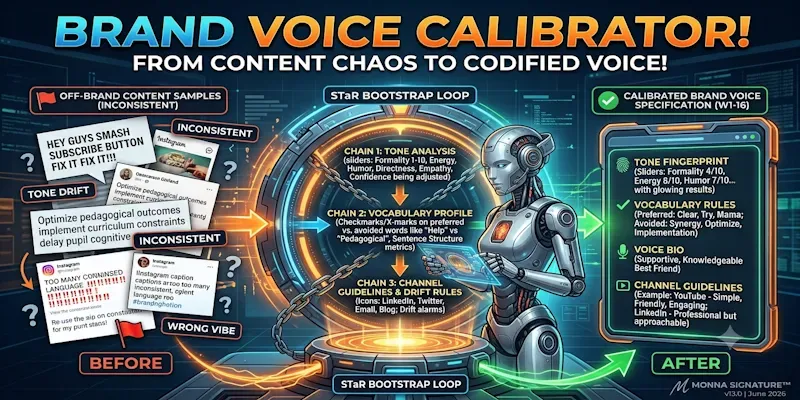
Off-brand content across channels? Runs a 3-chain Self-Taught Reasoner loop: analyzes your on-brand vs off-brand samples → extracts tone parameters → bootstraps vocabulary analysis → synthesizes channel-specific voice guidelines. Delivers a calibrated voice profile + drift detection rules.
Input: On-brand + off-brand samples + channels + competitor voice
Output: Voice profile + channel guidelines + consistency score + drift detection
...more
Added 5 days ago
