

Skill Details
Runtime
Any model
Example user message
[userMessage]: # EXAMPLE 1 — INPUT (paste this whole block) Use the Code Fix Executor skill on the following. FINDINGS_INPUT: FINDING #1 | SEVERITY: CRITICAL | LOCATION: fetch_rows, line 13 SQL built by string interpolation. user_id and status reach the query unescaped. DEPENDENCY: INDEPENDENT FINDING #2 | SEVERITY: HIGH | LOCATION: summarize, line 22 Division by len(rows) with no empty guard. ZeroDivisionError whenever a user has no rows in the requested status. DEPENDENCY: INDEPENDENT FINDING #3 | SEVERITY: MEDIUM | LOCATION: write_report, lines 27-29 File handle is not closed on exception. If f.write raises, the descriptor leaks. DEPENDENCY: INDEPENDENT FINDING #4 | SEVERITY: HIGH | LOCATION: purge_old, line 35 DELETE statement built by interpolation, and the transaction is never committed, so the delete is discarded when the connection closes. DEPENDENCY: BLOCKED BY #1 NOTE: the reviewer expects #1's parameterisation helper to be reused here. FINDING #5 | SEVERITY: MEDIUM | LOCATION: modul
Example agent response
# EXAMPLE 1 — OUTPUT
`patch-set-2026-08-25.md`
---
## 1. HEADER
| | |
|---|---|
| Findings supplied | 5 |
| Patched | 4 |
| Unresolved | 1 |
| Batch scope | full — 5 findings, under the 15 cap |
| Route | FULL (structured Finding Cards + code) |
| Constraints applied | none supplied — followed existing code conventions |
---
## 2. CLEAN PATCH RATE
```
0.75 [#########---] target 0.80
```
3 of 4 patches carry NONE side effects. Below the 0.80 target by one patch; the single
side effect is named in PATCH #2 and is a deliberate contract change, not a defect.
Proceeding under the 0.5–0.8 band after re-examining the one side effect.
---
## 3. PATCHES
```
── PATCH #1 | RESOLVES FINDING #1 (CRITICAL) ──────────────
Location: fetch_rows, line 13
Change: - before: q = "SELECT id, total, status FROM reports WHERE user_id = %s AND status = '%s'" % (user_id, status)
rows = c.execute(q).fetchall()
+ after: q = "SELECT id, total, status FROM reports WHERE user_id = ? AND status = ?"
rows = c.execute(q, (user_id, status)).fetchall()
Reasoning: sqlite3 parameter binding removes the interpolation entirely. The
smallest change that resolves the finding — no helper, no new
function, no signature change.
Verifies: grep the module for `%` and `.format(` inside any string passed to
execute(); this line no longer matches.
Confidence: HIGH
Side effects: NONE
```
```
── PATCH #2 | RESOLVES FINDING #2 (HIGH) ──────────────────
Location: summarize, line 22
Change: - before: avg = total / len(rows)
+ after: avg = total / len(rows) if rows else 0
Reasoning: guards the division at the point of failure. An early return would
duplicate the dict literal; the inline guard is smaller.
Verifies: call summarize() for a user with no rows in the requested status —
returns {"count": 0, "total": 0, "avg": 0} instead of raising.
Confidence: HIGH
Side effects: the empty case now returns avg 0 instead of raising
ZeroDivisionError. Any caller relying on the exception to detect
"no data" will stop seeing it. Callers testing count == 0 are
unaffected.
```
```
── PATCH #3 | RESOLVES FINDING #3 (MEDIUM) ────────────────
Location: write_report, lines 27-29
Change: - before: f = open(path, "w")
f.write(str(data))
f.close()
+ after: with open(path, "w") as f:
f.write(str(data))
Reasoning: the context manager closes on the exception path, which is exactly
what the finding cites. Three lines become two.
Verifies: no bare open( remains in the module; the write is inside a with
block.
Confidence: HIGH
Side effects: NONE
```
```
── PATCH #4 | RESOLVES FINDING #4 (HIGH) ──────────────────
Location: purge_old, lines 34-36
Change: - before: c.execute("DELETE FROM reports WHERE created_at < date('now', '-%d days')" % days)
return True
+ after: c.execute(
"DELETE FROM reports WHERE created_at < date('now', ?)",
("-%d days" % days,),
)
c.commit()
return True
Reasoning: two defects in one finding, so one patch: the interval string is
bound as a parameter, and the missing commit is added. Splitting
them would leave the module in a state where the delete is
parameterised but still discarded.
Verifies: call purge_old(30), reopen the connection, confirm the rows are
gone. Statically: the execute() call has no % formatting and a
commit() follows it.
Confidence: MEDIUM ⚠️
Assumes sqlite3's documented behaviour that date('now', ?) accepts
the modifier as a bound parameter, and that the connection is not
in autocommit mode (isolation_level is left at its default in
_conn(), so it is not).
Side effects: NONE
Tag: [DEPENDENCY-QUESTIONED]
The card declares BLOCKED BY #1 and expects #1's "parameterisation
helper" to be reused here. No such helper exists or is created —
#1's fix is local to fetch_rows and shares no code with purge_old.
The two are INDEPENDENT in the supplied code. Following the code.
```
---
## 4. APPLY ORDER
1. **PATCH #1** — INDEPENDENT
2. **PATCH #2** — INDEPENDENT
3. **PATCH #3** — INDEPENDENT
4. **PATCH #4** — INDEPENDENT (declared BLOCKED BY #1; see `[DEPENDENCY-QUESTIONED]`)
All four touch separate functions. Any order applies cleanly; the order above matches
descending severity.
---
## 5. INTRODUCED RISK
**PATCH #2 — convention / correctness, LOW severity.** Returning `avg: 0` for an empty
set is indistinguishable from a genuine average of zero. The finding asked for the
crash to stop, and it does. If callers must tell the two apart, `None` is the
alternative — that is a contract decision, not a defect in this patch.
No other patch introduces a new review-category risk.
---
## 6. UNRESOLVED
**FINDING #5 — connection lifecycle.** `[REQUIRES-ARCHITECTURE-CHANGE]`
`_conn()` is called by `fetch_rows` and `purge_old`, each opening a connection that is
never closed. A minimal patch does not exist: closing inside each caller changes their
control flow, and the finding itself asks for a context-managed layer or a pool —
either rewrites `_conn()` and every call site. That is four functions and a new
resource contract, which exceeds the finding's own scope as a patch.
**What would unblock it:** a decision on which shape you want — a `@contextmanager`
around `_conn()`, or a module-level connection with explicit lifecycle — plus
confirmation of whether this module runs single-threaded. `sqlite3` connections are
not shareable across threads by default, and that changes the answer.
---
## 7. RESIDUAL SCOPE
> This patch set covers the supplied findings and code only. It does not cover
> behaviour under production data or load, findings absent from the input,
> verification of anything tagged `[REQUIRES STAGING VALIDATION]`, architecture-level
> restructuring, or test authorship. **No patch here has been executed or tested** —
> each is constructed to resolve its cited finding, which is a different claim.
> Patches tagged `[ASSUMPTION]` need confirmation before merge. Any
> `[CONSTRAINT-CONFLICT]` patch needs a human decision.

$9.99-25%
$7.49
SPECIAL PROMOTION — Offer ends 12 October

 Instant access
 Commercial use
 Money‑back
By purchasing this skill, you agree to our terms of service
5.0
1 review
1
Favorites
57
Views


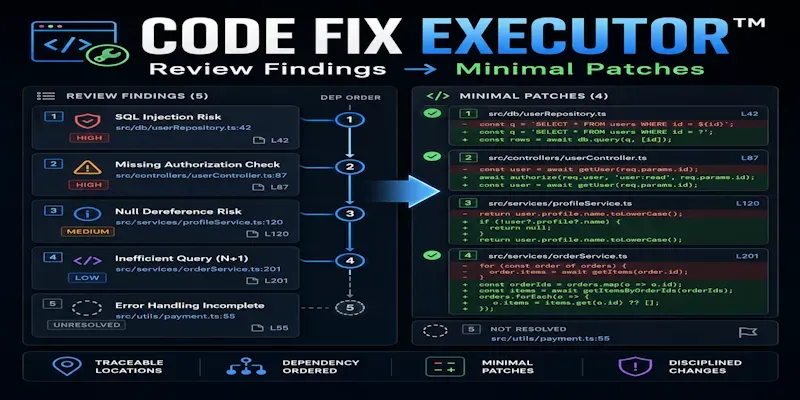
Code reviews find problems. Code Fix Executor™ handles the next step.
Give it an existing findings list plus the relevant source code, and it converts each patchable finding into the smallest targeted code change it can justify from the supplied code.
It checks whether cited locations actually exist, resolves dependencies between findings, questions incorrect dependency assumptions, avoids unrelated refactors, and more
...more
Added over 1 month ago

- Reviews for this skill (1)