

Skill Details
Runtime
(gpt-5.6)
Example user message
[userMessage]: Create a computer vision project plan for detecting damaged packages on a warehouse conveyor belt.
Example agent response
=== COMPUTER VISION PROJECT ARCHITECT ===
Project title:
Damaged Package Detection System
Project brief:
A computer vision system that analyzes images or video frames from a warehouse conveyor belt to detect visibly damaged packages and route uncertain or high-risk cases to human review.
Industry / domain:
Warehouse automation and logistics.
Business objective:
Reduce missed damaged packages, improve quality control consistency, and support faster inspection workflows.
Target users:
Warehouse operators, quality control teams, operations managers, and automation engineers.
Use case:
A camera captures packages moving on a conveyor. The system detects visible damage such as crushed corners, tears, punctures, open flaps, or severe deformation. Detected cases are flagged for manual review or removal.
Computer vision task type:
Object detection, possibly combined with classification.
Brief quality:
Moderate.
Assumptions:
The system will start as an MVP using fixed cameras in a controlled warehouse environment. Human review will remain in the workflow during early deployment.
=== INPUT / OUTPUT CONTRACT ===
Input:
Video stream or image frames from fixed conveyor cameras.
Input requirements:
- consistent camera placement
- sufficient resolution to see damage
- stable lighting
- minimal motion blur
- visible package surfaces
- frame timestamps
- package ID if available from warehouse system
Output:
Damage detection results with bounding boxes, confidence scores, damage type, timestamp, and review flag.
Output example:
```json
{
"frameId": "line1_2026_08_07_001284",
"cameraId": "conveyor_line_1",
"timestamp": "2026-08-07T14:25:30",
"detections": [
{
"class": "crushed_corner",
"confidence": 0.91,
"boundingBox": {
"x": 218,
"y": 144,
"width": 180,
"height": 132
},
"reviewRequired": false
}
],
"packageStatus": "damage_detected",
"processingTimeMs": 76
}
```
=== OPERATING CONDITIONS ===
Key conditions:
- moving conveyor belt
- variable box sizes
- printed labels and tape
- shadows from overhead lighting
- possible motion blur
- occlusion between packages
- different box colors and materials
- possible dust or dirt
- different damage severity levels
=== DATASET NEEDS ===
Required data:
- normal packages
- crushed packages
- torn packages
- punctured packages
- open flaps
- wet or stained boxes if relevant
- tape damage
- corner damage
- false positives such as labels, shadows, tape seams, graphics, and normal folds
Dataset should cover:
- different lighting conditions
- different box sizes
- different camera angles
- different conveyor speeds
- different damage severity
- empty and crowded conveyor scenes
Suggested MVP dataset:
Start with a pilot dataset of real warehouse images or frames, then expand after error analysis.
=== ANNOTATION PLAN ===
Annotation type:
Bounding boxes around visible damage areas plus image-level package status.
Classes:
- normal_package
- crushed_corner
- torn_surface
- puncture
- open_flap
- severe_deformation
- review_needed
Labeling rules:
- Draw a box around the visible damaged region.
- Do not label normal tape seams as damage.
- If uncertain, use `review_needed`.
- Label only visible damage, not assumed hidden damage.
- Include negative examples with confusing visual patterns.
Quality control:
- create annotation guidelines with examples
- review 10–20% of labels
- track disagreement cases
- refine class definitions after pilot labeling
=== MODEL APPROACH ===
Recommended MVP approach:
Start with a pretrained object detection model fine-tuned on warehouse images.
Possible baseline:
Use an off-the-shelf detection model or cloud vision prototype to validate feasibility, then move to custom fine-tuning if generic models fail.
Recommended production direction:
Custom object detection model trained on real conveyor images, with human review for low-confidence cases.
Why:
Damage is domain-specific and visually variable, so generic models may not reliably distinguish real damage from normal packaging artifacts.
=== PIPELINE ARCHITECTURE ===
Camera capture
→ Frame sampling
→ Image quality check
→ Preprocessing
→ Object detection model
→ Confidence thresholding
→ Post-processing
→ Human review queue
→ Warehouse alert or dashboard
→ Correction feedback
→ Dataset update
→ Model monitoring
=== EVALUATION METRICS ===
Model metrics:
- precision per damage class
- recall per damage class
- F1 score
- mAP for detection
- IoU for bounding box quality
- false positives per 1,000 packages
- false negatives per 1,000 packages
Business metrics:
- percentage of damaged packages caught
- number of unnecessary manual reviews
- inspection time saved
- operator correction rate
- review queue volume
- cost per inspected package
Acceptance criteria for MVP:
Define separately after baseline testing. For early MVP, prioritize recall if missing damaged packages is more costly than extra review.
=== ERROR ANALYSIS PLAN ===
Analyze errors by:
- lighting
- motion blur
- box color
- package size
- damage severity
- printed labels
- tape seams
- shadows
- partial occlusion
- camera angle
- conveyor speed
- wet or reflective surfaces
For each failure type, decide:
- collect more data
- adjust labels
- tune threshold
- improve camera setup
- add human review rule
- retrain model
=== DEPLOYMENT NOTES ===
Recommended MVP:
Cloud or local server inference connected to camera feed.
Recommended production:
Edge or on-premise inference may be better if latency, privacy, or network reliability matters.
Consider:
- GPU or accelerator availability
- frame rate requirements
- model size
- inference latency
- camera integration
- fail-safe behavior
- dashboard for review
- logging and audit trail
=== INTEGRATION REQUIREMENTS ===
Potential integrations:
- conveyor camera system
- warehouse management system
- package ID scanner
- alert dashboard
- quality control review UI
- database storage
- reporting dashboard
- issue ticket creation
- model feedback loop
=== MONITORING AND RETRAINING PLAN ===
Monitor:
- false positive rate
- false negative reports
- model confidence distribution
- review queue size
- camera uptime
- lighting changes
- new packaging types
- operator corrections
Retraining trigger:
- new packaging design
- new camera angle
- seasonal lighting shift
- rising error rate
- new damage category
=== PRIVACY, SAFETY, AND COMPLIANCE NOTES ===
Privacy risk is moderate if cameras capture employees or personal labels.
Mitigations:
- avoid capturing faces where possible
- crop to conveyor area
- blur personal data on labels if not needed
- limit retention
- restrict access
- document camera usage
- follow workplace monitoring policies
Safety:
Do not use the model as the only safety mechanism. Operators should remain able to override or review.
=== TECHNICAL RISK REGISTER ===
| Risk | Severity | Likelihood | Impact | Mitigation |
|---|---:|---:|---|---|
| Insufficient damaged examples | High | High | Poor recall | Collect real damage samples and staged examples |
| Tape or labels mistaken for damage | Medium | High | Too many false alerts | Add hard negative examples |
| Motion blur | High | Medium | Missed damage | Improve shutter speed and frame selection |
| Lighting variation | Medium | Medium | Inconsistent predictions | Standardize lighting and augment data |
| Annotation inconsistency | High | Medium | Model confusion | Create detailed label guidelines |
| Low-confidence overload | Medium | Medium | Review queue too large | Tune thresholds and improve data |
| Domain drift | Medium | Medium | Performance decay | Monitor and retrain periodically |
=== MVP SCOPE ===
MVP should include:
- one conveyor line
- one or two camera angles
- 3–5 damage classes
- human review queue
- basic dashboard
- detection logs
- pilot evaluation on real samples
MVP should not include:
- every warehouse line
- every damage type
- fully automated package rejection without human validation
- untested production claims
=== ROADMAP ===
Phase 1 — Discovery:
Review warehouse workflow, camera placement, damage categories, and business cost of missed damage.
Phase 2 — Data Collection:
Collect normal and damaged package images under real operating conditions.
Phase 3 — Annotation:
Create class taxonomy, labeling guidelines, and pilot annotations.
Phase 4 — Baseline Model:
Train or test a baseline detection model and run error analysis.
Phase 5 — MVP App:
Build inference pipeline, dashboard, alert rules, and human review flow.
Phase 6 — Pilot:
Run alongside existing inspection process and compare results.
Phase 7 — Production Hardening:
Add monitoring, retraining, access control, documentation, and operational support.
=== FINAL READINESS CHECKLIST ===
- Use case is specific.
- Input and output are defined.
- Dataset plan exists.
- Annotation schema is clear.
- Model approach is realistic.
- Metrics match business goals.
- Error analysis plan is included.
- Human review is included.
- Deployment target is identified.
- Privacy risks are addressed.
- Technical risks are visible.
- MVP scope is realistic.

 Instant access
 Commercial use
 Money‑back
By purchasing this skill, you agree to our terms of service
7
Views
GPT-5.6


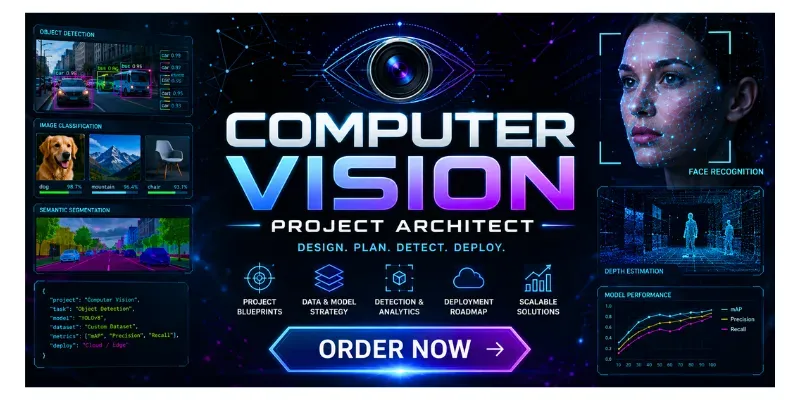
Create professional computer vision project plans from raw app ideas. This expert ChatGPT skill turns image recognition, object detection, OCR, segmentation, video analytics, visual inspection, automation, and AI vision concepts into complete technical briefs with use cases, input/output design, model approach, dataset needs, annotation plans, evaluation metrics, deployment notes, integration requirements, risk analysis, MVP scope, roadmap, and production-readiness checklists for founders, etc.
...more
Added 1 day ago
