


Skill Details
Runtime
(gpt-5.6)
Example user message
[userMessage]: Start an original 5-chapter psychological horror novella about a city acoustics technician who discovers impossible sounds in recordings of empty public rooms. Adult readers, subtle dread, third-person past tense, no gore. Include the book blueprint, threat rules, and one complete short opening chapter.
Example agent response
# Horror Book Writer
## 1. Horror Book Brief
Working Title:
"The Second Silence"
Subgenre:
Psychological Horror
Audience:
Adult readers
Tone:
Quiet, unsettling, investigative
Fear Intensity:
LOW — Atmospheric
POV:
Third-person limited
Tense:
Past
Planned Chapters:
5
Primary Fear:
Uncertainty about whether recorded evidence can be trusted.
## 2. Original Premise and Fear Engine
Logline:
While measuring acoustic conditions in a building scheduled for renovation, a technician discovers that recordings of empty rooms contain sounds that appear only after she plays them.
Protagonist:
Elin Rao, a municipal acoustics technician.
Central Conflict:
Elin needs to identify the source of a recurring sound before the building's recordings are submitted as official survey evidence.
Fear Engine:
Ordinary professional certainty → impossible playback detail → repeated anomaly → growing self-doubt → consequential investigation.
Distinctive Elements:
- Room-tone surveys as a source of clues.
- Silent spaces becoming unreliable evidence.
- A protagonist whose profession depends on careful observation.
No existing novel was used as a source for the premise. Global similarity has not been verified.
## 3. Character Bible and Personal Stakes
CHR-001 — Elin Rao
Age:
36
Occupation:
Municipal acoustics technician.
Personality:
Methodical, observant, reluctant to speculate.
Personal Goal:
Finish an accurate acoustic report.
Personal Fear:
Being unable to distinguish evidence from expectation.
CHR-002 — Pavan Mercer
Age:
49
Occupation:
Building maintenance supervisor.
Personality:
Practical, skeptical.
Relationship:
Provides access to survey rooms and maintenance records.
## 4. Horror Threat, Setting and World Rules
HOR-001 — The Playback Anomaly
Threat Type:
AMBIGUOUS / PSYCHOLOGICAL
Established Observation:
An unexplained scraping sound appears in a room-tone recording.
Not Established:
Its origin or whether it represents supernatural activity.
Rules Currently Established:
- Elin records empty rooms.
- The anomaly is detected during playback.
- No physical source has been confirmed.
- Technical failure remains a possible explanation.
LOC-001:
Old municipal rehearsal building.
LOC-002:
Room Four — unfurnished except for a fixed wooden chair and acoustic wall panels.
Atmosphere:
Quiet fluorescent corridors, worn acoustic panels, and mechanical ventilation.
## 5. Suspense Arc, Escalation and Revelation Map
Opening:
Elin records the room's ambient silence.
First Disturbance:
Playback reveals a noise she did not hear while recording.
Escalation:
Other records show a similar but changing pattern.
Midpoint:
The recording timestamps conflict with the access log.
Major Revelation:
A forgotten maintenance project offers a possible explanation, but does not account for every detail.
Climax:
Elin must decide whether to certify a report she can no longer completely trust.
Ending:
The immediate evidence mystery is resolved, with a limited uncanny question remaining.
## 6. Book Plot and Complete Chapter Map
CH-001 — "Room Four"
Elin detects the first impossible sound.
CH-002 — "Calibration"
She tests the recording equipment and uncovers a second anomaly.
CH-003 — "The Access Log"
Building records reveal a contradiction.
CH-004 — "What the Walls Kept"
Elin discovers the hidden purpose of the old rehearsal room.
CH-005 — "The Second Silence"
The central mystery reaches a meaningful resolution.
## 7. Complete Chapter 1
### Chapter One — Room Four
Elin Rao had spent twelve years measuring noises that other people had stopped noticing.
Ventilation fans. Loose window seals. The low complaint of fluorescent lights. She could tell which elevator had arrived on the third floor by the vibration it sent through a building's pipes.
Silence, she often said, was only a sound nobody had identified yet.
Room Four disagreed with her.
The municipal rehearsal building was scheduled for renovation, and Elin had been asked to measure its empty rooms before the walls came down. She set her recorder on a tripod, checked the levels, and waited for the ventilation to complete its cycle.
A wooden chair stood in the corner.
The chair was attached to the floor by four metal brackets. Elin had already noted it in the survey because the bolts were beginning to rust.
She pressed RECORD.
For sixty seconds, nothing happened beyond the faint hum of the building.
She stopped the recording, marked the file, and packed her equipment.
It was not until she returned to the survey office that she heard the scrape.
The sound came halfway through the recording: short, deliberate, unmistakably wooden.
She played it again.
Something had dragged across a hard floor.
Elin checked the room number.
Four.
She opened her photographs. The chair stood exactly where it had been when she entered. Its brackets were plainly visible.
Perhaps a sound had traveled through the ventilation shaft. Perhaps someone had moved furniture in another room. Acoustic reflections could be difficult in old buildings.
She reduced the playback speed.
The scrape stretched into a low groan. Behind it, she heard a second, quieter sound.
Three soft taps.
Elin looked toward her desk.
She had been tapping a pencil against the tabletop while listening.
She stopped.
The three taps in the recording continued.
She removed her headphones, let the file play silently across the screen, and counted the waveform peaks.
Three.
She put the headphones back on and returned to the beginning.
This time the scrape was followed by four taps.
Elin stared at the waveform.
She had used the same file. She was certain of it.
She saved a duplicate, locked the original against editing, and wrote a note in her survey log.
**Room Four: Unexplained transient noise. Repeat measurement required.**
The sentence looked professional.
It did not describe what frightened her.
Before closing the program, she played the duplicate one final time.
There was no scrape.
Only silence.
## 8. Originality, Safety and Horror Quality Review
Originality:
Original fictional premise, characters, setting, and prose.
Fear Mechanism:
The discrepancy between measured silence and recorded sound.
Violence:
None.
Horror Rules:
The cause remains unestablished and should not be declared supernatural without later evidence.
Chapter Quality:
The opening develops Elin's professional perspective and ends with a changed understanding of the recording.
## 9. Horror Book Continuity Pack
Book:
"The Second Silence"
Completed:
CH-001
Planned:
CH-002 through CH-005
CHR-001:
Elin Rao, acoustics technician.
HOR-001:
Unexplained recording anomalies.
LOC-002:
Room Four contains a chair fixed to the floor.
CAN-001:
Elin has preserved an original recording and created a duplicate.
THR-001:
Why does the recorded sound change during playback?
Current Knowledge:
Elin has observed an unexplained anomaly. She has not established its cause.
Next Chapter:
CH-002 — "Calibration"
## 10. Writing Progress and Next Steps
Completed:
One complete short original opening chapter.
Remaining:
Four planned chapters.
Next-Chapter Objective:
Elin tests the equipment using a controlled recording method and discovers whether the anomaly is limited to Room Four.
Continuation Command:
"Write Chapter 2 in complete prose using the Horror Book Continuity Pack."
No claim of external plagiarism verification or actual book publication is made.


 Instant access
 Commercial use
 Money‑back
By purchasing this skill, you agree to our terms of service
12
Views
GPT-5.6


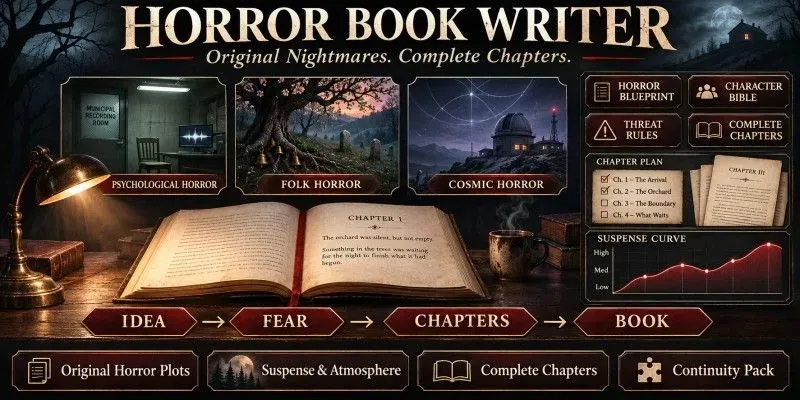
Turn an original horror idea into a novel or novella. This ChatGPT skill creates unsettling premises, distinctive characters, suspenseful plots, escalating dread, complete prose chapters, and consistent supernatural or psychological rules. Supports gothic, folk, cosmic, creature, mystery, and other horror subgenres. Includes a Horror Book Continuity Pack, chapter-writing workflow, editorial review, and safeguards against copying existing works.
...more
Added 1 week ago
