

Skill Details
Runtime
(gpt-5.5)
Example user message
[userMessage]: Create a 10-minute microlearning lesson for adult learners on SMART goals. Include a short explanation, activity, checks for understanding, recap notes, handout, and facilitator notes.
Example agent response
# Microlearning Lesson: Writing SMART Goals
## Lesson Context Summary
Topic: SMART goals.
Learner group: adult learners.
Duration: 10 minutes.
Delivery format: flexible for classroom, workshop, workplace training, or online lesson.
Main purpose: help learners turn a vague goal into a clearer, more actionable goal.
## Learner Profile
Learners may already understand what a goal is, but may struggle to make goals specific, measurable, realistic, and time-bound.
Likely confusion points:
- confusing tasks with goals
- writing goals that are too broad
- forgetting how progress will be measured
- setting deadlines that are unclear
## Learning Objective
By the end of this lesson, learners will be able to rewrite a vague goal into a basic SMART goal using the five SMART elements.
## Lesson Duration and Structure
0–1 minute: hook and relevance
1–4 minutes: explanation of SMART
4–6 minutes: worked example
6–8 minutes: quick activity
8–9 minutes: check for understanding
9–10 minutes: recap and next step
## Bite-Sized Explanation
A SMART goal is a goal that is easier to act on because it is clear and measurable.
SMART means:
S — Specific: what exactly do you want to do?
M — Measurable: how will you know it is done or improving?
A — Achievable: is it realistic with the time and resources available?
R — Relevant: does it connect to something that matters?
T — Time-bound: when will it happen or be reviewed?
A vague goal is hard to follow. A SMART goal gives you a clearer next step and a way to check progress.
## Worked Example or Scenario
Vague goal:
“I want to improve my communication.”
SMART version:
“Over the next four weeks, I will improve my meeting communication by preparing one key update before each weekly team meeting and asking for feedback from my manager after two meetings.”
Why this works:
- Specific: meeting communication
- Measurable: one update before each meeting and feedback after two meetings
- Achievable: small repeated action
- Relevant: connects to work communication
- Time-bound: four weeks
## Quick Learner Activity
Activity title: Make It SMART
Estimated time: 2 minutes.
Instructions:
Choose one vague goal and rewrite it as a SMART goal.
Vague goal options:
- I want to be more organised.
- I want to get better at studying.
- I want to improve customer service.
Learner output:
One rewritten SMART goal.
Success criteria:
- goal says exactly what will be done
- progress can be measured
- goal is realistic
- goal matters to the learner
- goal has a time frame
## Check-for-Understanding Questions
1. What does the “M” in SMART mean?
Answer: Measurable.
2. Which goal is more specific?
A: “I want to do better.”
B: “I will complete two practice questions by Friday.”
Answer: B.
3. Why does a SMART goal need a time frame?
Answer guidance: it helps the learner know when to act, review, or complete the goal.
4. Rewrite this goal to make it more measurable: “I want to read more.”
Answer guidance: add a number, amount, or frequency, such as “read 10 pages each weekday.”
## Recap Notes
- SMART goals are clearer than vague goals.
- Each goal should be specific, measurable, achievable, relevant, and time-bound.
- A good SMART goal tells you what to do next and how to check progress.
- Start small and make the goal realistic.
## Learner Handout
Lesson title: Writing SMART Goals
Objective: rewrite a vague goal into a SMART goal.
SMART checklist:
- Specific: What exactly will I do?
- Measurable: How will I know I have done it?
- Achievable: Can I realistically do this?
- Relevant: Why does this matter?
- Time-bound: When will I do or review it?
Example:
Vague: “I want to be more organised.”
SMART: “For the next two weeks, I will spend 10 minutes every Friday planning my tasks for the following week.”
Your turn:
Vague goal: ____________________
SMART goal: ____________________
One thing I will do next: ____________________
## Facilitator or Teacher Notes
Introduce the lesson by asking learners to think of a goal they have heard that was too vague to act on.
Common misconception: learners may think a SMART goal has to be complicated. Emphasize that the best SMART goals are usually simple and clear.
Support prompt:
“What number, deadline, or repeated action could make this goal easier to check?”
Extension prompt:
Ask learners to swap goals with a partner and identify which SMART element is strongest and which needs improvement.
## Follow-Up Task or Extension
Ask learners to use their SMART goal for one week, then write a short reflection:
- What action did I take?
- What progress did I notice?
- What should I adjust?
## Accessibility and Inclusion Notes
- Provide the SMART acronym in writing as well as verbally.
- Allow learners to use personal, study, or workplace goals.
- Avoid requiring learners to share private goals publicly.
- Offer sentence starters for learners who need more support.
- Use plain language and clear spacing in the handout.
## Final Lesson QA Checklist
- The lesson has one clear objective.
- The content fits a 10-minute format.
- Explanation is short and clear.
- Example supports the objective.
- Activity lets learners apply the concept.
- Checks for understanding match the objective.
- Recap reinforces the main idea.
- Handout is learner-friendly.
- Accessibility and inclusion are considered.
- No guaranteed learner outcome is claimed.
## Disclaimer
This microlearning lesson is educational content and training-design support. It does not replace qualified teaching judgement, curriculum approval, safeguarding review, accessibility review, institutional policy, subject-matter expert review, legal review, medical review, safety review, or professional training requirements. Verify the lesson against the learner level, learning outcomes, curriculum, training standards, accessibility needs, workplace policy, and subject accuracy before use.


Or get it with Select10 Select prompts/mo — under $2 each
Learn more
 Instant access
 Commercial use
 Money‑back
By purchasing this skill, you agree to our terms of service
2
Favorites
17
Views
GPT-5.5


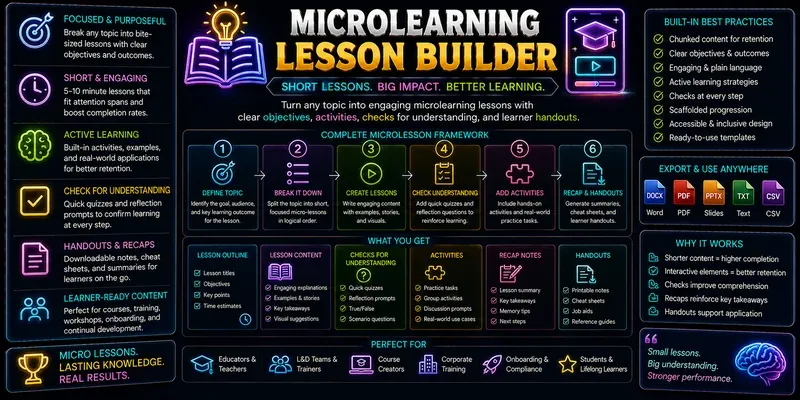
Turns any topic into short, focused microlearning lessons with clear learning objectives, bite-sized explanations, quick activities, checks for understanding, recap notes, learner handouts, reflection prompts, quiz questions, facilitator notes, and practical follow-up tasks for teachers, trainers, course creators, coaches, HR teams, and online educators.
...more
Added over 1 month ago
