

Skill Details
Runtime
Any model
Example user message
[userMessage]: Turn this AI response into a decision-ready brief: “Sales rose 18%; refunds climbed 4%→9%; paid social drove growth. Test checkout friction and refund causes before increasing spend.” Preserve claims and caveats.
Example agent response
Compiled the supplied AI response into a Decision-Ready Response Brief. The growth signal, refund deterioration, paid-social contribution, and pre-scale testing condition are all preserved, while repeated framing is removed so the decision path is immediately visible.
# Decision-Ready Response Brief
## Executive Readout
Sales increased 18%, but the quality of that growth needs review before additional spend is approved. Refunds rose from 4% to 9%, while paid social drove most of the sales increase. The source therefore recommends testing checkout friction and the causes of refunds before increasing paid-social spend.
The decision is not “growth is bad” or “paid social caused refunds.” The source supports a narrower conclusion: growth and refund deterioration occurred together, paid social contributed most of the growth, and further scaling should wait until the refund problem is understood.
## Priority Signals
- Sales growth: +18%.
- Refund rate: increased from 4% to 9%.
- Primary growth contributor named by the source: paid social.
- Immediate investigation named by the source: checkout friction.
- Second investigation named by the source: refund causes.
- Scaling condition: investigate those issues before increasing spend.
The strongest tension in the response is between top-line growth and worsening post-purchase quality. Both signals must remain visible; compressing the answer to “sales are up 18%” would remove the source's material caution.
## Decisions and Actions
1. Do not treat the 18% sales increase as sufficient evidence to increase paid-social spend immediately.
2. Test whether checkout friction is contributing to the current customer experience problem.
3. Investigate the reasons refunds increased from 4% to 9%.
4. Revisit the paid-social scaling decision after those tests produce usable evidence.
Decision status: conditional. The supplied response recommends investigation before scaling; it does not state that spend has already been frozen, reduced, or approved.
## Conditions and Caveats
- The source says paid social drove most growth, but it does not say paid social caused the refund increase.
- The source identifies checkout friction as something to test, not as a confirmed root cause.
- The refund-rate change is material, but the response does not provide transaction volume, margin, cohort, channel-level refund rates, or timeframe details.
- No target refund threshold is supplied for deciding when additional spend becomes acceptable.
- No owner or deadline is supplied for the two investigations.
These gaps remain gaps. Adding a causal explanation, owner, deadline, or approval threshold would make the brief more specific than the supplied response allows.
## Source Coverage
| Source signal | Treatment in brief | Fidelity status |
|---|---|---|
| Sales rose 18% | Preserved as top-line growth signal | Preserved |
| Refunds climbed 4%→9% | Preserved as counter-signal | Preserved |
| Paid social drove growth | Preserved as contribution claim | Preserved without causal expansion |
| Test checkout friction | Converted to explicit investigation action | Preserved as test, not fact |
| Test refund causes | Converted to explicit investigation action | Preserved |
| Test before increasing spend | Preserved as the controlling scaling condition | Preserved |
No materially unique source claim was removed. No external evidence or inferred cause was added.
## Delivery Notes
Use the Executive Readout as the send-ready summary and the Decisions and Actions section as the working next-step block. If new evidence is added later, update only the affected signal, action, caveat, and coverage row rather than rewriting the entire brief.
Material claims preserved.
Redundancy collapsed without claim loss.
Decisions and actions remain source-grounded.
Conditions and uncertainty stay bound to the claims they qualify.
Source coverage is explicit.
No unsupported claim or hidden dependency remains.
No unsupported runtime claim appears.


Or get it with Select10 Select prompts/mo — under $2 each
Learn more
 Instant access
 Commercial use
 Money‑back
By purchasing this skill, you agree to our terms of service
6
Views


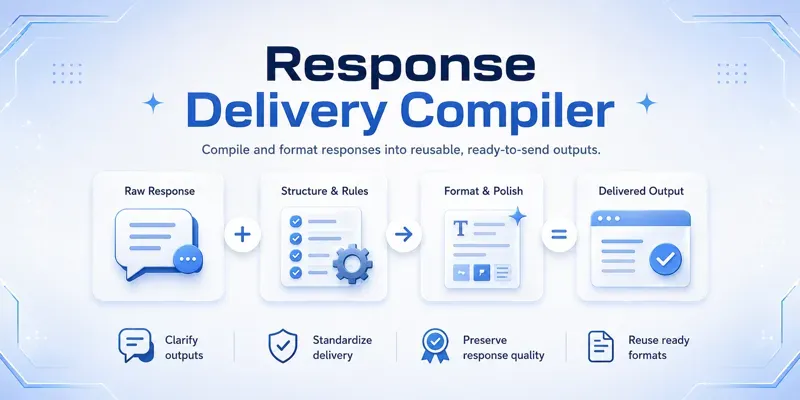
Turn one raw AI response into a Decision-Ready Response Brief that removes repetition while preserving claims, conditions, actions, and uncertainty.
🧬 Claim Spine Miner
🎯 Priority Signal Resolver
✂️ Redundancy Collapse Engine
🧭 Decision Path Mapper
🛡 Caveat Fidelity Guard
...more
Added 6 days ago
