

Skill Details
Runtime
Any model
Example user message
[userMessage]: I am cleaning up a SaaS homepage before launch. Analyze only this evidence; do not pretend you ran DevTools. Rules: analytics and marketing may load only after matching consent; chat may load only after Help is opened; checkout/navigation must not depend on third parties. Head: <script src="https://cdn.chat-example.com/widget.js"></script> <script defer src="https://stats-example.com/analytics.js"></script> <script async src="https://experiment-example.com/ab.js"></script> <script>window.analyticsQueue=window.analyticsQueue||[]; analyticsQueue.push(['pageview']);</script> <script src="https://pixel-example.com/pixel.js"></script> <script>pixel.track('PageView');</script> <script defer src="https://captcha-example.com/api.js"></script> Captcha is used only on /signup. Pixel must wait for marketing consent. Return the control plan, kill switches, and verification probes.
Example agent response
## EVIDENCE STATE
Mode: EVIDENCE.
I can inspect the supplied head markup and buyer-declared loading rules. I did not run DevTools, capture network requests, measure performance, inspect vendor dashboards, or verify runtime consent behavior.
## SCRIPT PROVENANCE LEDGER
| Integration | Evidence | Load form | Trigger finding | Status |
|---|---|---|---|---|
| Chat widget | external head script | parser-blocking by markup | page-load eligible despite rule requiring Help interaction | CONFIRMED |
| Analytics | external script with `defer` plus inline queue write | deferred library + immediate queue mutation | no supplied consent gate | VERIFY |
| Experiment SDK | external `async` script | async | page-load eligible; relative execution order is not guaranteed | CONFIRMED |
| Marketing pixel | external script plus immediate `pixel.track('PageView')` | blocking + immediate call | appears before any supplied marketing-consent gate | MISMATCH |
| Captcha | external script with `defer` | deferred | globally loaded although buyer states it is used only on `/signup` | MISMATCH |
Vendor purpose is taken only from the supplied rules and identifiers; no legal or consent-category determination is being inferred independently.
## EXECUTION ORDER GRAPH
From the supplied markup:
HTML parse
→ chat script encountered and eligible to download/execute
→ analytics script scheduled with `defer`
→ experiment SDK scheduled with `async`
→ analytics queue initialized and receives `pageview`
→ pixel library encountered and eligible to execute
→ `pixel.track('PageView')`
→ captcha script scheduled with `defer`
Important uncertainty: markup shows eligibility and ordering structure, not proof of actual downstream requests or measured blocking time.
## POLICY FENCE
**Chat after Help:** MISMATCH
The chat loader is present in the initial head path rather than behind the declared Help interaction.
**Marketing after matching consent:** MISMATCH
The pixel loader and immediate PageView call appear without a supplied marketing-consent guard.
**Analytics after matching consent:** VERIFY
The analytics library is deferred, but the supplied evidence contains no consent gate. The queue write alone does not prove when data is transmitted.
**Captcha only where needed:** MISMATCH
The captcha loader appears on the homepage although the buyer states it is needed only on `/signup`.
**Checkout/navigation independent of third parties:** VERIFY
No supplied code shows those flows depending on these integrations, but runtime independence has not been tested.
## BLAST-RADIUS MAP
**Chat widget — DEGRADED / possible blocking exposure**
Because it is a normal head script, vendor delay could affect parsing at that point. Actual delay is unknown.
**Analytics — UNKNOWN**
The supplied evidence does not establish whether analytics initialization affects first-party behavior.
**Experiment SDK — DEGRADED risk**
`async` prevents parser blocking, but any first-party code that assumes the SDK exists could still create order-dependent failure. No such dependency is supplied.
**Marketing pixel — policy-control failure**
The strongest evidenced issue is premature initialization relative to the buyer's rule.
**Captcha — unnecessary global dependency**
Its stated functional scope is `/signup`, yet its loader is present on the homepage.
## CONTROL PLAN
### 1. Create one first-party loader boundary per integration
Replace direct global loading with small first-party loader functions so trigger logic, failure handling, and kill switches have a single ownership point.
Preserve each vendor's required initialization parameters.
### 2. Gate the marketing pixel
Do not load the pixel or call `PageView` until the buyer's marketing-consent signal is true.
Kill switch:
`marketingPixelEnabled = false`
When disabled, the first-party page must continue functioning normally.
### 3. Lazy-load chat after Help interaction
Move chat loading behind the Help action.
Failure fallback:
keep a first-party support link or equivalent buyer-approved Help path available when the vendor cannot initialize.
Kill switch:
`chatEnabled = false`
### 4. Scope captcha to `/signup`
Remove homepage eligibility and load captcha only when the signup surface that needs it becomes active.
Kill switch:
`captchaEnabled = false`
Do not disable captcha in production flows where it is actually required without confirming the product/security requirement.
### 5. Hold analytics for verification
Do not assume `defer` satisfies the consent rule.
First identify:
- what buyer consent signal controls analytics;
- whether the queue may exist before consent;
- when the first vendor request actually occurs.
Only then choose the loading gate.
### 6. Keep experimentation isolated
No supplied evidence proves the experiment SDK should be removed or deferred further. Preserve it provisionally while checking whether any first-party startup path assumes that global exists.
## ROLLBACK
Implement each integration change independently.
Keep the previous loading path recoverable in version control or behind a temporary migration flag so one vendor can be reverted without restoring every global script.
Do not combine chat, captcha, analytics, pixel, and experiment changes into one irreversible migration.
## VERIFICATION PROBES
### Initial load before consent
Verify:
- no marketing-pixel request;
- no chat request;
- no captcha request on the homepage;
- whether analytics sends any request before its allowed consent signal.
### After marketing consent
Verify:
- the pixel loads once;
- one intended PageView path occurs;
- repeated consent-state updates do not duplicate initialization.
### Help interaction
Verify:
- chat is absent before Help;
- Help triggers one initialization;
- repeated Help actions do not inject duplicate loaders.
### `/signup`
Verify:
- captcha is absent from unrelated routes;
- captcha loads where required;
- signup retains its expected behavior.
### Vendor failure
Block each non-critical vendor origin independently and verify first-party navigation and checkout remain usable.
### Kill switches
Disable each integration independently and verify the corresponding vendor request disappears without breaking core UI.
These probes are required verification steps; they have not been run.
## CLAUDE HANDOFF
Refactor third-party loading only.
Centralize loader ownership. Gate the marketing pixel behind the buyer-declared marketing-consent signal. Load chat only after Help interaction. Scope captcha to `/signup`. Keep analytics provisional until its real pre/post-consent request behavior is known. Preserve required initialization parameters and existing first-party behavior.
Add independent reversible kill switches for non-critical integrations.
Do not redesign the UI, invent consent categories, remove experimentation without evidence, or claim performance improvements before browser/network verification.
## RECOVERY PATH
Highest-information next evidence: a request-domain or Network capture covering:
1. initial page load before consent;
2. each relevant consent transition;
3. Help interaction;
4. `/signup`.
That will resolve the largest remaining uncertainty: which supplied loaders actually create downstream requests and when.
$9.99-50%
$5.00
SPECIAL PROMOTION — Offer ends 31 July


Or get it with Select10 Select prompts/mo — under $2 each
Learn more
 Instant access
 Commercial use
 Money‑back
By purchasing this skill, you agree to our terms of service
2
Views


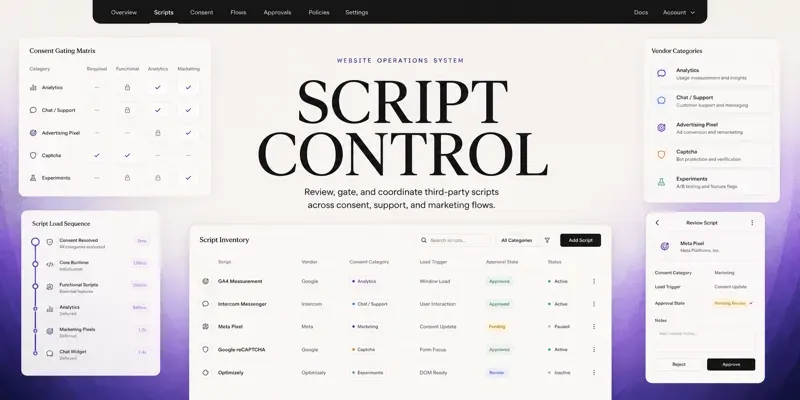
Control third-party JavaScript before it slows, breaks, or silently changes your site.
THIRD-PARTY SCRIPT CONTROL PLANE
🧾 Script Provenance Ledger
⏱️ Execution Order Graph
🚧 Trigger & Policy Fence
💥 Failure Blast-Radius Map
🛑 Containment & Kill-Switch Ladder
🧪 Verification Probe Builder
Paste HTML, loader code, tag-manager text, or a domain list. Get evidence-ranked findings, safer loading decisions, rollback paths, kill switches, and focused verification
...more
Added 1 day ago
