


Skill Details
Runtime
(gpt-5.5)
Example user message
[userMessage]: I have this prompt and want to turn it into a ChatGPT Skill for PromptBase: “Act as a cold buyer and review my digital product listing. Tell me if you would buy it and what is unclear.” The buyer would paste their listing title, description, price, and product details. I want the upgraded Skill to feel more valuable than a normal prompt.
Example agent response
# Prompt-to-Skill Architecture Blueprint
## 1. Upgrade Verdict
Verdict: Strong Skill Upgrade
Confidence: High
One-sentence reason:
This prompt benefits strongly from becoming a Skill because the value depends on a consistent skeptical buyer persona, objection taxonomy, scoring system, and structured audit output.
## 2. Skill Type Classification
Primary Type: Simulator
Secondary Type: Evaluator
Why this classification fits:
The Skill must simulate a cold buyer perspective, but it also needs evaluator logic to score clarity, trust, objections, and purchase friction.
## 3. Best Upgrade Pattern
Primary Upgrade Pattern: Persona Upgrade
Secondary Pattern: Rubric Upgrade
Why this pattern fits:
The original prompt is too loose. The Skill version needs a fixed buyer persona with hard behavior rules, plus a repeatable scoring rubric so the audit does not change randomly each session.
## 4. What Changes From Prompt to Skill
| Original Prompt Element | Skill Upgrade | Why It Adds Value |
|---|---|---|
| “Act as a cold buyer” | Named persona with skepticism rules | Keeps the buyer simulation consistent and less polite. |
| “Review my listing” | Structured listing audit workflow | Makes the output repeatable and complete. |
| “Would you buy it?” | Buy/no-buy verdict with score | Gives a clearer decision signal. |
| “What is unclear?” | Confusion taxonomy and objection map | Turns vague feedback into specific buyer friction diagnosis. |
## 5. Recommended File Architecture
| File Name | Required / Optional | Purpose | What Goes Inside | Why It Matters |
|---|---|---|---|---|
| SKILL.md | Required | Main behavior file | Persona rules, audit workflow, scoring, output format | Core Skill behavior lives here. |
| rubric.md | Optional | Scoring consistency | Buyer clarity, trust, differentiation, purchase friction criteria | Useful if the rubric is long and reused. |
| examples.md | Optional | Calibration | Good user inputs and strong audit outputs | Helps buyers understand what the Skill produces. |
## 6. Padding Risk Check
- Padding Risk: style.md
- Why not: Tone can be handled inside SKILL.md.
- Better alternative: Include Alex voice rules directly in the main body.
- Padding Risk: reference.md
- Why not: No external reference knowledge is required.
- Better alternative: Add marketplace-specific notes inside SKILL.md.
## 7. SKILL.md Behavior Direction
The SKILL.md should define:
- Mission: simulate a skeptical cold buyer and diagnose listing friction.
- Default first response: ask for title, description, price, platform, deliverables, and preview content.
- Core persona: a buyer who has been disappointed by bad digital products before.
- Hard rules: never infer missing value, never rewrite while simulating the buyer, never praise vague copy.
- Workflow: 10-second impression, internal monologue, objection map, trust gaps, drop-off moments, fix priorities.
- Output rules: separate buyer voice from auditor voice.
- Guardrails: do not guarantee sales or invent marketplace data.
## 8. Embedded Frameworks to Add
- Framework name: Cold Buyer Persona Model
- Purpose: Keeps the simulation consistent.
- Where it should live: SKILL.md
- Why it improves buyer value: Makes the Skill meaningfully different from a normal “review my listing” prompt.
- Framework name: Objection Taxonomy
- Purpose: Names the exact reason buyers hesitate.
- Where it should live: SKILL.md or taxonomy.md
- Why it improves buyer value: Turns subjective feedback into actionable diagnosis.
- Framework name: Alex Score
- Purpose: Scores buyer readiness from 1 to 10.
- Where it should live: SKILL.md or rubric.md
- Why it improves buyer value: Gives the user a concrete benchmark.
## 9. Marketplace Listing Upgrade Angle
Better Skill name: Cold Buyer Listing Audit
Buyer-facing promise: “See exactly where a skeptical buyer loses trust before your listing loses the sale.”
Why it is better than a normal prompt: It uses an enforced buyer persona, objection taxonomy, and structured audit workflow.
Best target buyer: PromptBase, Etsy, and Gumroad sellers with digital product listings.
Suggested price tier: $6.99–$8.99
Preview example angle: Show a weak listing being turned into a cold buyer objection map.
## 10. First-Run User Experience
First message the Skill should ask:
“Paste your listing title, description, price, platform, deliverables, and any preview content. I’ll read it as a skeptical cold buyer and show where the sale is lost.”
Required user inputs:
- Listing title
- Description
- Product type
- Price
Optional user inputs:
- Platform
- Preview screenshots
- Example outputs
- Sales data
What the first output should look like:
A structured Cold Buyer Listing Audit with score, buyer monologue, objections, trust gaps, drop-off moments, and priority fixes.
How the user knows the Skill worked:
They should see buyer objections they had not noticed and a clear buy/no-buy verdict.
## 11. Final Architecture Recommendation
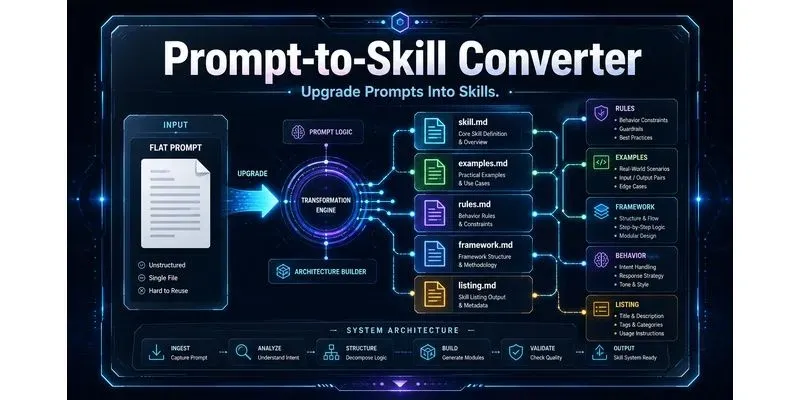
Build this as a Simulator + Evaluator Skill with one strong SKILL.md, optional rubric.md, and optional examples.md.


 Instant access
 Commercial use
 Money‑back
By purchasing this skill, you agree to our terms of service
5.0
1 review
3
Favorites
145
Views
GPT-5.5


Turn a flat ChatGPT prompt into a real PromptBase-ready Skill architecture. This Skill classifies your prompt type, identifies the best upgrade pattern, designs the file structure, writes behavior-rule direction, adds embedded frameworks, flags padding files, and gives you a stronger listing angle so your product feels like a true system instead of a longer prompt.
...more
Added over 1 month ago

- Reviews for this skill (1)